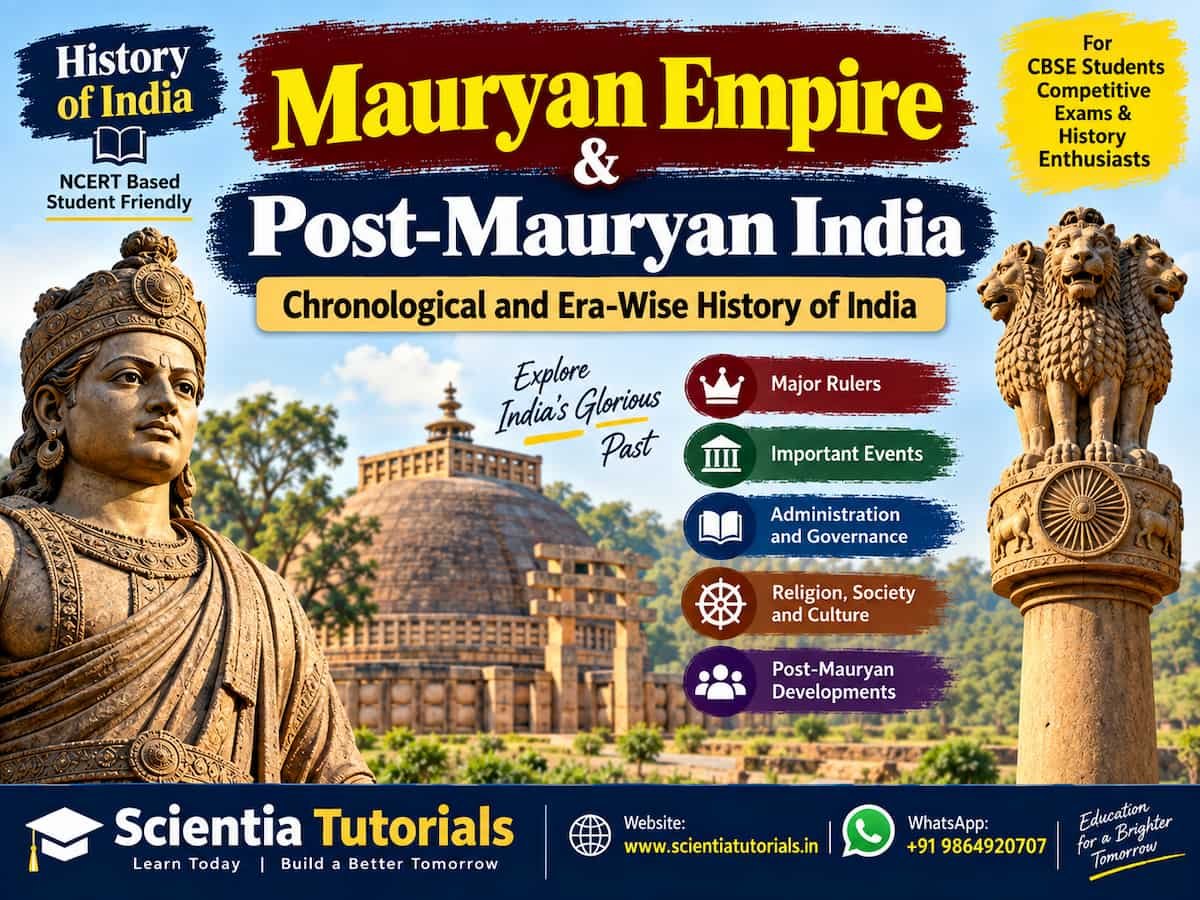
Mauryan Empire & Post-Mauryan India – Chronological and Era-Wise History of India
Mauryan Empire & Post-Mauryan India – Chronological and Era-Wise History of India In this Course, each Lesson under the Modules is divided into 4 Sections, as mentioned below: Study Module with Revision Notes, Questions with Answers, MCQs with Answers and …
Overview
Mauryan Empire & Post-Mauryan India – Chronological and Era-Wise History of India
In this Course, each Lesson under the Modules is divided into 4 Sections, as mentioned below:
- Study Module with Revision Notes,
- Questions with Answers,
- MCQs with Answers and detailed explanations.
Module-wise Breakdown of Lessons for Online Learning
This online learning course offers a comprehensive, chronological, and evidence-based understanding of the History of India, with special focus on controversial events, debates, and critical interpretations. Designed for both conceptual clarity and exam readiness, the course strengthens analytical thinking, source evaluation, and answer-writing skills required in competitive examinations.
The content is highly relevant for aspirants preparing for UPSC (CSE), State PSCs (APSC, UPPSC, BPSC, MPPSC, MPSC, WBCS, RPSC, TNPSC, etc.), UGC-NET/JRF, CUET (UG/PG), SSC, NDA, CDS, CAPF, as well as CBSE, ICSE, State Board examinations, and college/university undergraduate and postgraduate courses where History of India is a core subject.
Module 1: Background to the Mauryan Empire
Timeline: c. 6th century BCE – 322 BCE
Overview
This module examines the political, economic, and social background that led to the rise of the Mauryan Empire, marking the transition from Mahajanapada polity to imperial state formation.
Key Characteristics
- Decline of Mahajanapadas and political fragmentation
- Impact of Alexander’s invasion
- Growth of urban centres, trade, and monetisation
Lessons
- India on the Eve of the Mauryan Empire
- Political Conditions after the Mahajanapadas
- Economic and Social Background of Early Imperial India
- Greek Invasion and Its Impact on North-West India
Module 2: Foundation of the Mauryan Empire
Timeline: c. 322 BCE – 298 BCE
Overview
This module focuses on the establishment of the Mauryan Empire under Chandragupta Maurya, guided by Chanakya, and the creation of the first pan-Indian empire.
Key Characteristics
- Overthrow of the Nanda dynasty
- Centralised authority and imperial expansion
- Diplomacy and treaties with Seleucids
Lessons
- Rise of Chandragupta Maurya
- Role of Chanakya in Mauryan State Formation
- Conquests and Expansion of the Mauryan Empire
- Chandragupta Maurya and Foreign Relations
Module 3: Mauryan Imperial Administration and Statecraft
Timeline: c. 322 BCE – 185 BCE
Overview
This module analyses the highly centralised Mauryan administrative system and governance mechanisms that sustained imperial control.
Key Characteristics
- Bureaucratic governance and provincial administration
- Revenue system and espionage network
- Codified principles of statecraft
Lessons
- Mauryan Central and Provincial Administration
- Mauryan Army, Judiciary, and Espionage System
- Arthashastra as a Source of Mauryan Polity
- Nature of the Mauryan State
Module 4: Mauryan Economy, Society, and Urban Life
Timeline: c. 322 BCE – 185 BCE
Overview
This module explores the economic foundations of the Mauryan Empire and the social life of its people.
Key Characteristics
- State-controlled agriculture and revenue collection
- Growth of trade, crafts, and urban centres
- Social hierarchy and everyday life
Lessons
- Agriculture and Land Revenue System
- Trade, Coinage, and Urban Economy
- Society, Occupations, and Social Structure
- Towns and Cities in Mauryan India
Module 5: Reign of Ashoka and the Policy of Dhamma
Timeline: c. 273 BCE – 232 BCE
Overview
This module studies the reign of Ashoka, focusing on the transformation of kingship after the Kalinga War and the propagation of Dhamma.
Key Characteristics
- Ethical governance and moral state policy
- Religious tolerance and welfare measures
- Use of inscriptions as administrative communication
Lessons
- Ashoka’s Accession and the Kalinga War
- Ashoka’s Inscriptions: Rock and Pillar Edicts
- Dhamma: Principles, Aims, and Methods
- Ashoka and the Spread of Buddhism
Module 6: Mauryan Art, Architecture, and Culture
Timeline: c. 322 BCE – 185 BCE
Overview
This module highlights the artistic and cultural achievements of the Mauryan period.
Key Characteristics
- Monumental architecture and stone pillars
- Polished stone sculpture
- Cultural synthesis under imperial patronage
Lessons
- Mauryan Pillars, Stupas, and Architecture
- Mauryan Sculpture and Art Forms
- Cultural Life under the Mauryas
Module 7: Decline of the Mauryan Empire
Timeline: c. 232 BCE – 185 BCE
Overview
This module analyses the causes behind the decline and fall of the Mauryan Empire.
Key Characteristics
- Weak successors and succession disputes
- Economic strain and administrative challenges
- Regional revolts and loss of central control
Lessons
- Weakening of Central Authority after Ashoka
- Administrative and Economic Causes of Decline
- End of the Mauryan Empire
Module 8: Post-Mauryan India – Regional Dynasties
Timeline: c. 185 BCE – 300 CE
Overview
This module examines the rise of regional powers after the Mauryas, marking political decentralisation.
Key Characteristics
- Regional monarchies and cultural continuity
- Political fragmentation with economic vitality
Lessons
- Shunga and Kanva Dynasties of North India
- Satavahanas of the Deccan: Administration and Economy
- Regional Powers and Political Developments
Module 9: Foreign Rulers in Post-Mauryan India
Timeline: c. 200 BCE – 300 CE
Overview
This module focuses on foreign dynasties and their contribution to Indian history.
Key Characteristics
- Indo-Greeks, Shakas, Parthians, and Kushanas
- Cultural interaction and syncretism
Lessons
- Indo-Greeks and Their Administration
- Shakas and Parthians in India
- Kushanas: Kanishka and Imperial Expansion
Module 10: Economy, Trade, and Religion in Post-Mauryan India
Timeline: c. 200 BCE – 300 CE
Overview
This module explores economic growth, overseas trade, and religious developments in the Post-Mauryan period.
Key Characteristics
- Expansion of inland and maritime trade
- Roman trade contacts and coinage
- Growth of Buddhism, Jainism, and Brahmanism
Lessons
- Trade Routes, Ports, and Roman Contacts
- Urbanisation and Guild System
- Religious Developments: Buddhism, Jainism, and Brahmanism
Module 11: Historical Significance of the Mauryan and Post-Mauryan Age
Timeline: c. 322 BCE – 300 CE
Overview
This concluding module evaluates the long-term impact of the Mauryan and Post-Mauryan periods on Indian history.
Key Characteristics
- Foundation of imperial governance
- Cultural integration and political legacy
- Transition towards the Gupta Age
Lessons
- Mauryan Empire as the First Pan-Indian State
- Legacy of Ashoka and Dhamma
- Historical Importance of the Post-Mauryan Period
✅ Course Outcome
Upon completion, learners will achieve chronological clarity, conceptual depth, and exam-oriented mastery of the Mauryan and Post-Mauryan phases—essential for CBSE/ICSE syllabi, undergraduate studies, and competitive examinations such as UPSC and State PSCs.