
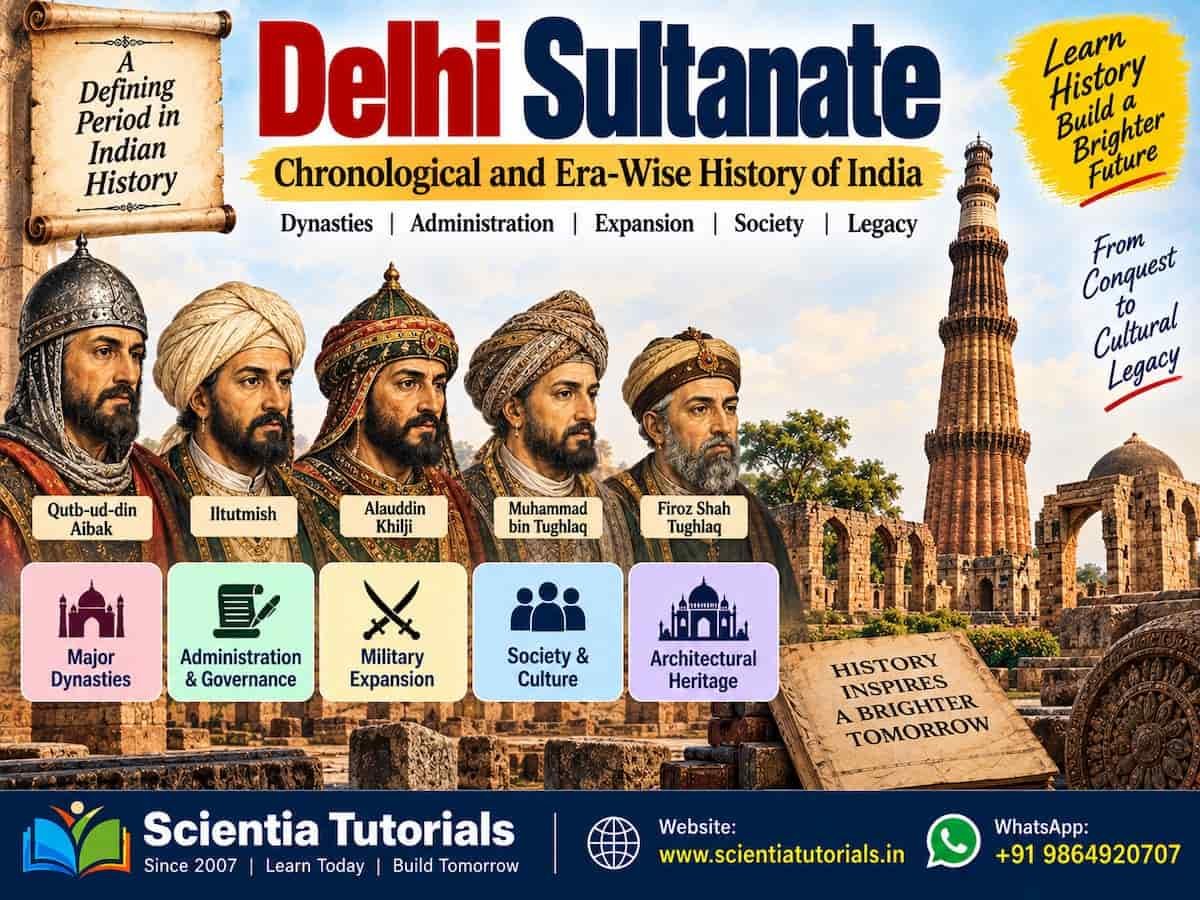
Delhi Sultanate – Chronological and Era-Wise History of India – MCQs
Course Overview Delhi Sultanate – Chronological and Era-Wise History of India – MCQs is an exam-oriented course covering the major political, administrative, military, social, economic, religious, and cultural developments of the Delhi Sultanate. The course follows a chronological and era-wise approach, covering the major dynasties, rulers, battles, administrative systems, expansion, …

Overview
Course Overview
Delhi Sultanate – Chronological and Era-Wise History of India – MCQs is an exam-oriented course covering the major political, administrative, military, social, economic, religious, and cultural developments of the Delhi Sultanate. The course follows a chronological and era-wise approach, covering the major dynasties, rulers, battles, administrative systems, expansion, architecture, literature, and significant developments from the establishment to the decline of the Sultanate.
The course provides MCQs with answers and clear explanations to strengthen conceptual understanding, improve factual recall, and support effective revision for competitive examinations across India.
Targeting Exams in India
This course is particularly relevant to:
- UPSC Civil Services & other UPSC examinations
- State PSC examinations, including APSC
- SSC examinations
- Railway recruitment examinations
- Banking and insurance examinations
- Teaching, TET & education-related examinations
- Defence and other government recruitment examinations
- University and other history-related entrance examinations
Curriculum
- 10 Sections
- 35 Lessons
- Lifetime
- Section 1: Foundation of the Delhi Sultanate Timeline: c. 1206 CE – 1211 CE3 ItemsThis module introduces the political background of North India after the Turkish invasions and explains the foundation of the Delhi Sultanate as the first major Muslim state in India.
- Section 2: Slave (Mamluk) Dynasty Timeline: c. 1206 CE – 1290 CE5 ItemsThis module studies the consolidation of the Sultanate under the Slave rulers and the creation of a stable administrative framework.
- Section 3: Khalji Dynasty Timeline: c. 1290 CE – 1320 CE5 ItemsThis module focuses on the expansionist and reform-oriented policies of the Khaljis, marking a strong phase of Sultanate authority.
- 3.1Rise of Khalji Dynasty in India: Jalaluddin Khalji MCQs
- 3.2Military Conquests of Alauddin Khalji: Major Campaigns MCQs
- 3.3Alauddin Khalji Market Control Policy and Price Regulations MCQs
- 3.4Alauddin Khalji Revenue Reforms and Military Organisation MCQs
- 3.5Causes of the Decline of the Khalji Dynasty – MCQs
- Section 4: Tughlaq Dynasty Timeline: c. 1320 CE – 1414 CE4 ItemsThis module analyses ambitious administrative experiments and their consequences during the Tughlaq period.
- Section 5: Sayyid Dynasty Timeline: c. 1414 CE – 1451 CE3 ItemsThis module examines the Sayyid rulers as a period of political weakness and regional fragmentation.
- Section 6: Lodi Dynasty Timeline: c. 1451 CE – 1526 CE3 ItemsThis module studies the Afghan Lodis, their attempts at consolidation, and the final collapse of the Delhi Sultanate.
- Section 7: Administration and Polity of the Delhi Sultanate Timeline: c. 1206 CE – 1526 CE3 ItemsThis thematic module provides a comprehensive understanding of the Sultanate’s administrative structure.
- Section 8: Society, Economy, and Religious Policy Timeline: c. 1206 CE – 1526 CE3 ItemsThis module explores social composition, economic policies, and religious attitudes of the Sultanate rulers.
- Section 9: Art, Architecture, and Indo-Islamic Culture Timeline: c. 1206 CE – 1526 CE3 ItemsThis module highlights the cultural synthesis achieved during the Sultanate period.
- Section 10: Decline and Historical Significance of the Delhi Sultanate Timeline: c. 15th–16th century CE3 ItemsThis concluding module analyses the decline of the Delhi Sultanate and its historical legacy.
You May Like
Early Medieval India & Regional Kingdoms – Chronological and Era-Wise History of India – MCQs
Course Overview Early Medieval India & Regional Kingdoms – Chronological and Era-Wise History of India – MCQs is an exam-oriented course covering the major political,...
Course Features
- Lectures 35
- Quiz 0
- Duration Lifetime access
- Skill level All levels
- Language English
- Students 0
- Assessments Yes