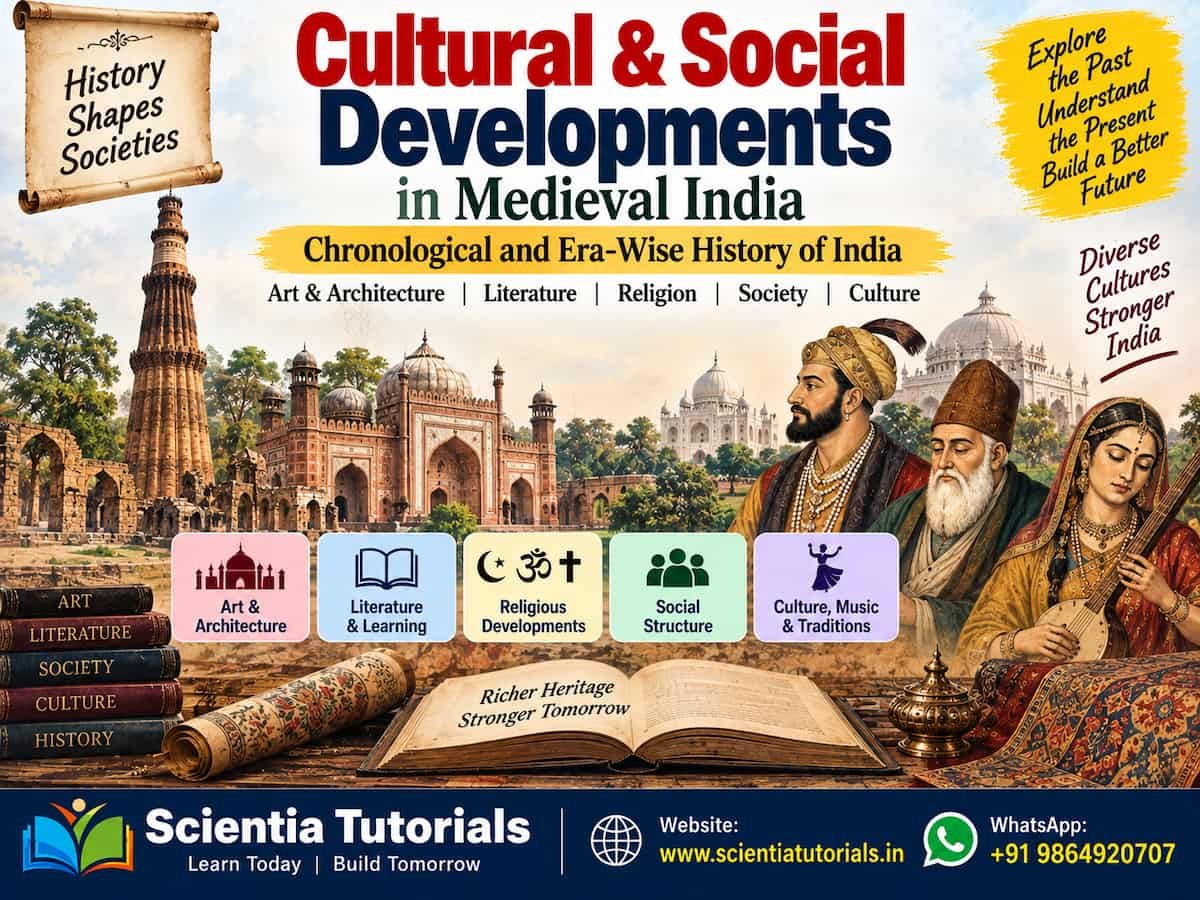
Cultural & Social Developments in Medieval India – Chronological and Era-Wise History of India
Cultural & Social Developments in Medieval India – Chronological and Era-Wise History of India Chronological Era-Wise Module-Wise Course Structure Below is a systematically organised, academically balanced, lesson-wise and module-wise course, converted directly from the earlier list and structured strictly in …
Overview
Cultural & Social Developments in Medieval India – Chronological and Era-Wise History of India
Chronological Era-Wise Module-Wise Course Structure
Below is a systematically organised, academically balanced, lesson-wise and module-wise course, converted directly from the earlier list and structured strictly in chronological order.
In this Course, each Lesson under the Modules is divided into 4 Sections, as mentioned below:
- Study Module with Revision Notes,
- Questions with Answers,
- MCQs with Answers and detailed explanations.
This online learning course offers a comprehensive, chronological, and evidence-based understanding of the History of India, with special focus on controversial events, debates, and critical interpretations. Designed for both conceptual clarity and exam readiness, the course strengthens analytical thinking, source evaluation, and answer-writing skills required in competitive examinations.
The content is highly relevant for aspirants preparing for UPSC (CSE), State PSCs (APSC, UPPSC, BPSC, MPPSC, MPSC, WBCS, RPSC, TNPSC, etc.), UGC-NET/JRF, CUET (UG/PG), SSC, NDA, CDS, CAPF, as well as CBSE, ICSE, State Board examinations, and college/university undergraduate and postgraduate courses where History of India is a core subject.
Module 1: Early Medieval India – Foundations of Cultural & Social Transformation
Time Period: c. 600 CE – 1200 CE
Key Cultural & Social Features
- Transition from ancient to medieval social structures
- Expansion of agrarian society and village communities
- Growth of temple culture and Brahmanical institutions
- Rise of regional languages and devotional practices
- Early Bhakti traditions and social integration
Lessons
- Social Structure and Everyday Life in Early Medieval India
- Caste System, Land Grants, and Agrarian Society
- Rise of Temple Culture and Religious Institutions
- Early Bhakti Traditions and Social Change
- Development of Regional Languages and Literature
Module 2: Cultural & Social Life under the Delhi Sultanate
Time Period: c. 1206 CE – 1526 CE
Key Cultural & Social Features
- Indo-Islamic cultural interaction
- Urbanisation and emergence of new social elites
- Sufi influence and spiritual pluralism
- Persian literary traditions and education
- Changing status of women and social customs
Lessons
- Social Structure of Delhi Sultanate India
- Indo-Islamic Cultural Synthesis in Medieval Society
- Sufism and Its Social Impact in Medieval India
- Art, Architecture, and Urban Culture of the Sultanate
- Language, Education, and Persian Literary Culture
Module 3: Regional Kingdoms and Local Cultural Traditions
Time Period: c. 800 CE – 1500 CE
Key Cultural & Social Features
- Flourishing regional cultures and identities
- Courtly traditions and patronage of arts
- Regional Bhakti movements and saints
- Vernacular literature and folk traditions
- Local social structures and community life
Lessons
- Cultural Life under South and Western Indian Kingdoms
- Regional Bhakti Movements and Social Reform
- Vernacular Literature and Folk Cultural Traditions
- Temple Architecture and Regional Art Schools
- Society, Women, and Community Life in Regional India
Module 4: Mughal Era – Cultural Synthesis and Social Organisation
Time Period: c. 1526 CE – 1707 CE
Key Cultural & Social Features
- Imperial patronage of art and culture
- Composite Mughal culture
- Social hierarchy and mansabdari system
- Mughal architecture, painting, and music
- Status of women and family life
Lessons
- Social Structure and Administration in Mughal India
- Mughal Cultural Policies and Religious Tolerance
- Art, Architecture, and Painting under the Mughals
- Literature, Music, and Education in Mughal Society
- Women, Family, and Social Customs in Mughal India
Module 5: Bhakti and Sufi Movements – Social and Cultural Renaissance
Time Period: c. 13th Century CE – 17th Century CE
Key Cultural & Social Features
- Spiritual egalitarianism and social harmony
- Opposition to caste rigidities and ritualism
- Popularisation of devotional worship
- Use of vernacular languages
- Influence on art, music, and poetry
Lessons
- Origins and Philosophy of the Bhakti Movement
- Major Bhakti Saints and Their Social Message
- Sufi Orders and Mystical Traditions in India
- Bhakti–Sufi Cultural Interaction and Harmony
- Social Impact of Devotional Movements
Module 6: Late Medieval India – Society on the Eve of Modern Transition
Time Period: c. 1707 CE – 1750 CE
Key Cultural & Social Features
- Decline of Mughal central authority
- Regional cultural continuity and change
- Persistence of traditional social institutions
- Early encounters with European cultural influences
- Transition towards early modern Indian society
Lessons
- Social and Cultural Changes in Late Medieval India
- Decline of Mughal Cultural Patronage
- Regional Societies and Cultural Continuities
- Early European Influences on Indian Society
- Transition from Medieval to Early Modern India