
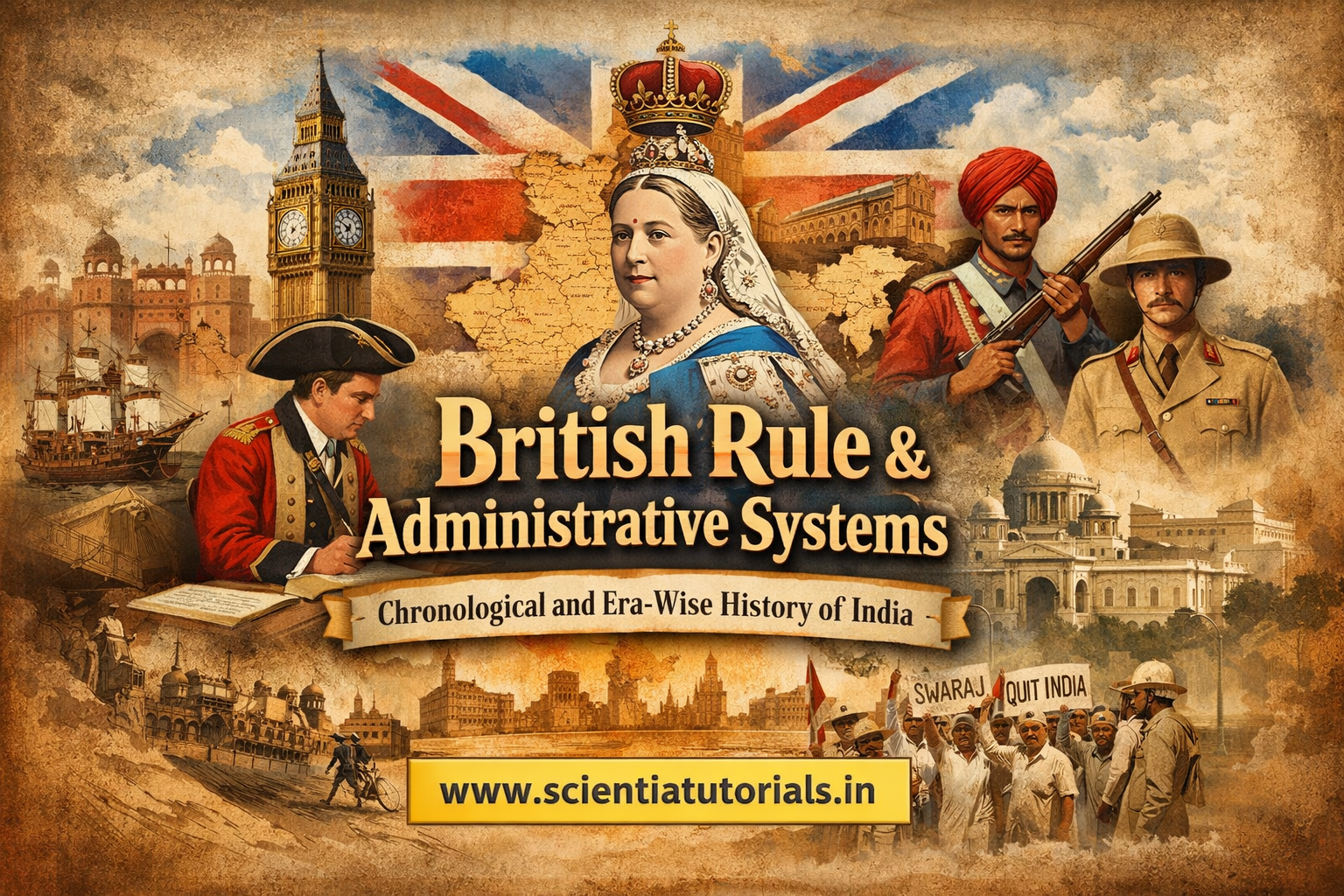
British Rule & Administrative Systems – Chronological and Era-Wise History of India
British Rule & Administrative Systems – Chronological and Era-Wise History of India Module-Wise Breakdown of Lessons for Online Learning Chronological Era-Wise Module-Wise Course Structure Below is a systematically organised, academically balanced, lesson-wise and module-wise course, converted directly from the earlier …

Overview
British Rule & Administrative Systems – Chronological and Era-Wise History of India
Module-Wise Breakdown of Lessons for Online Learning
Chronological Era-Wise Module-Wise Course Structure
Below is a systematically organised, academically balanced, lesson-wise and module-wise course, converted directly from the earlier list and structured strictly in chronological order.
In this Course, each Lesson under the Modules is divided into 4 Sections, as mentioned below:
- Study Module with Revision Notes,
- Questions with Answers,
- MCQs with Answers and detailed explanations.
This online learning course offers a comprehensive, chronological, and evidence-based understanding of the History of India, with special focus on controversial events, debates, and critical interpretations. Designed for both conceptual clarity and exam readiness, the course strengthens analytical thinking, source evaluation, and answer-writing skills required in competitive examinations.
The content is highly relevant for aspirants preparing for UPSC (CSE), State PSCs (APSC, UPPSC, BPSC, MPPSC, MPSC, WBCS, RPSC, TNPSC, etc.), UGC-NET/JRF, CUET (UG/PG), SSC, NDA, CDS, CAPF, as well as CBSE, ICSE, State Board examinations, and college/university undergraduate and postgraduate courses where History of India is a core subject.
Module 1: Foundations of British Administrative Rule in India
Era / Phase: Company Rule & Early Administrative Experiments
Timeline: c. 1757 – 1773 CE
Key Administrative Characteristics:
- Transition from trade to political power after territorial acquisitions
- Dual Government in Bengal
- Early revenue collection and judicial arrangements
- Weak central control over Company officials
Lessons:
- From Trade to Territorial Power: Rise of Company Administration in India
- Battle of Plassey and Administrative Control over Bengal
- Dual Government of Bengal: Structure, Functions, and Failures
- Early Revenue Collection and Judicial Practices under the Company
Module 2: Parliamentary Control and Early Centralisation
Era / Phase: Regulating Acts and Administrative Control
Timeline: 1773 – 1784 CE
Key Administrative Characteristics:
- Beginning of British parliamentary intervention
- Centralisation of administration in Bengal
- Establishment of Governor-Generalship
- Early judicial reforms
Lessons:
- Regulating Act of 1773: Objectives and Administrative Impact
- Office of the Governor-General and Supreme Council
- Supreme Court at Calcutta and Judicial Dualism
- Limitations of Early Parliamentary Control over Company Rule
Module 3: Company State and Administrative Consolidation
Era / Phase: Pitt’s India Act and Company State Formation
Timeline: 1784 – 1813 CE
Key Administrative Characteristics:
- Dual control system (Board of Control & Court of Directors)
- Expansion of British political authority
- Centralisation of civil and military administration
- Structured revenue settlements
Lessons:
- Pitt’s India Act of 1784: Dual Control System Explained
- Lord Cornwallis and Administrative Reforms in India
- Permanent Settlement and British Revenue Administration
- Cornwallis Code: Judicial and Civil Service Reforms
Module 4: Expansion and Bureaucratic Growth of British Administration
Era / Phase: Expansionist Company Rule
Timeline: 1813 – 1857 CE
Key Administrative Characteristics:
- Territorial expansion and administrative uniformity
- Development of civil services and bureaucracy
- Police and judicial system reorganisation
- Revenue systems beyond Bengal
Lessons:
- Charter Acts and Administrative Evolution of British India
- Ryotwari and Mahalwari Systems: Comparative Analysis
- Development of Police and Judicial Administration
- Growth of Indian Civil Service and Bureaucratic Control
Module 5: Revolt of 1857 and End of Company Rule
Era / Phase: Administrative Crisis and Transition
Timeline: 1857 – 1858 CE
Key Administrative Characteristics:
- Collapse of Company authority
- Military and administrative failures
- Reassessment of British governance
Lessons:
- Administrative Causes of the Revolt of 1857
- Failure of Company Administration and Governance
- Impact of 1857 on British Administrative Thinking
Module 6: Crown Rule and Centralised Colonial Administration
Era / Phase: British Crown Administration
Timeline: 1858 – 1905 CE
Key Administrative Characteristics:
- Transfer of power to the British Crown
- Highly centralised bureaucratic system
- Racial exclusivity in civil services
- Strong executive control
Lessons:
- Government of India Act 1858: End of Company Rule
- Viceroy, Secretary of State, and Central Administration
- Reorganisation of Civil Services under Crown Rule
- Police, Judiciary, and Revenue Administration under the Raj
Module 7: Constitutional Reforms and Decentralisation
Era / Phase: Early Constitutional Experiments
Timeline: 1905 – 1919 CE
Key Administrative Characteristics:
- Limited Indian participation in administration
- Beginning of decentralisation
- Provincial administrative reforms
Lessons:
- Indian Councils Act 1909 and Administrative Changes
- Morley–Minto Reforms: Structure and Limitations
- Growth of Provincial Administration and Local Bodies
Module 8: Dyarchy and Provincial Autonomy
Era / Phase: Dyarchic Administration
Timeline: 1919 – 1935 CE
Key Administrative Characteristics:
- Division of subjects between British and Indian ministers
- Expansion of legislative councils
- Increased bureaucratic control despite reforms
Lessons:
- Government of India Act 1919: Dyarchy Explained
- Central and Provincial Administration under Dyarchy
- Bureaucracy vs Elected Ministers: Administrative Conflicts
Module 9: Federal Vision and Administrative Transition
Era / Phase: Provincial Autonomy and Federal Planning
Timeline: 1935 – 1947 CE
Key Administrative Characteristics:
- Provincial autonomy
- Expansion of Indian participation in governance
- Administrative groundwork for independence
Lessons:
- Government of India Act 1935: Administrative Framework
- Provincial Autonomy and British Administrative Retreat
- Administrative Challenges during World War II
- Transfer of Power and Dismantling of Colonial Administration
Module 10: Legacy of British Administrative Systems in India
Era / Phase: Post-Colonial Administrative Continuities
Timeline: Post-1947 Context
Key Administrative Characteristics:
- Continuation of colonial administrative structures
- Transformation of civil services
- Constitutionalisation of governance
Lessons:
- Colonial Legacy in Indian Administrative Systems
- Indian Civil Services: From Colonial to National Administration
- British Administrative Impact on Modern Indian Governance
✅ Course Highlights
- Strict chronological and era-wise progression
- Fully aligned with UPSC, State PSC, NET, CUET, SSC standards
- SEO-friendly lesson titles with high-value keywords
- Ideal for self-paced online learning platforms
Curriculum
Course Features
- Lectures 36
- Quiz 0
- Duration Lifetime access
- Skill level All levels
- Language English
- Students 0
- Assessments Yes