
Early Medieval India & Regional Kingdoms – Chronological and Era-Wise History of India
Early Medieval India & Regional Kingdoms – Chronological and Era-Wise History of India In this Course, each Lesson under the Modules is divided into 4 Sections, as mentioned below: Study Module with Revision Notes, Questions with Answers, MCQs with Answers …

Overview
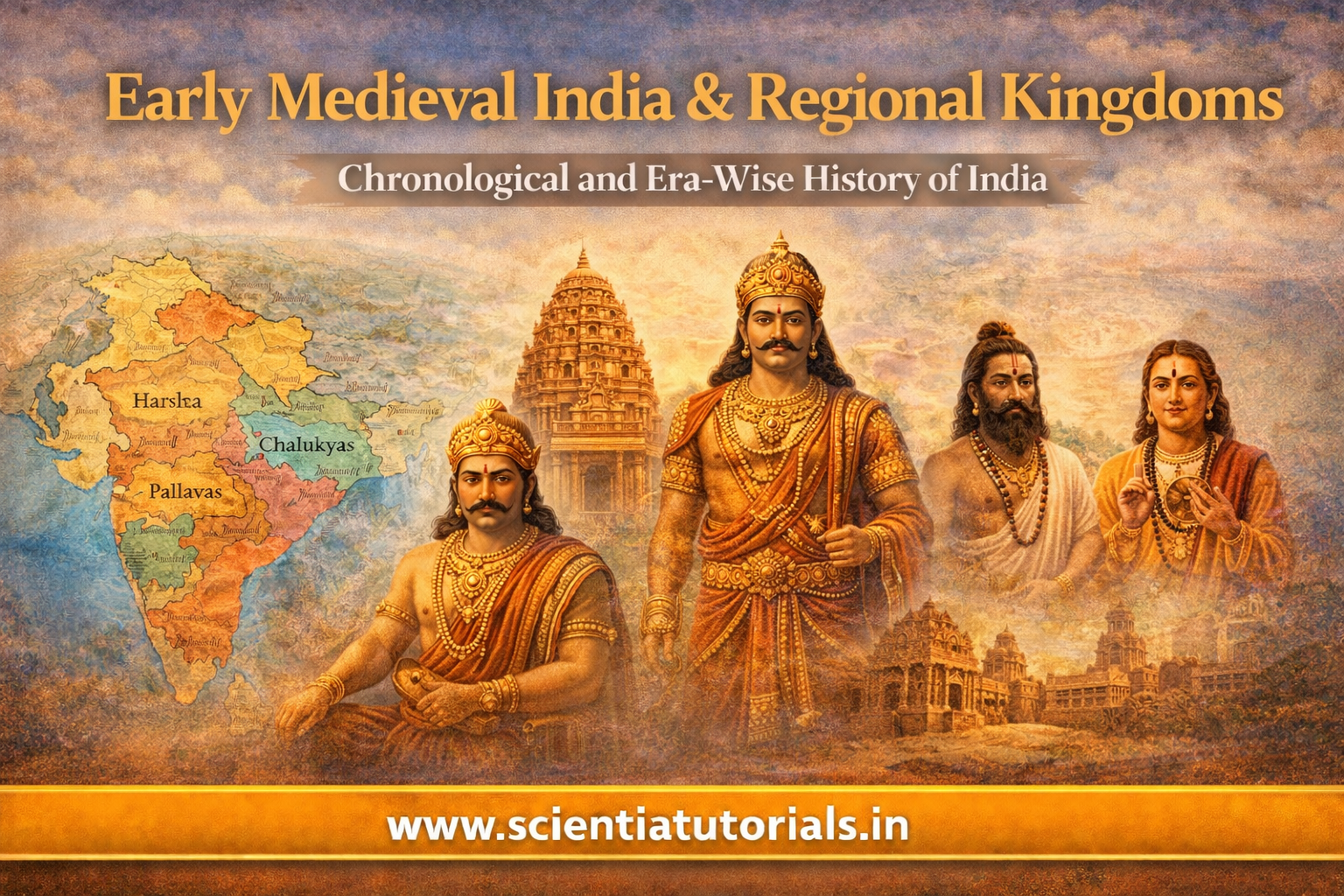
Early Medieval India & Regional Kingdoms – Chronological and Era-Wise History of India
In this Course, each Lesson under the Modules is divided into 4 Sections, as mentioned below:
- Study Module with Revision Notes,
- Questions with Answers,
- MCQs with Answers and detailed explanations.
Module-wise Breakdown of Lessons for Online Learning
This online learning course offers a comprehensive, chronological, and evidence-based understanding of the History of India, with special focus on controversial events, debates, and critical interpretations. Designed for both conceptual clarity and exam readiness, the course strengthens analytical thinking, source evaluation, and answer-writing skills required in competitive examinations.
The content is highly relevant for aspirants preparing for UPSC (CSE), State PSCs (APSC, UPPSC, BPSC, MPPSC, MPSC, WBCS, RPSC, TNPSC, etc.), UGC-NET/JRF, CUET (UG/PG), SSC, NDA, CDS, CAPF, as well as CBSE, ICSE, State Board examinations, and college/university undergraduate and postgraduate courses where History of India is a core subject.
Module 1: Early Medieval Transition Phase
Timeline: c. 600 CE – 750 CE
Overview
This module introduces the transition from the Gupta–Post-Gupta age to Early Medieval India, explaining political fragmentation, socio-economic changes, and the emergence of new power structures.
Key Characteristics
- Decline of Gupta imperial authority
- Rise of regional powers
- Expansion of land grants and early feudal tendencies
Lessons
- From Gupta to Early Medieval India: Historical Transition
- Political Disintegration and Rise of Regional Powers
- Early Medieval Sources: Inscriptions, Land Grants, and Chronicles
Module 2: Emergence of Early Medieval Polity and Feudal Tendencies
Timeline: c. 600 CE – 800 CE
Overview
This module examines the nature of early medieval polity marked by decentralisation and the growth of the samanta system.
Key Characteristics
- Land grants to Brahmanas and temples
- Rise of samantas (feudatories)
- Decline of centralised administration
Lessons
- Land Grant System and Agrarian Expansion
- Samanta System: Origin and Nature
- Debates on Indian Feudalism
Module 3: Age of Regional Kingdoms – Northern and Eastern India
Timeline: c. 750 CE – 1000 CE
Overview
This module focuses on the rise of powerful regional dynasties in North and East India and their political conflicts.
Key Characteristics
- Tripartite struggle for Kannauj
- Stable regional monarchies
- Patronage of learning and religion
Lessons
- Pala Dynasty: Administration and Culture
- Pratihara Dynasty: Polity and Military Power
- Rashtrakuta Dynasty and the Tripartite Struggle
Module 4: Deccan Kingdoms in Early Medieval India
Timeline: c. 600 CE – 1000 CE
Overview
This module studies the Deccan as a major political and cultural zone linking North and South India.
Key Characteristics
- Strategic control of trade routes
- Rock-cut architecture and temple patronage
- Strong military traditions
Lessons
- Early and Later Chalukyas: Administration and Expansion
- Rashtrakutas of the Deccan: Governance and Culture
- Deccan as a Political and Cultural Bridge
Module 5: South Indian Kingdoms – Pallavas and Cholas
Timeline: c. 600 CE – 1200 CE
Overview
This module analyses South Indian polities with advanced administrative systems and temple-centred economies.
Key Characteristics
- Strong local self-government
- Expansion of overseas trade
- Development of Dravidian temple architecture
Lessons
- Pallava Dynasty: Polity and Cultural Contributions
- Rise of the Cholas and Imperial Expansion
- Chola Administration: Village Assemblies and Governance
Module 6: Economy of Early Medieval India
Timeline: c. 600 CE – 1200 CE
Overview
This module examines agrarian expansion, rural economy, and the changing nature of trade and urban centres.
Key Characteristics
- Expansion of cultivation
- Temple-based economic networks
- Decline and revival of urban centres
Lessons
- Agrarian Economy and Rural Society
- Trade, Guilds, and Urban Decline Debate
- Temple Economy in Early Medieval India
Module 7: Society and Social Structure
Timeline: c. 600 CE – 1200 CE
Overview
This module focuses on social organisation, caste structure, and changing status of different social groups.
Key Characteristics
- Consolidation of caste hierarchy
- Role of Brahmanas and landed elites
- Position of women and peasants
Lessons
- Caste System and Social Stratification
- Position of Women in Early Medieval Society
- Social Impact of Land Grants
Module 8: Religion and the Bhakti Movement
Timeline: c. 600 CE – 1200 CE
Overview
This module explains the rise of devotional movements that reshaped Indian religious life.
Key Characteristics
- Growth of Bhakti traditions
- Popular religious expression
- Integration of local beliefs
Lessons
- Origins of the Bhakti Movement
- Shaiva and Vaishnava Bhakti Traditions
- Social and Cultural Impact of Bhakti
Module 9: Art, Architecture, and Cultural Developments
Timeline: c. 600 CE – 1200 CE
Overview
This module highlights artistic achievements and cultural continuity in Early Medieval India.
Key Characteristics
- Temple architecture styles (Nagara, Dravida, Vesara)
- Sculpture, painting, and iconography
- Patronage by kings and temples
Lessons
- Evolution of Early Medieval Temple Architecture
- Sculpture and Iconography
- Cultural Synthesis and Regional Styles
Module 10: Growth of Regional Languages and Literature
Timeline: c. 600 CE – 1200 CE
Overview
This module explores the emergence of regional languages and literary traditions.
Key Characteristics
- Decline of exclusive Sanskrit dominance
- Growth of Tamil, Kannada, Telugu, and Bengali
- Bhakti literature and court poetry
Lessons
- Sanskrit and Vernacular Languages
- Regional Literature and Bhakti Poetry
- Literature as a Social Mirror
Module 11: Transition towards High Medieval India
Timeline: c. 1000 CE – 1200 CE
Overview
This module analyses the changes that paved the way for High Medieval political formations.
Key Characteristics
- Militarisation of polity
- Expansion of state power
- Changing agrarian relations
Lessons
- Political Changes in the Late Early Medieval Period
- Economic and Social Transformation
- Early Medieval Legacy and Medieval Transition
Module 12: Historical Significance of Early Medieval India
Timeline: c. 600 CE – 1200 CE
Overview
This concluding module evaluates Early Medieval India in long-term historical perspective.
Key Characteristics
- Foundation of medieval polity and society
- Cultural continuity with transformation
- Regional diversity within unity
Lessons
- Significance of Early Medieval India in Indian History
- Early Medieval India: Continuity and Change
- Relevance for Competitive Examinations
✅ Course Outcome
By completing this course, learners will gain chronological clarity, conceptual depth, and exam-oriented understanding of Early Medieval India & Regional Kingdoms, making it highly suitable for CBSE/ICSE syllabi, undergraduate history courses, and competitive examinations (UPSC, State PSCs, SSC, CUET).
Curriculum
You May Like
Delhi Sultanate – Chronological and Era-Wise History of India
Delhi Sultanate – Chronological and Era-Wise History of India Module-wise Breakdown of Lessons for Online Learning In this Course, each Lesson under the Modules is...
Course Features
- Lectures 36
- Quiz 0
- Duration Lifetime access
- Skill level All levels
- Language English
- Students 0
- Assessments Yes