
Gupta Age & Post-Gupta Developments – Chronological and Era-Wise History of India
Gupta Age & Post-Gupta Developments – Chronological and Era-Wise History of India In this Course, each Lesson under the Modules is divided into 4 Sections, as mentioned below: Study Module with Revision Notes, Questions with Answers, MCQs with Answers and …

Overview
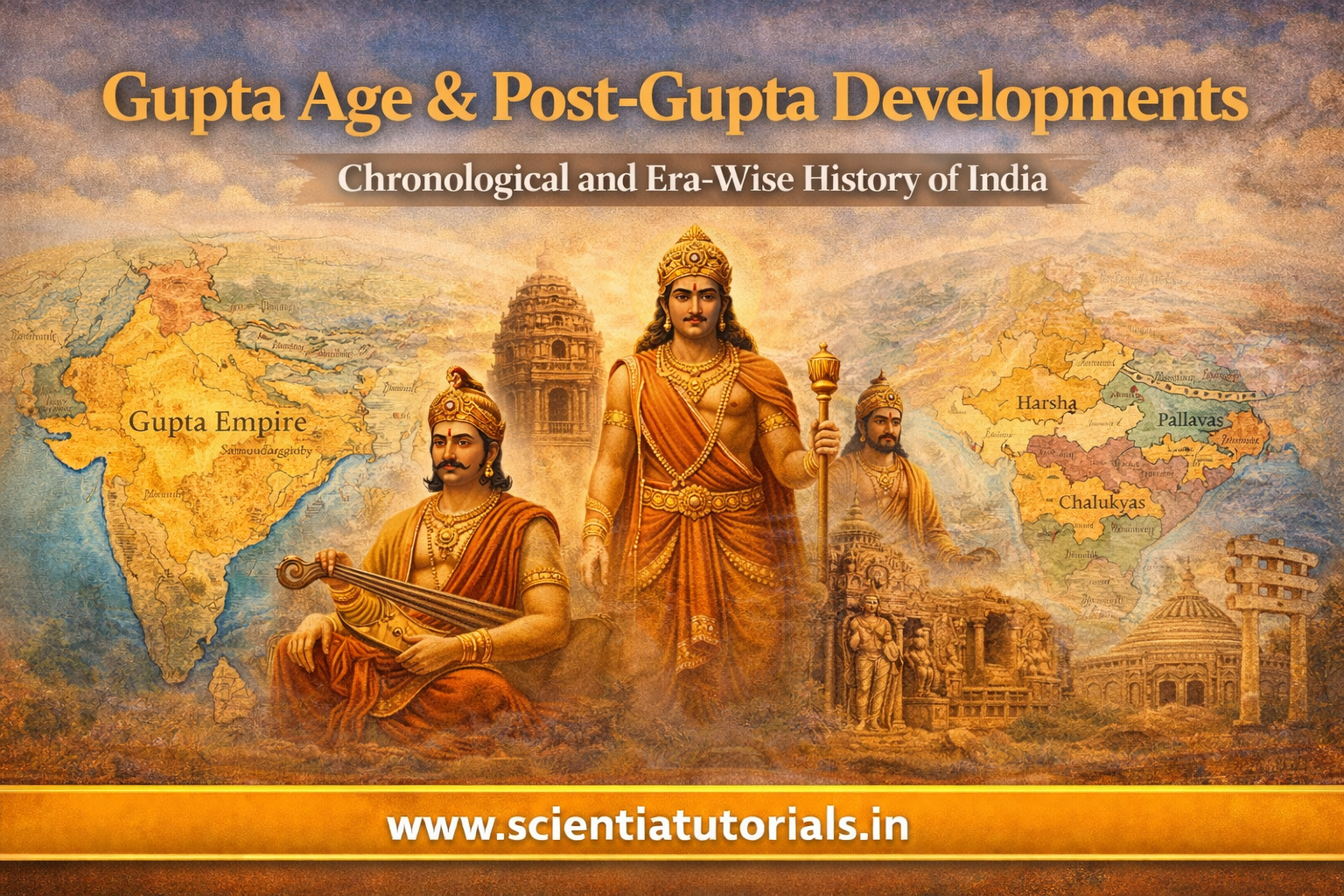
Gupta Age & Post-Gupta Developments – Chronological and Era-Wise History of India
In this Course, each Lesson under the Modules is divided into 4 Sections, as mentioned below:
- Study Module with Revision Notes,
- Questions with Answers,
- MCQs with Answers and detailed explanations.
Module-wise Breakdown of Lessons for Online Learning
This online learning course offers a comprehensive, chronological, and evidence-based understanding of the History of India, with special focus on controversial events, debates, and critical interpretations. Designed for both conceptual clarity and exam readiness, the course strengthens analytical thinking, source evaluation, and answer-writing skills required in competitive examinations.
The content is highly relevant for aspirants preparing for UPSC (CSE), State PSCs (APSC, UPPSC, BPSC, MPPSC, MPSC, WBCS, RPSC, TNPSC, etc.), UGC-NET/JRF, CUET (UG/PG), SSC, NDA, CDS, CAPF, as well as CBSE, ICSE, State Board examinations, and college/university undergraduate and postgraduate courses where History of India is a core subject.
Module 1: Background to the Rise of the Gupta Empire
Timeline: c. 250 CE – 320 CE
Overview
This module sets the historical context for the emergence of the Gupta Empire, focusing on political fragmentation after the Kushanas and changing socio-economic conditions.
Key Characteristics
- Decline of Kushana authority
- Regional powers and political instability
- Gradual revival of trade and agrarian economy
Lessons
- India after the Kushanas: Political and Economic Background
- Regional Kingdoms before the Guptas
- Factors Responsible for the Rise of the Gupta Empire
Module 2: Foundation of the Gupta Empire
Timeline: c. 320 CE – 335 CE
Overview
This module examines the establishment of Gupta rule under Chandragupta I and the creation of imperial authority.
Key Characteristics
- Strategic matrimonial alliances
- Beginning of imperial coinage
- Expansion in the Gangetic plain
Lessons
- Chandragupta I and the Foundation of the Gupta Empire
- Political Significance of the Lichchhavi Alliance
- Early Gupta Administration and Kingship
Module 3: Gupta Imperial Expansion under Samudragupta
Timeline: c. 335 CE – 375 CE
Overview
This module focuses on the military expansion and political consolidation under Samudragupta, often called the “Napoleon of India”.
Key Characteristics
- Extensive military campaigns
- Subjugation and diplomacy
- Cultural patronage
Lessons
- Samudragupta’s Conquests: Northern and Southern Campaigns
- Prayaga Prashasti as a Historical Source
- Administration and Cultural Achievements of Samudragupta
Module 4: Gupta Classical Age under Chandragupta II
Timeline: c. 375 CE – 415 CE
Overview
This module studies the height of Gupta power and prosperity under Chandragupta II.
Key Characteristics
- Imperial consolidation and stability
- Flourishing trade and urban centres
- Cultural and artistic excellence
Lessons
- Chandragupta II and Imperial Expansion
- Foreign Relations and Western Kshatrapa Conquest
- The Gupta Empire at Its Zenith
Module 5: Gupta Administration and Political System
Timeline: c. 320 CE – 550 CE
Overview
This module analyses the administrative structure and governance of the Gupta state.
Key Characteristics
- Monarchical system with decentralisation
- Role of governors and local officials
- Emergence of samantas
Lessons
- Central and Provincial Administration under the Guptas
- Judicial System and Military Organisation
- Nature of the Gupta State
Module 6: Gupta Economy, Society, and Urban Life
Timeline: c. 320 CE – 550 CE
Overview
This module explores economic prosperity and social organisation during the Gupta Age.
Key Characteristics
- Agrarian expansion and land grants
- Gold coinage and trade networks
- Varna system and family structure
Lessons
- Agriculture, Land Grants, and Revenue System
- Trade, Coinage, and Guild Organisation
- Social Structure and Position of Women
Module 7: Art, Architecture, and Cultural Achievements
Timeline: c. 320 CE – 550 CE
Overview
This module highlights why the Gupta Age is considered the Golden Age of India.
Key Characteristics
- Classical sculpture and temple architecture
- Ajanta cave paintings
- Royal and religious patronage
Lessons
- Gupta Sculpture and Temple Architecture
- Ajanta Paintings and Classical Aesthetics
- Cultural Patronage and Court Life
Module 8: Literature, Science, and Intellectual Life
Timeline: c. 320 CE – 550 CE
Overview
This module examines intellectual advancements that shaped classical Indian civilisation.
Key Characteristics
- Growth of Sanskrit literature
- Advances in mathematics and astronomy
- Scientific inquiry and education
Lessons
- Sanskrit Literature and Scholars of the Gupta Age
- Mathematics, Astronomy, and Medicine
- Education and Knowledge Systems
Module 9: Religion and Philosophy in the Gupta Age
Timeline: c. 320 CE – 550 CE
Overview
This module studies religious developments and philosophical tolerance under Gupta rule.
Key Characteristics
- Revival of Brahmanism
- Growth of Vaishnavism and Shaivism
- Continued patronage to Buddhism and Jainism
Lessons
- Religious Policy of the Gupta Rulers
- Vaishnavism, Shaivism, and Temple Culture
- Buddhism and Jainism during the Gupta Age
Module 10: Decline of the Gupta Empire
Timeline: c. 455 CE – 550 CE
Overview
This module analyses the causes behind the decline of Gupta power.
Key Characteristics
- Weak successors
- Hun invasions
- Administrative and economic strain
Lessons
- Hun Invasions and External Threats
- Internal Weaknesses and Administrative Decline
- End of Gupta Imperial Authority
Module 11: Post-Gupta Developments and Regional Kingdoms
Timeline: c. 550 CE – 750 CE
Overview
This module explains political decentralisation and the emergence of regional powers.
Key Characteristics
- Rise of regional dynasties
- Changing nature of kingship
- Transition towards early medieval polity
Lessons
- Rise of Regional Kingdoms in Post-Gupta India
- Rule of Harsha: Administration and Achievements
- Political Patterns of Post-Gupta India
Module 12: Socio-Economic, Cultural Changes and Historical Significance
Timeline: c. 550 CE – 750 CE
Overview
This concluding module evaluates long-term changes and historical importance.
Key Characteristics
- Land grants and feudal tendencies
- Cultural continuity with transformation
- Bridge between Ancient and Early Medieval India
Lessons
- Socio-Economic Changes in the Post-Gupta Period
- Cultural Continuity and Transformation
- Historical Significance of the Gupta and Post-Gupta Age
✅ Course Outcome
After completing this course, learners will gain clear chronological understanding, strong conceptual clarity, and exam-oriented mastery of the Gupta Age and Post-Gupta Developments, making it ideal for CBSE/ICSE curricula, undergraduate studies, and competitive examinations (UPSC, State PSCs, SSC, CUET).
Curriculum
You May Like
Mauryan Empire & Post-Mauryan India – Chronological and Era-Wise History of India
Mauryan Empire & Post-Mauryan India – Chronological and Era-Wise History of India In this Course, each Lesson under the Modules is divided into 4 Sections,...

Mahajanapadas & Rise of New Religious Movements – Chronological and Era-Wise History of India
Mahajanapadas & Rise of New Religious Movements – Chronological and Era-Wise History of India In this Course, each Lesson under the Modules is divided into...
Course Features
- Lectures 36
- Quiz 0
- Duration Lifetime access
- Skill level All levels
- Language English
- Students 0
- Assessments Yes