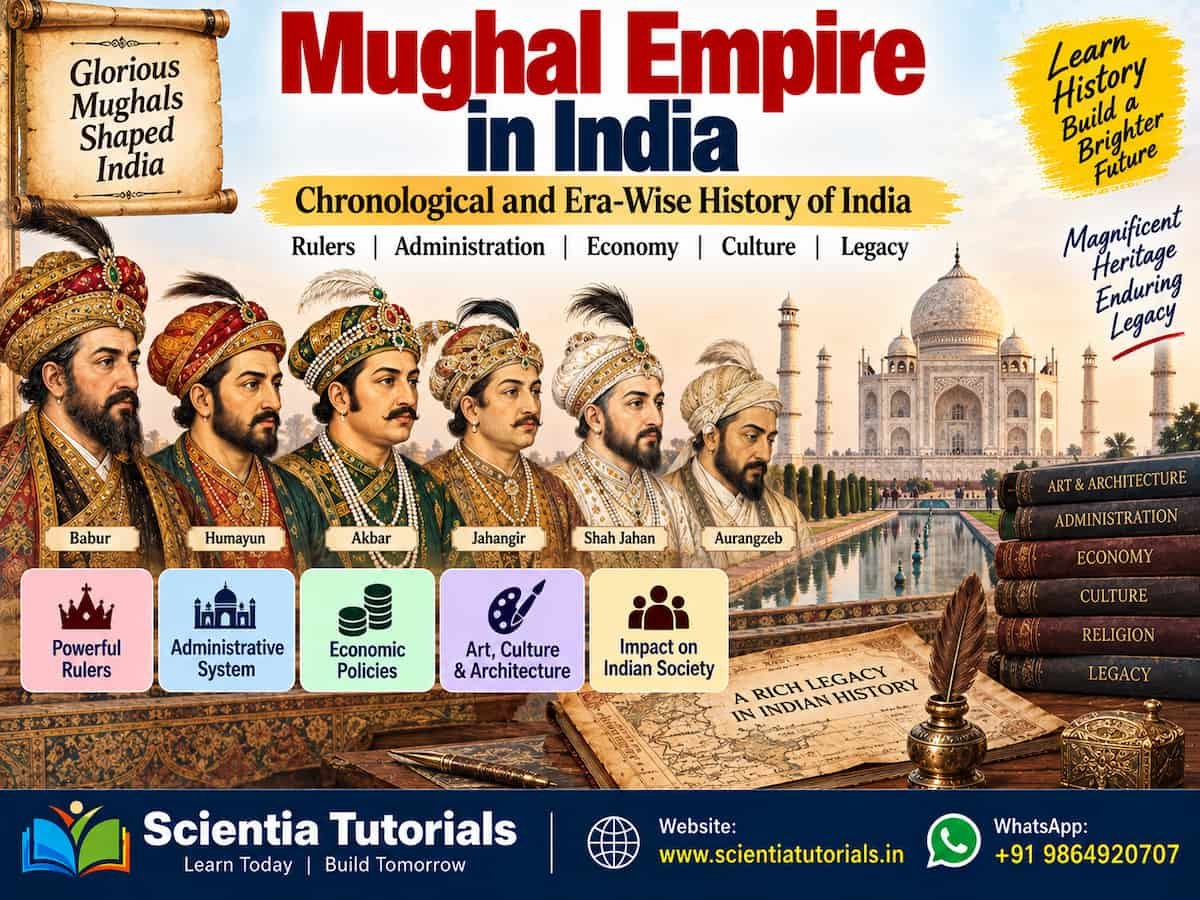
Mughal Empire in India – Chronological and Era-Wise History of India
Mughal Empire in India – Chronological and Era-Wise History of India Module-wise Breakdown of Lessons for Online Learning In this Course, each Lesson under the Modules is divided into 4 Sections, as mentioned below: Study Module with Revision Notes, Questions …
Overview
Mughal Empire in India – Chronological and Era-Wise History of India
Module-wise Breakdown of Lessons for Online Learning
In this Course, each Lesson under the Modules is divided into 4 Sections, as mentioned below:
- Study Module with Revision Notes,
- Questions with Answers,
- MCQs with Answers and detailed explanations.
This online learning course offers a comprehensive, chronological, and evidence-based understanding of the History of India, with special focus on controversial events, debates, and critical interpretations. Designed for both conceptual clarity and exam readiness, the course strengthens analytical thinking, source evaluation, and answer-writing skills required in competitive examinations.
The content is highly relevant for aspirants preparing for UPSC (CSE), State PSCs (APSC, UPPSC, BPSC, MPPSC, MPSC, WBCS, RPSC, TNPSC, etc.), UGC-NET/JRF, CUET (UG/PG), SSC, NDA, CDS, CAPF, as well as CBSE, ICSE, State Board examinations, and college/university undergraduate and postgraduate courses where History of India is a core subject.
Module 1: Foundation of the Mughal Empire (c. 1526 CE – 1530 CE)
Key Characteristics
- Political: Establishment of Mughal rule after the First Battle of Panipat; end of Delhi Sultanate dominance
- Administrative: Introduction of Central Asian military traditions
- Economic: Control over fertile Indo-Gangetic plains
- Social & Religious: Interaction between Turko-Mongol elites and Indian society
- Cultural: Beginning of Persian cultural influence in India
Lessons
- Central Asian Background and Rise of Babur
- First Battle of Panipat (1526): Causes, Course, and Consequences
- Early Mughal Military Strategy and Use of Gunpowder
- Significance of Mughal Foundation in Medieval Indian History
Module 2: Babur and Humayun Period (c. 1526 CE – 1556 CE)
Key Characteristics
- Political: Struggle for consolidation; Afghan resistance
- Administrative: Experimental governance and jagir assignments
- Economic: Revenue extraction from newly conquered territories
- Social & Religious: Limited religious interference
- Cultural: Baburnama and early Mughal art
Lessons
- Babur’s Indian Conquests and Administrative Challenges
- Reign of Humayun: Political Instability and Exile
- Sher Shah Suri and the Afghan Interregnum
- Restoration of Mughal Rule and the Legacy of Humayun
Module 3: Akbar’s Expansion and Consolidation (c. 1556 CE – 1605 CE)
Key Characteristics
- Political: Territorial expansion and political unification
- Administrative: Mansabdari system and centralized governance
- Economic: Todar Mal’s revenue reforms
- Social & Religious: Sulh-i-Kul (religious tolerance)
- Cultural: Mughal architecture, court culture, and literature
Lessons
- Early Reign of Akbar and the Second Battle of Panipat
- Mughal Administration: Mansabdari and Jagirdari Systems
- Revenue Administration under Raja Todar Mal
- Akbar’s Religious Policy and Cultural Contributions
Module 4: Jahangir’s Administration and Culture (c. 1605 CE – 1627 CE)
Key Characteristics
- Political: Stability with growing influence of nobles
- Administrative: Justice-oriented governance
- Economic: Expansion of foreign trade
- Social & Religious: Continued policy of tolerance
- Cultural: Development of Mughal painting
Lessons
- Accession of Jahangir and Political Conditions
- Administration of Justice and the Chain of Justice
- Role of Nur Jahan in Mughal Politics
- Mughal Painting and Cultural Flourishing
Module 5: Shah Jahan’s Golden Age (c. 1628 CE – 1658 CE)
Key Characteristics
- Political: Peak of Mughal territorial and administrative power
- Administrative: Highly centralized bureaucracy
- Economic: Prosperity through trade and taxation
- Social & Religious: Patronage of Islamic culture
- Cultural: Golden age of Mughal architecture
Lessons
- Reign of Shah Jahan: Political Achievements
- Mughal Economy and Global Trade Networks
- Architectural Marvels: Taj Mahal, Red Fort, Jama Masjid
- Court Culture and Artistic Excellence
Module 6: Aurangzeb and Imperial Overstretch (c. 1658 CE – 1707 CE)
Key Characteristics
- Political: Continuous wars and territorial overexpansion
- Administrative: Increased central control and military expenditure
- Economic: Strain on treasury
- Social & Religious: Orthodox religious policies
- Cultural: Decline of royal patronage
Lessons
- Accession of Aurangzeb and War of Succession
- Deccan Policy and Mughal-Maratha Conflict
- Religious Policies and Re-imposition of Jizya
- Causes and Consequences of Imperial Overstretch
Module 7: Later Mughals and Decline (c. 1707 CE – 1857 CE)
Key Characteristics
- Political: Weak successors and regional autonomy
- Administrative: Collapse of centralized authority
- Economic: Decline of imperial revenue
- Social & Religious: Fragmentation of Mughal society
- Cultural: Survival of Mughal traditions without power
Lessons
- Later Mughal Rulers and Political Disintegration
- Rise of Regional Powers: Awadh, Bengal, Hyderabad
- Foreign Invasions: Nadir Shah and Ahmad Shah Abdali
- Structural Causes of the Decline of the Mughal Empire
Module 8: Transition from Mughal to British Rule (c. 1757 CE – 1858 CE)
Key Characteristics
- Political: British dominance under nominal Mughal authority
- Administrative: East India Company control
- Economic: Colonial exploitation
- Social & Religious: Resistance and reform movements
- Cultural: End of Indo-Persian court culture
Lessons
- Mughal Decline and the Rise of the British East India Company
- 1857 Revolt and Role of Bahadur Shah Zafar
- End of the Mughal Empire and British Crown Rule
- Historical Significance of the Mughal Legacy in India
✅ Outcome
This structure ensures:
✔ Strict chronological clarity
✔ UPSC, State PSC, CBSE, CUET readiness
✔ Perfect alignment with Medieval Indian history syllabi