
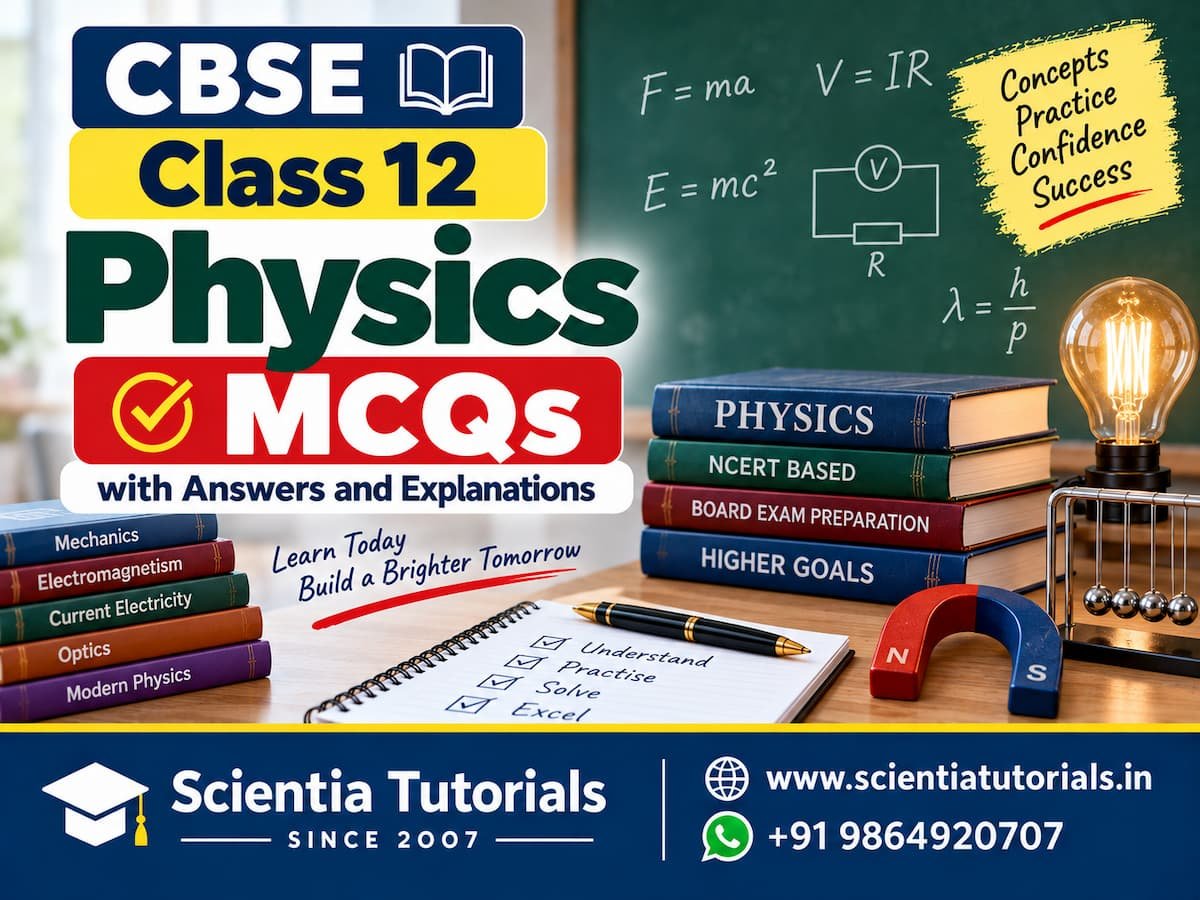
CBSE Class 12 Physics – MCQs with Answers and Explanations
📘 CBSE Class 12 Physics – MCQs with Answers and Explanations: Course Overview The CBSE Class 12 Physics – MCQs with Answers and Explanations course is a comprehensive, exam-focused practice program designed strictly as per the latest NCERT syllabus and CBSE examination pattern. This course aims to strengthen conceptual clarity, …

Overview
📘 CBSE Class 12 Physics – MCQs with Answers and Explanations: Course Overview
The CBSE Class 12 Physics – MCQs with Answers and Explanations course is a comprehensive, exam-focused practice program designed strictly as per the latest NCERT syllabus and CBSE examination pattern. This course aims to strengthen conceptual clarity, improve problem-solving skills, and enhance students’ confidence for board exams as well as competitive entrance tests.
The course covers all major units of Class 12 Physics, including Electrostatics, Current Electricity, Magnetism, Electromagnetic Induction, Optics, Dual Nature of Radiation, Atoms and Nuclei, and Semiconductor Electronics. Each chapter is supported with a wide range of carefully framed multiple-choice questions that test factual knowledge, numerical ability, conceptual understanding, and application skills.
🔍 Key Features of the Course
- ✔️ NCERT-Based MCQs aligned with CBSE question standards
- ✔️ Chapter-wise and topic-wise coverage for systematic preparation
- ✔️ Accurate answers with detailed explanations to clear common doubts
- ✔️ Emphasis on conceptual understanding, numerical problems, and case-based questions
- ✔️ Ideal for board exams, school tests, and competitive exams (JEE/NEET foundation)
🎯 Learning Outcomes
By completing this course, students will be able to:
- Develop a strong conceptual foundation in Class 12 Physics
- Analyze and solve MCQs quickly and accurately
- Identify common mistakes and misconceptions through explanations
- Improve time management and exam confidence
👨🎓 Who Should Use This Course?
- CBSE Class 12 students preparing for board examinations
- Students looking for quick revision and self-assessment
- Teachers seeking ready-to-use MCQ practice material
- Aspirants preparing for engineering and medical entrance exams
Curriculum
- 10 Sections
- 47 Lessons
- Lifetime
- 🔹 Section 1: Electrostatics5 ItemsElectrostatics deals with the study of electric charges at rest and the forces, fields, and potentials they produce. In this section, students learn key concepts like Coulomb’s law, electric field and field lines, electric potential, and capacitance. It builds a strong conceptual and numerical foundation essential for board exams and competitive physics preparation, strictly based on CBSE and NCERT guidelines.
- 🔹 Section 2: Current Electricity5 ItemsCurrent Electricity focuses on the flow of electric charges in conductors and the laws governing electric circuits. Key topics include Ohm’s law, resistance, resistivity, drift velocity, electrical power, and Kirchhoff’s rules. This section strengthens numerical problem-solving and circuit analysis skills, as prescribed by CBSE and NCERT.
- 🔹 Section 3: Magnetic Effects of Current & Magnetism5 ItemsThis section explores how electric current produces magnetic fields and how magnetic forces act on moving charges and conductors. Key concepts include Biot–Savart law, Ampere’s law, force on a current-carrying conductor, moving coil galvanometer, and properties of magnetic materials. It builds conceptual clarity and numerical skills as per CBSE and NCERT guidelines.
- 🔹 Section 4: Electromagnetic Induction & Alternating Current5 ItemsThis section explains how changing magnetic fields induce electric current and the principles governing AC circuits. Core topics include Faraday’s laws, Lenz’s law, self and mutual inductance, AC voltage/current, reactance, impedance, and power factor. It develops conceptual understanding and numerical aptitude in line with CBSE and NCERT.
- 🔹 Section 5: Electromagnetic Waves4 ItemsThis section covers the nature and properties of electromagnetic waves produced by accelerating charges. Students study Maxwell’s concept, characteristics of EM waves, and the complete electromagnetic spectrum with its uses. It strengthens conceptual understanding as per CBSE and NCERT guidelines.
- 🔹 Section 6: Optics5 ItemsThis section deals with the behavior of light through reflection, refraction, and wave phenomena. It covers ray optics, optical instruments, and wave optics topics like interference, diffraction, and polarisation. The unit builds strong conceptual and numerical skills as per CBSE and NCERT guidelines.
- 🔹 Section 7: Dual Nature of Radiation & Matter4 ItemsThis section explains the wave–particle duality of light and matter. Key topics include the photoelectric effect, Einstein’s explanation, and de Broglie wavelength, forming a bridge between classical and modern physics as per CBSE and NCERT guidelines.
- 🔹 Section 8: Atoms and Nuclei5 ItemsThis section explores atomic structure and nuclear physics concepts. It covers Bohr’s model, hydrogen spectrum, radioactivity, nuclear reactions, mass defect, and binding energy—building foundational knowledge of modern physics as prescribed by CBSE and NCERT guidelines.
- 🔹 Section 9: Electronic Devices5 ItemsThis section introduces semiconductor physics and basic electronic components. Key topics include PN junction diodes, transistors, rectifiers, logic gates, and digital electronics—focusing on practical applications and circuit understanding as per CBSE and NCERT guidelines.
- 🔹 Section 10: Experimental Skills4 ItemsThis section emphasizes practical understanding of physics through experiments and data analysis. It includes error analysis, graph interpretation, circuit diagrams, case-based questions, and competency-based MCQs, strengthening application skills as per CBSE and NCERT guidelines.
You May Like
CBSE Class 11 Physics – MCQs with Answers and Explanations
Course Overview: CBSE Class 11 Physics – MCQs with Answers and Explanations This course offers a comprehensive, exam-oriented collection of Multiple Choice Questions (MCQs) covering...
CBSE Class 12 Physics MCQs – Online Practice Test – Chapter Wise
Course Overview CBSE Class 12 Physics MCQs – Online Practice Test – Chapter Wise is an exam-focused online practice course designed to help Class 12...
Course Features
- Lectures 47
- Quiz 0
- Duration Lifetime access
- Skill level All levels
- Language English
- Students 0
- Assessments Yes