
World History: From Early Civilizations to the Contemporary Global System
Course Overview World History: From Early Civilizations to the Contemporary Global System In this Course, each Lesson under the Modules is divided into 4 Sections, as mentioned below: Chronologically Structured Study Module, Short Answer Type Questions, Long Answer Type Questions, …

Overview
Course Overview
World History: From Early Civilizations to the Contemporary Global System
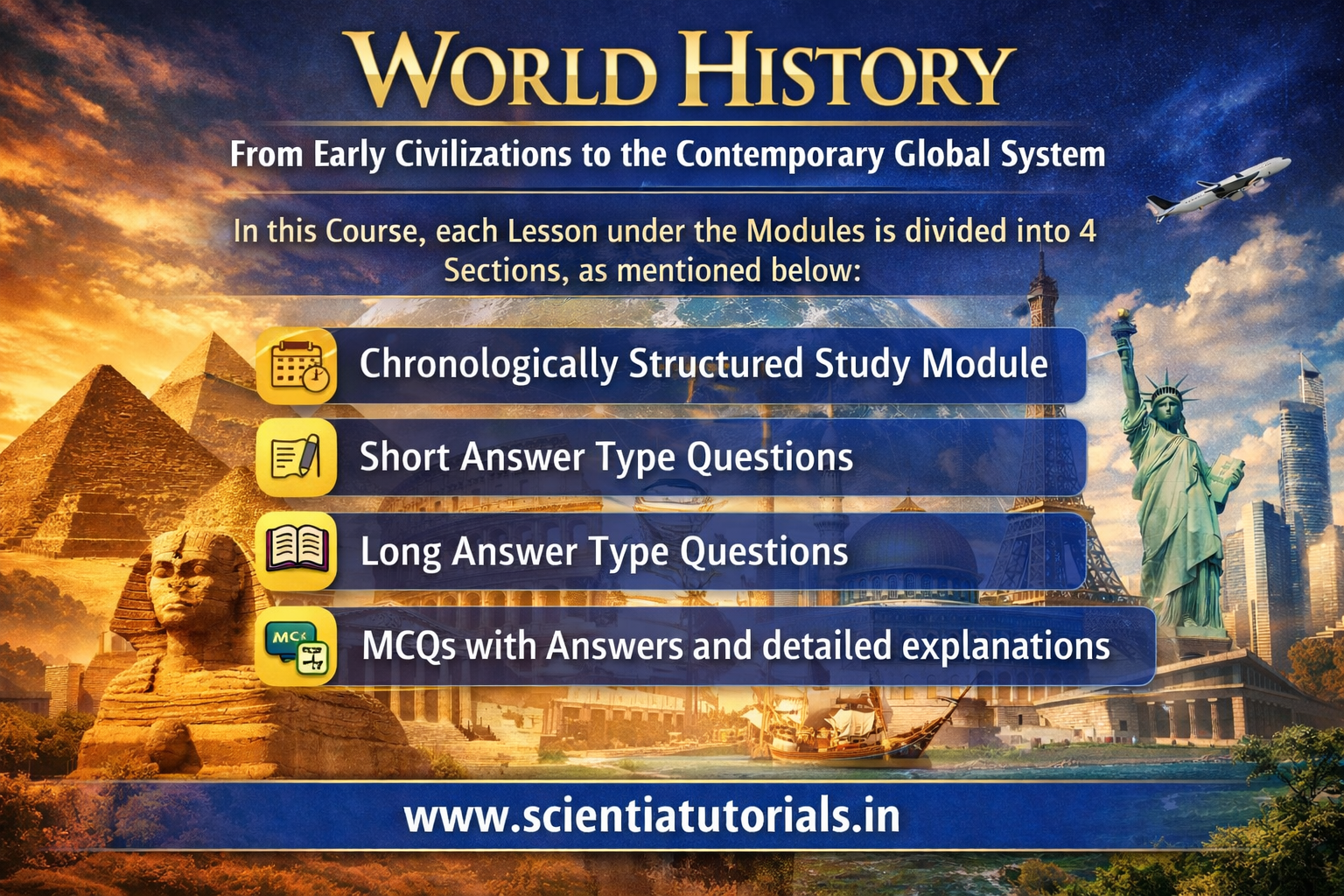
In this Course, each Lesson under the Modules is divided into 4 Sections, as mentioned below:
- Chronologically Structured Study Module,
- Short Answer Type Questions,
- Long Answer Type Questions,
- MCQs with Answers and detailed explanations.
This online learning course offers a comprehensive, chronological, and thematic exploration of World History, tracing humanity’s journey from the earliest civilizations to the complex, interconnected global system of the present era. Designed for students, competitive exam aspirants, educators, and lifelong learners, the course emphasizes both historical depth and global perspective.
Beginning with the rise of ancient civilizations in Mesopotamia, Egypt, the Indus Valley, and China, the course moves through classical empires, medieval societies, early modern transformations, colonial expansion, industrialization, world wars, decolonization, and contemporary globalization. Special attention is given to cross-cultural interactions, economic and political systems, technological change, and ideological movements that shaped world history.
The course is structured to develop:
- Clear chronological understanding
- Strong comparative and analytical skills
- The ability to link historical processes with contemporary global issues
It is ideal both as a standalone academic course and as a foundation course for national and international examinations.
World History: From Early Civilizations to the Contemporary Global System
Comprehensive Online Learning Study Material
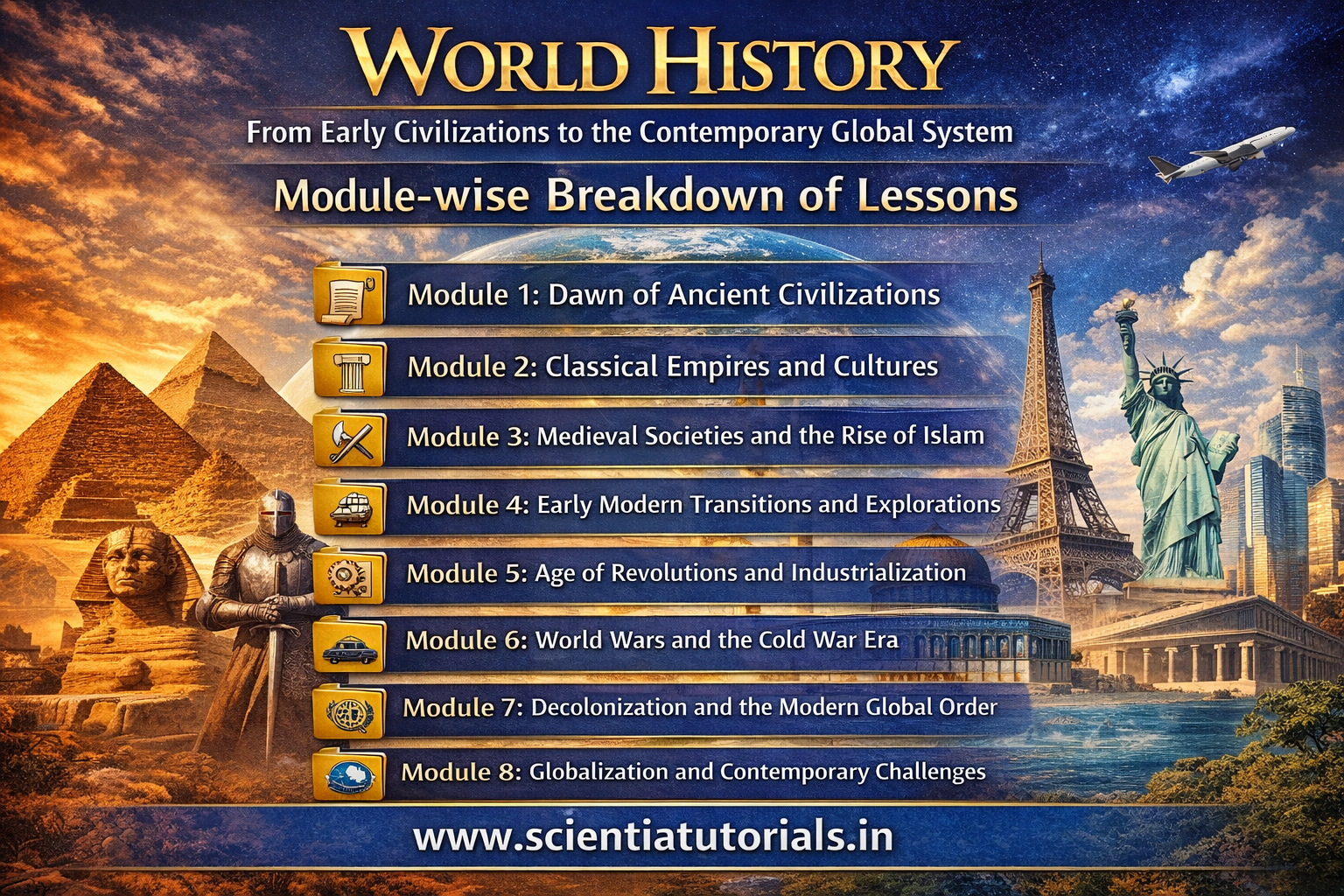
Module I: Dawn of Ancient Civilizations
Module Introduction
This module introduces the foundations of ancient civilizations, focusing on early human societies, the development of agriculture, urbanization, and the emergence of political, economic, and cultural systems that shaped world history.
Lesson 1: Prehistoric Societies and the Neolithic Revolution
Timeline: c. 2.5 million BCE – 3000 BCE
- Paleolithic and Mesolithic lifestyles
- Neolithic Revolution and agricultural surplus
- Transition from nomadic to settled life
Lesson 2: Mesopotamian Civilization
Timeline: c. 3000 BCE – 1600 BCE
- Sumerians, Akkadians, Babylonians, Assyrians
- Writing (cuneiform), law (Code of Hammurabi)
- Urban governance and trade networks
Lesson 3: Ancient Egyptian Civilization
Timeline: c. 3000 BCE – 1000 BCE
- Nile-based economy and political unity
- Pharaohs, religion, pyramids
- Science, medicine, and writing
Lesson 4: Indus Valley Civilization
Timeline: c. 2600 BCE – 1900 BCE
- Urban planning and drainage systems
- Trade, seals, and undeciphered script
- Decline theories and legacy
Lesson 5: Early Chinese Civilization
Timeline: c. 1600 BCE – 500 BCE
- Shang and Zhou dynasties
- Mandate of Heaven
- Bronze technology and social hierarchy
Module II: Classical Empires and Cultures
Module Introduction
This module examines classical civilizations and empires, highlighting governance, philosophy, warfare, and cultural achievements that influenced later world history.
Lesson 1: Greek City-States and Hellenistic World
Timeline: c. 800 BCE – 146 BCE
- Athens, Sparta, democracy
- Philosophy, art, science
- Alexander the Great and Hellenism
Lesson 2: Roman Republic and Empire
Timeline: c. 509 BCE – 476 CE
- Republican institutions and imperial expansion
- Roman law, engineering, administration
- Causes of decline
Lesson 3: Mauryan and Gupta Empires
Timeline: c. 322 BCE – 550 CE
- Statecraft under Ashoka
- Golden Age of Gupta rule
- Science, mathematics, religion
Lesson 4: Qin and Han Dynasties
Timeline: c. 221 BCE – 220 CE
- Centralized bureaucracy
- Confucianism and Legalism
- Silk Road trade
Lesson 5: Classical African and American Civilizations
Timeline: c. 500 BCE – 500 CE
- Nubia and Aksum
- Olmec and early Mesoamerican cultures
- Independent civilizational development
Module III: Medieval Societies and the Rise of Islam
Module Introduction
This module explores medieval world history, emphasizing feudal systems, religious institutions, Islamic civilization, and global interactions.
Lesson 1: Rise and Expansion of Islam
Timeline: c. 610 CE – 750 CE
- Life of Prophet Muhammad
- Caliphates and Islamic governance
- Cultural and scientific contributions
Lesson 2: Islamic Golden Age
Timeline: c. 750 CE – 1200 CE
- Science, medicine, philosophy
- Translation movement
- Trade and urban centers
Lesson 3: Medieval Europe and Feudalism
Timeline: c. 500 CE – 1300 CE
- Manorial system
- Role of the Church
- Chivalry and crusades
Lesson 4: Byzantine Empire
Timeline: c. 330 CE – 1453 CE
- Continuation of Roman legacy
- Orthodox Christianity
- Fall of Constantinople
Lesson 5: East Asian Medieval Developments
Timeline: c. 600 CE – 1300 CE
- Tang and Song dynasties
- Innovations: printing, gunpowder
- Maritime trade
Module IV: Early Modern Transitions and Explorations
Module Introduction
This module marks the transition from medieval to early modern world history, shaped by exploration, intellectual change, and emerging global connections.
Lesson 1: Renaissance and Humanism
Timeline: c. 1300 – 1600 CE
- Revival of classical learning
- Art, science, and individualism
Lesson 2: Reformation and Religious Conflicts
Timeline: c. 1517 – 1648 CE
- Protestant Reformation
- Catholic Counter-Reformation
- Political consequences
Lesson 3: Age of Exploration
Timeline: c. 1450 – 1700 CE
- Maritime technology
- European overseas expansion
- Columbian Exchange
Lesson 4: Rise of Nation-States
Timeline: c. 1500 – 1700 CE
- Absolute monarchies
- State-building and diplomacy
Lesson 5: Early Global Trade Systems
Timeline: c. 1600 – 1750 CE
- Mercantilism
- Atlantic slave trade
- Global economic integration
Module V: Age of Revolutions and Industrialization
Module Introduction
This module focuses on political revolutions and economic transformations that reshaped societies and laid the foundation of the modern world order.
Lesson 1: Scientific and Enlightenment Thought
Timeline: c. 1600 – 1800 CE
- Rationalism and empiricism
- Political philosophy
Lesson 2: American and French Revolutions
Timeline: c. 1775 – 1799 CE
- Ideas of liberty and equality
- Constitutional governance
Lesson 3: Latin American Revolutions
Timeline: c. 1800 – 1830 CE
- Anti-colonial movements
- Nation formation
Lesson 4: Industrial Revolution
Timeline: c. 1750 – 1900 CE
- Mechanization and factories
- Urbanization and labor
Lesson 5: Socialism, Capitalism, and Nationalism
Timeline: c. 1800 – 1900 CE
- Ideological conflicts
- Nation-state consolidation
Module VI: World Wars and the Cold War Era
Module Introduction
This module analyzes global conflicts, ideological struggles, and political realignments that dominated the twentieth century.
Lesson 1: Causes of the First World War
Timeline: c. 1870 – 1914 CE
- Imperialism and alliances
- Militarism and nationalism
Lesson 2: The First World War and Peace Settlements
Timeline: 1914 – 1919 CE
- Trench warfare
- Treaty of Versailles
Lesson 3: Interwar Period and Rise of Totalitarianism
Timeline: 1919 – 1939 CE
- Fascism, Nazism, Stalinism
- Economic depression
Lesson 4: Second World War
Timeline: 1939 – 1945 CE
- Global theatres of war
- Holocaust and war crimes
Lesson 5: Cold War Politics
Timeline: 1945 – 1991 CE
- Bipolar world order
- Proxy wars and nuclear tension
Module VII: Decolonization and the Modern Global Order
Module Introduction
This module studies decolonization processes and the emergence of new nations shaping the modern world order.
Lesson 1: End of Colonial Empires
Timeline: c. 1945 – 1975 CE
- Asia and Africa
- National liberation movements
Lesson 2: Formation of New Nation-States
Timeline: c. 1945 – 1980 CE
- Political challenges
- Economic development
Lesson 3: Non-Aligned Movement
Timeline: c. 1950 – 1980 CE
- Cold War neutrality
- Global South cooperation
Lesson 4: International Institutions
Timeline: c. 1945 – present
- United Nations
- Bretton Woods institutions
Lesson 5: Regional Conflicts and Global Politics
Timeline: c. 1950 – 2000 CE
- Middle East, Africa, Asia
- Power politics
Module VIII: Globalization and Contemporary Challenges
Module Introduction
This module examines contemporary world history, focusing on globalization, technological change, and global challenges.
Lesson 1: Globalization and World Economy
Timeline: c. 1980 – present
- Trade liberalization
- Multinational corporations
Lesson 2: Technological Revolution
Timeline: c. 1990 – present
- Digital age
- Information society
Lesson 3: Environmental and Climate Challenges
Timeline: c. 1970 – present
- Climate change
- Sustainable development
Lesson 4: Terrorism and Global Security
Timeline: c. 2000 – present
- Non-state actors
- Global counterterrorism
Lesson 5: Contemporary World Order
Timeline: c. 1991 – present
- Multipolar world
- Emerging powers
Conclusion
This world history course provides a chronological, comparative, and interconnected global history timeline, serving as a strong foundation for world history study materials, competitive examinations, and higher academic pursuits.
What You Will Learn
- Evolution of early civilizations and state systems
- Rise and fall of empires across regions
- Major religious, cultural, and intellectual traditions
- Impact of colonialism, nationalism, and industrialization
- World Wars, Cold War dynamics, and post-war global order
- Globalization, international institutions, and contemporary challenges
Worldwide Examinations Where World History Is Essential
Knowledge of World History is a core or significant component in several national and international examinations, including:
India
- Union Public Service Commission (UPSC – Civil Services Examination)
World History forms a major part of General Studies (GS Paper I). - State Public Service Commissions (State PCS Exams)
Included in General Studies and optional history papers.
United States
- College Board – AP World History
A core high school and college-level examination worldwide. - College Board – SAT (Reading & Writing sections)
Historical passages and global context questions. - Educational Testing Service – GRE (Humanities emphasis)
Relevant for students pursuing history and social sciences.
United Kingdom
- Oxford, Cambridge and RSA Examinations (OCR A-Level History)
- Pearson Edexcel (A-Level & IGCSE History)
International & Global Boards
- International Baccalaureate Organization (IB History – SL & HL)
- Cambridge Assessment International Education (IGCSE & A-Level History)
Other Competitive & Academic Contexts
- University entrance exams for History, International Relations, Political Science, and Area Studies
- Teacher eligibility and education exams in multiple countries
- Think-tank, diplomacy, and international organization recruitment assessments
Who Should Enroll
- Competitive exam aspirants (UPSC, PCS, AP, IB, A-Level)
- University and senior secondary students
- Teachers and educators of history and social sciences
- Learners interested in global affairs and historical foundations of the modern world
Why This Course Matters
Understanding World History is essential for interpreting current global politics, economic systems, cultural interactions, and international conflicts. This course equips learners with the historical literacy and analytical framework needed to succeed academically and professionally in a globalized world.
Disclaimer
This course, World History: From Early Civilizations to the Contemporary Global System, is created to support learning, understanding, and exam preparation. All lessons are based on well-established historical sources and commonly accepted academic interpretations used in schools, universities, and competitive examinations.
History is a subject that can have different viewpoints and interpretations. Wherever such differences exist, this course presents information in a neutral and balanced way, focusing on facts, timelines, and widely taught explanations rather than personal opinions or unverified claims.
The course content is exam-oriented and designed to help students prepare for assessments such as UPSC, AP World History, IB, A-Level, and university examinations. However, students should note that examination patterns, questions, and evaluation criteria may vary across institutions.
This course does not promote sensational, controversial, or speculative theories. Myths, exaggerated narratives, or unsupported claims are intentionally avoided. All civilizations, cultures, and historical figures are discussed with respect and in their historical context.
Students are encouraged to use this material as a strong foundation and to complement it with textbooks, reference books, and primary sources for deeper understanding and advanced study.
This course is intended to inform, educate, and guide, not to replace formal classroom instruction or official examination guidelines.
Curriculum
- 8 Sections
- 40 Lessons
- Lifetime
- Module I: Dawn of Ancient CivilizationsThis module introduces the foundations of ancient civilizations, focusing on early human societies, the development of agriculture, urbanization, and the emergence of political, economic, and cultural systems that shaped world history.5
- Module II: Classical Empires and CulturesThis module examines classical civilizations and empires, highlighting governance, philosophy, warfare, and cultural achievements that influenced later world history.5
- Module III: Medieval Societies and the Rise of IslamThis module explores medieval world history, emphasizing feudal systems, religious institutions, Islamic civilization, and global interactions.5
- Module IV: Early Modern Transitions and ExplorationsThis module marks the transition from medieval to early modern world history, shaped by exploration, intellectual change, and emerging global connections.5
- Module V: Age of Revolutions and IndustrializationThis module focuses on political revolutions and economic transformations that reshaped societies and laid the foundation of the modern world order.5
- Module VI: World Wars and the Cold War EraThis module analyzes global conflicts, ideological struggles, and political realignments that dominated the twentieth century.5
- Module VII: Decolonization and the Modern Global OrderThis module studies decolonization processes and the emergence of new nations shaping the modern world order.5
- Module VIII: Globalization and Contemporary ChallengesThis module examines contemporary world history, focusing on globalization, technological change, and global challenges.5
Course Features
- Lectures 40
- Quiz 0
- Duration Lifetime access
- Skill level All levels
- Language English
- Students 0
- Assessments Yes