
Lesson 1: Causes of the First World War
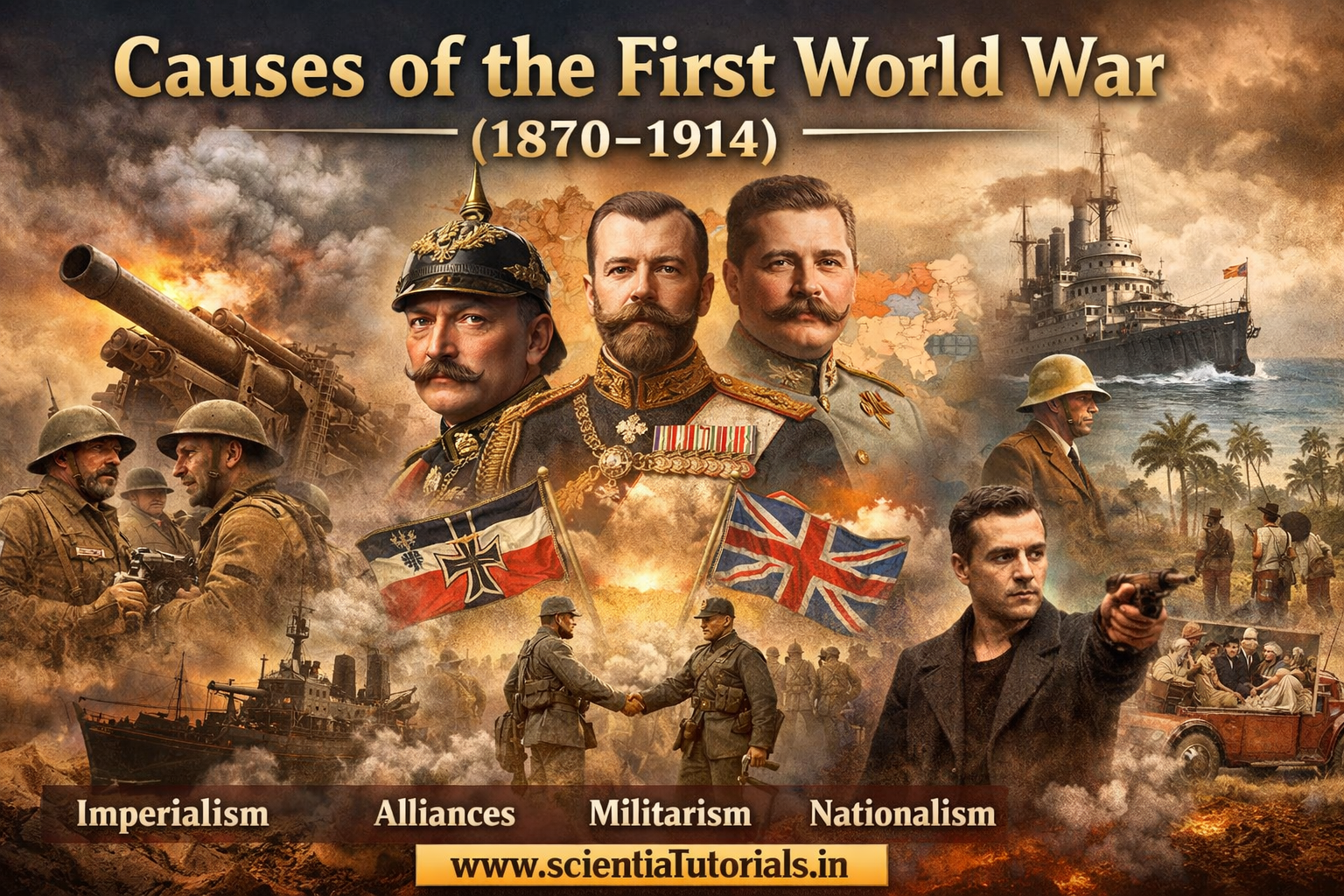
Causes of the First World War (1870–1914) | Imperialism, Alliances & Nationalism
Course: World History: From Early Civilizations to the Contemporary Global System
Module VI: World Wars and the Cold War Era
Lesson 1: Causes of the First World War (c. 1870–1914 CE)
This lesson is systematically organized into four clearly structured sections, as detailed below:
- Chronologically Structured Study Module
- Short-Answer Type Questions
- Long-Answer Type Questions
- Multiple-Choice Questions (MCQs) with Answers and Detailed Explanations
Chronologically Structured Study Module
Module Introduction
Module VI examines the era of unprecedented global conflict that reshaped political systems, societies, and international relations during the twentieth century. The First World War (1914–1918) marked a decisive break from earlier patterns of warfare and diplomacy. It was not an accidental or sudden event but the culmination of long-term structural tensions combined with short-term crises.
This lesson focuses on the causes of the First World War, emphasizing the interconnected roles of imperialism, alliance systems, militarism, and nationalism between c. 1870 and 1914. Understanding these causes is essential for grasping how Europe—and eventually the world—descended into total war.
Lesson Objectives
By the end of this lesson, learners will be able to:
- Analyze the long-term and short-term causes of the First World War
- Understand how imperialism and alliance systems intensified global tensions
- Evaluate the roles of militarism and nationalism in destabilizing Europe
- Trace the chronological buildup of conflicts from 1870 to 1914
- Develop examination-ready answers using structured historical arguments
Chronological Overview: c. 1870 – 1914 CE
The period from the unification of Germany in 1871 to the outbreak of war in 1914 witnessed dramatic shifts in global power. Industrialization, empire-building, and aggressive diplomacy transformed international relations, especially in Europe.
Historians often describe the causes of World War I through the acronym M.A.I.N.:
- Militarism
- Alliances
- Imperialism
- Nationalism
These forces developed over decades and interacted in complex ways.
I. Imperialism and Global Rivalries
1. Age of New Imperialism (c. 1870 onwards)
After 1870, European powers embarked on aggressive overseas expansion, particularly in Africa and Asia. Industrial growth created a demand for raw materials, markets, and strategic territories.
Major imperial powers included:
- Britain
- France
- Germany
- Russia
Imperialism intensified rivalry, suspicion, and competition, especially between Britain, France, and Germany.
2. German Challenge to British Supremacy
After its unification in 1871, Germany emerged as an industrial and military power. Under Kaiser Wilhelm II, Germany pursued Weltpolitik (world policy), aiming to acquire colonies and naval power.
This directly challenged Britain’s global dominance and strained diplomatic relations.
3. Imperial Crises and Conflicts
Imperial rivalries led to repeated international crises:
- Moroccan Crises (1905 & 1911): Germany challenged French influence in Morocco, alarming Britain and France
- African Rivalries: Competition for territories heightened distrust
- Asian Interests: Conflicting ambitions in the Ottoman and Chinese regions
These crises did not cause war immediately but hardened alliances and deepened hostilities.
II. Alliance Systems and the Division of Europe
1. Origins of the Alliance System
Following German unification, Otto von Bismarck sought to maintain peace through diplomacy. His goal was to isolate France and prevent a two-front war against Germany.
Early alliances included:
- Three Emperors’ League
- Dual Alliance (Germany–Austria-Hungary, 1879)
2. Formation of Rival Blocs
By the early twentieth century, Europe was divided into two hostile camps:
Triple Alliance (1882):
- Germany
- Austria-Hungary
- Italy
Triple Entente (1907):
- Britain
- France
- Russia
These alliances transformed local disputes into potential continental wars.
3. Consequences of the Alliance System
- Created an atmosphere of fear and mistrust
- Encouraged arms buildup
- Reduced flexibility in diplomacy
- Made escalation more likely during crises
By 1914, a conflict involving one power threatened to involve all major European states.
III. Militarism and the Arms Race
1. Growth of Militarism
Militarism refers to the belief that military strength is essential for national security and prestige. Between 1870 and 1914, European states expanded armies, modernized weapons, and glorified military values.
Governments increasingly relied on generals and military planners in decision-making.
2. Naval and Military Arms Race
- Anglo-German Naval Rivalry: Germany challenged Britain’s naval dominance by building battleships (Dreadnoughts)
- Conscription Systems: Large standing armies became standard
- War Planning: Detailed war plans such as Germany’s Schlieffen Plan encouraged rapid mobilization
Once mobilization began, it was difficult to stop, making war more likely during crises.
3. Militarism and Public Culture
Militarism influenced education, media, and politics:
- Military parades and propaganda
- National glorification of soldiers
- War portrayed as honorable and inevitable
This culture reduced public resistance to war.
IV. Nationalism as a Destabilizing Force
1. Nationalism in Western Europe
In countries like France and Germany, nationalism fostered pride but also resentment. France sought revenge for its defeat in the Franco-Prussian War (1870–71) and the loss of Alsace-Lorraine.
German nationalism emphasized unity, strength, and expansion.
2. Nationalism in Eastern Europe and the Balkans
The Balkans were the most volatile region in Europe. Declining Ottoman control created power vacuums and ethnic tensions.
Key features:
- Slavic nationalism
- Pan-Slavism supported by Russia
- Rivalry between Austria-Hungary and Serbia
3. Role of Serbia and Balkan Crises
Serbia sought to unite Slavic peoples, threatening Austria-Hungary.
The Balkan Wars (1912–1913) increased instability and left unresolved tensions that would explode in 1914.
V. Immediate Cause: The July Crisis of 1914
1. Assassination at Sarajevo
On 28 June 1914, Archduke Franz Ferdinand, heir to the Austro-Hungarian throne, was assassinated in Sarajevo by Gavrilo Princip.
The assassination was carried out by a nationalist linked to Serbian networks.
2. Diplomatic Breakdown
Following the assassination:
- Austria-Hungary issued an ultimatum to Serbia
- Germany offered unconditional support (“blank cheque”)
- Russia mobilized in defense of Serbia
- Germany declared war on Russia and France
- Britain entered the war after Germany invaded Belgium
What began as a regional crisis escalated into a world war due to alliances and militarism.
VI. Interconnection of Causes: A Structural Perspective
The First World War was not caused by a single event but by the interaction of long-term and short-term factors:
- Imperialism created global rivalries
- Alliances locked nations into conflict
- Militarism ensured readiness for war
- Nationalism inflamed ethnic and political tensions
The assassination at Sarajevo merely triggered a conflict already primed for explosion.
VII. Historical Significance and Examination Perspective
From an examination standpoint, students must:
- Distinguish between long-term and immediate causes
- Explain cause-and-effect relationships
- Use chronological structure in answers
- Support arguments with relevant examples
The causes of the First World War demonstrate how interconnected political, economic, and ideological forces can produce global conflict.
Conclusion
Between 1870 and 1914, Europe experienced profound transformations driven by industrialization, imperial expansion, and ideological change. The First World War emerged from decades of mounting tension rather than a single diplomatic failure.
Understanding these causes provides essential insight into modern world history and explains why the twentieth century became an age of global warfare and political realignment. This lesson lays the foundation for analyzing the course and consequences of the World Wars and the Cold War that followed.
Short Answer Type Questions: Causes of the First World War
1. What is meant by imperialism in the context of the First World War?
Answer: Imperialism refers to the policy by which European powers extended political and economic control over overseas territories, leading to rivalry and international tension before 1914.
2. How did imperial competition contribute to tensions among European powers?
Answer: Competition for colonies and resources intensified mistrust, particularly among Britain, France, and Germany, increasing the likelihood of conflict.
3. What was the significance of German unification in 1871?
Answer: German unification created a powerful new state in Europe, disrupting the balance of power and alarming older powers such as France and Britain.
4. Who was Otto von Bismarck and what was his role in European diplomacy?
Answer: Otto von Bismarck was the German Chancellor who used alliance diplomacy to isolate France and preserve peace after 1871.
5. What happened to European diplomacy after Bismarck’s dismissal?
Answer: After Bismarck’s removal, Germany followed an aggressive foreign policy, weakening diplomatic stability and increasing international tensions.
6. What was the Triple Alliance?
Answer: The Triple Alliance was a military agreement formed in 1882 between Germany, Austria-Hungary, and Italy for mutual defense.
7. What was the Triple Entente?
Answer: The Triple Entente was an understanding formed by 1907 between Britain, France, and Russia to counter the Triple Alliance.
8. How did alliance systems increase the risk of war?
Answer: Alliances meant that a conflict involving one country could quickly involve multiple nations, turning local disputes into large-scale wars.
9. What is meant by militarism?
Answer: Militarism is the belief that military strength and preparedness are essential for national security and prestige.
10. How did the arms race contribute to the outbreak of war?
Answer: The arms race increased suspicion and fear, while large standing armies and war plans made rapid mobilization inevitable during crises.
11. What role did naval rivalry play before 1914?
Answer: Naval rivalry, especially between Britain and Germany, intensified competition and hostility, particularly with the construction of modern battleships.
12. Who was Kaiser Wilhelm II and why is he important?
Answer: Kaiser Wilhelm II was the German emperor whose aggressive foreign policy heightened international tensions.
13. What is nationalism?
Answer: Nationalism is a strong sense of pride and loyalty to one’s nation, often leading to hostility toward other nations.
14. How did French nationalism influence pre-war Europe?
Answer: French nationalism was driven by resentment over the loss of Alsace-Lorraine to Germany after the Franco-Prussian War.
15. Why was the Balkans called the “powder keg of Europe”?
Answer: The Balkans were marked by ethnic nationalism, declining Ottoman control, and rivalry between Austria-Hungary and Russia.
16. What role did Serbia play in Balkan nationalism?
Answer: Serbia promoted Slavic nationalism and sought to unite Slavic peoples, threatening Austria-Hungary.
17. How did Russia support Balkan nationalism?
Answer: Russia supported Slavic states through Pan-Slavism, increasing tensions with Austria-Hungary.
18. What were the Balkan Wars (1912–1913)?
Answer: The Balkan Wars were conflicts among Balkan states that weakened the Ottoman Empire and intensified regional instability.
19. Who was Archduke Franz Ferdinand?
Answer: Franz Ferdinand was the heir to the Austro-Hungarian throne whose assassination triggered World War I.
20. Where and when was Franz Ferdinand assassinated?
Answer: He was assassinated on 28 June 1914 in Sarajevo, Bosnia.
21. Who assassinated Archduke Franz Ferdinand?
Answer: Gavrilo Princip, a Bosnian Serb nationalist, carried out the assassination.
22. What was the “blank cheque” policy?
Answer: It was Germany’s unconditional support to Austria-Hungary after the Sarajevo assassination, encouraging a hardline response to Serbia.
23. Why did the July Crisis escalate into a world war?
Answer: Mobilizations, rigid alliances, and militarism caused rapid escalation from a regional dispute to a global conflict.
24. Distinguish between long-term and immediate causes of World War I.
Answer: Long-term causes include imperialism, alliances, militarism, and nationalism, while the immediate cause was the Sarajevo assassination.
25. Why is the First World War considered a result of interconnected causes?
Answer: Because no single factor caused the war; instead, political, military, and ideological forces combined over decades to make war unavoidable.
Long Answer Type Questions: Causes of the First World War
1. Analyze the long-term causes of the First World War.
Answer:
The First World War was the result of long-term structural tensions that developed between c. 1870 and 1914. These included imperialism, militarism, alliance systems, and nationalism. European powers competed aggressively for colonies, especially after industrialization intensified the demand for raw materials and markets. Militarism led to an arms race and glorification of war, while rigid alliance systems divided Europe into hostile blocs. Nationalism, particularly in the Balkans, destabilized multinational empires. These interconnected factors created a fragile international system in which even a minor crisis could trigger war.
2. Examine the role of imperialism in causing the First World War.
Answer:
Imperialism intensified rivalry among European powers by fostering competition for overseas territories. Britain and France possessed vast empires, while Germany, unified only in 1871, sought colonies to match its rivals. German ambitions under Weltpolitik directly challenged British naval and commercial supremacy. Repeated imperial crises, especially in Africa and Morocco, increased diplomatic hostility and mistrust. Although imperial disputes did not directly cause war, they hardened attitudes and strengthened rival alliances, making peaceful resolution increasingly difficult.
3. How did the alliance system contribute to the outbreak of the First World War?
Answer:
The alliance system transformed Europe into two rival military blocs: the Triple Alliance and the Triple Entente. Initially designed to preserve peace, alliances instead created insecurity and reduced diplomatic flexibility. Any local conflict risked escalation because alliance obligations required member states to support one another. When war broke out in 1914, these alliances ensured that what began as a Balkan crisis rapidly expanded into a continental and then global war.
4. Discuss the diplomatic role of Otto von Bismarck in maintaining peace after 1871.
Answer:
Otto von Bismarck pursued a cautious foreign policy aimed at preserving peace and isolating France. He constructed a complex system of alliances to prevent Germany from facing a two-front war. His diplomacy maintained stability in Europe for nearly two decades. However, after his dismissal in 1890, Germany abandoned this careful approach, leading to increased aggression and diplomatic isolation, which contributed significantly to rising tensions.
5. Assess the impact of militarism on pre-war Europe.
Answer:
Militarism shaped political decision-making and public culture across Europe. Governments prioritized military expansion, compulsory conscription, and detailed war planning. Military leaders gained significant influence over civilian authorities. The arms race, particularly in land forces and naval power, increased suspicion among rival states. Militarism also created a belief that war was inevitable and even desirable, reducing public resistance to conflict and making diplomatic compromise less likely.
6. Explain the significance of the Anglo-German naval rivalry.
Answer:
The naval rivalry between Britain and Germany was a key manifestation of militarism. Britain relied on naval supremacy to protect its empire, while Germany sought to build a powerful navy to assert its global status. The construction of Dreadnought battleships escalated competition and deepened hostility. Britain increasingly viewed Germany as its primary threat, which strengthened British ties with France and Russia and contributed to the formation of the Triple Entente.
7. Analyze nationalism as a cause of the First World War.
Answer:
Nationalism promoted loyalty and unity within nation-states but also encouraged hostility toward others. In Western Europe, nationalism fostered rivalry and resentment, particularly in France after the loss of Alsace-Lorraine. In Eastern Europe, nationalism was more destabilizing, as ethnic groups sought independence from multinational empires. Nationalist ideologies undermined diplomatic cooperation and intensified conflicts, especially in regions like the Balkans.
8. Why was the Balkans considered the “powder keg of Europe”?
Answer:
The Balkans were politically unstable due to ethnic diversity, nationalist movements, and declining Ottoman authority. Competing ambitions of Austria-Hungary and Russia further destabilized the region. Small states, particularly Serbia, sought territorial expansion and ethnic unification. Repeated crises and wars made the Balkans highly volatile, where even a minor incident could spark a larger conflict.
9. Discuss the role of Pan-Slavism and Russia in Balkan affairs.
Answer:
Pan-Slavism was an ideology promoting unity among Slavic peoples, supported by Russia. Russia saw itself as the protector of Slavic nations in the Balkans, particularly Serbia. This brought Russia into direct conflict with Austria-Hungary, which controlled large Slavic populations. Russian support for Balkan nationalism heightened tensions and contributed to the chain reaction that led to war in 1914.
10. Evaluate the importance of the Balkan Wars (1912–1913) in the road to World War I.
Answer:
The Balkan Wars weakened the Ottoman Empire and intensified regional instability. They increased Serbian power and confidence, alarming Austria-Hungary. The wars also demonstrated that international diplomacy was ineffective in resolving Balkan disputes. Unresolved tensions after these conflicts created an environment ripe for confrontation, making the region a flashpoint for a wider war.
11. Examine the impact of German foreign policy after 1890.
Answer:
After 1890, Germany adopted an aggressive foreign policy aimed at expanding its influence. This approach abandoned Bismarck’s cautious diplomacy and antagonized Britain, France, and Russia. Germany’s pursuit of colonies, naval expansion, and assertive diplomacy increased its isolation and contributed significantly to the breakdown of European stability.
12. Explain the concept of the “blank cheque” and its consequences.
Answer:
The “blank cheque” referred to Germany’s unconditional support to Austria-Hungary following the assassination of Archduke Franz Ferdinand. This assurance emboldened Austria-Hungary to adopt a hardline stance against Serbia. The policy removed incentives for compromise and directly contributed to the escalation of the July Crisis into a general war.
13. Describe the immediate causes of the First World War.
Answer:
The immediate cause of the First World War was the assassination of Franz Ferdinand in Sarajevo on 28 June 1914 by Gavrilo Princip. This event triggered a diplomatic crisis involving Austria-Hungary, Serbia, Russia, Germany, France, and Britain, culminating in declarations of war.
14. Analyze the July Crisis of 1914.
Answer:
The July Crisis involved a rapid breakdown of diplomacy following the Sarajevo assassination. Austria-Hungary issued a harsh ultimatum to Serbia, backed by Germany. Russia mobilized to support Serbia, prompting German declarations of war on Russia and France. Britain entered the war after Germany invaded Belgium. The crisis demonstrated how alliances, militarism, and poor diplomacy made war unavoidable.
15. How did war plans and mobilization schedules contribute to the outbreak of war?
Answer:
European powers had rigid war plans that required rapid mobilization. Once mobilization began, it was perceived as an act of war. Political leaders had little control over military timetables, which escalated the crisis quickly and reduced opportunities for diplomatic solutions.
16. Distinguish between long-term and short-term causes of the First World War.
Answer:
Long-term causes include imperialism, militarism, nationalism, and alliances developed over decades. Short-term causes include the assassination at Sarajevo and the July Crisis. The war resulted from the interaction of both structural tensions and immediate events.
17. Assess whether the First World War was inevitable.
Answer:
While war was not inevitable, the combination of aggressive nationalism, militarism, alliance commitments, and diplomatic failures made peace increasingly unlikely. The international system lacked effective mechanisms for conflict resolution, allowing crises to escalate rapidly.
18. Explain how the balance of power system failed in pre-war Europe.
Answer:
The balance of power system failed because alliances became rigid and confrontational. Instead of maintaining stability, they created opposing blocs that increased fear and encouraged arms buildup, ultimately contributing to war.
19. Evaluate the role of nationalism in multi-national empires.
Answer:
Nationalism weakened empires such as Austria-Hungary and the Ottoman Empire by encouraging ethnic groups to seek independence. These movements destabilized imperial authority and generated conflicts that drew in major powers.
20. Conclude with an overall assessment of the causes of the First World War.
Answer:
The First World War was the product of interconnected political, economic, and ideological forces operating over several decades. Imperial rivalry, alliance systems, militarism, and nationalism created a fragile international order. The assassination of 1914 merely ignited a conflict that had long been in the making, marking the beginning of a new and destructive phase in world history.
MCQs: Causes of the First World War
1. Which event is commonly regarded as the immediate cause of the First World War?
A. Balkan Wars
B. Moroccan Crisis
C. Assassination of Archduke Franz Ferdinand
D. Formation of the Triple Alliance
Correct Answer: C
Explanation:
The assassination of Franz Ferdinand at Sarajevo in June 1914 triggered the July Crisis, which rapidly escalated into a global war due to alliances and militarism.
2. The policy of extending political and economic control over other territories is known as
A. Militarism
B. Imperialism
C. Nationalism
D. Isolationism
Correct Answer: B
Explanation:
Imperialism intensified rivalry among European powers as they competed for colonies, resources, and strategic advantage, increasing international tensions before 1914.
3. Which newly unified country emerged as a major European power after 1871?
A. Italy
B. Russia
C. Germany
D. Austria-Hungary
Correct Answer: C
Explanation:
After unification in 1871, Germany became a powerful industrial and military nation, upsetting the European balance of power.
4. Who was the chief architect of Germany’s alliance system aimed at preserving peace after 1871?
A. Kaiser Wilhelm II
B. Franz Ferdinand
C. Otto von Bismarck
D. Gavrilo Princip
Correct Answer: C
Explanation:
Otto von Bismarck created a complex system of alliances to isolate France and prevent a major European war.
5. The Triple Alliance included all of the following EXCEPT
A. Germany
B. Austria-Hungary
C. Italy
D. Britain
Correct Answer: D
Explanation:
Britain was not part of the Triple Alliance; it later aligned with France and Russia in the Triple Entente.
6. Which group of countries formed the Triple Entente by 1907?
A. Germany, Austria-Hungary, Italy
B. Britain, France, Russia
C. Germany, Russia, Britain
D. France, Italy, Russia
Correct Answer: B
Explanation:
The Triple Entente united Britain, France, and Russia to counter German power.
7. How did alliance systems increase the likelihood of war?
A. They promoted neutrality
B. They reduced military spending
C. They turned local disputes into wider conflicts
D. They encouraged peaceful negotiation
Correct Answer: C
Explanation:
Alliances created a chain reaction: if one country went to war, its allies were obliged to join, rapidly expanding conflicts.
8. What is meant by militarism?
A. Opposition to war
B. Dependence on diplomacy
C. Emphasis on military strength and preparedness
D. Reduction of armed forces
Correct Answer: C
Explanation:
Militarism glorified war and military power, leading to arms races, conscription, and aggressive war planning across Europe.
9. Which rivalry best illustrates the naval arms race before 1914?
A. France and Russia
B. Britain and Germany
C. Italy and Austria-Hungary
D. Serbia and Bulgaria
Correct Answer: B
Explanation:
Britain and Germany competed fiercely in naval construction, especially battleships, intensifying hostility and suspicion.
10. Who pursued an aggressive foreign policy known as Weltpolitik?
A. Otto von Bismarck
B. Franz Joseph
C. Kaiser Wilhelm II
D. Nicholas II
Correct Answer: C
Explanation:
Kaiser Wilhelm II abandoned Bismarck’s cautious diplomacy and sought global power through expansion and naval strength.
11. Nationalism primarily encouraged
A. International cooperation
B. Loyalty to multinational empires
C. Pride and loyalty toward one’s nation
D. Decline of ethnic identity
Correct Answer: C
Explanation:
Nationalism fostered unity within states but also created hostility toward other nations and empires.
12. Why was French nationalism particularly hostile toward Germany?
A. Religious conflict
B. Colonial rivalry
C. Loss of Alsace-Lorraine
D. Naval competition
Correct Answer: C
Explanation:
France resented Germany for defeating it in the Franco-Prussian War (1870–71) and annexing Alsace-Lorraine.
13. Which region was described as the “powder keg of Europe”?
A. Scandinavia
B. Western Europe
C. Balkans
D. Iberian Peninsula
Correct Answer: C
Explanation:
The Balkans were unstable due to ethnic nationalism, weakening Ottoman control, and rivalry among great powers.
14. Which country promoted Pan-Slavism in the Balkans?
A. Germany
B. Austria-Hungary
C. Russia
D. Italy
Correct Answer: C
Explanation:
Russia supported Slavic unity and backed Serbia, increasing tensions with Austria-Hungary.
15. Which Balkan state sought to unite Slavic peoples and threatened Austria-Hungary?
A. Greece
B. Bulgaria
C. Serbia
D. Romania
Correct Answer: C
Explanation:
Serbia championed Slavic nationalism, directly challenging Austrian authority in the region.
16. The Balkan Wars (1912–1913) mainly resulted in
A. Strengthening of the Ottoman Empire
B. Reduced nationalism
C. Increased regional instability
D. End of imperial rivalry
Correct Answer: C
Explanation:
The wars intensified nationalism and left unresolved tensions, making the Balkans more volatile.
17. Who assassinated Archduke Franz Ferdinand?
A. Slobodan Milošević
B. Gavrilo Princip
C. Kaiser Wilhelm II
D. Franz Joseph
Correct Answer: B
Explanation:
Gavrilo Princip, a Bosnian Serb nationalist, carried out the assassination at Sarajevo.
18. The “blank cheque” referred to
A. Britain’s neutrality promise
B. Germany’s unconditional support to Austria-Hungary
C. Russian military loan
D. French diplomatic protest
Correct Answer: B
Explanation:
Germany assured Austria-Hungary of full support, encouraging a harsh response to Serbia and escalating the crisis.
19. Which country issued an ultimatum to Serbia after the assassination?
A. Germany
B. Russia
C. Austria-Hungary
D. France
Correct Answer: C
Explanation:
Austria-Hungary held Serbia responsible and issued a severe ultimatum that Serbia could not fully accept.
20. Why did mobilization make war difficult to avoid in 1914?
A. Mobilization was reversible
B. It was slow and flexible
C. It was viewed as an act of war
D. It reduced military readiness
Correct Answer: C
Explanation:
Rigid war plans meant that once mobilization began, diplomatic solutions were almost impossible.
21. Which factor best explains why a regional crisis became a world war?
A. Industrialization alone
B. Colonial trade routes
C. Alliance obligations
D. Agricultural competition
Correct Answer: C
Explanation:
Alliance commitments ensured that multiple powers became involved once hostilities began.
22. Which of the following was NOT a long-term cause of World War I?
A. Militarism
B. Nationalism
C. Alliance systems
D. Sarajevo assassination
Correct Answer: D
Explanation:
The Sarajevo assassination was the immediate cause, not a long-term structural factor.
23. The balance of power system failed mainly because
A. Empires were too weak
B. Alliances became rigid and hostile
C. Diplomacy was unnecessary
D. Colonies were equally distributed
Correct Answer: B
Explanation:
Instead of maintaining stability, rigid alliances increased fear and encouraged arms buildup.
24. Which empire was most threatened by nationalism within its borders?
A. British Empire
B. German Empire
C. Austria-Hungarian Empire
D. French Empire
Correct Answer: C
Explanation:
Austria-Hungary was a multi-national empire vulnerable to ethnic nationalist movements, especially in the Balkans.
25. Which conclusion best explains the causes of the First World War?
A. It was caused by one single event
B. It resulted from interconnected long- and short-term factors
C. It was unavoidable due to geography
D. It was planned decades in advance
Correct Answer: B
Explanation:
The war resulted from the interaction of imperialism, alliances, militarism, and nationalism, with the 1914 crisis acting as a trigger.