
Lesson 1: End of Colonial Empires
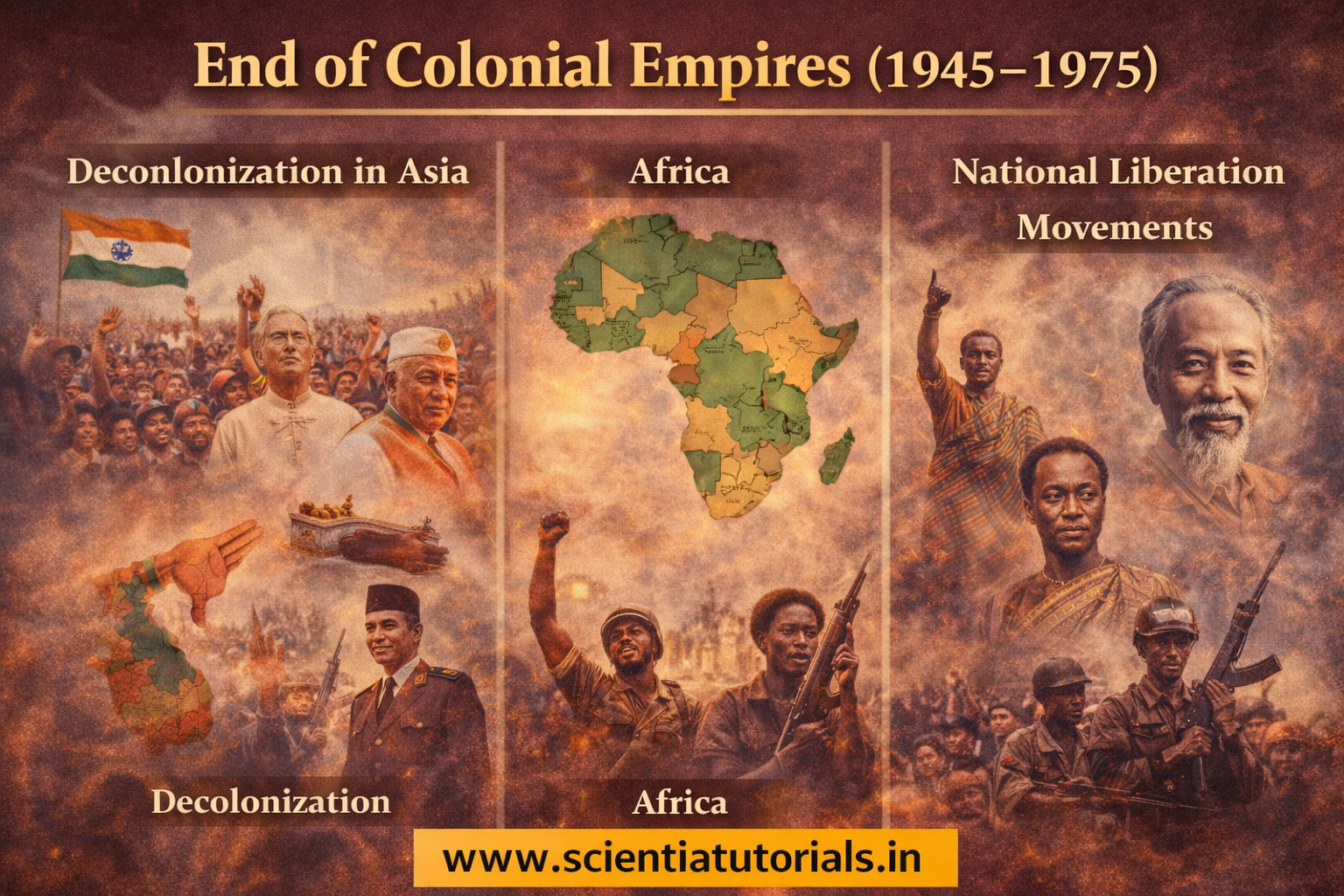
End of Colonial Empires (1945–1975) | Decolonization in Asia and Africa
Course: World History: From Early Civilizations to the Contemporary Global System
Module VII: Decolonization and the Modern Global Order
Lesson 1: End of Colonial Empires (c. 1945–1975 CE)
This lesson is systematically organized into four clearly structured sections, as detailed below:
- Chronologically Structured Study Module
- Short-Answer Type Questions
- Long-Answer Type Questions
- Multiple-Choice Questions (MCQs) with Answers and Detailed Explanations
Chronologically Structured Study Module
Module Introduction
The period following the Second World War witnessed one of the most profound transformations in world history—the collapse of European colonial empires and the emergence of newly independent nations across Asia and Africa. Between 1945 and 1975, dozens of colonies gained independence, fundamentally reshaping the global political, economic, and ideological landscape.
Decolonization was not a uniform or peaceful process. While some regions achieved independence through negotiation and constitutional reform, others experienced prolonged armed struggles marked by violence, repression, and mass mobilization. These movements were deeply connected to national liberation ideologies, Cold War geopolitics, and changing international norms about sovereignty and self-determination.
This lesson provides a chronologically structured and examination-oriented analysis of the end of colonial empires, focusing on Asia and Africa, the nature of national liberation movements, and the consequences of decolonization for the modern global order.
Lesson Objectives
By the end of this lesson, learners will be able to:
- Explain why European colonial empires declined after 1945
- Trace the chronological phases of decolonization in Asia and Africa
- Analyze the role of nationalism and liberation movements
- Compare peaceful and violent paths to independence
- Assess the impact of decolonization on global politics
- Evaluate the challenges faced by newly independent states
Chronological Framework: c. 1945 – 1975 CE
- 1945–1950 – Early decolonization in Asia
- 1950–1960 – Expansion of nationalist movements
- 1960 – “Year of Africa”
- 1960–1975 – Violent liberation struggles and late decolonization
I. Background: The Crisis of Colonialism after 1945
1. Impact of the Second World War
The Second World War weakened European colonial powers economically, militarily, and politically. Britain, France, the Netherlands, and others emerged from the war exhausted and heavily indebted. Their ability to maintain overseas empires was severely reduced.
Colonial soldiers from Asia and Africa had fought in large numbers during the war. Their participation:
- Raised political consciousness
- Exposed contradictions between colonial rule and democratic ideals
- Strengthened demands for self-rule
2. Rise of Anti-Colonial Nationalism
Nationalism became the driving force behind decolonization. Educated elites, workers, peasants, and veterans mobilized around the idea of nationhood, political freedom, and economic justice.
Key influences included:
- Enlightenment ideals
- American and French revolutionary principles
- Anti-imperialist ideologies
3. International Context
The post-war international climate favored decolonization:
- The United Nations promoted self-determination
- The United States opposed old-style imperialism
- The Soviet Union supported anti-colonial movements ideologically
II. Decolonization in Asia (1945–1955)
1. India: Peaceful Mass Nationalism
The most significant Asian decolonization occurred in India. Under the leadership of Mahatma Gandhi and Jawaharlal Nehru, the Indian National Movement employed mass mobilization, non-violent resistance, and political negotiation.
In 1947, British India was granted independence but was partitioned into India and Pakistan, leading to:
- Communal violence
- Massive refugee movements
- Long-term regional tensions
2. Southeast Asia
Indonesia
Indonesia declared independence from Dutch rule in 1945 under Sukarno. After four years of armed struggle and international pressure, the Netherlands recognized Indonesian independence in 1949.
Vietnam
In French Indochina, nationalist and communist forces led by Ho Chi Minh fought French colonial rule. The defeat of France in 1954 ended colonial control and divided Vietnam, setting the stage for future conflict.
3. Significance of Asian Decolonization
Asian independence:
- Inspired African nationalist movements
- Demonstrated that colonial rule could be challenged successfully
- Shifted global power relations
III. Decolonization in Africa (1950–1975)
1. Early African Nationalism
African nationalism emerged through:
- Trade unions
- Political parties
- Pan-African movements
Educated elites demanded representation, civil rights, and independence.
2. The “Year of Africa” (1960)
In 1960, seventeen African nations gained independence, mainly from France and Britain. This rapid transition marked the collapse of European dominance in Africa.
Countries such as Ghana, Nigeria, Senegal, and Congo became sovereign states.
3. Violent Liberation Struggles
Not all decolonization was peaceful.
Algeria
The Algerian War of Independence (1954–1962) against French rule was one of the bloodiest anti-colonial conflicts. After years of guerrilla warfare and repression, Algeria gained independence in 1962.
Southern Africa
Portuguese colonies such as Angola and Mozambique fought long wars before gaining independence in 1975. White minority regimes delayed independence in Zimbabwe, Namibia, and South Africa.
IV. National Liberation Movements
1. Ideology and Leadership
National liberation movements combined:
- Nationalism
- Anti-imperialism
- Social reform
Leaders emphasized unity, cultural revival, and political sovereignty.
2. Methods of Struggle
Liberation movements used diverse methods:
- Non-violent resistance (India)
- Guerrilla warfare (Algeria, Vietnam)
- Diplomatic pressure
The chosen path often depended on colonial policies and political conditions.
3. Role of Mass Mobilization
Mass participation was crucial:
- Peasants and workers joined movements
- Women played active roles
- Youth organizations spread nationalist ideas
V. Role of the Cold War in Decolonization
1. Superpower Involvement
Decolonization unfolded within Cold War rivalry:
- The U.S. supported decolonization selectively
- The Soviet Union backed revolutionary movements
- Newly independent states became arenas of influence
2. Non-Aligned Movement
Some leaders rejected alignment with either bloc. The Non-Aligned Movement (NAM) sought political independence and peaceful coexistence.
Prominent figures included Jawaharlal Nehru, Josip Broz Tito, and Gamal Abdel Nasser.
VI. Challenges Faced by Newly Independent Nations
1. Political Challenges
Post-colonial states struggled with:
- Weak institutions
- Ethnic and regional divisions
- Military coups and authoritarianism
2. Economic Problems
Colonial economies were export-oriented and dependent:
- Lack of industrial base
- Poverty and unemployment
- Continued reliance on former colonial powers
3. Social and Cultural Issues
Nation-building required:
- Integrating diverse populations
- Promoting education
- Addressing inequality
VII. Impact of Decolonization on the Global Order
1. Transformation of International Politics
Decolonization:
- Ended European imperial dominance
- Expanded UN membership
- Increased influence of the Global South
2. Redefinition of Sovereignty
The principle of self-determination became central to international relations, challenging imperialism and racial hierarchy.
3. Long-Term Global Significance
The modern global order—with its emphasis on nation-states, development, and international cooperation—emerged largely from decolonization.
VIII. Examination Perspective
For examinations, students should:
- Use chronological structure (1945–1975)
- Compare Asian and African experiences
- Distinguish peaceful vs violent decolonization
- Link nationalism with Cold War context
- Evaluate post-independence challenges
Conclusion
The end of colonial empires between 1945 and 1975 reshaped world history. Decolonization was driven by nationalist movements, global political change, and the decline of European power. While independence fulfilled long-standing aspirations for freedom and dignity, it also introduced new challenges of governance, development, and unity.
The legacy of decolonization continues to shape international relations, economic inequalities, and political struggles in the contemporary world. Understanding this process is essential for grasping the foundations of the modern global order.
Short Answer Type Questions: End of Colonial Empires
1. What is meant by decolonization?
Answer:
Decolonization refers to the process by which colonies gained political independence from European imperial powers after the Second World War.
2. Which period is generally associated with the end of colonial empires?
Answer:
Approximately from 1945 to 1975.
3. Name two continents most affected by decolonization after 1945.
Answer:
Asia and Africa.
4. How did the Second World War weaken colonial powers?
Answer:
It exhausted European economies, weakened military control, and undermined the legitimacy of imperial rule.
5. Why did colonial soldiers play an important role in decolonization?
Answer:
Their wartime service increased political awareness and strengthened demands for self-rule and equality.
6. What role did nationalism play in decolonization?
Answer:
Nationalism unified people against foreign rule and inspired mass movements for independence.
7. Which international organization promoted the principle of self-determination?
Answer:
The United Nations.
8. Why did the United States generally support decolonization?
Answer:
It opposed old European imperialism and promoted free trade and self-government.
9. Name one Asian country that gained independence peacefully.
Answer:
India.
10. Who was the leading figure of India’s non-violent freedom struggle?
Answer:
Mahatma Gandhi.
11. What major event accompanied Indian independence in 1947?
Answer:
The Partition of India into India and Pakistan.
12. Which Southeast Asian country gained independence from Dutch rule?
Answer:
Indonesia.
13. Who led the Indonesian struggle for independence?
Answer:
Sukarno.
14. Which country fought a long war against French colonial rule in Indochina?
Answer:
Vietnam.
15. Who was the main leader of the Vietnamese nationalist movement?
Answer:
Ho Chi Minh.
16. What is meant by the “Year of Africa”?
Answer:
The year 1960, when seventeen African nations gained independence.
17. Name one African country that achieved independence in 1960.
Answer:
Nigeria.
18. Which African country fought a violent war against French rule?
Answer:
Algeria.
19. What were national liberation movements?
Answer:
Organized political and military movements aimed at ending colonial rule and achieving independence.
20. Mention one method used by national liberation movements.
Answer:
Guerrilla warfare.
21. How did the Cold War influence decolonization?
Answer:
Superpowers supported liberation movements or new states to expand their ideological influence.
22. What was the Non-Aligned Movement?
Answer:
A group of newly independent countries that chose not to align with either Cold War power bloc.
23. Name one challenge faced by newly independent nations.
Answer:
Political instability.
24. Why were post-colonial economies often weak?
Answer:
They were dependent on exports of raw materials and lacked industrial development.
25. How did decolonization change the global order?
Answer:
It ended European imperial dominance and increased the political influence of Asia and Africa in world affairs.
Long Answer Type Questions: End of Colonial Empires (1945–1975)
1. Explain the concept of decolonization and its historical significance after 1945.
Answer:
Decolonization refers to the process by which colonies gained political independence from European imperial powers. After 1945, it marked the collapse of centuries-old colonial empires and the emergence of sovereign nation-states in Asia and Africa. This process transformed global politics by ending European dominance, expanding international participation, and reshaping ideas of sovereignty, equality, and self-determination.
2. Analyze the impact of the Second World War on the decline of colonial empires.
Answer:
The Second World War weakened colonial powers economically, militarily, and morally. European states lacked the resources to maintain empires, while wartime rhetoric of freedom and democracy exposed the contradictions of colonial rule. Colonized peoples, having contributed soldiers and labor, demanded political rights, accelerating the collapse of imperial control.
3. Examine the role of nationalism in the process of decolonization.
Answer:
Nationalism unified diverse social groups around the idea of political independence. Educated elites articulated nationalist ideologies, while mass movements mobilized workers, peasants, and veterans. Nationalism transformed resistance from isolated protests into organized national liberation movements demanding sovereign nation-states.
4. Discuss the role of international factors in promoting decolonization.
Answer:
The post-war international climate favored decolonization. The United Nations promoted self-determination, while both the United States and the Soviet Union opposed traditional colonialism for ideological and strategic reasons. Global opinion increasingly viewed imperialism as illegitimate.
5. Explain why Asia was the first region to experience large-scale decolonization.
Answer:
Asian colonies experienced early decolonization due to strong nationalist leadership, wartime disruptions of colonial control, and international support. Independence movements in India, Indonesia, and Vietnam demonstrated that European rule could be successfully challenged, inspiring later movements in Africa.
6. Examine India’s path to independence as an example of peaceful decolonization.
Answer:
India’s independence movement combined mass mobilization, non-violent resistance, and negotiation. Under Mahatma Gandhi and Jawaharlal Nehru, the movement pressured Britain politically and morally. Independence in 1947 ended colonial rule but was accompanied by partition and communal violence.
7. Analyze the consequences of the Partition of India.
Answer:
Partition created two new states—India and Pakistan—but caused massive displacement, communal violence, and loss of life. While it resolved some political demands, it generated long-term regional tensions and humanitarian crises, illustrating the complex consequences of decolonization.
8. Discuss the nature of decolonization in Southeast Asia.
Answer:
Decolonization in Southeast Asia was often violent. Indonesia fought Dutch attempts at recolonization before achieving independence in 1949. In Vietnam, armed struggle against French rule led to independence but also prolonged conflict. These cases show that colonial resistance varied according to imperial policies and local conditions.
9. Explain why decolonization in Africa occurred later than in Asia.
Answer:
African decolonization occurred later due to stronger European economic interests, settler populations, and weaker early nationalist organization. However, growing political awareness, international pressure, and Asian precedents accelerated African independence after 1950.
10. Analyze the significance of the “Year of Africa” (1960).
Answer:
In 1960, seventeen African states gained independence, signaling the rapid collapse of European colonial rule on the continent. This event dramatically increased African representation in global institutions and marked a decisive shift in world politics.
11. Examine the Algerian War of Independence as a case of violent decolonization.
Answer:
The Algerian struggle against French rule (1954–1962) involved guerrilla warfare, repression, and mass violence. It demonstrated the limits of colonial power and forced France to abandon its empire. Algeria’s independence became a symbol of militant anti-colonial resistance.
12. Compare peaceful and violent paths to independence in Asia and Africa.
Answer:
Peaceful decolonization, as in India and Ghana, relied on negotiation and mass protest. Violent decolonization, seen in Algeria and Vietnam, involved armed struggle due to colonial resistance. Both paths reflected differing colonial policies and nationalist strategies.
13. Discuss the role of national liberation movements in ending colonial rule.
Answer:
National liberation movements organized political parties, armed resistance, and mass mobilization. They articulated demands for sovereignty, mobilized popular support, and challenged imperial authority, making colonial governance increasingly unsustainable.
14. Examine the influence of the Cold War on decolonization.
Answer:
Cold War rivalry shaped decolonization as superpowers supported movements aligned with their ideologies. Newly independent states often became arenas of competition, complicating nation-building and sometimes leading to proxy conflicts.
15. Explain the emergence and aims of the Non-Aligned Movement.
Answer:
The Non-Aligned Movement emerged as newly independent states sought to avoid Cold War blocs. Leaders such as Jawaharlal Nehru, Josip Broz Tito, and Gamal Abdel Nasser promoted independence, peace, and cooperation among developing nations.
16. Analyze the political challenges faced by newly independent states.
Answer:
Post-colonial states faced weak institutions, ethnic divisions, lack of democratic traditions, and military intervention in politics. These challenges often led to instability, authoritarian rule, and internal conflict.
17. Discuss the economic problems inherited by post-colonial nations.
Answer:
Colonial economies were structured around raw material exports, leaving new states dependent and underdeveloped. Lack of industrial infrastructure, capital shortages, and unequal trade relations hindered economic growth.
18. Examine the social and cultural challenges of nation-building after independence.
Answer:
New states had to integrate diverse ethnic, linguistic, and religious groups into unified nations. Education, cultural identity, and social equality became central challenges in the post-colonial period.
19. Evaluate the impact of decolonization on international politics.
Answer:
Decolonization ended European imperial dominance, expanded UN membership, and increased the influence of Asia and Africa. It reshaped global diplomacy and highlighted issues of development and inequality.
20. Explain how decolonization redefined the concept of sovereignty.
Answer:
Decolonization emphasized self-determination as a fundamental right, redefining sovereignty as belonging to peoples rather than empires. This principle became central to modern international relations.
21. Assess the long-term global significance of the end of colonial empires.
Answer:
The end of colonialism transformed global power structures and laid the foundation for the modern nation-state system. However, economic dependency and political instability continue to shape post-colonial societies.
22. Conclude with an overall assessment of decolonization (1945–1975).
Answer:
Decolonization was a transformative but complex process. It fulfilled aspirations for freedom and dignity while introducing new challenges of governance and development. Its legacy continues to shape the modern global order, making it one of the most significant developments of twentieth-century history.
MCQs: End of Colonial Empires (1945–1975)
1. Decolonization refers to
A. Expansion of European empires
B. Process of colonies gaining independence
C. Economic globalization
D. Cultural assimilation
Correct Answer: B
Explanation:
Decolonization is the process through which colonies achieved political independence from imperial powers, mainly after 1945.
2. The main period of large-scale decolonization occurred between
A. 1918–1939
B. 1939–1945
C. 1945–1975
D. 1975–2000
Correct Answer: C
Explanation:
Most Asian and African colonies gained independence in the three decades following World War II.
3. Which two continents experienced the most extensive decolonization after 1945?
A. Europe and America
B. Asia and Africa
C. Africa and Latin America
D. Asia and Europe
Correct Answer: B
Explanation:
Asia and Africa witnessed the collapse of European colonial rule on a massive scale.
4. Which event significantly weakened European colonial powers?
A. Russian Revolution
B. Great Depression
C. Second World War
D. Cold War
Correct Answer: C
Explanation:
World War II exhausted European economies and military strength, undermining imperial control.
5. A major ideological force behind decolonization was
A. Fascism
B. Imperialism
C. Nationalism
D. Militarism
Correct Answer: C
Explanation:
Nationalism unified people against colonial rule and inspired independence movements.
6. Which international organization promoted the principle of self-determination?
A. League of Nations
B. NATO
C. European Union
D. United Nations
Correct Answer: D
Explanation:
The United Nations supported self-determination and opposed colonial domination.
7. Which Asian country gained independence through largely non-violent struggle?
A. Vietnam
B. Indonesia
C. India
D. China
Correct Answer: C
Explanation:
India’s independence movement relied heavily on non-violent mass resistance.
8. Who was the leading figure of India’s non-violent freedom movement?
A. Subhas Chandra Bose
B. Mahatma Gandhi
C. Jawaharlal Nehru
D. Muhammad Ali Jinnah
Correct Answer: B
Explanation:
Gandhi advocated non-violence and mass civil disobedience against colonial rule.
9. Indian independence in 1947 was accompanied by
A. Civil war
B. Military dictatorship
C. Partition
D. Economic collapse
Correct Answer: C
Explanation:
British India was divided into India and Pakistan, causing large-scale violence and migration.
10. Which Southeast Asian country fought the Dutch for independence?
A. Malaysia
B. Philippines
C. Indonesia
D. Thailand
Correct Answer: C
Explanation:
Indonesia fought Dutch attempts to reassert colonial control after 1945.
11. Who led the Indonesian independence movement?
A. Pol Pot
B. Ho Chi Minh
C. Sukarno
D. Aung San
Correct Answer: C
Explanation:
Sukarno played a central role in Indonesia’s struggle and became its first president.
12. Which country fought a prolonged war against French colonial rule in Indochina?
A. Cambodia
B. Laos
C. Vietnam
D. Thailand
Correct Answer: C
Explanation:
Vietnam’s armed struggle led to the defeat of French forces in 1954.
13. The year 1960 is known as the “Year of Africa” because
A. African Union was formed
B. Colonial rule ended completely
C. Seventeen African nations gained independence
D. Cold War ended in Africa
Correct Answer: C
Explanation:
In 1960, a large number of African colonies achieved independence, mainly from France and Britain.
14. Which African country fought a violent war against French rule?
A. Ghana
B. Kenya
C. Algeria
D. Nigeria
Correct Answer: C
Explanation:
The Algerian War of Independence (1954–1962) was one of the bloodiest anti-colonial conflicts.
15. National liberation movements aimed primarily to
A. Expand colonial trade
B. Achieve political independence
C. Promote European culture
D. Strengthen imperial rule
Correct Answer: B
Explanation:
Their main objective was ending foreign domination and achieving sovereignty.
16. Which method was commonly used in violent decolonization struggles?
A. Parliamentary debate
B. Guerrilla warfare
C. Economic sanctions
D. Diplomatic isolation
Correct Answer: B
Explanation:
Guerrilla warfare was widely used where colonial powers resisted peaceful transfer of power.
17. How did the Cold War influence decolonization?
A. It delayed independence everywhere
B. It had no effect
C. Superpowers supported liberation movements for influence
D. It strengthened colonial empires
Correct Answer: C
Explanation:
Both superpowers supported movements aligned with their ideological interests.
18. The Non-Aligned Movement was formed to
A. Support NATO
B. Support the Soviet bloc
C. Avoid alignment with either superpower bloc
D. Promote colonial cooperation
Correct Answer: C
Explanation:
Non-alignment sought political independence from Cold War rivalry.
19. Which leader was associated with the Non-Aligned Movement?
A. Winston Churchill
B. Charles de Gaulle
C. Jawaharlal Nehru
D. Margaret Thatcher
Correct Answer: C
Explanation:
Nehru was a key advocate of non-alignment among newly independent states.
20. One major political challenge faced by new nations was
A. Excessive industrialization
B. Weak political institutions
C. Too much foreign investment
D. Lack of population
Correct Answer: B
Explanation:
New states often lacked strong administrative and democratic institutions.
21. Post-colonial economies were often weak because
A. They had strong industries
B. They were export-oriented and dependent
C. They rejected trade
D. They lacked natural resources
Correct Answer: B
Explanation:
Colonial economies were designed to serve imperial needs, not balanced development.
22. Which social challenge affected many newly independent states?
A. Overpopulation only
B. Ethnic and cultural divisions
C. Lack of agriculture
D. Absence of labor force
Correct Answer: B
Explanation:
Colonial borders often grouped diverse communities, creating post-independence tensions.
23. Decolonization increased the importance of which global institution?
A. NATO
B. IMF
C. World Bank
D. United Nations
Correct Answer: D
Explanation:
Newly independent states joined the UN in large numbers, reshaping global politics.
24. Which statement best describes the impact of decolonization on world politics?
A. Strengthened European dominance
B. Reduced number of nation-states
C. Shifted power toward Asia and Africa
D. Ended international conflict
Correct Answer: C
Explanation:
Decolonization ended imperial dominance and increased the global role of former colonies.
25. Which conclusion best summarizes decolonization (1945–1975)?
A. Simple and peaceful process everywhere
B. Failed historical experiment
C. Transformative but complex global change
D. Limited to one continent
Correct Answer: C
Explanation:
Decolonization reshaped the modern world but involved both achievements and enduring challenges.