
Lesson 1: Greek City-States and Hellenistic World
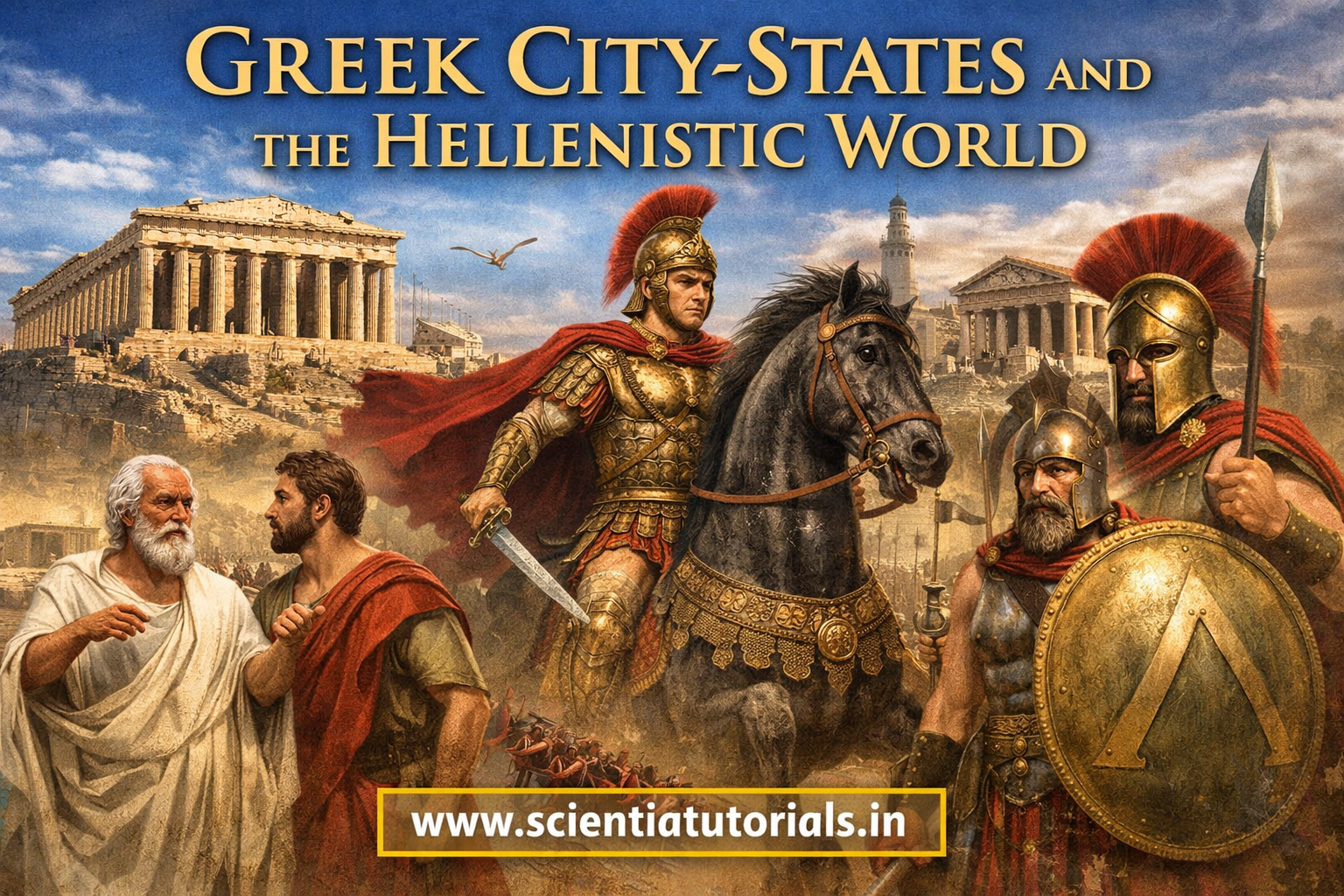
Greek City-States and the Hellenistic World | Athens, Sparta & Alexander the Great
Course: World History – From Early Civilizations to the Contemporary Global System
Module II: Classical Empires and Cultures
Lesson 1: Greek City-States and Hellenistic World
This lesson is systematically organized into four clearly structured sections, as detailed below:
- Chronologically Structured Study Module
- Short-Answer Type Questions
- Long-Answer Type Questions
- Multiple-Choice Questions (MCQs) with Answers and Detailed Explanations
Chronologically Structured Study Module
Module Introduction
The Classical Age marks a decisive phase in world history when human societies moved beyond early civilizations into more complex political, intellectual, and cultural systems. Module II: Classical Empires and Cultures focuses on this transformation by examining how classical societies developed enduring ideas of governance, citizenship, philosophy, warfare, science, and cultural expression. These ideas not only shaped their own regions but also profoundly influenced later civilizations across Europe, Asia, Africa, and the Mediterranean world.
Lesson 1: Greek City-States and the Hellenistic World explores the rise of ancient Greek civilization from fragmented city-states to a culturally unified Hellenistic world. Spanning the period from c. 800 BCE to 146 BCE, this lesson traces the political evolution of Greek poleis, the intellectual and artistic achievements of classical Greece, and the globalizing impact of Alexander’s conquests. The lesson is central to understanding how Western political thought, philosophy, art, and science were formed and transmitted across continents.
Lesson Objectives
By the end of this lesson, students should be able to:
- Understand the geographical and historical context of ancient Greece.
- Analyze the political systems of major Greek city-states, especially Athens and Sparta.
- Explain the development of democracy and citizenship in classical Athens.
- Assess Greek contributions to philosophy, art, science, and education.
- Trace the rise of Macedonia and the conquests of Alexander the Great.
- Evaluate the cultural synthesis and long-term significance of the Hellenistic world.
Chronological Framework
- c. 800–600 BCE: Formation of Greek city-states (Archaic Period)
- c. 500–323 BCE: Classical Greek Age
- 336–323 BCE: Reign of Alexander the Great
- 323–146 BCE: Hellenistic Period
- 146 BCE: Roman conquest of Greece
I. Geographical and Historical Background of Ancient Greece (c. 800 BCE)
Ancient Greece was located in southeastern Europe, consisting of the Balkan Peninsula, the Aegean islands, and the western coast of Asia Minor. Its mountainous terrain and fragmented geography prevented political unification and encouraged the development of independent city-states (poleis).
The collapse of Mycenaean civilization around 1200 BCE led to a period known as the Greek Dark Ages. By approximately 800 BCE, Greek society revived through renewed trade, population growth, and the adoption of the Phoenician alphabet. This revival laid the foundation for classical Greek civilization.
II. Rise of Greek City-States (Archaic Period, c. 800–500 BCE)
Nature of the Polis
The polis was the fundamental political unit of Greek civilization. It included:
- A central city
- Surrounding agricultural land
- A body of citizens with political rights
Citizenship was typically restricted to free, native-born adult males, excluding women, slaves, and foreigners.
Each polis developed its own laws, institutions, and customs, fostering a strong sense of local identity and political participation.
III. Athens: Birthplace of Democracy
Political Evolution of Athens
Athens emerged as the most influential polis in political experimentation.
- Early Reforms
- Draco (c. 621 BCE) introduced a written law code.
- Solon (c. 594 BCE) reformed debt laws and broadened political participation.
- Cleisthenes (c. 508 BCE)
- Reorganized citizens into new tribes.
- Established the foundations of direct democracy.
- Periclean Democracy (5th century BCE)
- Citizens participated directly in the Assembly.
- Public offices were often chosen by lot.
- State payment enabled poorer citizens to engage in politics.
Significance of Athenian Democracy
Athenian democracy emphasized civic participation, equality before law, and public debate. Though limited in inclusiveness, it established principles that later influenced Roman republicanism and modern democratic thought.
IV. Sparta: Militaristic Oligarchy
In contrast to Athens, Sparta developed a rigid, militaristic society.
Political and Social Structure
- Dual kingship
- Council of Elders (Gerousia)
- Assembly of citizens
- Five Ephors overseeing daily governance
Social Classes
- Spartiates: Full citizens and professional soldiers
- Perioikoi: Free non-citizens
- Helots: Enslaved agricultural laborers
Spartan society prioritized discipline, obedience, and military excellence. Education (agoge) trained boys from childhood for warfare.
Historical Role
Sparta played a crucial role in resisting Persian invasions and later dominated Greece after defeating Athens in the Peloponnesian War (431–404 BCE).
V. Greek Warfare and Inter-State Rivalries
Constant rivalry among city-states shaped Greek political history.
- Persian Wars (c. 490–479 BCE) united Greeks against external threat.
- Peloponnesian War weakened Greek unity and economy.
The decline of the major city-states created conditions for Macedonian intervention.
VI. Cultural and Intellectual Achievements of Classical Greece
Philosophy
Greek philosophy sought rational explanations for the universe and human existence.
- Socrates emphasized ethical inquiry.
- Plato explored ideal forms and political philosophy.
- Aristotle systematized logic, science, and ethics.
Their works became foundational texts in Western education.
Art and Architecture
Greek art emphasized realism, balance, and harmony.
- Temples like the Parthenon exemplified architectural perfection.
- Sculpture celebrated idealized human forms.
Science and Education
Greek thinkers advanced astronomy, medicine, and mathematics.
- Hippocrates established medical ethics.
- Pythagoras contributed to mathematics.
Education aimed at producing well-rounded citizens (paideia).
VII. Rise of Macedonia and Alexander the Great (4th century BCE)
Macedonian Ascendancy
Macedonia, under Philip II, unified Greece through military innovation and diplomacy.
Alexander the Great (336–323 BCE)
Alexander the Great inherited a strong kingdom and launched unprecedented conquests.
Major Campaigns
- Defeat of Persian Empire
- Conquests stretching from Greece to Egypt, Mesopotamia, Persia, and northwest India
Alexander aimed to create a universal empire based on cultural integration rather than mere domination.
VIII. The Hellenistic World (323–146 BCE)
Meaning of Hellenism
Hellenism refers to the spread of Greek culture blended with local traditions across Alexander’s empire.
Political Structure
After Alexander’s death, his empire fragmented into Hellenistic kingdoms ruled by his generals.
Cultural Synthesis
- Greek language (Koine Greek) became a common medium.
- Cities like Alexandria became centers of learning.
- Advances in science, medicine, astronomy, and engineering flourished.
Social and Economic Impact
Trade networks expanded, urban life intensified, and cultural exchange accelerated between East and West.
IX. Decline of Greek Independence and Roman Conquest (146 BCE)
Continuous warfare weakened the Hellenistic states. In 146 BCE, Greece fell under Roman control. However, Greek culture deeply influenced Roman education, philosophy, and art, ensuring its survival and transmission to later European civilizations.
X. Historical Significance and Legacy
The Greek city-states and the Hellenistic world contributed enduring concepts to world history:
- Democratic governance and citizenship
- Rational philosophy and scientific inquiry
- Artistic ideals of beauty and proportion
- Cultural globalization through Hellenism
These legacies form the intellectual foundation of Western civilization and remain relevant in modern political and cultural thought.
Conclusion
From the independent city-states of classical Greece to the cosmopolitan Hellenistic world, this period represents a transformative era in global history. The Greeks pioneered political participation, philosophical reasoning, artistic excellence, and scientific curiosity. Alexander’s conquests expanded these ideas across continents, creating a shared cultural heritage that shaped future civilizations.
Short Answer Type Questions with Answers
Course: World History – From Early Civilizations to the Contemporary Global System
Module II: Classical Empires and Cultures
Lesson 1: Greek City-States and the Hellenistic World (c. 800 BCE – 146 BCE)
1. What is meant by a Greek polis?
Answer: A polis was an independent Greek city-state consisting of a central city, surrounding countryside, and a body of citizens who participated in political life.
2. Why did geography encourage political fragmentation in ancient Greece?
Answer: Greece’s mountainous terrain and scattered islands hindered communication and unity, leading to the rise of independent city-states rather than a single kingdom.
3. Name two major Greek city-states and mention one distinguishing feature of each.
Answer: Athens was known for democracy, while Sparta was known for its militaristic society.
4. What reforms did Solon introduce in Athens?
Answer: Solon ended debt slavery, reorganized citizens into classes based on wealth, and broadened political participation beyond the aristocracy.
5. Who is considered the founder of Athenian democracy and why?
Answer: Cleisthenes is considered the founder of Athenian democracy because he reorganized political structures to give greater power to ordinary citizens.
6. What is meant by direct democracy in Athens?
Answer: Direct democracy meant that citizens participated personally in decision-making through the Assembly rather than electing representatives.
7. Who were excluded from citizenship in Athens?
Answer: Women, slaves, and foreigners (metics) were excluded from citizenship and political rights.
8. Describe the dual kingship system of Sparta.
Answer: Sparta had two kings who ruled simultaneously, primarily leading the army and performing religious duties.
9. Who were the Helots in Spartan society?
Answer: Helots were state-owned serfs who worked the land and supported the Spartan warrior class.
10. What was the agoge system?
Answer: The agoge was Sparta’s state-controlled education and military training system for boys, emphasizing discipline and combat skills.
11. What were the Persian Wars and why were they significant?
Answer: The Persian Wars were conflicts between Greek city-states and the Persian Empire; they were significant because Greek victory preserved Greek independence.
12. What was the Peloponnesian War?
Answer: It was a prolonged conflict between Athens and Sparta (431–404 BCE) that weakened the Greek city-states politically and economically.
13. Name one major consequence of constant warfare among Greek city-states.
Answer: Constant warfare weakened Greece and made it vulnerable to Macedonian conquest.
14. What role did philosophy play in Greek civilization?
Answer: Philosophy encouraged rational thinking, ethical inquiry, and the search for knowledge about nature, society, and human behavior.
15. Mention one contribution of Aristotle to world thought.
Answer: Aristotle systematized logic and laid foundations for scientific reasoning.
16. What were the main features of Greek art and architecture?
Answer: Greek art emphasized balance, proportion, realism, and idealized human forms, especially visible in sculpture and temples.
17. Who was Philip II of Macedonia and what was his achievement?
Answer: Philip II was the king of Macedonia who unified the Greek city-states under Macedonian leadership.
18. Who was Alexander the Great?
Answer: Alexander the Great was a Macedonian ruler who created one of the largest empires of the ancient world.
19. Name two regions conquered by Alexander the Great.
Answer: Persia and Egypt were among the major regions conquered by Alexander.
20. What is meant by Hellenism?
Answer: Hellenism refers to the spread and blending of Greek culture with local cultures across Alexander’s empire.
21. What language helped unify the Hellenistic world?
Answer: Koine Greek served as the common language of administration, trade, and culture.
22. Why was Alexandria an important Hellenistic city?
Answer: Alexandria was a major center of learning, science, and trade, famous for its library and scholars.
23. How did Hellenistic culture differ from classical Greek culture?
Answer: Hellenistic culture was more cosmopolitan, combining Greek ideas with Eastern traditions, unlike the polis-centered classical culture.
24. What happened to Greece in 146 BCE?
Answer: Greece was conquered by Rome and became part of the Roman Republic.
25. Mention one way Greek culture influenced Roman civilization.
Answer: Romans adopted Greek philosophy, art, education, and literary traditions.
26. Why is Athenian democracy historically significant despite its limitations?
Answer: It introduced principles of citizen participation and equality before law that influenced later democratic systems.
27. How did Greek philosophy influence later world civilizations?
Answer: Greek philosophy shaped Roman thought and later European intellectual traditions, influencing science, ethics, and political theory.
28. State one long-term legacy of the Hellenistic world.
Answer: The Hellenistic world facilitated cultural exchange between East and West, shaping the development of global civilization.
Long Answer Type Questions with Answers
Course: World History – From Early Civilizations to the Contemporary Global System
Module II: Classical Empires and Cultures
Lesson 1: Greek City-States and the Hellenistic World (c. 800 BCE – 146 BCE)
1. Explain the geographical factors that shaped the political structure of ancient Greece.
Answer:
The geography of ancient Greece was dominated by mountains, narrow valleys, and scattered islands. This rugged terrain hindered communication and large-scale political unification. As a result, Greece developed into numerous independent city-states or poleis rather than a centralized empire. The long coastline and proximity to the sea encouraged trade, colonization, and maritime activity, making the Greeks outward-looking and commercially active. Geography thus directly contributed to political fragmentation, local identities, and the growth of self-governing city-states.
2. Describe the concept of the polis and its importance in Greek civilization.
Answer:
The polis was the fundamental political and social unit of Greek civilization. It comprised a city, surrounding agricultural land, and a community of citizens. Beyond a physical space, the polis represented a shared political identity where citizens actively participated in governance, law-making, and defense. The polis fostered civic responsibility, loyalty, and public debate, laying the foundation for later political concepts such as citizenship and republican governance.
3. Trace the evolution of democracy in ancient Athens.
Answer:
Democracy in Athens evolved gradually. Early aristocratic rule gave way to reforms by Draco, who codified laws, and Solon, who reduced aristocratic privilege and expanded political participation. The decisive transformation came under Cleisthenes, who reorganized citizens into new tribes and introduced institutions that empowered the Assembly. By the 5th century BCE, especially under Pericles, Athens practiced direct democracy, where male citizens directly participated in governance. Though limited in scope, Athenian democracy became a lasting model for participatory government.
4. Examine the political institutions of Athens and assess their significance.
Answer:
Athens had several key institutions: the Assembly, the Council of 500, popular courts, and elected or randomly selected officials. The Assembly was the supreme decision-making body, while the Council prepared legislation. Courts ensured justice and accountability. These institutions institutionalized citizen participation and equality before law, making Athens a pioneering experiment in democratic governance whose principles influenced later political systems.
5. Analyze the social structure of Athenian society.
Answer:
Athenian society was divided into citizens, metics (foreign residents), women, and slaves. Only male citizens enjoyed political rights. Women managed households but lacked political status, while slaves formed a significant labor force. Despite its democratic ideals, Athenian society remained hierarchical and exclusionary, highlighting the limitations of ancient democracy.
6. Discuss the political and social organization of Sparta.
Answer:
Sparta was a militaristic oligarchy with a unique dual kingship, supported by the Gerousia (Council of Elders), Ephors, and an Assembly. Society was rigidly divided into Spartiates, Perioikoi, and Helots. The state emphasized military discipline, austerity, and obedience, subordinating individual freedom to collective security. This system produced an efficient warrior state but discouraged cultural and intellectual growth.
7. Compare and contrast Athens and Sparta.
Answer:
Athens valued democracy, education, art, and intellectual freedom, while Sparta prioritized military discipline, obedience, and social stability. Politically, Athens practiced direct democracy, whereas Sparta followed an oligarchic system. Socially and culturally, Athens was open and progressive, while Sparta was conservative and rigid. Together, they represent contrasting models of Greek civilization.
8. Evaluate the role of warfare in shaping Greek history.
Answer:
Warfare was central to Greek political life. Inter-city rivalries led to frequent conflicts, shaping alliances and power structures. The Persian Wars fostered unity and pride, while the Peloponnesian War devastated Greek city-states and weakened them. Constant warfare ultimately undermined Greek independence and paved the way for Macedonian domination.
9. Explain the causes and consequences of the Persian Wars.
Answer:
The Persian Wars arose from Persian expansion into the Greek world and Greek resistance to foreign domination. Greek victories preserved independence and strengthened cultural confidence. Athens emerged as a naval power, while Sparta gained military prestige. However, rivalry between these powers intensified, leading to later internal conflicts.
10. Analyze the Peloponnesian War and its impact on Greece.
Answer:
The Peloponnesian War (431–404 BCE) was fought between Athens and Sparta for dominance. It drained resources, weakened political institutions, and destabilized Greek society. Sparta’s victory did not restore stability, and Greece emerged fragmented and vulnerable to external conquest.
11. Discuss the major achievements of Greek philosophy.
Answer:
Greek philosophy emphasized rational inquiry and critical thinking. Philosophers explored ethics, politics, metaphysics, and science. Their emphasis on reason over myth transformed intellectual life and established traditions that shaped Roman thought and modern Western philosophy.
12. Examine the contributions of Socrates, Plato, and Aristotle.
Answer:
Socrates promoted ethical inquiry through questioning. Plato explored ideal forms and political philosophy, envisioning a just state. Aristotle systematized logic, science, and ethics, influencing education and scientific thought for centuries.
13. Assess the significance of Greek art and architecture.
Answer:
Greek art emphasized realism, balance, and proportion, reflecting ideals of beauty and harmony. Architecture, especially temple design, showcased mathematical precision and aesthetic perfection. These artistic standards became models for Roman and later European art.
14. Describe the educational ideals of classical Greece.
Answer:
Greek education aimed at developing well-rounded citizens through physical training, music, philosophy, and rhetoric. This concept of paideia influenced later educational systems by emphasizing intellectual and moral development.
15. Explain the rise of Macedonia under Philip II.
Answer:
Philip II strengthened Macedonia through military reforms, diplomacy, and strategic alliances. By unifying Greece under Macedonian leadership, he ended the independence of the city-states and prepared the ground for Alexander’s conquests.
16. Examine the life and achievements of Alexander the Great.
Answer:
Alexander inherited a strong Macedonian state and launched campaigns that destroyed the Persian Empire. His conquests extended from Greece to India, creating one of the largest empires in history. He promoted cultural integration and founded cities that became centers of learning.
17. Discuss Alexander’s policy of cultural integration.
Answer:
Alexander encouraged intermarriage, adopted local customs, and employed non-Greeks in administration. His policies aimed to unify diverse peoples under a shared cultural framework, laying the foundation for the Hellenistic world.
18. Define the Hellenistic Age and its chronological limits.
Answer:
The Hellenistic Age (323–146 BCE) began after Alexander’s death and ended with Roman conquest of Greece. It was marked by the spread of Greek culture across the eastern Mediterranean and Asia.
19. Analyze the political structure of the Hellenistic kingdoms.
Answer:
Alexander’s empire fragmented into kingdoms ruled by his generals. These monarchies combined Greek administrative practices with local traditions, creating centralized but culturally diverse states.
20. Evaluate the cultural features of the Hellenistic world.
Answer:
Hellenistic culture blended Greek and Eastern traditions. Koine Greek became the common language, cities flourished as cultural centers, and advances were made in science, medicine, and philosophy.
21. Discuss the role of Alexandria in the Hellenistic Age.
Answer:
Alexandria became a major intellectual hub, housing scholars, libraries, and scientific institutions. It symbolized the cosmopolitan character of the Hellenistic world.
22. Compare classical Greek culture with Hellenistic culture.
Answer:
Classical culture was centered on the polis and civic participation, while Hellenistic culture was cosmopolitan and empire-oriented. The latter emphasized cultural exchange and individual achievement.
23. Explain how Greek culture influenced Roman civilization.
Answer:
Romans adopted Greek philosophy, art, education, and religion. Greek tutors educated Roman elites, ensuring the transmission of Greek intellectual traditions.
24. Describe the circumstances leading to Roman conquest of Greece.
Answer:
Internal conflicts and weakened Hellenistic kingdoms allowed Rome to intervene in Greek affairs. In 146 BCE, Greece was conquered and incorporated into the Roman Republic.
25. Assess the long-term legacy of Greek democracy.
Answer:
Greek democracy introduced ideas of citizenship, political participation, and rule of law. Despite its limitations, it influenced Roman republicanism and modern democratic systems.
26. Evaluate the global historical significance of the Hellenistic world.
Answer:
The Hellenistic world facilitated cultural globalization, spreading Greek ideas across continents. It connected East and West, influencing later civilizations and shaping the foundations of global history.
Multiple Choice Questions (MCQs) with Answers and Explanations
Course: World History – From Early Civilizations to the Contemporary Global System
Module II: Classical Empires and Cultures
Lesson 1: Greek City-States and the Hellenistic World (c. 800 BCE – 146 BCE)
1. The fundamental political unit of ancient Greek civilization was the:
A. Empire
B. Kingdom
C. Polis
D. Confederation
Correct Answer: C. Polis
Explanation:
The polis, or city-state, was the core political and social unit of ancient Greece. Each polis functioned as an independent state with its own government, laws, and identity, unlike empires or kingdoms with centralized authority.
2. Which geographical feature most contributed to political fragmentation in ancient Greece?
A. Vast deserts
B. Mountainous terrain
C. Dense forests
D. River valleys
Correct Answer: B. Mountainous terrain
Explanation:
Greece’s rugged mountains and narrow valleys isolated communities, making centralized rule difficult. This led to the emergence of numerous independent city-states rather than a unified empire.
3. Which Greek city-state is most closely associated with the development of democracy?
A. Corinth
B. Thebes
C. Athens
D. Sparta
Correct Answer: C. Athens
Explanation:
Athens developed a system of direct democracy in which male citizens participated directly in governance through the Assembly, making it historically significant in political thought.
4. Athenian democracy is best described as:
A. Representative democracy
B. Direct democracy
C. Oligarchy
D. Monarchy
Correct Answer: B. Direct democracy
Explanation:
In Athens, citizens voted directly on laws and policies rather than electing representatives, which defines a direct democratic system.
5. Which group was excluded from citizenship in Athens?
A. Adult male citizens
B. Landowners
C. Women and slaves
D. Council members
Correct Answer: C. Women and slaves
Explanation:
Athenian democracy was limited in scope. Women, slaves, and foreigners (metics) were denied political rights, highlighting the exclusivity of ancient democracy.
6. The Spartan political system can best be described as a:
A. Democracy
B. Tyranny
C. Oligarchy
D. Republic
Correct Answer: C. Oligarchy
Explanation:
Sparta was governed by a small group of elites, including kings, elders, and ephors, rather than by the entire citizen body.
7. The Helots in Spartan society were:
A. Merchant traders
B. Foreign allies
C. Enslaved agricultural laborers
D. Military officers
Correct Answer: C. Enslaved agricultural laborers
Explanation:
Helots were state-owned serfs who farmed the land and supported the Spartan military class, forming the economic backbone of Spartan society.
8. The agoge system in Sparta was related to:
A. Trade regulation
B. Religious training
C. Military education
D. Political administration
Correct Answer: C. Military education
Explanation:
The agoge was a rigorous state-controlled education system designed to train Spartan boys for military life, emphasizing discipline and endurance.
9. The Persian Wars were significant because they:
A. Ended Greek culture
B. Unified Greece permanently
C. Preserved Greek independence
D. Established Roman rule
Correct Answer: C. Preserved Greek independence
Explanation:
Greek victory over Persia ensured the survival of Greek political and cultural traditions, allowing classical Greek civilization to flourish.
10. The Peloponnesian War was fought mainly between:
A. Athens and Persia
B. Sparta and Persia
C. Athens and Sparta
D. Macedonia and Greece
Correct Answer: C. Athens and Sparta
Explanation:
The Peloponnesian War (431–404 BCE) was a prolonged conflict between Athens and Sparta for dominance in Greece.
11. One major consequence of the Peloponnesian War was:
A. Greek unification
B. Strengthening of democracy
C. Weakening of Greek city-states
D. Expansion of trade routes
Correct Answer: C. Weakening of Greek city-states
Explanation:
The war exhausted Greek resources and destabilized political institutions, making Greece vulnerable to external conquest.
12. Greek philosophy is best characterized by its emphasis on:
A. Myth and legend
B. Divine revelation
C. Rational inquiry
D. Military strategy
Correct Answer: C. Rational inquiry
Explanation:
Greek philosophers sought logical and reasoned explanations for nature, ethics, and society, marking a shift from mythological thinking.
13. Which philosopher laid the foundations of logic and scientific reasoning?
A. Socrates
B. Plato
C. Aristotle
D. Pythagoras
Correct Answer: C. Aristotle
Explanation:
Aristotle systematized logic and classified knowledge, influencing science, philosophy, and education for centuries.
14. Greek art is best known for its emphasis on:
A. Abstract symbolism
B. Religious ritual
C. Balance and proportion
D. Monumental size
Correct Answer: C. Balance and proportion
Explanation:
Greek art aimed to represent ideal beauty through harmony, symmetry, and realistic human forms.
15. The concept of paideia in Greek society referred to:
A. Military conquest
B. Religious worship
C. Holistic education
D. Trade organization
Correct Answer: C. Holistic education
Explanation:
Paideia emphasized the overall development of individuals through physical, intellectual, and moral education.
16. Macedonia rose to prominence under the leadership of:
A. Pericles
B. Philip II
C. Darius I
D. Xerxes
Correct Answer: B. Philip II
Explanation:
Philip II strengthened Macedonia through military reforms and unified Greece, paving the way for Alexander’s conquests.
17. Alexander the Great is best remembered for:
A. Establishing democracy
B. Writing philosophical texts
C. Creating a vast empire
D. Defeating Rome
Correct Answer: C. Creating a vast empire
Explanation:
Alexander conquered territories from Greece to India, creating one of the largest empires of the ancient world.
18. Which empire did Alexander the Great overthrow?
A. Roman Empire
B. Egyptian Empire
C. Persian Empire
D. Mauryan Empire
Correct Answer: C. Persian Empire
Explanation:
Alexander’s defeat of the Persian Empire marked the end of Persian dominance in the eastern Mediterranean and West Asia.
19. The term “Hellenism” refers to:
A. Greek religion only
B. Spread of Greek culture alone
C. Fusion of Greek and local cultures
D. Decline of Greek civilization
Correct Answer: C. Fusion of Greek and local cultures
Explanation:
Hellenism describes the blending of Greek culture with Eastern traditions across Alexander’s former empire.
20. Which language became the common medium of the Hellenistic world?
A. Latin
B. Classical Greek
C. Koine Greek
D. Aramaic
Correct Answer: C. Koine Greek
Explanation:
Koine Greek served as a common language for administration, trade, and culture across Hellenistic kingdoms.
21. The Hellenistic Age began after the:
A. Persian Wars
B. Peloponnesian War
C. Death of Alexander
D. Roman conquest of Greece
Correct Answer: C. Death of Alexander
Explanation:
The Hellenistic Age started in 323 BCE following Alexander’s death, when his empire fragmented into successor kingdoms.
22. Hellenistic culture differed from classical Greek culture because it was:
A. Rural and isolated
B. Centered on the polis
C. Cosmopolitan and global
D. Militaristic only
Correct Answer: C. Cosmopolitan and global
Explanation:
Hellenistic culture extended beyond city-states, blending Greek and non-Greek traditions across vast territories.
23. Alexandria became famous in the Hellenistic world mainly for its:
A. Military strength
B. Democratic institutions
C. Centers of learning
D. Agricultural production
Correct Answer: C. Centers of learning
Explanation:
Alexandria emerged as a major intellectual hub, known for scholars, libraries, and scientific research.
24. Greece finally lost its political independence in:
A. 323 BCE
B. 300 BCE
C. 200 BCE
D. 146 BCE
Correct Answer: D. 146 BCE
Explanation:
In 146 BCE, Greece was conquered by Rome, marking the end of Greek political independence.
25. One major long-term contribution of Greek civilization to world history is:
A. Absolute monarchy
B. Democratic ideals and rational thought
C. Feudal institutions
D. Industrial technology
Correct Answer: B. Democratic ideals and rational thought
Explanation:
Greek ideas of democracy, philosophy, science, and art deeply influenced Roman civilization and later Western and global history.