
Lesson 1: Prehistoric Societies and the Neolithic Revolution
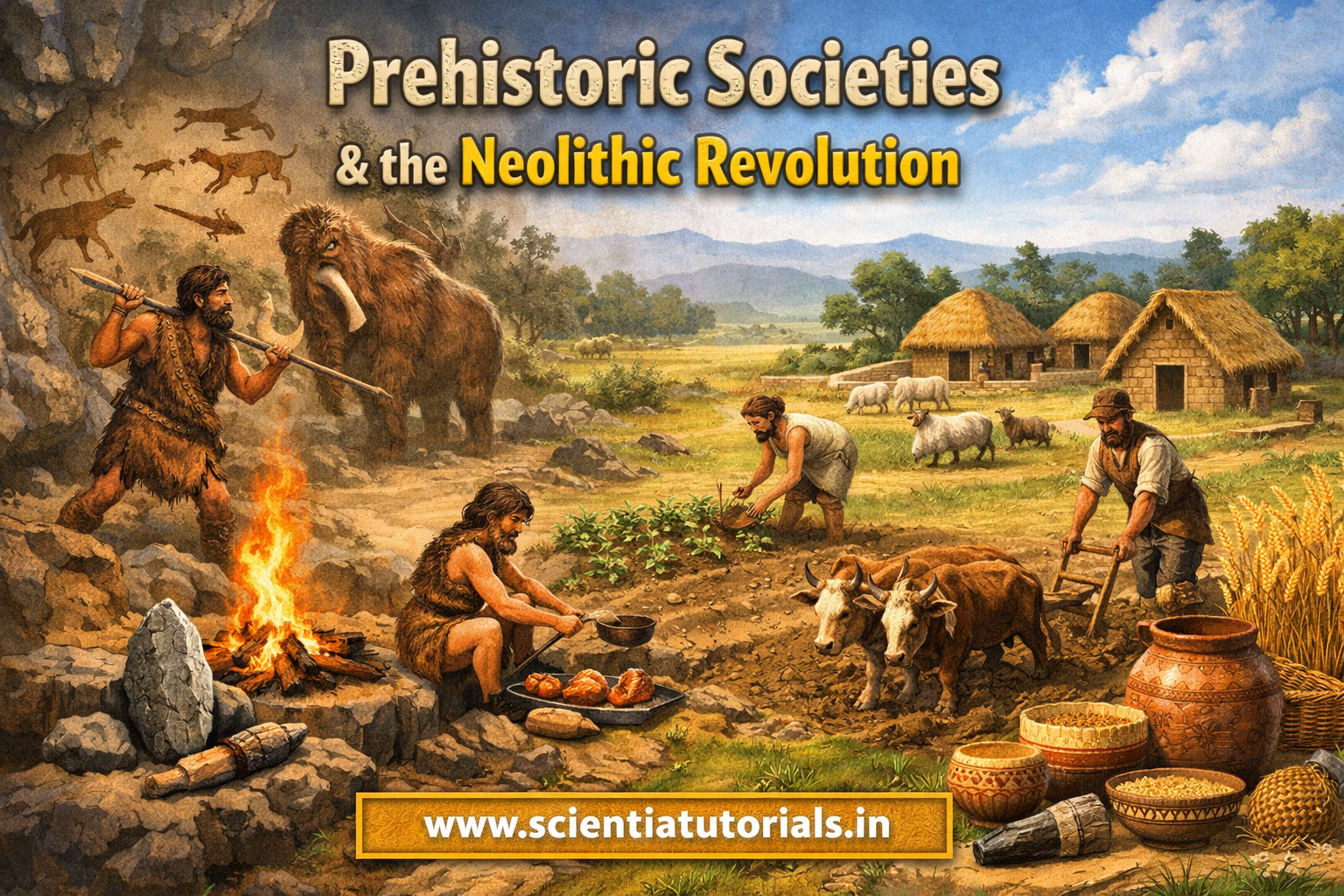
Prehistoric Societies and the Neolithic Revolution | World History Study Module
Module I: Dawn of Ancient Civilizations
Lesson 1: Prehistoric Societies and the Neolithic Revolution
Timeline: c. 2.5 million BCE – 3000 BCE
This lesson is systematically organized into four clearly structured sections, as detailed below:
- Chronologically Structured Study Module
- Short-Answer Type Questions
- Long-Answer Type Questions
- Multiple-Choice Questions (MCQs) with Answers and Detailed Explanations
Chronologically Structured Study Module
Introduction
The study of prehistoric societies marks the beginning of world history and provides the essential foundation for understanding the emergence of civilizations. Prehistory refers to the long period of human existence before the invention of writing, during which early humans gradually developed tools, social organization, cultural practices, and economic systems. This lesson examines the Paleolithic, Mesolithic, and Neolithic phases of prehistory, culminating in the Neolithic Revolution, one of the most significant turning points in human history.
From a hunter-gatherer mode of subsistence to the adoption of agriculture and settled life, prehistoric developments shaped the economic, social, and cultural patterns that later civilizations would inherit. This lesson is particularly important for competitive examinations as it explains long-term historical processes, continuity and change, and cause-and-effect relationships in early human history.
Understanding Prehistory and Its Sources
Prehistory is reconstructed primarily through archaeological evidence rather than written records. The major sources include:
- Stone tools and implements
- Cave paintings and rock art
- Fossils and skeletal remains
- Burial sites and habitation remains
These sources allow historians and archaeologists to understand human adaptation, technological progress, and social evolution over millions of years.
Paleolithic Age: The Old Stone Age
Chronological Framework
c. 2.5 million BCE – 10,000 BCE
The Paleolithic Age represents the longest phase of human history, accounting for over 95% of humanity’s existence. It is characterized by the use of crude stone tools, a nomadic lifestyle, and complete dependence on nature.
Key Features of Paleolithic Life
Subsistence and Economy
- Humans survived as hunter-gatherers
- Food sources included wild animals, fruits, roots, nuts, and berries
- No food production; complete reliance on natural availability
Tools and Technology
- Simple stone tools such as hand axes, choppers, and scrapers
- Gradual improvement in tool-making techniques
- Discovery and controlled use of fire, a major technological breakthrough
Social Organization
- Lived in small kin-based groups
- Cooperative hunting and food sharing
- Egalitarian social structure with minimal hierarchy
Culture and Beliefs
- Cave paintings depicting animals and hunting scenes
- Early forms of symbolic expression
- Possible belief in spirits and nature worship
Historical Significance
The Paleolithic Age laid the biological and cultural foundations of humanity, including language development, social cooperation, and adaptive intelligence.
Mesolithic Age: The Transitional Phase
Chronological Framework
c. 10,000 BCE – 8000 BCE
(Dates vary by region)
The Mesolithic Age serves as a transitional stage between hunting-gathering societies and agricultural communities.
Key Features of Mesolithic Life
Economic Activities
- Continued hunting and gathering
- Increasing reliance on fishing and coastal resources
- Early domestication of animals in some regions
Technological Developments
- Use of microliths (small, sharp stone tools)
- Development of bows and arrows
- Improved tools for fishing and food processing
Settlement Patterns
- Semi-nomadic lifestyle
- Seasonal settlements near water sources
- Early experimentation with plant cultivation
Historical Importance
The Mesolithic Age demonstrates human adaptability to post-Ice Age environments and shows the gradual shift towards food production.
Neolithic Age: The New Stone Age
Chronological Framework
c. 8000 BCE – 3000 BCE
The Neolithic Age marks a revolutionary transformation in human history, known as the Neolithic Revolution.
The Neolithic Revolution
Meaning and Nature
The Neolithic Revolution refers to the transition from food gathering to food production, particularly the domestication of plants and animals. This change was not sudden but occurred gradually across different regions.
Causes of the Neolithic Revolution
- Climatic changes after the Ice Age
- Population pressure
- Accumulated knowledge of plants and animals
- Need for stable food supply
Agriculture and Domestication
Agricultural Practices
- Cultivation of cereals such as wheat and barley
- Development of farming tools like sickles and hoes
- Seasonal agricultural cycles
Domestication of Animals
- Sheep, goats, cattle, and pigs
- Animals used for food, labor, and secondary products
Impact on Human Life
- Regular food surplus
- Reduced dependence on hunting
- Support for larger populations
Transition from Nomadic to Settled Life
One of the most significant consequences of the Neolithic Revolution was the shift from nomadic life to permanent settlements.
Emergence of Villages
- Construction of houses using mud, wood, and stone
- Development of storage facilities
- Organized community living
Social Changes
- Emergence of private property
- Social differentiation and inequality
- Division of labor based on age, gender, and skill
Technological and Cultural Advancements
Tools and Crafts
- Polished stone tools
- Pottery making for storage and cooking
- Weaving and textile production
Religious and Cultural Life
- Worship of fertility deities
- Burial practices indicating belief in afterlife
- Artistic expression through pottery and figurines
Economic and Social Consequences
The Neolithic Revolution led to:
- Surplus production and trade
- Specialization of occupations
- Growth of leadership and authority
- Foundations of political organization
These developments directly contributed to the rise of early civilizations in river valleys.
Comparative Perspective
| Aspect | Paleolithic | Mesolithic | Neolithic |
|---|---|---|---|
| Economy | Hunting-gathering | Mixed subsistence | Agriculture |
| Lifestyle | Nomadic | Semi-nomadic | Settled |
| Tools | Crude stone tools | Microliths | Polished stone tools |
| Society | Egalitarian | Transitional | Stratified |
Long-Term Historical Significance
The Neolithic Revolution is considered a turning point in world history because it:
- Enabled population growth
- Led to permanent settlements
- Laid the foundation for cities, states, and civilizations
- Initiated complex social, economic, and political systems
Without this transformation, ancient civilizations would not have emerged.
Examination-Oriented Key Points
- Prehistory precedes written records
- Paleolithic life was nomadic and dependent on nature
- Mesolithic phase acted as a bridge between hunting and farming
- Neolithic Revolution introduced agriculture and settlement
- Food surplus led to social complexity and inequality
- Neolithic developments laid the foundation of civilization
Conclusion
The study of Prehistoric Societies and the Neolithic Revolution provides a critical understanding of how humanity transitioned from simple survival strategies to complex social organization. This lesson explains the origins of agriculture, settlement, technology, and culture, making it fundamental to the study of world history. By examining long-term processes and transformations, students gain insight into the roots of civilization and the historical forces that shaped the human journey.
This lesson forms the conceptual base for subsequent modules on ancient civilizations, empires, and global history.
Short Answer Type Questions with Answers
Lesson: Prehistoric Societies and the Neolithic Revolution
Timeline: c. 2.5 million BCE – 3000 BCE
1. What is meant by Prehistory?
Answer:
Prehistory refers to the long period of human history before the invention of writing, reconstructed mainly through archaeological evidence such as tools, fossils, and cave art.
2. Why are prehistoric societies important in world history?
Answer:
Prehistoric societies laid the biological, cultural, and technological foundations of human civilization, including tool-making, social cooperation, and subsistence patterns.
3. What are the main sources for studying prehistoric societies?
Answer:
Archaeological sources such as stone tools, fossils, cave paintings, burial sites, and habitation remains are the main sources for studying prehistory.
4. What is the Paleolithic Age?
Answer:
The Paleolithic Age, or Old Stone Age, is the earliest phase of human history characterized by hunting-gathering, nomadic life, and the use of crude stone tools.
5. What type of economy existed during the Paleolithic Age?
Answer:
The Paleolithic economy was based on hunting, fishing, and gathering, with complete dependence on natural food resources.
6. Mention two important technological achievements of Paleolithic humans.
Answer:
The controlled use of fire and the development of stone tools such as hand axes and scrapers were key technological achievements.
7. Describe the social structure of Paleolithic societies.
Answer:
Paleolithic societies were small, kin-based, and largely egalitarian, with cooperation and food sharing as central features.
8. What role did fire play in Paleolithic life?
Answer:
Fire provided warmth, protection from animals, cooked food, and supported social interaction, greatly improving human survival.
9. What is meant by the Mesolithic Age?
Answer:
The Mesolithic Age is a transitional phase between the Paleolithic and Neolithic periods, marked by mixed subsistence and improved tools.
10. Why is the Mesolithic period considered a transitional phase?
Answer:
It shows the gradual shift from hunting-gathering to early agriculture and animal domestication, bridging nomadic and settled life.
11. What are microliths?
Answer:
Microliths are small, finely made stone tools used during the Mesolithic Age for hunting, fishing, and cutting purposes.
12. Define the Neolithic Age.
Answer:
The Neolithic Age, or New Stone Age, is characterized by the adoption of agriculture, domestication of animals, and settled village life.
13. What is the Neolithic Revolution?
Answer:
The Neolithic Revolution refers to the transition from food gathering to food production through agriculture and animal domestication.
14. Mention two causes of the Neolithic Revolution.
Answer:
Climatic changes after the Ice Age and population pressure were major causes of the Neolithic Revolution.
15. What crops were commonly cultivated during the Neolithic Age?
Answer:
Early Neolithic farmers cultivated crops such as wheat, barley, and millet.
16. Name two animals domesticated during the Neolithic period.
Answer:
Sheep and goats were among the earliest domesticated animals during the Neolithic Age.
17. How did agriculture lead to settled life?
Answer:
Agriculture required people to stay near cultivated fields, leading to permanent settlements and village communities.
18. What social changes resulted from the Neolithic Revolution?
Answer:
The Neolithic Revolution led to social differentiation, division of labor, and the emergence of property ownership.
19. How did surplus production affect Neolithic societies?
Answer:
Food surplus supported population growth, specialization of occupations, and the development of trade.
20. Mention two technological advancements of the Neolithic Age.
Answer:
Polished stone tools and pottery-making were significant technological advancements of the Neolithic period.
21. What religious beliefs emerged during the Neolithic Age?
Answer:
Fertility worship and beliefs related to nature and the afterlife became prominent during the Neolithic Age.
22. How did the Neolithic Revolution contribute to the rise of civilizations?
Answer:
It enabled permanent settlements, surplus food, and social complexity, which later led to the emergence of cities and states.
23. Distinguish between Paleolithic and Neolithic lifestyles.
Answer:
Paleolithic people were nomadic hunter-gatherers, while Neolithic people lived in settled communities and practiced agriculture.
24. Why is the Neolithic Revolution considered a turning point in world history?
Answer:
It fundamentally transformed human life by introducing agriculture, settlement, and complex social organization.
25. How does the study of prehistory help in understanding later civilizations?
Answer:
Prehistory explains the origins of agriculture, technology, and social institutions that formed the basis of ancient civilizations.
Long Answer Type Questions with Answers
Lesson: Prehistoric Societies and the Neolithic Revolution
Timeline: c. 2.5 million BCE – 3000 BCE
1. Explain the significance of Prehistory in the study of world history.
Answer:
Prehistory forms the foundation of world history as it covers the longest phase of human existence before the invention of writing. During this period, humans developed essential biological, cultural, and technological traits such as tool-making, social cooperation, language, and adaptation to the environment. The study of prehistory explains how early humans survived as hunter-gatherers and gradually transitioned to food production. These developments laid the groundwork for agriculture, settlement, social organization, and ultimately the rise of civilizations. Without understanding prehistory, the origins of later political, economic, and cultural systems cannot be fully explained.
2. Discuss the sources used for reconstructing prehistoric societies and their limitations.
Answer:
Prehistoric societies are reconstructed mainly through archaeological sources such as stone tools, fossils, cave paintings, burial sites, and habitation remains. These sources provide insight into early technology, subsistence patterns, social life, and belief systems. However, the absence of written records limits precise interpretation. Archaeological evidence often requires inference, making reconstructions tentative. Despite these limitations, material remains remain the most reliable means of understanding early human history.
3. Describe the main characteristics of Paleolithic life.
Answer:
Paleolithic life was characterized by a nomadic hunter-gatherer economy, simple stone tools, and close dependence on nature. Humans lived in small kin-based groups and followed animal herds and seasonal food availability. The use of fire improved survival, while cave art and symbolic behavior reflected early cultural expression. Social relations were largely egalitarian, with cooperation and sharing essential for survival.
4. Analyze the importance of fire in Paleolithic societies.
Answer:
Fire was one of the most significant discoveries of Paleolithic humans. It provided warmth, protection from predators, and the ability to cook food, improving nutrition and digestion. Fire also extended human activity into colder regions and nighttime, encouraged social interaction, and supported technological innovation. Its controlled use marked a major step in human evolution.
5. Explain the technological developments of the Paleolithic Age.
Answer:
Paleolithic technology evolved from simple stone tools to more refined implements such as hand axes, scrapers, and blades. These tools improved hunting efficiency and food processing. Over time, humans developed better tool-making techniques and learned to use fire. These innovations reflect growing intelligence and adaptability.
6. Why is the Mesolithic Age considered a transitional phase?
Answer:
The Mesolithic Age represents a bridge between the Paleolithic and Neolithic periods. While hunting and gathering continued, humans began experimenting with plant cultivation and animal domestication. The use of microliths and semi-permanent settlements indicates gradual adaptation toward a settled lifestyle, preparing the ground for agriculture.
7. Discuss the main features of Mesolithic subsistence and settlement patterns.
Answer:
Mesolithic societies practiced mixed subsistence, including hunting, fishing, and gathering. Seasonal settlements near rivers and coasts became common. Technological innovations such as bows, arrows, and fishing tools improved food security. These developments reflect increasing environmental adaptation.
8. Define the Neolithic Age and highlight its distinguishing features.
Answer:
The Neolithic Age is marked by the adoption of agriculture, domestication of animals, and settled village life. Humans used polished stone tools, produced pottery, and developed crafts. Food production replaced food gathering, leading to surplus and population growth.
9. What is the Neolithic Revolution? Examine its causes.
Answer:
The Neolithic Revolution refers to the transition from hunting-gathering to agriculture and animal domestication. Its causes include climatic changes after the Ice Age, population pressure, accumulated knowledge of plants and animals, and the need for a stable food supply. This transformation occurred independently in different regions.
10. Examine the role of agriculture in transforming human society.
Answer:
Agriculture ensured a regular food supply, enabling population growth and permanent settlements. It led to surplus production, division of labor, social differentiation, and trade. These changes formed the economic base of early civilizations.
11. Discuss the process and impact of animal domestication.
Answer:
Animal domestication provided meat, milk, labor, and raw materials. It supported agricultural productivity and transportation. Domesticated animals also played a role in social and economic life, strengthening human control over nature.
12. How did the transition from nomadic to settled life occur?
Answer:
Agriculture required people to remain near fields, leading to permanent settlements. Villages developed with houses, storage facilities, and community organization. This shift transformed social relations and economic activities.
13. Analyze the social consequences of the Neolithic Revolution.
Answer:
The Neolithic Revolution led to social stratification, emergence of leadership, private property, and gender-based division of labor. Inequality increased as surplus production allowed control over resources.
14. Examine technological advancements during the Neolithic Age.
Answer:
Neolithic technology included polished stone tools, pottery, weaving, and improved farming implements. These innovations enhanced efficiency, storage, and daily life, contributing to social complexity.
15. Discuss religious and cultural developments in Neolithic societies.
Answer:
Neolithic societies practiced fertility worship and nature-based beliefs. Burial practices indicate belief in the afterlife. Artifacts such as figurines and pottery reflect symbolic thinking and ritual life.
16. Compare Paleolithic and Neolithic economies.
Answer:
The Paleolithic economy was based on hunting-gathering and mobility, while the Neolithic economy relied on agriculture and surplus production. The latter supported permanent settlements and complex societies.
17. Explain how surplus production led to economic specialization.
Answer:
Food surplus allowed some individuals to engage in non-agricultural activities such as tool-making, pottery, and trade. This specialization increased productivity and social differentiation.
18. Evaluate the long-term historical significance of the Neolithic Revolution.
Answer:
The Neolithic Revolution laid the foundation for civilization by enabling settlement, surplus, social hierarchy, and political organization. It represents one of the most decisive turning points in world history.
19. Discuss the role of environment in shaping prehistoric human life.
Answer:
Environmental conditions influenced food availability, migration, and settlement patterns. Climatic changes encouraged agricultural experimentation and shaped regional variations in prehistoric development.
20. How does the study of prehistoric societies help in understanding the origins of civilization?
Answer:
Prehistoric societies explain the origins of agriculture, settlement, technology, and social institutions. These elements directly contributed to the rise of early civilizations in river valleys.
MCQs with Answers and Explanations
Lesson: Prehistoric Societies and the Neolithic Revolution
Timeline: c. 2.5 million BCE – 3000 BCE
1. Prehistory refers to the period of human history that
A. Began with the rise of agriculture
B. Started after the invention of writing
C. Preceded the invention of writing
D. Ended with the Bronze Age
Correct Answer: C
Explanation:
Prehistory covers the vast period before written records existed. Since writing had not yet developed, knowledge of this period is derived from archaeological evidence rather than texts.
2. Which of the following is the most important source for studying prehistoric societies?
A. Literary texts
B. Inscriptions
C. Archaeological remains
D. Coins
Correct Answer: C
Explanation:
Prehistoric societies left no written records; therefore, tools, fossils, cave paintings, and habitation remains uncovered by archaeology are the primary sources.
3. The Paleolithic Age is best characterized by
A. Permanent settlements and pottery
B. Domestication of plants and animals
C. Hunting-gathering and nomadic life
D. Use of metal tools
Correct Answer: C
Explanation:
Paleolithic humans depended on hunting, fishing, and gathering and moved frequently in search of food, making their lifestyle nomadic.
4. Which of the following was a major technological breakthrough of Paleolithic humans?
A. Invention of the wheel
B. Discovery of iron
C. Controlled use of fire
D. Development of pottery
Correct Answer: C
Explanation:
The controlled use of fire improved food quality, provided warmth and protection, and played a crucial role in human survival and social development.
5. Paleolithic societies were generally
A. Highly stratified
B. Egalitarian in nature
C. Organized into kingdoms
D. Dependent on agriculture
Correct Answer: B
Explanation:
Due to limited resources and shared survival activities, Paleolithic societies were largely egalitarian with minimal social hierarchy.
6. Cave paintings of Paleolithic humans mainly depict
A. Agricultural activities
B. Trade and commerce
C. Hunting scenes and animals
D. Religious ceremonies
Correct Answer: C
Explanation:
Cave paintings often show animals and hunting scenes, reflecting the importance of hunting in Paleolithic life and early symbolic expression.
7. The Mesolithic Age is considered transitional because it
A. Ended hunting and gathering completely
B. Introduced metal tools
C. Combined hunting with early farming practices
D. Witnessed the rise of cities
Correct Answer: C
Explanation:
The Mesolithic Age shows gradual changes such as early domestication and semi-permanent settlements, bridging Paleolithic and Neolithic lifestyles.
8. Microliths are associated with which prehistoric phase?
A. Paleolithic
B. Mesolithic
C. Neolithic
D. Chalcolithic
Correct Answer: B
Explanation:
Microliths are small, sharp stone tools characteristic of the Mesolithic Age and used for hunting and food processing.
9. The Neolithic Age is marked by
A. Nomadic hunting-gathering
B. Use of crude stone tools
C. Adoption of agriculture and settled life
D. Exclusive dependence on fishing
Correct Answer: C
Explanation:
The defining feature of the Neolithic Age is the shift to agriculture and animal domestication, leading to permanent settlements.
10. The term “Neolithic Revolution” refers to
A. Sudden invention of metal tools
B. Transition from food gathering to food production
C. Spread of industrial technology
D. Rise of early empires
Correct Answer: B
Explanation:
The Neolithic Revolution was a gradual transformation where humans began producing food through farming and domestication.
11. Which climatic factor contributed to the Neolithic Revolution?
A. Volcanic eruptions
B. End of the Ice Age
C. Increase in rainfall during monsoons
D. Desertification
Correct Answer: B
Explanation:
Post-Ice Age climatic stability created favorable conditions for agriculture and settlement.
12. Which of the following crops was among the earliest cultivated?
A. Rice
B. Wheat
C. Cotton
D. Sugarcane
Correct Answer: B
Explanation:
Wheat and barley were among the earliest domesticated crops in Neolithic farming communities.
13. Which animal was commonly domesticated during the Neolithic period?
A. Horse
B. Elephant
C. Sheep
D. Tiger
Correct Answer: C
Explanation:
Sheep were domesticated early for meat, wool, and other products.
14. One major consequence of agriculture was
A. Decline in population
B. Increased mobility
C. Food surplus
D. End of social organization
Correct Answer: C
Explanation:
Agriculture produced surplus food, enabling population growth and economic specialization.
15. Permanent settlements became possible primarily due to
A. Discovery of fire
B. Growth of trade
C. Agricultural practices
D. Religious beliefs
Correct Answer: C
Explanation:
Farming required people to remain near fields, leading to settled village life.
16. Neolithic pottery was mainly used for
A. Decoration only
B. Weapon making
C. Storage and cooking
D. Religious ceremonies exclusively
Correct Answer: C
Explanation:
Pottery helped store surplus food and cook meals, improving daily life.
17. Which social change is associated with the Neolithic Revolution?
A. Complete equality
B. Social stratification
C. Absence of leadership
D. Elimination of labor division
Correct Answer: B
Explanation:
Surplus production led to private property and social inequality.
18. Division of labor during the Neolithic Age resulted from
A. Nomadic lifestyle
B. Agricultural surplus
C. Climatic disasters
D. Decline in population
Correct Answer: B
Explanation:
Surplus food allowed individuals to specialize in non-agricultural tasks.
19. Which of the following best explains the term “food-producing economy”?
A. Gathering edible plants
B. Hunting wild animals
C. Cultivating crops and domesticating animals
D. Trading food items
Correct Answer: C
Explanation:
Food-producing economies rely on agriculture and domestication rather than gathering.
20. Neolithic religious practices often centered on
A. Warrior worship
B. Fertility and nature
C. Monotheism
D. Imperial authority
Correct Answer: B
Explanation:
Fertility worship reflected the importance of agriculture and reproduction.
21. Which factor most directly led to population growth in Neolithic societies?
A. Improved weapons
B. Stable food supply
C. Climatic instability
D. Migration
Correct Answer: B
Explanation:
Reliable agricultural production supported larger populations.
22. Which statement correctly distinguishes Paleolithic and Neolithic societies?
A. Both were agricultural
B. Paleolithic was settled, Neolithic was nomadic
C. Paleolithic relied on hunting, Neolithic on farming
D. Both used metal tools
Correct Answer: C
Explanation:
This distinction reflects the fundamental economic difference between the two periods.
23. The long-term outcome of the Neolithic Revolution was
A. Decline of technology
B. End of hunting
C. Rise of civilizations
D. Collapse of social systems
Correct Answer: C
Explanation:
Neolithic changes laid the foundation for cities, states, and civilizations.
24. Which of the following best describes prehistoric society in general?
A. Literate and urban
B. Dependent on written law
C. Based on adaptation to environment
D. Controlled by empires
Correct Answer: C
Explanation:
Prehistoric societies survived by adapting to natural environments and resources.
25. Why is the Neolithic Revolution considered a turning point in world history?
A. It introduced metal tools
B. It ended religion
C. It transformed economic and social life
D. It created empires
Correct Answer: C
Explanation:
The shift to agriculture fundamentally changed human life, making civilization possible.
26. Which prehistoric phase shows the earliest evidence of semi-permanent settlements?
A. Paleolithic
B. Mesolithic
C. Neolithic
D. Chalcolithic
Correct Answer: B
Explanation:
Mesolithic communities often settled seasonally near resources.
27. Archaeological burials in Neolithic societies indicate
A. Absence of beliefs
B. Belief in afterlife
C. Lack of social structure
D. Purely scientific practices
Correct Answer: B
Explanation:
Burial goods suggest spiritual beliefs and ritual practices.
28. Which innovation most directly encouraged storage of surplus food?
A. Fire
B. Microliths
C. Pottery
D. Cave art
Correct Answer: C
Explanation:
Pottery allowed long-term storage of agricultural produce.
29. The earliest farming communities first emerged in
A. Polar regions
B. Dense forests
C. River valleys and fertile regions
D. High mountain areas
Correct Answer: C
Explanation:
Fertile river valleys provided water and rich soil suitable for agriculture.
30. In the context of world history, prehistoric developments are important because they
A. Explain modern politics directly
B. Provide myths and legends
C. Form the base of human civilization
D. Are unrelated to later history
Correct Answer: C
Explanation:
Prehistoric developments established the economic, social, and technological foundations of civilization.