
Lesson 1: Renaissance and Humanism
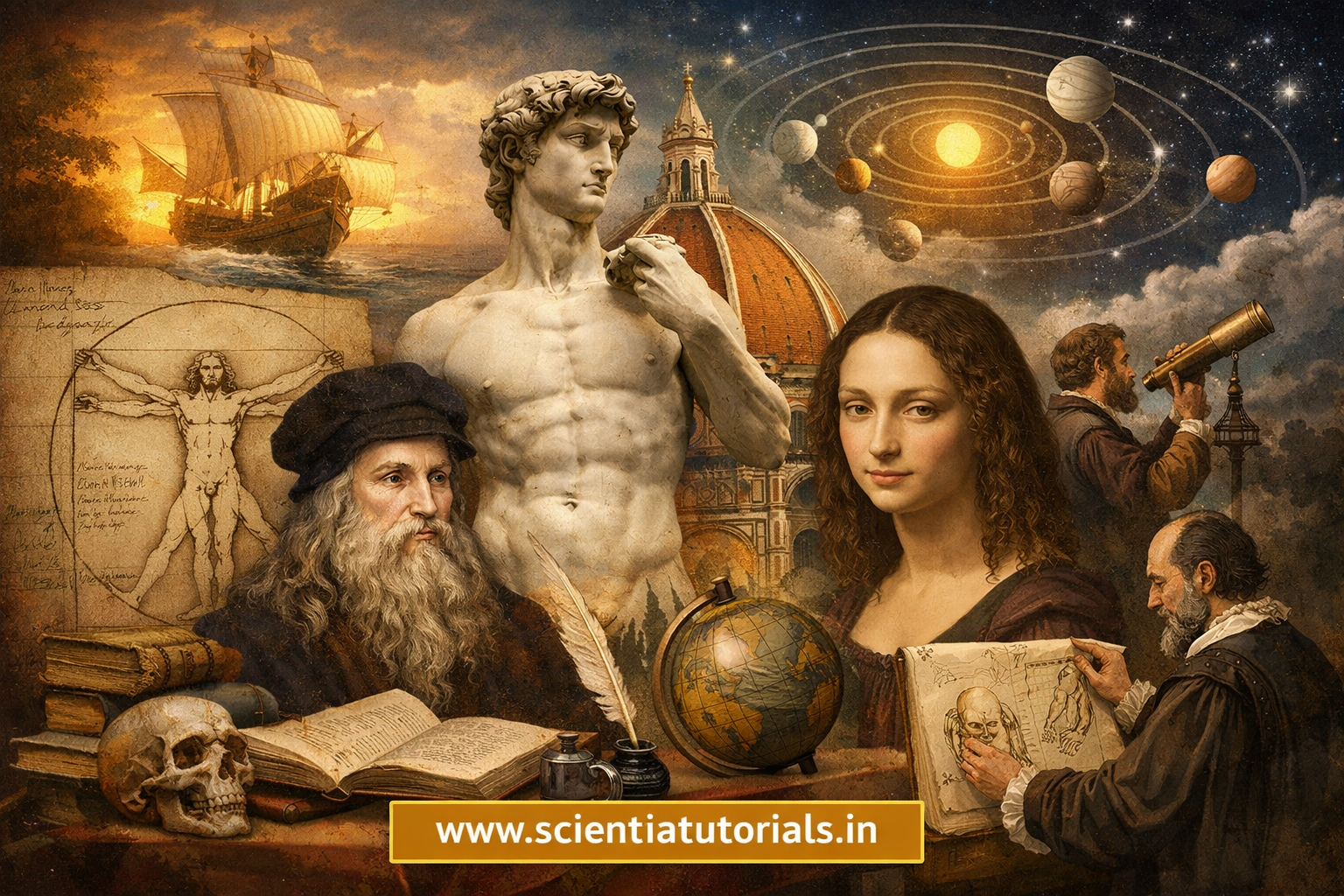
Renaissance and Humanism (1300–1600 CE): Foundations of the Early Modern World
Module IV: Early Modern Transitions and Explorations
Lesson 1: Renaissance and Humanism (c. 1300–1600 CE)
This lesson is systematically organized into four clearly structured sections, as detailed below:
- Chronologically Structured Study Module
- Short-Answer Type Questions
- Long-Answer Type Questions
- Multiple-Choice Questions (MCQs) with Answers and Detailed Explanations
Chronologically Structured Study Module
Module Introduction: From Medieval to Early Modern World
Module IV marks a decisive turning point in world history—the gradual transition from the medieval order to the early modern global system. This era was characterized by intellectual awakening, artistic innovation, scientific curiosity, and expanding global connections. At the heart of this transformation lay the Renaissance and the philosophy of Humanism, which reshaped European thought and laid foundations for the modern world.
Lesson 1 focuses on the Renaissance (c. 1300–1600 CE), emphasizing the revival of classical learning, the growth of art and science, and the emergence of individualism. Chronologically structured, this study module traces how Renaissance ideas evolved over time, influenced societies, and contributed to broader early modern transitions.
I. Background and Preconditions (Before c. 1300 CE)
1. The Medieval Legacy
Before the Renaissance, European society was dominated by:
- Feudal political structures
- A largely agrarian economy
- Scholasticism, which emphasized theology over empirical inquiry
- The cultural authority of the Church
Despite this dominance, medieval Europe preserved elements of classical learning through monasteries and universities. Islamic scholars had already preserved and expanded Greek and Roman knowledge, later reintroduced to Europe via translations.
2. The Late Medieval Crisis
Several developments weakened medieval structures and prepared the ground for Renaissance change:
- Decline of feudalism due to monetary economy and urban growth
- The Black Death (14th century), reducing population and altering social relations
- The rise of wealthy merchant classes in Italian city-states
These shifts encouraged questioning of traditional authority and greater focus on human experience.
II. Emergence of the Renaissance in Italy (c. 1300–1400 CE)
1. Why Italy Became the Cradle of the Renaissance
Italy’s unique conditions made it the birthplace of the Renaissance:
- Proximity to Roman ruins and classical heritage
- Prosperous city-states such as Florence, Venice, and Milan
- Patronage by powerful families like the Medici
- Strong trade links with the Islamic world and Asia
These factors created an environment supportive of art, scholarship, and innovation.
2. Humanism: A New Intellectual Movement
Humanism emphasized the study of classical Greek and Roman texts focusing on grammar, rhetoric, history, poetry, and moral philosophy. Unlike medieval scholasticism, it stressed:
- Human potential and dignity
- Secular subjects alongside religious studies
- Education for active civic life
The scholar Francesco Petrarch is often called the “Father of Humanism” for promoting classical Latin literature and individual self-expression.
III. Early Renaissance Cultural Developments (c. 1400–1450 CE)
1. Artistic Transformation
Renaissance art departed from medieval symbolic styles and embraced realism and human emotion. Key features included:
- Linear perspective
- Anatomical accuracy
- Use of light and shadow (chiaroscuro)
- Focus on the human form
Artists such as Masaccio pioneered realistic fresco painting, marking a clear break from medieval artistic conventions.
2. Architecture and Classical Inspiration
Architects drew inspiration from Roman designs:
- Symmetry and proportion
- Domes and columns
- Mathematical precision
Filippo Brunelleschi exemplified this shift through his architectural innovations in Florence, blending engineering skill with classical aesthetics.
IV. High Renaissance: Artistic and Intellectual Zenith (c. 1450–1520 CE)
1. Universal Genius and Individualism
The High Renaissance celebrated the ideal of the “Renaissance Man”—an individual skilled in multiple disciplines. This ideal reflected growing belief in human versatility and creativity.
- Leonardo da Vinci blended art, anatomy, engineering, and scientific observation.
- Michelangelo Buonarroti expressed human emotion and physical perfection through sculpture and painting.
- Raphael harmonized classical philosophy and Christian theology in his works.
2. Renaissance Science and Observation
Although not yet fully modern, Renaissance science emphasized:
- Observation of nature
- Study of anatomy and mechanics
- Questioning traditional authorities
Leonardo’s anatomical sketches and engineering designs foreshadowed later scientific advances.
V. Spread of the Renaissance Beyond Italy (c. 1500–1600 CE)
1. The Printing Revolution
The invention of the printing press by Johannes Gutenberg around 1450 CE transformed Renaissance culture by:
- Mass-producing books
- Lowering the cost of education
- Spreading humanist ideas rapidly
This innovation accelerated literacy and intellectual exchange across Europe.
2. Northern Renaissance Humanism
In Northern Europe, Renaissance ideas blended with Christian reform:
- Emphasis on moral philosophy
- Criticism of corruption in Church and society
- Use of vernacular languages
Erasmus of Rotterdam promoted education, reason, and ethical Christianity, influencing religious reform movements.
3. Art in Northern Europe
Northern Renaissance artists focused on:
- Detailed realism
- Everyday life
- Religious themes with emotional depth
This contrasted with Italian idealism but reflected shared humanist values.
VI. Renaissance and Society: Social and Cultural Impact
1. Education and Curriculum Reform
Humanist education emphasized:
- Classical texts
- Rhetoric and history
- Civic responsibility
Schools and universities adopted curricula preparing individuals for public life rather than monastic isolation.
2. Role of Women
While largely excluded from formal education, elite women participated as:
- Patrons of art
- Writers and scholars in limited circles
Figures such as Isabella d’Este exemplified female influence within Renaissance courts.
3. Patronage and Power
Art and scholarship flourished due to patronage from:
- Wealthy merchants
- Monarchs and popes
Patronage linked cultural achievement to political prestige, reinforcing state power.
VII. Renaissance Thought and the Early Modern Transition
1. From God-Centered to Human-Centered Worldview
The Renaissance did not reject religion but rebalanced focus toward:
- Human reason
- Earthly life
- Individual achievement
This intellectual shift marked a crucial step toward secular modernity.
2. Link to Exploration and Global Awareness
Renaissance curiosity encouraged:
- Improved cartography
- Navigation techniques
- Desire for new knowledge
These developments directly supported the Age of Exploration, expanding Europe’s global interactions.
VIII. Chronological Summary Timeline (c. 1300–1600 CE)
- c. 1300 – Rise of humanism in Italian city-states
- 14th century – Petrarch promotes classical learning
- Early 1400s – Artistic realism and perspective emerge
- Mid-1400s – Printing press revolutionizes knowledge
- Late 1400s – High Renaissance flourishes in Italy
- Early 1500s – Renaissance ideas spread across Europe
- c. 1600 – Transition toward Scientific Revolution and early modern state systems
IX. Historical Significance and Legacy
The Renaissance and Humanism were transformative forces in world history. They:
- Revived classical learning and critical inquiry
- Redefined art, education, and science
- Encouraged individualism and intellectual freedom
- Prepared Europe for religious reform, scientific revolution, and global expansion
As the opening lesson of Module IV, the Renaissance provides essential context for understanding early modern transitions and the emergence of the contemporary global system.
Conclusion
Lesson 1: Renaissance and Humanism captures the spirit of early modern change. Chronologically unfolding from medieval roots to early modern outcomes, the Renaissance reshaped how humans viewed themselves and their world. By emphasizing learning, creativity, and human potential, it laid enduring foundations for modern history and global interconnectedness.
Short Answer Type Questions
Lesson 1: Renaissance and Humanism (c. 1300–1600 CE)
1. What is meant by the term “Renaissance”?
The Renaissance refers to a cultural and intellectual revival in Europe marked by renewed interest in classical Greek and Roman learning, art, and philosophy between c. 1300 and 1600 CE.
2. Why is the Renaissance considered a turning point in world history?
It marked the transition from medieval to early modern history by promoting human-centered thinking, scientific inquiry, artistic realism, and individualism.
3. Define Humanism.
Humanism was an intellectual movement that emphasized the study of classical literature, history, rhetoric, and moral philosophy, focusing on human potential and achievements.
4. How did Renaissance Humanism differ from medieval scholasticism?
While scholasticism emphasized theology and religious authority, Humanism focused on classical texts, secular subjects, and human reason.
5. Why did the Renaissance begin in Italy?
Italy’s wealth, urbanization, classical Roman heritage, trade networks, and patronage by powerful families created favorable conditions for the Renaissance.
6. Name two important Italian city-states associated with the Renaissance.
Florence and Venice were two major Italian city-states that played key roles in Renaissance cultural development.
7. Who is known as the “Father of Humanism” and why?
Francesco Petrarch is called the Father of Humanism for reviving classical Latin literature and promoting individual intellectual achievement.
8. What role did patronage play during the Renaissance?
Patronage by wealthy families, rulers, and the Church supported artists and scholars, enabling cultural and artistic growth.
9. Mention two main characteristics of Renaissance art.
Realism and the use of perspective were key characteristics of Renaissance art.
10. How did Renaissance artists differ from medieval artists?
Renaissance artists focused on realism, human emotion, and anatomical accuracy rather than symbolic and religious representations.
11. Who introduced linear perspective in Renaissance painting?
Masaccio was among the first artists to use linear perspective effectively.
12. What is meant by the term “Renaissance Man”?
It refers to an individual skilled in multiple fields such as art, science, literature, and engineering, reflecting Renaissance ideals of versatility.
13. Name one Renaissance figure who exemplified the idea of a Renaissance Man.
Leonardo da Vinci exemplified this ideal through his achievements in art, science, anatomy, and engineering.
14. How did Renaissance ideas influence scientific thinking?
They encouraged observation, experimentation, and questioning of traditional authorities, laying foundations for modern science.
15. What was the significance of anatomical studies during the Renaissance?
Anatomical studies improved medical knowledge and helped artists achieve realistic depictions of the human body.
16. How did the printing press contribute to the spread of Renaissance ideas?
It made books cheaper and widely available, increasing literacy and spreading humanist ideas across Europe.
17. Who invented the printing press in Europe?
Johannes Gutenberg invented the movable-type printing press around 1450 CE.
18. What is meant by the Northern Renaissance?
The Northern Renaissance refers to the spread of Renaissance ideas to Northern Europe, where they blended with Christian reform and social criticism.
19. Name one prominent Northern Renaissance humanist.
Erasmus of Rotterdam was a leading Northern Renaissance humanist who emphasized education and moral reform.
20. How did Northern Renaissance art differ from Italian Renaissance art?
Northern Renaissance art focused more on detailed realism and everyday life, while Italian art emphasized classical ideals and proportion.
21. What role did education play in Renaissance society?
Education aimed to develop well-rounded individuals capable of civic responsibility through the study of humanities.
22. How did the Renaissance affect the status of women?
Although largely excluded from formal education, elite women contributed as patrons, writers, and cultural influencers.
23. What was the relationship between Renaissance ideas and the Age of Exploration?
Renaissance curiosity and improved knowledge of geography and science supported exploration and global expansion.
24. Did the Renaissance reject religion? Explain briefly.
No, it did not reject religion; instead, it combined religious belief with human-centered intellectual and artistic pursuits.
25. How did the Renaissance prepare the way for the modern world?
It promoted critical thinking, scientific inquiry, individualism, and cultural innovation, shaping modern European and global history.
26. State one long-term impact of Renaissance Humanism.
It influenced later movements such as the Scientific Revolution, Reformation, and Enlightenment.
27. Why is the Renaissance important to the study of early modern history?
It represents the intellectual and cultural foundation upon which early modern political, scientific, and global developments were built.
Long Answer Type Questions
Lesson 1: Renaissance and Humanism
1. Explain the historical meaning of the Renaissance and discuss why it is considered a major turning point in world history.
Answer:
The Renaissance was a cultural and intellectual movement that began in Europe around the 14th century and lasted until the 16th century. The term “Renaissance” means “rebirth,” referring to the revival of classical Greek and Roman learning, art, and philosophy. It is considered a turning point because it marked the transition from medieval, religiously dominated thinking to early modern human-centered ideas. The Renaissance encouraged critical inquiry, scientific observation, artistic realism, and individual achievement, laying the foundations of modern European civilization.
2. Analyze the social and economic conditions that led to the emergence of the Renaissance in Europe.
Answer:
Several social and economic changes prepared the ground for the Renaissance. The decline of feudalism, growth of towns, expansion of trade, and rise of a wealthy merchant class created new patrons for art and learning. The impact of the Black Death weakened traditional structures and encouraged questioning of authority. Increased contact with the Islamic world brought classical knowledge to Europe. These conditions fostered intellectual freedom and cultural innovation.
3. Why did Italy become the birthplace of the Renaissance? Explain with suitable reasons.
Answer:
Italy became the birthplace of the Renaissance due to its unique combination of factors. Italian city-states such as Florence and Venice were wealthy from trade and banking. Italy possessed the physical remains of ancient Rome, which inspired admiration for classical culture. Powerful families supported artists and scholars through patronage. Political independence of city-states encouraged competition in culture and learning, accelerating Renaissance development.
4. Define Humanism and examine its role in shaping Renaissance thought.
Answer:
Humanism was an intellectual movement that emphasized the study of classical literature, history, rhetoric, poetry, and moral philosophy. Humanists believed in the dignity, potential, and rationality of human beings. Unlike medieval scholasticism, Humanism focused on secular education and practical civic life. It shaped Renaissance thought by promoting critical inquiry, individualism, and appreciation of classical knowledge.
5. Discuss the contribution of Francesco Petrarch to the development of Humanism.
Answer:
Francesco Petrarch is regarded as the “Father of Humanism.” He revived interest in classical Latin literature and emphasized personal reflection and individual achievement. Petrarch believed that studying classical texts could morally improve individuals. His writings encouraged scholars to value human emotions, creativity, and historical consciousness, shaping Renaissance intellectual life.
6. Examine the transformation of art during the Early Renaissance.
Answer:
Early Renaissance art marked a clear departure from medieval styles. Artists focused on realism, perspective, proportion, and the human form. Techniques such as linear perspective and shading created depth and naturalism. Religious themes continued, but figures appeared more lifelike and emotional. Art became a means of understanding human experience rather than only expressing religious symbolism.
7. Analyze the artistic innovations introduced by Masaccio.
Answer:
Masaccio was a pioneer of Early Renaissance painting. He introduced linear perspective, realistic human figures, and emotional depth into art. His frescoes demonstrated accurate anatomy and three-dimensional space, influencing later Renaissance artists. Masaccio’s work marked a decisive break from medieval artistic conventions.
8. Describe the concept of the “Renaissance Man” and its historical significance.
Answer:
The “Renaissance Man” referred to an ideal individual skilled in multiple fields such as art, science, literature, and engineering. This concept reflected Humanist belief in the unlimited potential of human intellect. It emphasized versatility, creativity, and lifelong learning, representing a shift from medieval specialization to holistic development.
9. Assess the contributions of Leonardo da Vinci to Renaissance art and science.
Answer:
Leonardo da Vinci exemplified the Renaissance Man. He made outstanding contributions to painting, anatomy, engineering, and scientific observation. His detailed anatomical studies improved understanding of the human body, while his artistic works combined realism with emotional expression. Leonardo’s curiosity and empirical approach anticipated modern scientific methods.
10. Evaluate the significance of Michelangelo Buonarroti in Renaissance culture.
Answer:
Michelangelo was one of the greatest artists of the High Renaissance. His sculptures and paintings emphasized human emotion, strength, and idealized beauty. Through works such as monumental sculptures and frescoes, he expressed the Humanist belief in human potential while maintaining religious themes. His art deeply influenced Western artistic traditions.
11. Discuss the role of architecture in expressing Renaissance ideals.
Answer:
Renaissance architecture drew inspiration from classical Greek and Roman designs. Architects emphasized symmetry, proportion, geometry, and harmony. Buildings reflected Humanist ideals by combining mathematical precision with aesthetic beauty. Architecture became an expression of rational order and human creativity.
12. Explain how Renaissance ideas influenced the development of science.
Answer:
Renaissance thinkers emphasized observation, experimentation, and questioning of traditional authorities. Scholars studied anatomy, astronomy, and mechanics based on direct evidence. Although still influenced by classical ideas, Renaissance science laid the groundwork for the Scientific Revolution by promoting empirical inquiry.
13. Examine the importance of the printing press in spreading Renaissance ideas.
Answer:
The printing press revolutionized communication by making books affordable and widely available. It increased literacy and enabled rapid dissemination of Humanist texts, scientific knowledge, and artistic ideas. Printing helped standardize knowledge and connect scholars across Europe.
14. Analyze the role of Johannes Gutenberg in the Renaissance.
Answer:
Johannes Gutenberg invented the movable-type printing press in Europe around 1450 CE. His innovation transformed education and intellectual life by enabling mass production of books. Gutenberg’s invention played a crucial role in spreading Renaissance ideas and accelerating cultural change.
15. Describe the characteristics of the Northern Renaissance.
Answer:
The Northern Renaissance developed in regions such as Germany, the Netherlands, and England. It combined Humanist learning with Christian moral reform. Northern scholars emphasized education, ethics, and social criticism. Art focused on detailed realism and everyday life rather than classical idealism.
16. Discuss the contribution of Erasmus of Rotterdam to Northern Renaissance thought.
Answer:
Erasmus was a leading Humanist of Northern Europe. He promoted education, moral philosophy, and reform within Christianity. Through his writings, he criticized corruption and emphasized ethical living. Erasmus influenced religious reform movements and the spread of Humanist values.
17. Compare Italian Renaissance art with Northern Renaissance art.
Answer:
Italian Renaissance art emphasized classical ideals, proportion, and idealized human forms. Northern Renaissance art focused on realism, fine detail, and daily life. While Italian artists looked to ancient Rome, Northern artists emphasized moral themes and domestic settings, reflecting regional cultural differences.
18. Evaluate the impact of the Renaissance on education.
Answer:
Renaissance education shifted focus from theology to the humanities. Schools emphasized classical texts, rhetoric, history, and moral philosophy. Education aimed to produce well-rounded citizens capable of leadership and public service, influencing modern educational systems.
19. Examine the position of women during the Renaissance.
Answer:
Women were largely excluded from formal education and public life. However, elite women participated as patrons, writers, and cultural influencers. Though limited, their contributions highlight gradual social change during the Renaissance period.
20. Discuss the relationship between Renaissance thought and the Age of Exploration.
Answer:
Renaissance curiosity encouraged exploration of the natural world and distant lands. Advances in geography, cartography, and navigation supported overseas voyages. Humanist interest in knowledge and discovery directly contributed to European expansion and global interaction.
21. Did the Renaissance reject religion? Analyze critically.
Answer:
The Renaissance did not reject religion but rebalanced it with Humanist ideals. Religious themes continued in art and thought, but greater emphasis was placed on human reason and worldly experience. This shift reduced the dominance of medieval religious authority without eliminating faith.
22. Explain how the Renaissance contributed to the decline of medieval traditions.
Answer:
The Renaissance challenged feudalism, scholasticism, and unquestioned authority. It promoted critical thinking, secular education, and individual achievement. These changes weakened medieval institutions and encouraged modern political, cultural, and intellectual systems.
23. Assess the long-term historical significance of Renaissance Humanism.
Answer:
Renaissance Humanism influenced the Reformation, Scientific Revolution, and Enlightenment. It encouraged rational inquiry, individual freedom, and cultural creativity. Humanist ideas continue to shape modern education, democracy, and scientific thought.
24. Place the Renaissance within the broader framework of early modern world history.
Answer:
The Renaissance represents the intellectual foundation of early modern history. It connected medieval Europe to the modern world by promoting innovation, global awareness, and intellectual freedom. Its legacy is evident in modern science, art, politics, and global culture.
25. “The Renaissance laid the foundations of the modern world.” Justify this statement.
Answer:
The Renaissance laid foundations for the modern world by transforming education, art, science, and thought. It emphasized human potential, rational inquiry, and creativity. These values shaped modern institutions, global exploration, and cultural progress, making the Renaissance a defining era in world history.
Multiple Choice Questions (MCQs)
Lesson 1: Renaissance and Humanism
1. The term “Renaissance” literally means:
A. Reform
B. Enlightenment
C. Rebirth
D. Revolution
Correct Answer: C. Rebirth
Explanation:
The word “Renaissance” comes from the French term meaning “rebirth.” It signifies the revival of classical Greek and Roman learning, art, and culture after the medieval period.
2. The Renaissance is generally dated between:
A. 500–1000 CE
B. 1000–1300 CE
C. 1300–1600 CE
D. 1600–1800 CE
Correct Answer: C. 1300–1600 CE
Explanation:
The Renaissance began in the 14th century and continued until the 16th century, marking the transition from medieval to early modern Europe.
3. Which of the following best defines Humanism?
A. Complete rejection of religion
B. Emphasis on feudal loyalty
C. Focus on classical learning and human potential
D. Blind acceptance of church authority
Correct Answer: C. Focus on classical learning and human potential
Explanation:
Humanism emphasized the study of classical texts and focused on human dignity, reason, and capabilities rather than solely religious doctrine.
4. Humanism differed from medieval scholasticism mainly because it:
A. Rejected education
B. Focused on science alone
C. Emphasized theology over logic
D. Valued secular subjects and classical texts
Correct Answer: D. Valued secular subjects and classical texts
Explanation:
Scholasticism focused on theological debates, whereas Humanism promoted history, literature, rhetoric, and moral philosophy based on classical sources.
5. Why did the Renaissance begin in Italy?
A. Strong feudal structure
B. Isolation from trade
C. Presence of Roman heritage and wealthy city-states
D. Centralized monarchy
Correct Answer: C. Presence of Roman heritage and wealthy city-states
Explanation:
Italy’s ancient Roman legacy, prosperous trade cities, political independence, and patronage system created ideal conditions for Renaissance growth.
6. Which Italian city is most closely associated with the early Renaissance?
A. Rome
B. Naples
C. Florence
D. Palermo
Correct Answer: C. Florence
Explanation:
Florence became the center of early Renaissance art and learning due to its wealth, banking system, and patronage by elite families.
7. Who is known as the “Father of Humanism”?
A. Dante
B. Machiavelli
C. Francesco Petrarch
D. Thomas Aquinas
Correct Answer: C. Francesco Petrarch
Explanation:
Petrarch revived classical Latin literature and emphasized personal reflection, making him a central figure in the development of Humanism.
8. Renaissance art is best characterized by:
A. Flat figures and symbolism
B. Abstract designs
C. Realism, perspective, and human emotion
D. Complete rejection of religious themes
Correct Answer: C. Realism, perspective, and human emotion
Explanation:
Renaissance artists aimed to depict realistic human forms, emotions, and three-dimensional space using scientific techniques.
9. The technique that created depth and realism in Renaissance painting was:
A. Fresco
B. Mosaic
C. Linear perspective
D. Calligraphy
Correct Answer: C. Linear perspective
Explanation:
Linear perspective used mathematical principles to create the illusion of depth, a major innovation of Renaissance art.
10. Which concept best explains the idea of a “Renaissance Man”?
A. Religious devotion only
B. Expertise in a single field
C. Mastery of multiple disciplines
D. Military leadership
Correct Answer: C. Mastery of multiple disciplines
Explanation:
The Renaissance Man symbolized the Humanist belief that individuals could excel in art, science, literature, and technology.
11. Which individual best exemplified the Renaissance Man?
A. Galileo Galilei
B. Leonardo da Vinci
C. Erasmus
D. Martin Luther
Correct Answer: B. Leonardo da Vinci
Explanation:
Leonardo excelled in painting, anatomy, engineering, and scientific observation, embodying Renaissance versatility.
12. Renaissance science was marked by:
A. Blind faith in tradition
B. Empirical observation and curiosity
C. Rejection of classical ideas
D. Complete secularism
Correct Answer: B. Empirical observation and curiosity
Explanation:
Renaissance thinkers began observing nature directly and questioning traditional authorities, laying groundwork for modern science.
13. The invention that helped spread Renaissance ideas rapidly was:
A. Compass
B. Astrolabe
C. Printing press
D. Gunpowder
Correct Answer: C. Printing press
Explanation:
The printing press allowed mass production of books, increasing literacy and spreading Humanist ideas across Europe.
14. Who invented the movable-type printing press in Europe?
A. Marco Polo
B. Isaac Newton
C. Johannes Gutenberg
D. Copernicus
Correct Answer: C. Johannes Gutenberg
Explanation:
Gutenberg’s printing press revolutionized education and communication in 15th-century Europe.
15. The spread of Renaissance ideas to Northern Europe is known as:
A. Scientific Revolution
B. Enlightenment
C. Northern Renaissance
D. Protestant Reformation
Correct Answer: C. Northern Renaissance
Explanation:
The Northern Renaissance adapted Humanist ideas to local conditions, blending classical learning with Christian reform.
16. Northern Renaissance thinkers emphasized:
A. Artistic idealism
B. Moral philosophy and religious reform
C. Feudal loyalty
D. Military expansion
Correct Answer: B. Moral philosophy and religious reform
Explanation:
Northern Humanists focused on ethical living, education, and reforming Christian practices.
17. Which scholar was a leading figure of Northern Renaissance Humanism?
A. Michelangelo
B. Dante
C. Erasmus of Rotterdam
D. Petrarch
Correct Answer: C. Erasmus of Rotterdam
Explanation:
Erasmus promoted education, reason, and moral reform and criticized corruption within society and the Church.
18. Northern Renaissance art differed from Italian art because it:
A. Ignored realism
B. Focused on abstract themes
C. Emphasized fine detail and daily life
D. Avoided religious subjects
Correct Answer: C. Emphasized fine detail and daily life
Explanation:
Northern artists focused on realism, domestic settings, and emotional depth rather than classical idealism.
19. Renaissance education primarily emphasized:
A. Military training
B. Theology alone
C. Humanities and civic responsibility
D. Agricultural skills
Correct Answer: C. Humanities and civic responsibility
Explanation:
Humanist education aimed to develop well-rounded citizens through literature, history, rhetoric, and ethics.
20. The Renaissance contributed to the Age of Exploration by:
A. Discouraging travel
B. Promoting isolation
C. Encouraging curiosity and scientific knowledge
D. Rejecting geography
Correct Answer: C. Encouraging curiosity and scientific knowledge
Explanation:
Renaissance interest in maps, navigation, and discovery supported overseas exploration and global interaction.
21. Which social group played a major role as patrons during the Renaissance?
A. Serfs
B. Feudal lords only
C. Merchants and bankers
D. Peasants
Correct Answer: C. Merchants and bankers
Explanation:
Wealthy merchants and banking families financed artists and scholars, promoting cultural growth.
22. How did the Renaissance view religion?
A. Completely rejected it
B. Replaced it with science
C. Balanced faith with human-centered ideas
D. Ignored it entirely
Correct Answer: C. Balanced faith with human-centered ideas
Explanation:
Religion remained important, but Renaissance thinkers emphasized human reason and worldly experience alongside faith.
23. The Renaissance contributed to the decline of medieval society by:
A. Strengthening feudalism
B. Reinforcing scholasticism
C. Promoting critical thinking and individualism
D. Ending education
Correct Answer: C. Promoting critical thinking and individualism
Explanation:
Renaissance ideas challenged traditional authority and medieval worldviews, leading to social and intellectual change.
24. One long-term impact of Renaissance Humanism was the:
A. Collapse of universities
B. Rise of modern science and democracy
C. End of education
D. Decline of literacy
Correct Answer: B. Rise of modern science and democracy
Explanation:
Humanism encouraged rational inquiry, education, and civic responsibility, shaping modern institutions.
25. The Renaissance is best described as:
A. A purely artistic movement
B. A religious reform movement
C. An intellectual, cultural, and social transformation
D. A military revolution
Correct Answer: C. An intellectual, cultural, and social transformation
Explanation:
The Renaissance transformed art, education, science, and thought, making it a defining phase in early modern world history.