
Lesson 1: Rise and Expansion of Islam
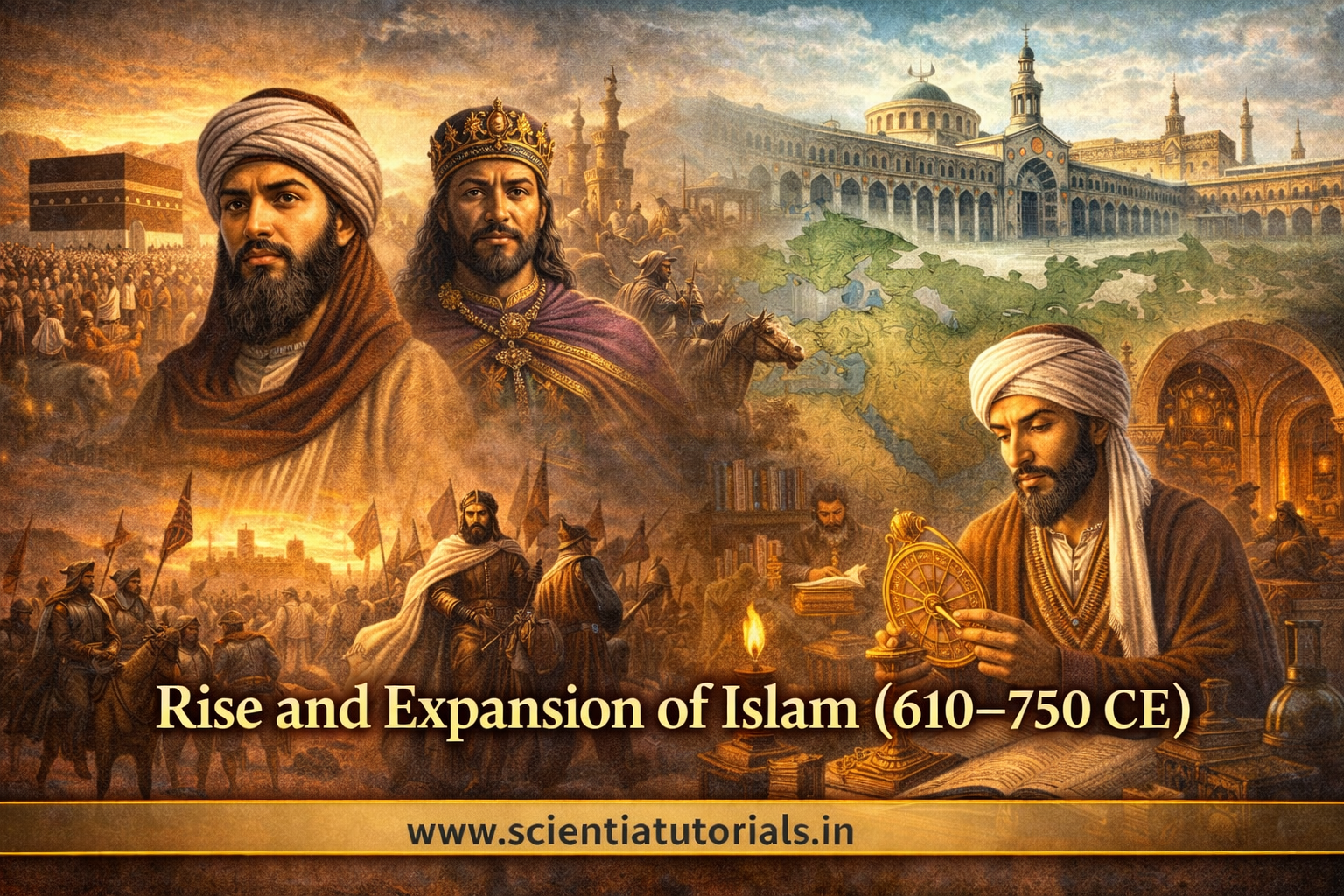
Rise and Expansion of Islam (610–750 CE): Prophet Muhammad, Caliphates & Contributions
Course: World History – From Early Civilizations to the Contemporary Global System
Module III: Medieval Societies and the Rise of Islam
This lesson is systematically organized into four clearly structured sections, as detailed below:
- Chronologically Structured Study Module
- Short-Answer Type Questions
- Long-Answer Type Questions
- Multiple-Choice Questions (MCQs) with Answers and Detailed Explanations
Chronologically Structured Study Module
Module Introduction
Module III examines the medieval world through the lens of political systems, religious institutions, cultural transformations, and expanding global interactions. A defining development of this era was the rise and expansion of Islam, which reshaped the political, social, and intellectual landscape of West Asia, North Africa, Europe, and parts of Asia.
From its origins in the Arabian Peninsula in the early 7th century CE, Islam rapidly evolved into a civilization-building force, creating new models of governance, fostering scientific and cultural achievements, and linking diverse regions through trade, scholarship, and shared religious identity. This lesson explores the life of Prophet Muhammad, the emergence of Caliphates and Islamic governance, and the cultural and scientific contributions of early Islamic civilization between c. 610 CE and 750 CE.
Lesson 1: Rise and Expansion of Islam
Timeline: c. 610 CE – 750 CE
I. Arabia before Islam: Historical Background
Before the rise of Islam, Arabia was characterized by:
- Tribal society based on kinship and clan loyalty
- Predominantly nomadic Bedouin lifestyle, alongside trading towns
- Polytheistic religious practices centered on tribal deities
- Mecca as a major commercial and pilgrimage center
The absence of centralized political authority and social justice created conditions ripe for religious and moral reform.
II. Life of Prophet Muhammad (c. 570–632 CE)
1. Early Life in Mecca
Prophet Muhammad was born around 570 CE in Mecca into the Quraysh tribe. Orphaned at an early age, he earned a reputation as Al-Amin (the Trustworthy). His exposure to trade introduced him to diverse cultures and religious ideas.
2. The First Revelation (610 CE)
In 610 CE, while meditating in the Cave of Hira, Muhammad received the first revelation from Allah through the Angel Gabriel. This event marked the beginning of Islam.
Key teachings included:
- Monotheism (Tawhid) – belief in one God
- Social justice and care for the poor
- Moral accountability and ethical conduct
3. Opposition in Mecca
Muhammad’s message challenged:
- Polytheistic beliefs
- Economic interests tied to pilgrimage
- Social inequalities
As a result, early Muslims faced persecution, boycotts, and violence from Meccan elites.
4. Hijra: Migration to Medina (622 CE)
In 622 CE, Muhammad and his followers migrated to Medina—an event known as the Hijra, which marks the beginning of the Islamic calendar.
Significance of Hijra:
- Formation of the first Islamic community (Ummah)
- Muhammad’s role as both religious and political leader
- Establishment of social and legal norms
5. The Islamic State in Medina
In Medina:
- The Constitution of Medina created a pluralistic society
- Muslims, Jews, and other groups coexisted under shared political authority
- Islam evolved from a religious movement into a governing system
6. Return to Mecca and Death
By 630 CE, Mecca was peacefully conquered. Idols in the Kaaba were removed, establishing monotheism. Muhammad died in 632 CE, leaving behind a unified religious community.
III. Foundations of Islam
1. Core Beliefs and Practices
Islam is based on:
- Belief in one God (Allah)
- Prophethood of Muhammad
- The Qur’an as the revealed scripture
The Five Pillars of Islam structured religious life and communal identity.
2. Islam as a Social and Political System
Islam provided:
- Ethical guidelines
- Legal principles (Sharia)
- A sense of collective identity transcending tribal divisions
IV. The Caliphates and Islamic Governance
1. The Rashidun Caliphate (632–661 CE)
After Muhammad’s death, leadership passed to the Caliphs (successors).
The Rashidun Caliphate included:
- Abu Bakr
- Umar
- Uthman
- Ali
Key Features
- Expansion into Syria, Egypt, Persia, and Iraq
- Governance based on consultation (Shura)
- Integration of Islamic principles with existing administrative systems
2. The Umayyad Caliphate (661–750 CE)
The Umayyad Caliphate shifted the capital to Damascus.
Characteristics
- Hereditary monarchy
- Massive territorial expansion (Spain to Central Asia)
- Arabic as the official administrative language
- Construction of monumental architecture
The Umayyads created the largest empire of the medieval world.
3. The Abbasid Revolution and Early Abbasid Rule
In 750 CE, the Umayyads were overthrown by the Abbasid Caliphate, which shifted the capital to Baghdad.
Early Abbasid governance emphasized:
- Persian administrative influences
- Scholarly patronage
- Cultural and intellectual flourishing
V. Expansion of Islam: Methods and Impact
1. Military Conquest
- Well-organized armies
- Weakness of Byzantine and Sassanian empires
- Strategic leadership
2. Trade and Cultural Exchange
- Merchants spread Islam peacefully
- Trade routes connected Africa, Asia, and Europe
- Urban centers flourished
3. Religious Tolerance
- Dhimmi system protected non-Muslims
- Religious communities retained autonomy
- Taxes replaced forced conversion
This approach facilitated long-term stability.
VI. Cultural and Scientific Contributions of Islamic Civilization
1. Knowledge Preservation and Translation
Islamic scholars:
- Translated Greek, Persian, and Indian texts
- Preserved classical knowledge lost in Europe
- Established libraries and academies
The House of Wisdom in Baghdad symbolized intellectual openness.
2. Science and Medicine
Achievements included:
- Advances in algebra, astronomy, and optics
- Development of hospitals and medical ethics
- Contributions by scholars like Al-Khwarizmi and Ibn Sina
3. Literature, Art, and Architecture
- Arabic literature and poetry flourished
- Calligraphy and geometric art replaced figurative imagery
- Mosques, madrasas, and palaces showcased architectural innovation
4. Global Influence
Islamic civilization:
- Linked East and West
- Influenced European Renaissance through knowledge transmission
- Created a shared intellectual world across continents
VII. Social and Economic Life in Early Islamic Society
- Agriculture improved through irrigation
- Cities like Mecca, Medina, Damascus, and Baghdad grew
- Trade guilds and markets expanded
Women received legal rights in inheritance and marriage, representing a shift from pre-Islamic norms.
VIII. Comparative Perspective: Islam in Medieval World History
| Aspect | Islamic World | Medieval Europe |
|---|---|---|
| Governance | Caliphate-based | Feudal monarchies |
| Religion | Integrated with state | Church-state separation |
| Knowledge | Scientific openness | Limited until later |
| Trade | Global networks | Regional |
Islamic civilization acted as a bridge between ancient and modern worlds.
IX. Historical Significance of the Rise of Islam
The rise and expansion of Islam:
- Created a unified religious and political community
- Established durable governance models
- Advanced science, learning, and culture
- Reshaped Afro-Eurasian history
By 750 CE, Islam had become one of the world’s major civilizations.
Conclusion
Between c. 610 CE and 750 CE, Islam evolved from a spiritual message delivered by Prophet Muhammad into a vast civilization spanning three continents. The formation of the Caliphates, the development of Islamic governance, and the flourishing of cultural and scientific traditions transformed the medieval world. Islam not only reshaped political authority but also acted as a powerful engine of intellectual exchange and global interaction.
This period marks one of the most significant transitions in world history, laying foundations that continue to influence societies, cultures, and global relations today.
Short Answer Type Questions with Answers
Lesson: Rise and Expansion of Islam
1. What is meant by the rise of Islam?
Answer:
The rise of Islam refers to the emergence of Islam as a religious, social, and political system beginning in Arabia in the early 7th century CE.
2. Who was Prophet Muhammad?
Answer:
Prophet Muhammad was the founder of Islam and the final messenger of God according to Islamic belief.
3. In which year did Prophet Muhammad receive his first revelation?
Answer:
Prophet Muhammad received his first revelation in 610 CE.
4. What is the significance of the Cave of Hira?
Answer:
It is the place where Prophet Muhammad received the first revelation from Allah through Angel Gabriel.
5. What was the religious condition of Arabia before Islam?
Answer:
Arabia was largely polytheistic, with tribes worshipping multiple gods and idols.
6. What is meant by Tawhid?
Answer:
Tawhid is the Islamic belief in the oneness of God.
7. Why did the Meccan elites oppose Islam?
Answer:
They opposed Islam because it challenged polytheism, social inequality, and economic interests linked to pilgrimage.
8. What is the Hijra?
Answer:
The Hijra was the migration of Prophet Muhammad from Mecca to Medina in 622 CE.
9. Why is the Hijra historically important?
Answer:
It marks the beginning of the Islamic calendar and the formation of the first Islamic community.
10. What was the Ummah?
Answer:
The Ummah was the community of believers united by faith rather than tribal ties.
11. What was the Constitution of Medina?
Answer:
It was an agreement that regulated relations among Muslims, Jews, and other groups in Medina.
12. When did Muslims peacefully conquer Mecca?
Answer:
Mecca was peacefully conquered in 630 CE.
13. What happened to the Kaaba after the conquest of Mecca?
Answer:
Idols were removed and the Kaaba was dedicated to the worship of one God.
14. What is the Qur’an?
Answer:
The Qur’an is the holy book of Islam containing the revelations received by Prophet Muhammad.
15. Who were the Caliphs?
Answer:
Caliphs were the successors of Prophet Muhammad who led the Muslim community after his death.
16. Name the first Caliph of Islam.
Answer:
Abu Bakr was the first Caliph of Islam.
17. What was the Rashidun Caliphate?
Answer:
It was the first Islamic state ruled by the four rightly guided Caliphs from 632 to 661 CE.
18. Which regions were conquered during the Rashidun Caliphate?
Answer:
Syria, Egypt, Iraq, and Persia were conquered during this period.
19. What was the Umayyad Caliphate?
Answer:
It was an Islamic dynasty that ruled from Damascus and expanded the empire from Spain to Central Asia.
20. What administrative reform did the Umayyads introduce?
Answer:
Arabic was made the official language of administration.
21. Who overthrew the Umayyad Caliphate in 750 CE?
Answer:
The Umayyads were overthrown by the Abbasid Caliphate.
22. What was the capital of the Abbasid Caliphate?
Answer:
Baghdad was the capital of the Abbasid Caliphate.
23. Name one method by which Islam spread beyond Arabia.
Answer:
Islam spread through military conquests as well as trade and missionary activity.
24. What is meant by religious tolerance in early Islamic rule?
Answer:
Non-Muslims were allowed to practice their religion under protection by paying a tax.
25. Mention one scientific or cultural contribution of early Islamic civilization.
Answer:
Islamic scholars preserved and advanced knowledge in mathematics, medicine, and astronomy.
Long Answer Type Questions with Answers
Lesson: Rise and Expansion of Islam
1. Describe the social, religious, and economic conditions of Arabia before the rise of Islam.
Answer:
Before Islam, Arabia was dominated by tribal societies based on kinship and loyalty. Politically, there was no centralized authority, leading to frequent tribal conflicts. Economically, trade flourished in towns like Mecca, while nomadic Bedouins depended on pastoralism. Religiously, most Arabs practiced polytheism, worshipping tribal gods and idols housed in the Kaaba. Social inequalities, exploitation of the poor, and lack of moral regulation were common. These conditions created the background for a reformist religious movement like Islam.
2. Trace the early life of Prophet Muhammad and explain how it shaped his mission.
Answer:
Prophet Muhammad was born around 570 CE in Mecca into the Quraysh tribe. Orphaned early, he was raised by relatives and developed qualities of honesty and integrity, earning the title Al-Amin. His involvement in trade exposed him to diverse cultures and beliefs. These experiences, combined with his concern for social injustice, shaped his spiritual outlook and prepared him for his prophetic mission.
3. Explain the significance of the first revelation in 610 CE.
Answer:
The first revelation received by Muhammad in the Cave of Hira in 610 CE marked the beginning of Islam. It introduced the concept of monotheism (Tawhid) and emphasized moral accountability, compassion, and social justice. This event transformed Muhammad from a respected merchant into a prophet and laid the foundation of a new religious and social order.
4. Why did Prophet Muhammad face opposition in Mecca?
Answer:
Muhammad’s message challenged the polytheistic beliefs of Meccan society, threatened the economic interests tied to pilgrimage, and questioned social inequalities upheld by tribal elites. His emphasis on equality and moral responsibility undermined the authority of Meccan leaders, leading to persecution of early Muslims.
5. Discuss the Hijra and its importance in Islamic history.
Answer:
The Hijra refers to the migration of Muhammad and his followers from Mecca to Medina in 622 CE. It marks the beginning of the Islamic calendar. The Hijra transformed Islam from a persecuted faith into a political and social community. In Medina, Muhammad became both a religious and political leader, laying the foundations of the Islamic state.
6. Examine the significance of the Constitution of Medina.
Answer:
The Constitution of Medina established a framework for coexistence among Muslims, Jews, and other groups. It recognized religious freedom, collective security, and shared political authority. This document is considered one of the earliest examples of a written constitution, highlighting Islam’s role as both a spiritual and governing system.
7. Analyze the role of Prophet Muhammad as a statesman in Medina.
Answer:
In Medina, Muhammad acted as a lawgiver, judge, and military leader. He resolved disputes, organized defense, and regulated social and economic relations. His leadership unified diverse groups into the Ummah, demonstrating the integration of religion and governance in early Islam.
8. Describe the peaceful conquest of Mecca and its consequences.
Answer:
In 630 CE, Muhammad entered Mecca peacefully after years of conflict. He forgave former enemies and removed idols from the Kaaba, establishing monotheism. This event consolidated Islamic authority in Arabia and symbolized reconciliation rather than vengeance.
9. Explain the basic beliefs and practices of Islam.
Answer:
Islam is based on belief in one God (Allah), prophethood of Muhammad, and the Qur’an as divine revelation. The Five Pillars of Islam—faith, prayer, charity, fasting, and pilgrimage—structure religious life. These principles created moral discipline and communal identity.
10. What challenges arose after the death of Prophet Muhammad in 632 CE?
Answer:
After Muhammad’s death, the Muslim community faced the challenge of leadership succession. Questions of authority, unity, and governance emerged. The institution of the Caliphate was created to ensure continuity and stability.
11. Discuss the formation and achievements of the Rashidun Caliphate.
Answer:
The Rashidun Caliphate (632–661 CE) was led by four rightly guided Caliphs. It expanded rapidly into Syria, Egypt, Persia, and Iraq. Governance emphasized consultation, justice, and simplicity. This period laid the foundations of Islamic administration and law.
12. Examine the administrative policies of the Rashidun Caliphs.
Answer:
The Rashidun Caliphs maintained existing administrative systems of conquered regions while introducing Islamic principles. Taxation, military organization, and judicial systems were regulated to ensure stability and fairness.
13. Analyze the rise and expansion of the Umayyad Caliphate.
Answer:
The Umayyad Caliphate (661–750 CE) established hereditary rule with Damascus as its capital. It expanded the Islamic empire from Spain to Central Asia. Administrative reforms included Arabic as the official language and construction of monumental architecture, strengthening imperial unity.
14. Compare the Rashidun and Umayyad systems of governance.
Answer:
While the Rashidun emphasized consultative leadership and moral authority, the Umayyads adopted monarchical rule and centralized administration. Both contributed to expansion, but differed in political style and legitimacy.
15. Explain the Abbasid Revolution of 750 CE.
Answer:
The Abbasid Revolution overthrew the Umayyads due to dissatisfaction among non-Arab Muslims and political opposition. The Abbasids established a new dynasty emphasizing inclusivity, Persian administrative traditions, and intellectual patronage.
16. Describe the early policies of the Abbasid Caliphate.
Answer:
The Abbasids shifted the capital to Baghdad and promoted scholarship, trade, and cultural exchange. They supported scholars and translators, creating a vibrant intellectual environment.
17. Assess the role of military conquest in the spread of Islam.
Answer:
Military conquests expanded Islamic political control rapidly, aided by weak neighboring empires. However, conversion was not forced; Islamic rule often allowed religious freedom, encouraging gradual acceptance.
18. Discuss the role of trade and merchants in the spread of Islam.
Answer:
Muslim merchants carried Islamic beliefs along trade routes across Africa, Asia, and Europe. Their ethical conduct and commercial networks facilitated peaceful conversion and cultural exchange.
19. Explain the concept of religious tolerance under early Islamic rule.
Answer:
Non-Muslims, known as dhimmis, were allowed to practice their religion in exchange for a tax. This policy ensured stability and coexistence within a diverse empire.
20. Evaluate the cultural and scientific contributions of early Islamic civilization.
Answer:
Islamic civilization preserved and expanded knowledge in mathematics, medicine, astronomy, and philosophy. Translation movements and institutions like the House of Wisdom linked ancient learning with medieval Europe, profoundly influencing global history.
Multiple Choice Questions (MCQs) with Answers and Explanations
Lesson: Rise and Expansion of Islam
1. The rise of Islam began in the early 7th century CE in
A. Persia
B. Mesopotamia
C. Arabia
D. North Africa
Correct Answer: C
Explanation:
Islam originated in the Arabian Peninsula, particularly in Mecca and Medina, during the early 7th century CE.
2. Prophet Muhammad was born around
A. 500 CE
B. 550 CE
C. 570 CE
D. 600 CE
Correct Answer: C
Explanation:
Prophet Muhammad was born around 570 CE in Mecca, a major commercial and religious center of Arabia.
3. The first revelation to Prophet Muhammad occurred in
A. 600 CE
B. 610 CE
C. 622 CE
D. 632 CE
Correct Answer: B
Explanation:
In 610 CE, Muhammad received the first revelation in the Cave of Hira, marking the beginning of Islam.
4. The core message of Islam emphasizes
A. Polytheism
B. Tribal loyalty
C. Monotheism
D. Ascetic isolation
Correct Answer: C
Explanation:
The central principle of Islam is Tawhid, the belief in the oneness of God.
5. Why did Meccan elites strongly oppose the message of Islam?
A. It rejected trade
B. It supported foreign rule
C. It threatened religious, social, and economic interests
D. It promoted warfare
Correct Answer: C
Explanation:
Islam challenged idol worship, social inequality, and the economic system linked to pilgrimage, alarming Meccan elites.
6. The Hijra refers to
A. The conquest of Mecca
B. The migration from Mecca to Medina
C. The death of Prophet Muhammad
D. The first Caliphate
Correct Answer: B
Explanation:
The Hijra (622 CE) was the migration of Muhammad and his followers to Medina, marking the start of the Islamic calendar.
7. The Hijra is historically important because it
A. Ended tribal conflicts
B. Established Islam as a political community
C. Spread Islam to Europe
D. Began the Abbasid rule
Correct Answer: B
Explanation:
After the Hijra, Islam evolved from a religious movement into a socio-political system.
8. The Constitution of Medina was significant because it
A. Declared Islam the only religion
B. Established hereditary monarchy
C. Regulated relations among diverse communities
D. Abolished tribal identities
Correct Answer: C
Explanation:
It provided a framework for coexistence among Muslims, Jews, and other groups under a shared political authority.
9. The Islamic community based on faith rather than tribe was called
A. Caliphate
B. Sharia
C. Ummah
D. Dhimmi
Correct Answer: C
Explanation:
The Ummah united believers beyond tribal divisions, creating a new social identity.
10. Mecca was peacefully conquered by Muslims in
A. 622 CE
B. 625 CE
C. 630 CE
D. 632 CE
Correct Answer: C
Explanation:
In 630 CE, Mecca was peacefully taken, symbolizing reconciliation and consolidation of Islam.
11. After the conquest of Mecca, the Kaaba was
A. Destroyed
B. Converted into a palace
C. Dedicated to monotheistic worship
D. Closed to pilgrims
Correct Answer: C
Explanation:
Idols were removed, and the Kaaba became the center of monotheistic worship.
12. The holy book of Islam is the
A. Hadith
B. Torah
C. Bible
D. Qur’an
Correct Answer: D
Explanation:
The Qur’an contains the divine revelations received by Prophet Muhammad.
13. Who succeeded Prophet Muhammad as leaders of the Islamic community?
A. Imams
B. Caliphs
C. Sultans
D. Scholars
Correct Answer: B
Explanation:
Caliphs were chosen as successors to lead the Muslim community after Muhammad’s death.
14. The first Caliph of Islam was
A. Umar
B. Ali
C. Abu Bakr
D. Uthman
Correct Answer: C
Explanation:
Abu Bakr became the first Caliph in 632 CE.
15. The first Islamic state ruled by the “Rightly Guided Caliphs” was the
A. Umayyad Caliphate
B. Abbasid Caliphate
C. Fatimid Caliphate
D. Rashidun Caliphate
Correct Answer: D
Explanation:
The Rashidun Caliphate (632–661 CE) expanded Islam rapidly while emphasizing justice and consultation.
16. Which regions were conquered during the Rashidun period?
A. China and India
B. Spain and France
C. Syria, Egypt, Persia
D. Central Europe
Correct Answer: C
Explanation:
Early Islamic expansion reached the Byzantine and Sassanian territories.
17. The capital of the Umayyad Caliphate was
A. Mecca
B. Medina
C. Baghdad
D. Damascus
Correct Answer: D
Explanation:
The Umayyads ruled from Damascus and expanded the empire extensively.
18. A major administrative reform of the Umayyads was
A. Ending taxation
B. Making Arabic the official language
C. Abolishing the army
D. Introducing democracy
Correct Answer: B
Explanation:
Arabic was adopted as the administrative language, strengthening unity across the empire.
19. The Umayyad Caliphate was overthrown in 750 CE by the
A. Seljuks
B. Ottomans
C. Byzantines
D. Abbasid Caliphate
Correct Answer: D
Explanation:
The Abbasids replaced the Umayyads and shifted the center of power to Baghdad.
20. One major reason for the rapid expansion of Islam was
A. Forced conversion
B. Weak neighboring empires
C. Superior technology only
D. Isolationist policy
Correct Answer: B
Explanation:
The Byzantine and Sassanian empires were weakened by wars, enabling swift Muslim expansion.
21. Trade helped spread Islam mainly through
A. Missionaries appointed by the state
B. Merchants and commercial networks
C. Military governors
D. Slave traders
Correct Answer: B
Explanation:
Merchants carried Islamic beliefs along trade routes across Africa and Asia.
22. Under early Islamic rule, non-Muslims were
A. Forced to convert
B. Expelled from cities
C. Protected and taxed
D. Enslaved
Correct Answer: C
Explanation:
Non-Muslims (dhimmis) were allowed religious freedom in exchange for a tax.
23. The House of Wisdom in Baghdad was associated with
A. Military training
B. Religious conversion
C. Scientific translation and learning
D. Tax administration
Correct Answer: C
Explanation:
It became a major center for translating and preserving Greek, Persian, and Indian knowledge.
24. Islamic scholars made major contributions in
A. Only theology
B. Mathematics, medicine, and astronomy
C. Agriculture alone
D. Navigation only
Correct Answer: B
Explanation:
Early Islamic civilization advanced multiple fields, influencing later global knowledge.
25. Historically, the rise of Islam is important because it
A. Ended all wars
B. Created a global civilization linking continents
C. Isolated Arabia from the world
D. Rejected earlier knowledge
Correct Answer: B
Explanation:
Islam connected Africa, Asia, and Europe through trade, governance, and scholarship, reshaping medieval world history.