
Lesson 1: Scientific and Enlightenment Thought
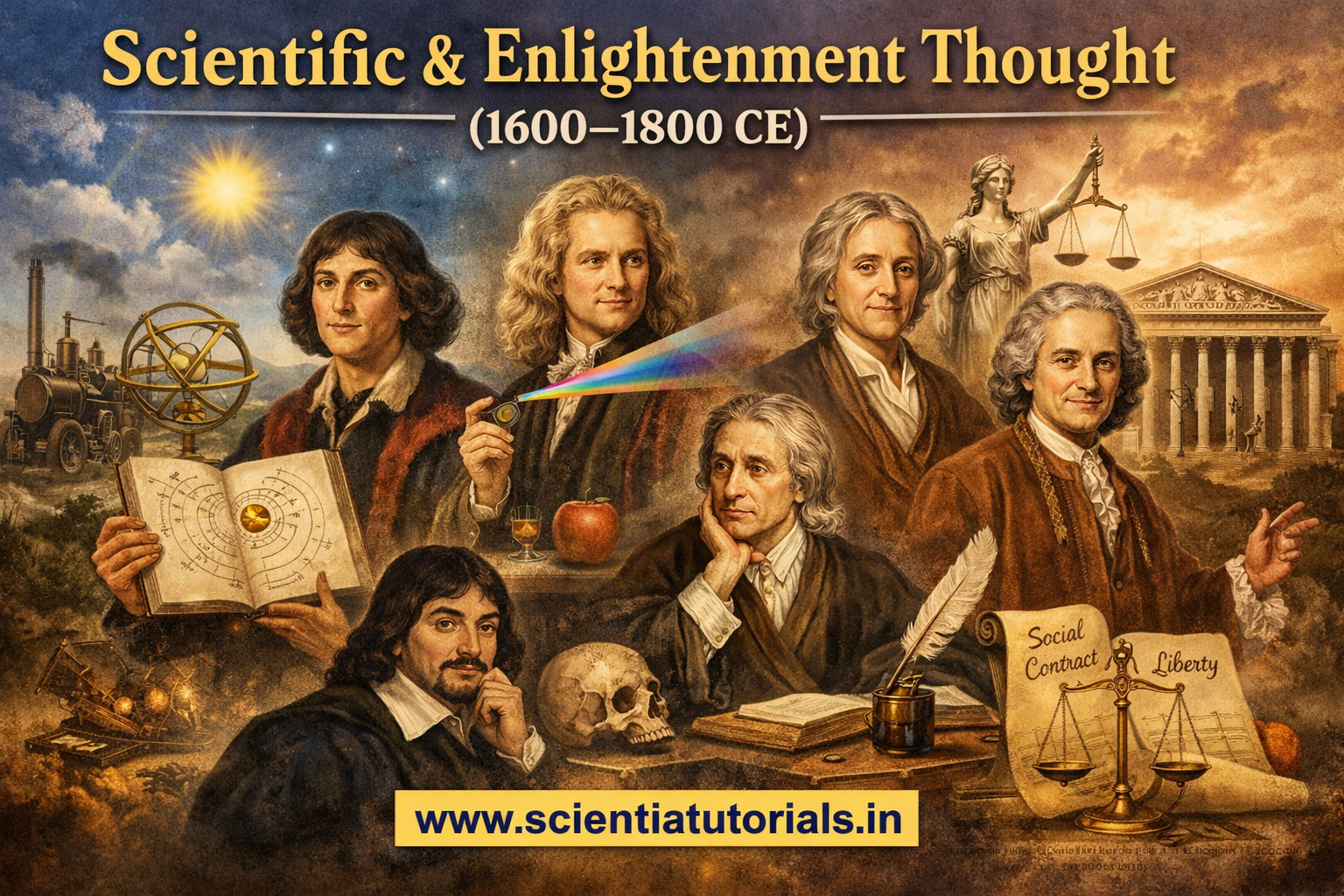
Scientific and Enlightenment Thought (1600–1800 CE) | World History
Course: World History: From Early Civilizations to the Contemporary Global System
-
Module V: Age of Revolutions and Industrialization
-
Lesson 1: Scientific and Enlightenment Thought (c. 1600–1800 CE)
This lesson is systematically organized into four clearly structured sections, as detailed below:
- Chronologically Structured Study Module
- Short-Answer Type Questions
- Long-Answer Type Questions
- Multiple-Choice Questions (MCQs) with Answers and Detailed Explanations
Chronologically Structured Study Module
Module Introduction
The period between c. 1600 and 1800 CE marks one of the most decisive intellectual turning points in world history. During these two centuries, European societies experienced profound transformations in how knowledge was acquired, how nature was understood, and how political authority was justified. Known collectively as the Scientific Revolution and the Enlightenment, these movements laid the intellectual foundations for modern science, democratic governance, secularism, and human rights.
This lesson is situated within Module V: Age of Revolutions and Industrialization, as the ideas developed during this era directly inspired the American Revolution, the French Revolution, and later social and industrial transformations. The Scientific and Enlightenment thinkers challenged inherited traditions, religious dogma, and absolutist political authority, replacing them with reason, experimentation, and critical inquiry.
This chronologically structured study module is designed for examination-oriented preparation, presenting concepts in an era-wise progression while highlighting key thinkers, ideas, and their long-term historical significance.
Lesson Objectives
By the end of this lesson, learners should be able to:
- Explain the origins and significance of the Scientific Revolution
- Distinguish between rationalism and empiricism
- Identify major Enlightenment thinkers and their core ideas
- Analyze Enlightenment political philosophy and its challenge to absolutism
- Evaluate the global and long-term impact of Scientific and Enlightenment thought
I. Intellectual Background: Europe Before 1600
Before the seventeenth century, European intellectual life was dominated by medieval scholasticism, which emphasized theology and the authority of ancient texts, especially those of Aristotle as interpreted by the Church. Knowledge was largely derived from tradition rather than observation.
However, several developments prepared the ground for change:
- The Renaissance revived interest in classical learning and human potential
- The Protestant Reformation encouraged questioning of authority
- The Age of Exploration expanded geographical knowledge
- The printing press facilitated the rapid spread of new ideas
Together, these forces weakened intellectual conformity and created conditions for a new way of understanding the natural world.
II. The Scientific Revolution (c. 1600 – 1700 CE)
A. Defining the Scientific Revolution
The Scientific Revolution refers to a period of fundamental transformation in scientific thinking, characterized by:
- Reliance on observation and experimentation
- Use of mathematics to explain natural laws
- Rejection of blind reliance on ancient authorities
This revolution changed science from a speculative discipline into a systematic method of inquiry.
B. Key Figures of the Scientific Revolution
- Nicolaus Copernicus proposed the heliocentric model, placing the Sun at the center of the universe.
- Galileo Galilei used the telescope to confirm heliocentrism and championed experimental science.
- Johannes Kepler formulated laws of planetary motion, showing that orbits were elliptical.
- Isaac Newton synthesized earlier discoveries in his Principia, establishing the laws of motion and universal gravitation.
Newton’s work symbolized the triumph of scientific reasoning and inspired Enlightenment thinkers to apply similar logic to society and politics.
C. Impact of the Scientific Revolution
- Undermined religious explanations of natural phenomena
- Encouraged confidence in human reason
- Introduced the idea of natural laws, which later influenced political theory
III. Rationalism and Empiricism: Competing Paths to Knowledge
One of the central intellectual debates of this era concerned how humans acquire knowledge.
A. Rationalism
Rationalism emphasized reason as the primary source of knowledge.
- René Descartes famously declared “I think, therefore I am”, arguing that truth could be discovered through logical reasoning.
- Rationalists believed that certain ideas were innate, existing prior to experience.
Rationalism encouraged skepticism of tradition and emphasized systematic doubt.
B. Empiricism
Empiricism argued that knowledge comes from sensory experience.
- Francis Bacon advocated inductive reasoning and experimentation.
- John Locke described the human mind as a tabula rasa (blank slate), shaped by experience.
Empiricism strongly influenced scientific methodology and political philosophy.
C. Significance of the Debate
The tension between rationalism and empiricism shaped modern epistemology and continues to influence scientific and philosophical inquiry today.
IV. The Enlightenment (c. 1700 – 1800 CE)
A. Defining the Enlightenment
The Enlightenment was an intellectual movement that sought to apply reason and scientific principles to human society, including politics, religion, and economics.
Core Enlightenment ideals included:
- Reason and critical thinking
- Individual liberty
- Religious tolerance
- Progress and reform
B. Major Enlightenment Thinkers
- Voltaire criticized intolerance and defended freedom of speech.
- Montesquieu proposed the separation of powers in government.
- Jean-Jacques Rousseau argued that sovereignty rested with the general will of the people.
- Denis Diderot edited the Encyclopédie, spreading Enlightenment ideas across Europe.
C. Enlightenment Salons and Print Culture
- Salons hosted debates among intellectuals and aristocrats
- Pamphlets and books expanded literacy and public discourse
- Knowledge became increasingly democratized
V. Enlightenment Political Philosophy
A. Natural Rights and Social Contract
Enlightenment philosophers rejected the divine right of kings, arguing instead that governments existed to protect natural rights.
- Thomas Hobbes emphasized order and strong authority.
- John Locke argued for life, liberty, and property as natural rights.
- Jean-Jacques Rousseau believed legitimate authority came from popular sovereignty.
B. Influence on Revolutions
These ideas directly influenced:
- The American Declaration of Independence (1776)
- The French Declaration of the Rights of Man (1789)
VI. Global and Historical Significance
The Scientific and Enlightenment Thought transformed world history by:
- Establishing the foundations of modern science
- Promoting constitutionalism and democracy
- Encouraging secular governance
- Inspiring reform movements beyond Europe
Although primarily European in origin, these ideas later spread globally through imperialism, education, and reform movements.
VII. Chronological Summary Table
| Period | Key Developments |
|---|---|
| c. 1600–1650 | Early Scientific Revolution |
| c. 1650–1700 | Newtonian synthesis |
| c. 1700–1750 | High Enlightenment |
| c. 1750–1800 | Political application of Enlightenment ideas |
Conclusion
Scientific and Enlightenment Thought reshaped humanity’s understanding of the universe, society, and governance. By emphasizing reason, evidence, and individual rights, this era laid the intellectual groundwork for political revolutions and industrial transformation. Its legacy remains visible in modern scientific institutions, democratic systems, and the global commitment to human rights.
This lesson forms a crucial intellectual bridge between early modern Europe and the revolutionary transformations that define the modern world.
Short Answer Type Questions with Answers
1. What is meant by the Scientific Revolution?
The Scientific Revolution was a period (c. 1600–1700 CE) marked by a shift from traditional beliefs to scientific inquiry based on observation, experimentation, and mathematical reasoning.
2. How did the Scientific Revolution differ from medieval scholasticism?
Medieval scholasticism relied on religious authority and classical texts, whereas the Scientific Revolution emphasized empirical evidence, experimentation, and rational inquiry.
3. State one major contribution of Nicolaus Copernicus.
He proposed the heliocentric theory, arguing that the Earth revolves around the Sun, challenging the geocentric model.
4. Why is Galileo Galilei considered a pioneer of modern science?
He used systematic observation and experimentation, especially astronomical observations through the telescope, to support heliocentrism.
5. What were the laws of planetary motion formulated by Johannes Kepler?
They stated that planets move in elliptical orbits and that their motion follows precise mathematical principles.
6. Mention one key achievement of Isaac Newton.
He formulated the laws of motion and universal gravitation, unifying physics and astronomy under universal natural laws.
7. What is meant by rationalism?
Rationalism is the belief that reason and logical thinking are the primary sources of knowledge rather than sensory experience.
8. Name the philosopher most closely associated with rationalism.
René Descartes, known for emphasizing doubt and logical reasoning.
9. What is empiricism?
Empiricism is the theory that knowledge is derived mainly from sensory experience and observation.
10. Identify the thinker who promoted the inductive scientific method.
Francis Bacon advocated experimentation and inductive reasoning.
11. What does the term tabula rasa signify?
It means “blank slate,” suggesting that the human mind is shaped by experience rather than innate ideas.
12. Which philosopher introduced the idea of tabula rasa?
John Locke introduced this concept to explain human learning.
13. Define the Enlightenment.
The Enlightenment was an intellectual movement (c. 1700–1800 CE) that emphasized reason, individual rights, tolerance, and progress.
14. What role did salons play during the Enlightenment?
Salons served as meeting places where intellectuals discussed philosophy, science, and politics, helping spread Enlightenment ideas.
15. State one major idea advocated by Voltaire.
He supported freedom of speech and religious tolerance and criticized intolerance and absolutism.
16. What is the theory of separation of powers?
It is the idea that government power should be divided into legislative, executive, and judicial branches to prevent tyranny.
17. Which Enlightenment thinker proposed the separation of powers?
Montesquieu proposed this principle.
18. What is meant by the social contract?
The social contract is the idea that political authority arises from an agreement among individuals to form a government for mutual benefit.
19. How did Jean-Jacques Rousseau differ from other social contract theorists?
He argued that sovereignty lies with the general will of the people rather than rulers.
20. What was the purpose of the Encyclopédie?
It aimed to compile and spread human knowledge and promote Enlightenment ideals.
21. Name the chief editor of the Encyclopédie.
Denis Diderot was its chief editor.
22. How did Enlightenment thinkers challenge the divine right of kings?
They argued that political authority should be based on reason, law, and the consent of the governed, not divine approval.
23. Mention one political document influenced by Enlightenment ideas.
The American Declaration of Independence (1776) was strongly influenced by Enlightenment principles.
24. State one long-term impact of Scientific Thought on society.
It laid the foundation for modern science and technological advancement.
25. Why is Scientific and Enlightenment Thought important to the Age of Revolutions?
These ideas inspired political revolutions by promoting liberty, equality, rational governance, and individual rights.
Long Answer Type Questions with Answers
1. Examine the historical conditions that led to the rise of the Scientific Revolution in Europe.
The Scientific Revolution emerged due to multiple interconnected developments. The Renaissance revived classical learning and emphasized human potential. The Protestant Reformation weakened unquestioned Church authority. Overseas explorations expanded geographical knowledge, while the printing press enabled rapid circulation of ideas. Together, these developments encouraged skepticism, inquiry, and reliance on observation rather than tradition, leading to a new scientific outlook.
2. Define the Scientific Revolution and explain its major characteristics.
The Scientific Revolution was a transformation in scientific thinking between c. 1600 and 1700 CE. Its key characteristics included reliance on observation and experimentation, use of mathematics to explain natural phenomena, rejection of blind reliance on ancient authorities, and belief in universal natural laws governing the universe.
3. Discuss the significance of the heliocentric theory in transforming scientific thought.
The heliocentric theory, proposed by Nicolaus Copernicus, challenged the long-accepted geocentric worldview supported by the Church. By placing the Sun at the center of the universe, it revolutionized astronomy, weakened religious explanations of nature, and encouraged independent scientific reasoning, marking a decisive break from medieval thought.
4. Assess the contribution of Galileo Galilei to the Scientific Revolution.
Galileo combined experimentation with mathematical analysis and used the telescope to make groundbreaking astronomical observations. His confirmation of heliocentrism and insistence on empirical evidence strengthened scientific methodology. His conflict with the Church symbolized the struggle between new science and traditional authority.
5. Explain how Isaac Newton unified earlier scientific discoveries.
Newton synthesized the findings of Copernicus, Galileo, and Kepler into a coherent system governed by universal laws. His laws of motion and gravitation demonstrated that the same principles governed both earthly and celestial motion, reinforcing confidence in reason and scientific explanation.
6. What is rationalism? Discuss its philosophical foundations and significance.
Rationalism is the belief that reason is the primary source of knowledge. Rationalists argued that truth could be discovered through logical deduction rather than sensory experience. This approach encouraged systematic doubt and critical thinking, weakening traditional authority and contributing to Enlightenment philosophy.
7. Analyze the philosophical contributions of René Descartes.
Descartes emphasized methodological doubt, arguing that only ideas that could withstand rational scrutiny were valid. His statement “I think, therefore I am” established self-conscious reasoning as the foundation of knowledge, shaping modern philosophy and scientific inquiry.
8. Explain empiricism and its importance in the development of modern science.
Empiricism holds that knowledge originates from sensory experience. Empiricists emphasized observation, experimentation, and evidence. This approach became the foundation of the scientific method and influenced political philosophy by emphasizing experience-based understanding of society.
9. Discuss the role of Francis Bacon in shaping scientific methodology.
Francis Bacon advocated inductive reasoning, encouraging scientists to derive general principles from specific observations. He rejected speculative philosophy and promoted experimentation, helping establish the modern scientific method.
10. Examine the political and philosophical ideas of John Locke.
Locke argued that humans are born with a blank slate (tabula rasa) and that governments exist to protect natural rights such as life, liberty, and property. He supported limited government and popular consent, directly influencing modern democratic theory.
11. Define the Enlightenment and explain its core ideals.
The Enlightenment was an intellectual movement emphasizing reason, progress, tolerance, and individual rights. Thinkers believed that applying scientific reasoning to society and politics could reform institutions and improve human conditions.
12. How did Enlightenment thinkers challenge religious and political authority?
They questioned divine right monarchy, criticized religious intolerance, and promoted secular governance. By emphasizing reason over tradition, Enlightenment thinkers undermined absolutism and promoted accountability and reform.
13. Evaluate the contributions of Voltaire to Enlightenment thought.
Voltaire championed freedom of speech, religious tolerance, and civil liberties. Through satire and essays, he criticized intolerance and arbitrary authority, helping popularize Enlightenment ideals among a broader public.
14. Explain the theory of separation of powers proposed by Montesquieu.
Montesquieu argued that political power should be divided among legislative, executive, and judicial branches. This separation prevents tyranny and ensures liberty, influencing modern constitutional systems worldwide.
15. Discuss the social contract theory as developed by Enlightenment thinkers.
Social contract theory explains government as an agreement among individuals to form a society for mutual protection. It replaced divine explanations of authority with rational, human-centered justifications for political power.
16. Analyze the political philosophy of Jean-Jacques Rousseau.
Rousseau argued that sovereignty rests with the people and that laws should reflect the general will. He emphasized equality and popular participation, influencing democratic and revolutionary movements.
17. Assess the importance of the Encyclopédie in spreading Enlightenment ideas.
Edited by Denis Diderot, the Encyclopédie compiled contemporary knowledge and promoted reason, secularism, and reform. It played a crucial role in disseminating Enlightenment ideas across Europe.
18. How did salons and print culture contribute to the Enlightenment?
Salons facilitated intellectual exchange among thinkers, while books, pamphlets, and newspapers expanded literacy and public debate. These platforms helped democratize knowledge and spread reformist ideas beyond elite circles.
19. Examine the relationship between Enlightenment ideas and political revolutions.
Enlightenment principles inspired revolutionary movements by promoting liberty, equality, and representative government. These ideas directly influenced the American and French Revolutions and challenged absolutist regimes.
20. Evaluate the long-term global significance of Scientific and Enlightenment Thought.
Scientific and Enlightenment ideas laid the foundations of modern science, democracy, secular governance, and human rights. Though European in origin, they spread globally and continue to shape political institutions, education systems, and intellectual life.
Multiple Choice Questions (MCQs) with Answers and Explanations
1. The Scientific Revolution is best described as a shift from
A. Religious faith to superstition
B. Tradition and authority to observation and reason
C. Philosophy to theology
D. Art to literature
Correct Answer: B
Explanation:
The Scientific Revolution emphasized empirical observation, experimentation, and rational analysis, replacing medieval reliance on religious authority and classical texts.
2. Which theory challenged the Church-supported geocentric model?
A. Theory of gravitation
B. Social contract theory
C. Heliocentric theory
D. Theory of evolution
Correct Answer: C
Explanation:
The heliocentric theory placed the Sun at the center of the universe, directly contradicting the geocentric belief endorsed by the Church.
3. Who proposed the heliocentric model of the universe?
A. Galileo Galilei
B. Johannes Kepler
C. Nicolaus Copernicus
D. Isaac Newton
Correct Answer: C
Explanation:
Copernicus argued that the Earth and other planets revolve around the Sun, initiating a major scientific shift.
4. Which scientist used a telescope to support heliocentrism?
A. Newton
B. Galileo
C. Bacon
D. Descartes
Correct Answer: B
Explanation:
Galileo’s telescopic observations of planetary motion provided strong empirical evidence for heliocentrism.
5. The laws of motion and universal gravitation were formulated by
A. Copernicus
B. Kepler
C. Descartes
D. Isaac Newton
Correct Answer: D
Explanation:
Newton unified physics and astronomy by explaining motion and gravity through universal laws.
6. Rationalism emphasizes
A. Sensory experience
B. Religious faith
C. Reason as the source of knowledge
D. Tradition
Correct Answer: C
Explanation:
Rationalists believed that knowledge could be discovered through logical reasoning rather than observation.
7. “I think, therefore I am” is associated with
A. John Locke
B. Francis Bacon
C. René Descartes
D. Voltaire
Correct Answer: C
Explanation:
Descartes used this statement to establish reason and self-awareness as the foundation of knowledge.
8. Empiricism holds that knowledge is derived from
A. Logic alone
B. Divine revelation
C. Sensory experience
D. Innate ideas
Correct Answer: C
Explanation:
Empiricists argued that observation and experience shape human understanding.
9. Who promoted the inductive method of scientific inquiry?
A. Descartes
B. Hobbes
C. Newton
D. Francis Bacon
Correct Answer: D
Explanation:
Bacon encouraged deriving general principles from specific observations through experimentation.
10. The idea of tabula rasa suggests that
A. Humans are naturally sinful
B. Knowledge is inherited
C. The mind is shaped by experience
D. Reason is superior to experience
Correct Answer: C
Explanation:
Tabula rasa means “blank slate,” indicating that experience forms knowledge.
11. Which philosopher introduced the concept of tabula rasa?
A. Rousseau
B. Hobbes
C. John Locke
D. Montesquieu
Correct Answer: C
Explanation:
Locke rejected innate ideas and emphasized experience in shaping the human mind.
12. The Enlightenment primarily emphasized
A. Obedience to monarchy
B. Reason, liberty, and progress
C. Military expansion
D. Feudal loyalty
Correct Answer: B
Explanation:
Enlightenment thinkers believed reason and reform could improve society and governance.
13. Which thinker strongly advocated freedom of speech and religious tolerance?
A. Rousseau
B. Montesquieu
C. Voltaire
D. Hobbes
Correct Answer: C
Explanation:
Voltaire criticized intolerance and defended civil liberties through his writings.
14. The theory of separation of powers was proposed by
A. Locke
B. Rousseau
C. Hobbes
D. Montesquieu
Correct Answer: D
Explanation:
Montesquieu argued that dividing governmental power prevents tyranny.
15. Which branches of government are included in separation of powers?
A. Church, State, Army
B. Executive, Legislative, Judicial
C. King, Nobility, Clergy
D. Central, Provincial, Local
Correct Answer: B
Explanation:
This division ensures checks and balances within a political system.
16. The social contract theory explains
A. Divine origin of kingship
B. Economic inequality
C. Origin of government through agreement
D. Scientific laws of nature
Correct Answer: C
Explanation:
Social contract theorists argued that governments are formed by consent of the governed.
17. Who emphasized popular sovereignty and the general will?
A. Hobbes
B. Locke
C. Voltaire
D. Jean-Jacques Rousseau
Correct Answer: D
Explanation:
Rousseau believed true authority lies with the collective will of the people.
18. Which work aimed to compile and spread Enlightenment knowledge?
A. Leviathan
B. Principia
C. Social Contract
D. Encyclopédie
Correct Answer: D
Explanation:
The Encyclopédie disseminated scientific, political, and philosophical ideas.
19. The chief editor of the Encyclopédie was
A. Voltaire
B. Montesquieu
C. Rousseau
D. Denis Diderot
Correct Answer: D
Explanation:
Diderot played a central role in organizing and publishing Enlightenment knowledge.
20. Enlightenment thinkers rejected
A. Reason
B. Popular consent
C. Divine right of kings
D. Natural rights
Correct Answer: C
Explanation:
They argued that political authority should be based on reason and consent, not divine approval.
21. Which revolution was directly influenced by Enlightenment ideas?
A. Russian Revolution
B. American Revolution
C. Industrial Revolution
D. Neolithic Revolution
Correct Answer: B
Explanation:
Ideas of liberty, natural rights, and representative government shaped the American Revolution.
22. Which concept links Scientific Thought to political philosophy?
A. Astrology
B. Natural laws
C. Feudal loyalty
D. Mysticism
Correct Answer: B
Explanation:
The idea of natural laws inspired thinkers to seek rational laws governing society and politics.
23. Salons during the Enlightenment were
A. Religious courts
B. Military academies
C. Social gatherings for intellectual debate
D. Government offices
Correct Answer: C
Explanation:
Salons helped spread Enlightenment ideas through discussion and debate.
24. One long-term impact of Enlightenment Thought was
A. Strengthening absolutism
B. Growth of democracy
C. Decline of education
D. Return to feudalism
Correct Answer: B
Explanation:
Enlightenment ideas promoted constitutional government and individual rights.
25. Scientific and Enlightenment Thought is considered revolutionary because it
A. Promoted superstition
B. Reinforced medieval beliefs
C. Encouraged critical inquiry and reform
D. Opposed education
Correct Answer: C
Explanation:
By emphasizing reason, evidence, and reform, these ideas transformed science, politics, and society.