Indian Railways GK Questions and Answers – 30 MCQs
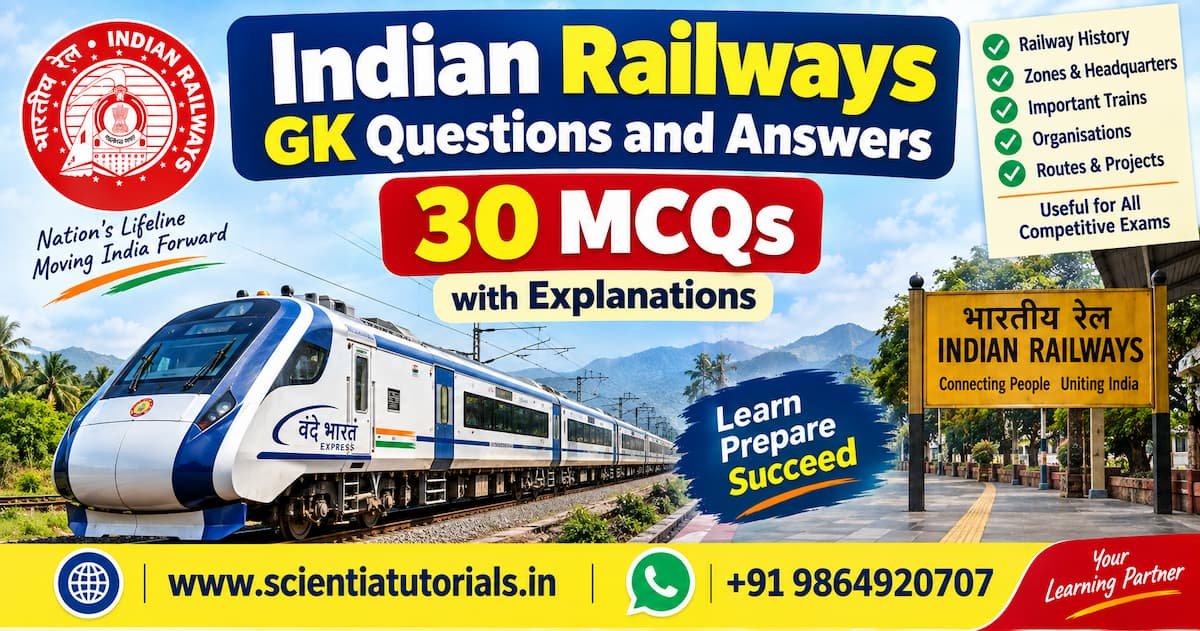
Indian Railways GK Questions and Answers – 30 MCQs
This comprehensive set of 30 Indian Railways GK MCQs covers railway history, zones and headquarters, gauges, electrification, important trains, railway organisations, infrastructure, technology, safety, and modernisation. The questions are designed for UPSC, SSC, Railway Recruitment Exams, Banking, PSC, State Exams, Defence Exams, and other competitive examinations in India.
1. When did the first passenger train in India run?
A) 15 August 1947
B) 16 April 1853
C) 26 January 1950
D) 1 April 1851
Answer: B) 16 April 1853
Explanation:
The first passenger railway service in India began on 16 April 1853, when a train ran from Bori Bunder (Mumbai) to Thane. The train covered approximately 34 km, carrying around 400 passengers in 14 coaches. This event marked the beginning of India’s passenger railway era.
Concept:
1853 → First passenger train → Mumbai–Thane → approximately 34 km.
2. The first passenger train in India ran between which two places?
A) Kolkata and Howrah
B) Mumbai and Pune
C) Mumbai and Thane
D) Chennai and Arakkonam
Answer: C) Mumbai and Thane
Explanation:
The first passenger train operated between Bori Bunder in Mumbai and Thane. It was operated by the Great Indian Peninsula Railway (GIPR), whose system later became part of Central Railway.
The train was hauled by three steam locomotives and covered about 34 km.
Exam Tip:
Do not confuse the first railway line with the first railway workshop or later railway developments.
3. What is the broad gauge used by Indian Railways?
A) 1,000 mm
B) 1,435 mm
C) 1,676 mm
D) 762 mm
Answer: C) 1,676 mm
Explanation:
The principal broad gauge used by Indian Railways is 1,676 mm (5 feet 6 inches). It is wider than standard gauge, which is 1,435 mm.
Historically, Indian Railways used broad gauge, metre gauge and narrow gauges. A major gauge-conversion programme has progressively converted many routes to broad gauge. Official Indian Railways technical documents identify 1,676 mm as the broad gauge.
Concept:
Broad Gauge in Indian Railways → 1,676 mm.
4. Which railway zone has its headquarters at Gorakhpur?
A) Northern Railway
B) North Eastern Railway
C) North Central Railway
D) East Central Railway
Answer: B) North Eastern Railway
Explanation:
The headquarters of North Eastern Railway (NER) is at Gorakhpur, Uttar Pradesh. Its divisions include Lucknow, Izzatnagar and Varanasi.
Concept:
Gorakhpur → North Eastern Railway.
Exam Tip:
Do not confuse North Eastern Railway (Gorakhpur) with Northeast Frontier Railway (Guwahati).
5. What is the headquarters of the Northeast Frontier Railway?
A) Guwahati
B) Gorakhpur
C) Kolkata
D) Siliguri
Answer: A) Guwahati
Explanation:
The Northeast Frontier Railway (NFR) has its headquarters at Guwahati, Assam. It plays an important role in providing railway connectivity to Northeast India.
Its divisions include Alipurduar, Katihar, Lumding, Rangiya and Tinsukia.
Concept:
Northeast Frontier Railway → Guwahati → Northeast India.
6. Which railway zone has its headquarters at New Delhi?
A) Northern Railway
B) North Central Railway
C) North Western Railway
D) Northern Frontier Railway
Answer: A) Northern Railway
Explanation:
Northern Railway has its headquarters in New Delhi. According to the Railway Board’s list, its divisions include Ambala, Delhi, Lucknow, Moradabad and Firozpur.
Concept:
Northern Railway → New Delhi.
7. Which railway zone has its headquarters at Prayagraj?
A) North Eastern Railway
B) North Central Railway
C) Northern Railway
D) East Central Railway
Answer: B) North Central Railway
Explanation:
The headquarters of North Central Railway (NCR) is at Prayagraj, Uttar Pradesh. Its divisions include Prayagraj, Agra and Jhansi.
Concept:
North Central Railway → Prayagraj → Agra/Jhansi divisions.
8. Which railway zone has its headquarters at Hajipur?
A) East Central Railway
B) Eastern Railway
C) East Coast Railway
D) North Eastern Railway
Answer: A) East Central Railway
Explanation:
East Central Railway (ECR) has its headquarters at Hajipur, Bihar. Its divisions include Sonpur, Samastipur, Danapur, Dhanbad and Pt. Deen Dayal Upadhyaya.
Concept:
Hajipur → East Central Railway.
9. Which railway zone has its headquarters at Jaipur?
A) North Western Railway
B) Western Railway
C) Northern Railway
D) West Central Railway
Answer: A) North Western Railway
Explanation:
The headquarters of North Western Railway (NWR) is at Jaipur, Rajasthan. Its divisions are Ajmer, Bikaner, Jaipur and Jodhpur.
Concept:
Jaipur → North Western Railway.
10. Which railway zone has its headquarters at Jabalpur?
A) West Central Railway
B) Western Railway
C) Central Railway
D) South Central Railway
Answer: A) West Central Railway
Explanation:
West Central Railway (WCR) has its headquarters at Jabalpur, Madhya Pradesh. Its divisions include Bhopal, Jabalpur and Kota.
Concept:
Jabalpur → West Central Railway.
11. India’s first electric train was introduced between which two stations?
A) Mumbai VT and Kurla
B) Mumbai and Thane
C) Howrah and Burdwan
D) Chennai and Arakkonam
Answer: A) Mumbai VT and Kurla
Explanation:
India’s first electric train was introduced on 3 February 1925 between Bombay VT (now Chhatrapati Shivaji Maharaj Terminus) and Kurla. The service used 1,500-volt DC electric traction.
Concept:
1925 → First electric train → Bombay VT–Kurla.
12. Which railway route is famous for running along the western coast through difficult terrain?
A) Konkan Railway
B) Grand Chord
C) Kalka-Shimla Railway
D) Frontier Railway
Answer: A) Konkan Railway
Explanation:
The Konkan Railway is an important railway route along India’s western coast. It passes through challenging geographical terrain involving mountains, valleys, rivers and numerous tunnels and bridges.
It greatly improved connectivity between parts of Maharashtra, Goa and Karnataka.
Concept:
Konkan Railway → Western Coast → Difficult terrain → Maharashtra–Goa–Karnataka.
13. Which of the following is a UNESCO World Heritage railway associated with the Darjeeling hills?
A) Nilgiri Mountain Railway
B) Darjeeling Himalayan Railway
C) Konkan Railway
D) Palace on Wheels
Answer: B) Darjeeling Himalayan Railway
Explanation:
The Darjeeling Himalayan Railway (DHR) is popularly known as the Toy Train. It is a narrow-gauge mountain railway connecting the Darjeeling region with the plains and is part of the UNESCO-listed Mountain Railways of India.
The other components of the UNESCO property include the Nilgiri Mountain Railway and Kalka-Shimla Railway.
Concept:
Darjeeling → Toy Train → Mountain Railway → UNESCO.
14. Which city was the first in India to have a metro railway service?
A) Delhi
B) Mumbai
C) Kolkata
D) Chennai
Answer: C) Kolkata
Explanation:
Kolkata Metro was the first metro railway system in India. The first metro service began operations in 1984.
Delhi Metro began later and has subsequently developed into one of India’s largest urban rapid-transit systems.
Concept:
First Metro in India → Kolkata.
15. Which organisation is primarily responsible for railway ticketing and catering-related services through its online platform?
A) IRCTC
B) RDSO
C) RITES
D) RVNL
Answer: A) IRCTC
Explanation:
The Indian Railway Catering and Tourism Corporation (IRCTC) was established in 1999 as a public-sector enterprise under the Ministry of Railways. It provides services related to online railway ticketing, catering, tourism and related passenger services.
Concept:
IRCTC → Online ticketing + Catering + Tourism.
16. What does IRCTC stand for?
A) Indian Railway Cargo and Travel Corporation
B) Indian Railway Catering and Tourism Corporation
C) Indian Rail Coach and Transport Corporation
D) Indian Railway Commercial and Tourism Council
Answer: B) Indian Railway Catering and Tourism Corporation
Explanation:
IRCTC stands for Indian Railway Catering and Tourism Corporation. It is closely associated with online railway ticket booking, catering, tourism packages, Rail Neer and other passenger-related services.
Exam Tip:
IRCTC is different from Indian Railways, although it is a railway-sector public enterprise.
17. Where is the headquarters of the Research Designs & Standards Organisation (RDSO)?
A) New Delhi
B) Lucknow
C) Mumbai
D) Chennai
Answer: B) Lucknow
Explanation:
The Research Designs & Standards Organisation (RDSO) is located at Lucknow, Uttar Pradesh. It plays an important role in railway research, design, standards, testing and technical development. Official RDSO documents identify its location as Manak Nagar, Lucknow.
Concept:
RDSO → Research & technical standards → Lucknow.
18. What is the primary function of RDSO?
A) Conducting railway ticket reservations
B) Research, design and development of railway standards
C) Operating railway stations
D) Collecting railway fares
Answer: B) Research, design and development of railway standards
Explanation:
RDSO supports Indian Railways through research, design, development, testing and standardisation of railway equipment, systems and technologies. Its work covers areas such as rolling stock, track, signalling, telecommunications and electrical systems.
Concept:
RDSO → Research + Designs + Standards + Testing.
19. In which year was the Railway Budget merged with the Union Budget?
A) 2014
B) 2015
C) 2016
D) 2017
Answer: D) 2017
Explanation:
The separate Railway Budget was merged with the Union Budget in 2017. From the financial year 2017–18, railway financial estimates were incorporated into the Union Budget framework. Official Railway documents confirm the merger in 2017.
Concept:
Separate Railway Budget → merged with Union Budget → 2017–18.
20. Which railway zone has its headquarters at Bhubaneswar?
A) East Coast Railway
B) Eastern Railway
C) South Eastern Railway
D) East Central Railway
Answer: A) East Coast Railway
Explanation:
East Coast Railway (ECoR) has its headquarters at Bhubaneswar, Odisha. Its divisions include Khurda Road, Sambalpur and Waltair according to the Railway Board’s listed organisational structure.
Concept:
Bhubaneswar → East Coast Railway.
21. Which railway zone has its headquarters at Secunderabad?
A) South Central Railway
B) Southern Railway
C) South Western Railway
D) South Eastern Railway
Answer: A) South Central Railway
Explanation:
South Central Railway (SCR) has its headquarters at Secunderabad, Telangana. It serves important parts of southern and central India and includes divisions such as Secunderabad, Hyderabad, Vijayawada, Guntur, Guntakal and Nanded.
Concept:
Secunderabad → South Central Railway.
22. Which railway zone has its headquarters at Hubballi?
A) South Western Railway
B) Southern Railway
C) South Central Railway
D) Central Railway
Answer: A) South Western Railway
Explanation:
South Western Railway (SWR) has its headquarters at Hubballi (Hubli), Karnataka. Its divisions include Bengaluru, Hubballi and Mysuru.
Concept:
Hubballi → South Western Railway.
23. Which railway zone has its headquarters at Chennai?
A) Southern Railway
B) South Central Railway
C) South Western Railway
D) Eastern Railway
Answer: A) Southern Railway
Explanation:
Southern Railway has its headquarters at Chennai, Tamil Nadu. Its divisions include Chennai, Madurai, Palakkad, Tiruchirappalli, Thiruvananthapuram and Salem.
Concept:
Chennai → Southern Railway.
24. Which railway zone has its headquarters at Mumbai and includes divisions such as Mumbai Central and Vadodara?
A) Central Railway
B) Western Railway
C) Northern Railway
D) West Central Railway
Answer: B) Western Railway
Explanation:
Western Railway (WR) has its headquarters at Mumbai. Its divisions include Mumbai Central, Vadodara, Ratlam, Ahmedabad, Rajkot and Bhavnagar.
Exam Tip:
Mumbai is associated with both Central Railway and Western Railway, so the divisions help distinguish them.
25. Which railway zone has its headquarters at Kolkata and includes the Howrah and Sealdah divisions?
A) Eastern Railway
B) South Eastern Railway
C) East Coast Railway
D) East Central Railway
Answer: A) Eastern Railway
Explanation:
Eastern Railway (ER) has its headquarters at Kolkata. Its divisions include Howrah, Sealdah, Asansol and Malda.
Concept:
Eastern Railway → Kolkata → Howrah + Sealdah.
26. Which of the following is correctly matched?
A) North Eastern Railway — Guwahati
B) Northeast Frontier Railway — Gorakhpur
C) South Central Railway — Secunderabad
D) West Central Railway — Jaipur
Answer: C) South Central Railway — Secunderabad
Explanation:
The correct headquarters are:
- North Eastern Railway → Gorakhpur
- Northeast Frontier Railway → Guwahati
- South Central Railway → Secunderabad
- West Central Railway → Jabalpur
These headquarters are frequently tested in Railway and general-awareness examinations.
27. What is the full form of RPF in the Indian Railways context?
A) Railway Protection Force
B) Railway Passenger Force
C) Railway Police Federation
D) Railway Public Force
Answer: A) Railway Protection Force
Explanation:
RPF stands for Railway Protection Force. It is a central armed force under the administrative control of the Ministry of Railways and is responsible for protecting railway property, passenger areas and related railway security responsibilities under its legal mandate.
Concept:
RPF → Railway Protection Force → Railway security.
28. The Vande Bharat Express is best described as which of the following?
A) A steam-powered heritage train
B) An indigenously designed semi-high-speed electric trainset
C) A narrow-gauge mountain railway
D) A dedicated freight train
Answer: B) An indigenously designed semi-high-speed electric trainset
Explanation:
Vande Bharat Express is an indigenously designed and manufactured semi-high-speed trainset developed under the Make in India initiative. The first Vande Bharat service was inaugurated in February 2019. Indian Railways describes the trainsets as an important part of modern railway passenger services.
Concept:
Vande Bharat → Indigenous → Semi-high-speed → Modern passenger trainset.
29. Which railway system is particularly associated with the Nilgiri Hills of Tamil Nadu?
A) Kalka-Shimla Railway
B) Darjeeling Himalayan Railway
C) Nilgiri Mountain Railway
D) Konkan Railway
Answer: C) Nilgiri Mountain Railway
Explanation:
The Nilgiri Mountain Railway (NMR) operates in the Nilgiri Hills of Tamil Nadu and connects the plains with the hill station of Ooty (Udhagamandalam). It is part of the UNESCO World Heritage property Mountain Railways of India.
Concept:
Nilgiri Hills → Nilgiri Mountain Railway → Ooty.
30. Which of the following statements about Indian Railways is correct?
A) It operates only passenger trains
B) It uses only narrow gauge
C) It is an important system for both passenger and freight transportation
D) It has no role in national economic development
Answer: C) It is an important system for both passenger and freight transportation
Explanation:
Indian Railways performs a vital dual role by transporting passengers as well as freight. It carries large quantities of commodities such as coal, iron ore, food grains, cement, fertilizers and petroleum products, while also providing extensive passenger connectivity.
Railways therefore have major importance for economic development, national integration, industrial activity, regional connectivity and logistics.
Concept:
Indian Railways → Passenger + Freight → Connectivity + Economic development.
Quick Revision Table – Indian Railways GK
| Topic | Important Fact |
|---|---|
| First passenger train | Mumbai–Thane |
| First passenger train year | 1853 |
| First passenger train date | 16 April 1853 |
| First electric train | Bombay VT–Kurla |
| First electric train year | 1925 |
| Broad Gauge | 1,676 mm |
| First Metro | Kolkata |
| Konkan Railway | Western coastal route |
| Darjeeling Railway | Mountain railway |
| Nilgiri Mountain Railway | Tamil Nadu |
| RDSO headquarters | Lucknow |
| IRCTC established | 1999 |
| Railway Budget merger | 2017 |
| Northern Railway HQ | New Delhi |
| North Eastern Railway HQ | Gorakhpur |
| Northeast Frontier Railway HQ | Guwahati |
| North Central Railway HQ | Prayagraj |
| North Western Railway HQ | Jaipur |
| East Central Railway HQ | Hajipur |
| East Coast Railway HQ | Bhubaneswar |
| Eastern Railway HQ | Kolkata |
| South Central Railway HQ | Secunderabad |
| South Western Railway HQ | Hubballi |
| Southern Railway HQ | Chennai |
| Western Railway HQ | Mumbai |
| West Central Railway HQ | Jabalpur |
| Vande Bharat | Indigenous semi-high-speed trainset |
High-Value Exam Revision Points
Remember these combinations carefully:
- Mumbai–Thane → First passenger train → 1853
- Bombay VT–Kurla → First electric train → 1925
- 1,676 mm → Broad Gauge
- Kolkata → First Metro
- Gorakhpur → North Eastern Railway
- Guwahati → Northeast Frontier Railway
- Prayagraj → North Central Railway
- Hajipur → East Central Railway
- Bhubaneswar → East Coast Railway
- Jaipur → North Western Railway
- Jabalpur → West Central Railway
- Secunderabad → South Central Railway
- Hubballi → South Western Railway
- Chennai → Southern Railway
- Mumbai → Western Railway
- Lucknow → RDSO
- IRCTC → Catering, tourism and online railway ticketing
- 2017 → Railway Budget merged with Union Budget
- Vande Bharat → Indigenous semi-high-speed trainset
These facts are especially useful for Railway Recruitment examinations, SSC, UPSC, Banking, APSC, State PSC, Defence and other General Awareness/GK examinations.