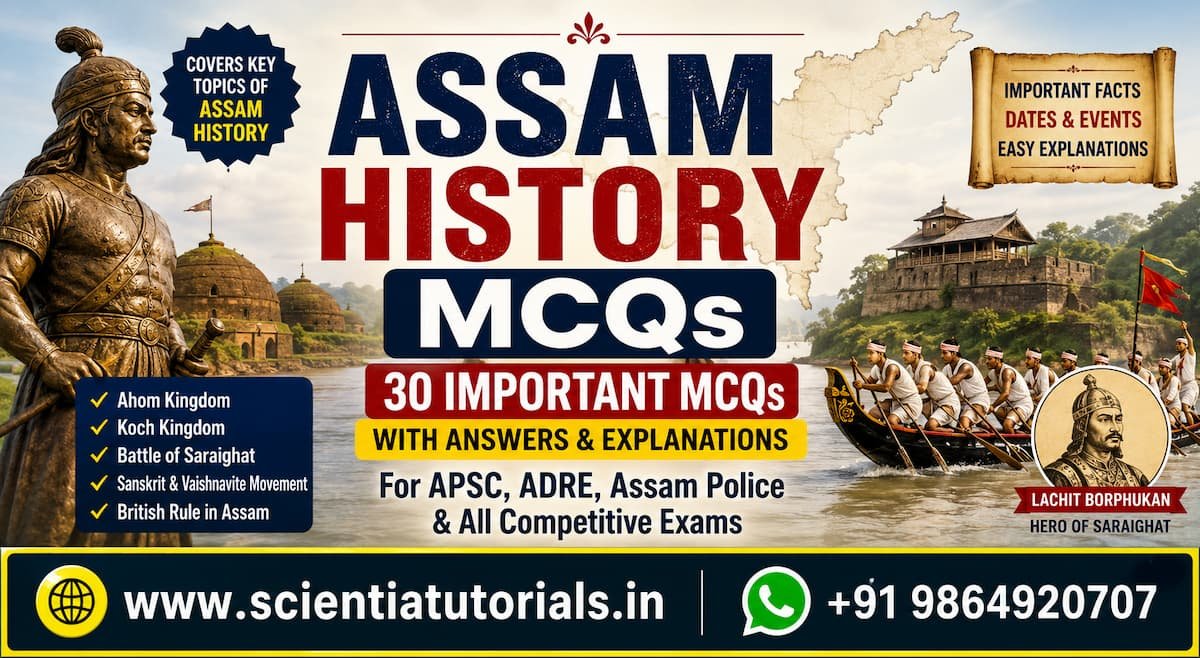
Assam History MCQs with Answers & Explanations for APSC, ADRE, Assam Police and Competitive Exams
Assam History MCQs for APSC, ADRE and Assam Police
The following 30 Multiple Choice Questions (MCQs) have been carefully prepared for APSC, ADRE, Assam Police, Assam TET, Grade III & Grade IV, SSC, Railway, Banking, and other competitive examinations. Each question includes the correct answer along with a detailed explanation to strengthen conceptual understanding.
1. Who is regarded as the founder of the Ahom Kingdom in Assam?
A. Sukapha
B. Suhungmung
C. Gadadhar Singha
D. Rudra Singha
✅ Answer: A. Sukapha
Explanation:
Sukapha, a Tai prince from Mong Mao (present-day Myanmar-China border region), entered Assam in 1228 AD and established the Ahom Kingdom. His arrival marks the beginning of Ahom rule, which continued for nearly 600 years.
Exam Tip:
1228 AD – Arrival of Sukapha is one of the most important dates in Assam History.
2. In which year did Sukapha enter Assam?
A. 1206 AD
B. 1228 AD
C. 1253 AD
D. 1285 AD
✅ Answer: B. 1228 AD
Explanation:
Sukapha crossed the Patkai Hills and entered Assam in 1228 AD with his followers. This event laid the foundation of the Ahom Kingdom.
Remember:
1228 = Beginning of Ahom Rule.
3. The Ahom capital was initially established at:
A. Garhgaon
B. Rangpur
C. Charaideo
D. Jorhat
✅ Answer: C. Charaideo
Explanation:
Sukapha established his first capital at Charaideo in present-day Sivasagar district. It later became the royal burial site of Ahom kings.
Exam Fact:
Charaideo is known as the “Pyramids of Assam” due to the Ahom burial mounds called Moidams.
4. Which Ahom king assumed the Hindu title “Swarganarayan”?
A. Suklenmung
B. Suhungmung
C. Rudra Singha
D. Gadadhar Singha
✅ Answer: B. Suhungmung
Explanation:
Suhungmung (1497–1539) expanded the Ahom Kingdom considerably and adopted the Hindu title Swarganarayan, marking increasing Hindu influence on Ahom administration.
5. Who was the Koch king that founded the Koch Kingdom?
A. Chilarai
B. Biswa Singha
C. Naranarayana
D. Lakshmi Narayan
✅ Answer: B. Biswa Singha
Explanation:
Biswa Singha established the Koch Kingdom in the early 16th century and became its first ruler.
Exam Fact:
Biswa Singha is considered the founder of the Koch dynasty.
6. Chilarai was the brother of:
A. Biswa Singha
B. Naranarayana
C. Lakshmi Narayan
D. Pratap Singha
✅ Answer: B. Naranarayana
Explanation:
Chilarai was the famous military commander and younger brother of King Naranarayana of the Koch Kingdom.
Nickname:
“Chilarai” means Kite King, due to his swift military attacks.
7. Who was the greatest military commander of the Ahoms during the Battle of Saraighat?
A. Gadadhar Singha
B. Sukapha
C. Lachit Borphukan
D. Rudra Singha
✅ Answer: C. Lachit Borphukan
Explanation:
Lachit Borphukan led the Ahom forces against the Mughals and secured a historic victory in the Battle of Saraighat (1671).
Important for Exams:
Lachit Borphukan symbolizes bravery, patriotism, and military leadership.
8. The Battle of Saraighat took place in:
A. 1662
B. 1667
C. 1671
D. 1682
✅ Answer: C. 1671
Explanation:
The Battle of Saraighat was fought in 1671 on the Brahmaputra River between the Ahoms and the Mughal forces led by Raja Ram Singh.
9. The Mughal commander defeated in the Battle of Saraighat was:
A. Mir Jumla
B. Raja Ram Singh
C. Shaista Khan
D. Aurangzeb
✅ Answer: B. Raja Ram Singh
Explanation:
Raja Ram Singh I of Amber commanded the Mughal army but was defeated by Lachit Borphukan.
10. Which Mughal general invaded Assam in 1662?
A. Raja Ram Singh
B. Shaista Khan
C. Mir Jumla
D. Man Singh
✅ Answer: C. Mir Jumla
Explanation:
Mir Jumla, a general of Emperor Aurangzeb, invaded Assam and temporarily occupied Garhgaon.
11. The treaty signed after Mir Jumla’s invasion was:
A. Treaty of Yandaboo
B. Treaty of Ghilajharighat
C. Treaty of Sadiya
D. Treaty of Rangpur
✅ Answer: B. Treaty of Ghilajharighat
Explanation:
The Treaty of Ghilajharighat (1663) was signed between the Ahoms and Mughals after Mir Jumla’s campaign.
12. Who was the first British Commissioner of Assam?
A. David Scott
B. Robert Bruce
C. Francis Jenkins
D. John Butler
✅ Answer: C. Francis Jenkins
Explanation:
Francis Jenkins played a major role in the administration of Assam during the early British period.
13. The Treaty of Yandaboo was signed in:
A. 1824
B. 1825
C. 1826
D. 1830
✅ Answer: C. 1826
Explanation:
The Treaty of Yandaboo ended the First Anglo-Burmese War and transferred Assam to British control.
Most Important Exam Date:
1826 = Beginning of British Rule in Assam.
14. The Treaty of Yandaboo was signed between the British and:
A. Ahoms
B. Koch Kingdom
C. Burma (Myanmar)
D. Mughals
✅ Answer: C. Burma (Myanmar)
Explanation:
The treaty was signed between the British East India Company and Burma on 24 February 1826.
15. Who discovered tea in Assam?
A. David Scott
B. Robert Bruce
C. Charles Bruce
D. Francis Jenkins
✅ Answer: B. Robert Bruce
Explanation:
Robert Bruce identified tea plants growing naturally in Assam in 1823 with the help of local Singpho chiefs.
16. The first tea garden in Assam was established at:
A. Dibrugarh
B. Chabua
C. Jorhat
D. Tezpur
✅ Answer: B. Chabua
Explanation:
Chabua Tea Estate, established in 1837, is regarded as the first tea garden of Assam.
17. The Moamoria Rebellion occurred during the:
A. British Period
B. Koch Period
C. Ahom Period
D. Mughal Period
✅ Answer: C. Ahom Period
Explanation:
The Moamoria Rebellion (1769–1805) weakened the Ahom Kingdom and contributed to its decline.
18. The famous Assamese saint-scholar Srimanta Sankardeva was born in:
A. Majuli
B. Bordowa
C. Barpeta
D. Hajo
✅ Answer: B. Bordowa
Explanation:
Sankardeva was born at Bordowa (Nagaon district) in 1449.
19. Srimanta Sankardeva propagated:
A. Shaivism
B. Shaktism
C. Neo-Vaishnavism
D. Buddhism
✅ Answer: C. Neo-Vaishnavism
Explanation:
He introduced Eka-Sarana-Nama-Dharma, a form of Neo-Vaishnavism emphasizing devotion to Lord Krishna.
20. Who was the chief disciple of Sankardeva?
A. Harideva
B. Madhavdeva
C. Damodardeva
D. Gopaldeva
✅ Answer: B. Madhavdeva
Explanation:
Madhavdeva became the foremost disciple and successor of Sankardeva.
21. Which institution was introduced by Sankardeva?
A. Namghar and Satra
B. Panchayat
C. Mughal Mansabdari
D. Khel System
✅ Answer: A. Namghar and Satra
Explanation:
Namghars and Satras became centers of religion, education, culture, and community life in Assam.
22. The capital of the Kachari Kingdom was:
A. Sadiya
B. Charaideo
C. Dimapur
D. Hajo
✅ Answer: C. Dimapur
Explanation:
Dimapur served as the capital of the Kachari Kingdom before later shifts.
23. Who shifted the Ahom capital from Garhgaon to Rangpur?
A. Gadadhar Singha
B. Rudra Singha
C. Pratap Singha
D. Sukapha
✅ Answer: B. Rudra Singha
Explanation:
Rudra Singha developed Rangpur as an important administrative and cultural center.
24. The Ahom administrative system known as the “Paik System” was primarily related to:
A. Tax Collection
B. Labour and Military Service
C. Trade Regulation
D. Judicial Administration
✅ Answer: B. Labour and Military Service
Explanation:
Every adult male was registered as a Paik and had to provide labour or military service to the state.
25. The first Assamese newspaper was:
A. Asomiya Pratidin
B. Dainik Asam
C. Arunodoi
D. Janambhumi
✅ Answer: C. Arunodoi
Explanation:
Arunodoi was first published in 1846 by American Baptist Missionaries from Sivasagar.
26. Arunodoi was first published in:
A. 1836
B. 1842
C. 1846
D. 1857
✅ Answer: C. 1846
Explanation:
Arunodoi played a major role in modern Assamese literature and journalism.
27. Assam became a separate Chief Commissioner’s Province in:
A. 1858
B. 1866
C. 1874
D. 1905
✅ Answer: C. 1874
Explanation:
In 1874, Assam was separated from Bengal and became a Chief Commissioner’s Province.
28. The capital of Assam when it became a separate province in 1874 was:
A. Guwahati
B. Shillong
C. Tezpur
D. Jorhat
✅ Answer: B. Shillong
Explanation:
Shillong served as the capital of Assam until 1972.
29. The famous Ahom chronicle is known as:
A. Kirtan Ghoxa
B. Nam Ghoxa
C. Buranji
D. Hastividyarnava
✅ Answer: C. Buranji
Explanation:
Buranjis are historical chronicles maintained by the Ahoms and are among the most important sources of Assam’s history.
30. Who is known as the “Father of Assamese Prose”?
A. Lakshminath Bezbaroa
B. Hemchandra Barua
C. Bhattadeva
D. Anandaram Dhekial Phukan
✅ Answer: C. Bhattadeva
Explanation:
Bhattadeva pioneered Assamese prose literature through his translations and religious writings.
Exam Fact:
Bhattadeva is widely regarded as the Father of Assamese Prose.
Quick Revision Table
| Topic | Important Fact |
|---|---|
| Founder of Ahom Kingdom | Sukapha |
| Arrival of Sukapha | 1228 AD |
| First Ahom Capital | Charaideo |
| Battle of Saraighat | 1671 |
| Ahom Commander | Lachit Borphukan |
| Treaty of Yandaboo | 1826 |
| Tea Discovery | Robert Bruce |
| First Tea Garden | Chabua |
| First Assamese Newspaper | Arunodoi |
| Arunodoi Published | 1846 |
| Neo-Vaishnavism | Sankardeva |
| Chief Disciple | Madhavdeva |
| Ahom Chronicle | Buranji |
| Separate Assam Province | 1874 |
These 30 MCQs cover the most frequently asked Assam History topics in APSC, ADRE, Assam Police, Assam TET, SSC, Railway, Banking, and other competitive examinations.