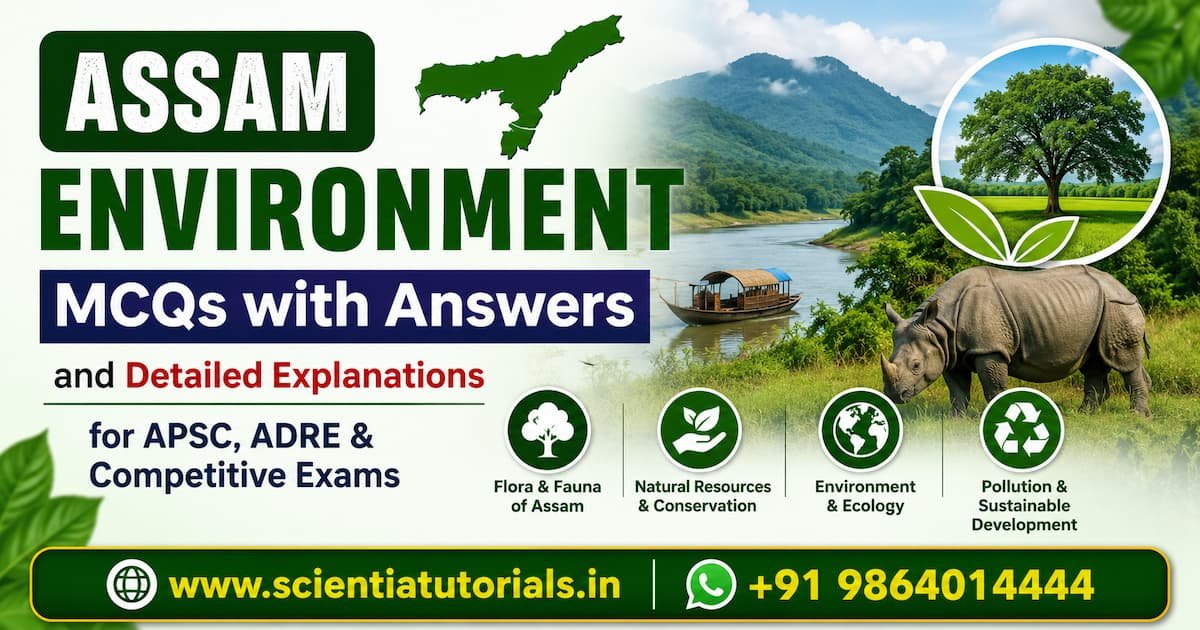
Assam Environment MCQs with Answers and Detailed Explanations for APSC, ADRE & Competitive Exams
Assam Environment MCQs with Answers and Detailed Explanations (Part 1: Questions 1–10)
The following 30 Assam Environment MCQs are designed for APSC, ADRE, Assam Police, Assam TET, Grade III & Grade IV, SSC, Railway, Banking, and other competitive examinations. Each question includes four options, the correct answer, and a detailed explanation to strengthen conceptual understanding.
1. Which national park in Assam is a UNESCO World Heritage Site and is famous for the one-horned rhinoceros?
A. Manas National Park
B. Kaziranga National Park
C. Dibru-Saikhowa National Park
D. Nameri National Park
✅ Correct Answer: B. Kaziranga National Park
Explanation:
Kaziranga National Park, located mainly in Golaghat and Nagaon districts, is one of India’s most celebrated wildlife reserves. It was declared a UNESCO World Heritage Site in 1985 because of its outstanding biodiversity. The park shelters nearly two-thirds of the world’s population of the Greater One-Horned Rhinoceros.
- Option A: Manas is also a UNESCO World Heritage Site but is renowned for tiger conservation and diverse wildlife.
- Option B: Correct.
- Option C: Dibru-Saikhowa is famous for feral horses and riverine ecosystems.
- Option D: Nameri is well known for bird watching and rafting.
2. Which river is considered the lifeline of Assam’s ecosystem?
A. Barak
B. Dhansiri
C. Brahmaputra
D. Kopili
✅ Correct Answer: C. Brahmaputra
Explanation:
The Brahmaputra River shapes Assam’s geography, agriculture, wetlands, forests, and biodiversity. It supports numerous ecosystems including floodplain grasslands and wetlands.
- Option A: Barak mainly flows through southern Assam.
- Option B: Important tributary but not the lifeline.
- Option C: Correct.
- Option D: Kopili is another tributary.
3. Assam has the highest population of which endangered animal?
A. Bengal Tiger
B. Asian Elephant
C. Greater One-Horned Rhinoceros
D. Snow Leopard
✅ Correct Answer: C. Greater One-Horned Rhinoceros
Explanation:
Assam, especially Kaziranga National Park, supports the world’s largest population of the Greater One-Horned Rhinoceros, making the state globally important for rhino conservation.
- Option A: Tigers are present but not the world’s largest population.
- Option B: Assam has many elephants but not the highest globally.
- Option C: Correct.
- Option D: Snow leopards are not found in Assam.
4. Which biosphere reserve is located in Assam?
A. Nilgiri Biosphere Reserve
B. Manas Biosphere Reserve
C. Sundarbans Biosphere Reserve
D. Pachmarhi Biosphere Reserve
✅ Correct Answer: B. Manas Biosphere Reserve
Explanation:
The Manas Biosphere Reserve is internationally recognized for its rich biodiversity and forms part of the Eastern Himalayan biodiversity hotspot.
- Option A: Located in South India.
- Option B: Correct.
- Option C: Located in West Bengal.
- Option D: Located in Madhya Pradesh.
5. Which wetland in Assam is recognized as a Ramsar Site?
A. Chandubi Lake
B. Deepor Beel
C. Haflong Lake
D. Joysagar
✅ Correct Answer: B. Deepor Beel
Explanation:
Deepor Beel, situated near Guwahati, is Assam’s famous freshwater wetland and a designated Ramsar Site. It provides habitat for migratory birds and helps control floods.
- Option A: Important lake but not Ramsar-listed.
- Option B: Correct.
- Option C: Hill lake in Dima Hasao.
- Option D: Historic tank.
6. Which forest type is most widespread in Assam?
A. Tropical Evergreen Forest
B. Tropical Moist Deciduous Forest
C. Thorn Forest
D. Alpine Forest
✅ Correct Answer: B. Tropical Moist Deciduous Forest
Explanation:
Most forests in Assam belong to the Tropical Moist Deciduous category due to the state’s warm climate and abundant rainfall.
- Option A: Present mainly in upper Assam and hills.
- Option B: Correct.
- Option C: Found in dry regions.
- Option D: Found in high mountains.
7. Which bird sanctuary in Assam is famous for migratory birds?
A. Pobitora Wildlife Sanctuary
B. Hoollongapar Gibbon Sanctuary
C. Deepor Beel
D. Bornadi Wildlife Sanctuary
✅ Correct Answer: C. Deepor Beel
Explanation:
Deepor Beel attracts thousands of migratory birds during winter, making it one of Assam’s most significant bird habitats.
- Option A: Famous for rhinos.
- Option B: Famous for hoolock gibbons.
- Option C: Correct.
- Option D: Known for pygmy hog conservation.
8. Which endangered primate is found only in Northeast India and is protected in Assam?
A. Lion-tailed Macaque
B. Hoolock Gibbon
C. Langur
D. Rhesus Monkey
✅ Correct Answer: B. Hoolock Gibbon
Explanation:
The Hoolock Gibbon is India’s only ape. Assam’s Hoollongapar Gibbon Wildlife Sanctuary was established mainly for its conservation.
- Option A: Found in Western Ghats.
- Option B: Correct.
- Option C: Common primate.
- Option D: Widely distributed.
9. Floods in Assam mainly help maintain which ecosystem?
A. Desert ecosystem
B. Grassland ecosystem
C. Alpine ecosystem
D. Mangrove ecosystem
✅ Correct Answer: B. Grassland ecosystem
Explanation:
Annual floods replenish nutrients, remove invasive vegetation, and maintain the floodplain grasslands that support rhinos, elephants, deer, and buffaloes.
- Option A: Not found in Assam.
- Option B: Correct.
- Option C: Found in Himalayan regions.
- Option D: Mainly coastal.
10. Which animal is declared the State Animal of Assam?
A. Royal Bengal Tiger
B. Indian Elephant
C. One-Horned Rhinoceros
D. Wild Water Buffalo
✅ Correct Answer: C. One-Horned Rhinoceros
Explanation:
The Greater One-Horned Rhinoceros is the State Animal of Assam and symbolizes the state’s successful wildlife conservation efforts.
- Option A: National animal is the tiger.
- Option B: State animal of some other states.
- Option C: Correct.
- Option D: State animal of Chhattisgarh.
11. Which wildlife sanctuary in Assam is popularly known as the “Rhino Sanctuary” after Kaziranga?
A. Nameri Wildlife Sanctuary
B. Pobitora Wildlife Sanctuary
C. Bornadi Wildlife Sanctuary
D. Chakrashila Wildlife Sanctuary
✅ Correct Answer: B. Pobitora Wildlife Sanctuary
Explanation:
Pobitora Wildlife Sanctuary, located in Morigaon district, has one of the highest densities of the Greater One-Horned Rhinoceros in the world. Although much smaller than Kaziranga, it plays a vital role in rhino conservation.
- Option A: Famous for birds, elephants, and rafting.
- Option B: Correct.
- Option C: Known for pygmy hog and hispid hare conservation.
- Option D: Famous for the Golden Langur.
12. Which national park in Assam is famous for the endangered Golden Langur?
A. Orang National Park
B. Dibru-Saikhowa National Park
C. Raimona National Park
D. Kaziranga National Park
✅ Correct Answer: C. Raimona National Park
Explanation:
Raimona National Park, declared Assam’s sixth national park in 2021, is internationally known for the Golden Langur, an endangered primate found mainly in western Assam and adjoining Bhutan.
- Option A: Famous for rhinos.
- Option B: Famous for riverine biodiversity.
- Option C: Correct.
- Option D: Famous for one-horned rhinoceros.
13. Which of the following is India’s first Ape Sanctuary?
A. Kaziranga National Park
B. Hoollongapar Gibbon Wildlife Sanctuary
C. Nameri National Park
D. Orang National Park
✅ Correct Answer: B. Hoollongapar Gibbon Wildlife Sanctuary
Explanation:
Located in Jorhat district, Hoollongapar Gibbon Wildlife Sanctuary is India’s first sanctuary dedicated to apes. It protects the endangered Western Hoolock Gibbon, India’s only ape species.
- Option A: Rhino habitat.
- Option B: Correct.
- Option C: Bird and elephant habitat.
- Option D: Rhino habitat.
14. Which national park in Assam is often called the “Mini Kaziranga”?
A. Orang National Park
B. Manas National Park
C. Nameri National Park
D. Dibru-Saikhowa National Park
✅ Correct Answer: A. Orang National Park
Explanation:
Orang National Park is known as the Mini Kaziranga because it supports populations of one-horned rhinoceroses, elephants, tigers, and rich grassland ecosystems similar to Kaziranga.
- Option A: Correct.
- Option B: UNESCO site with diverse habitats.
- Option C: Bird sanctuary and rafting destination.
- Option D: River island ecosystem.
15. Which endangered species found in Assam is also known as the “Pigmy Hog”?
A. Wild Boar
B. Pygmy Hog
C. Indian Hog Deer
D. Wild Buffalo
✅ Correct Answer: B. Pygmy Hog
Explanation:
The Pygmy Hog is the world’s smallest and rarest wild pig. It inhabits the tall grasslands of Assam and is found mainly in Manas National Park. It is classified as Critically Endangered by the IUCN.
- Option A: Common wild species.
- Option B: Correct.
- Option C: Different deer species.
- Option D: Large bovine species.
16. Which national park of Assam is situated along the India-Bhutan border?
A. Orang National Park
B. Manas National Park
C. Dibru-Saikhowa National Park
D. Kaziranga National Park
✅ Correct Answer: B. Manas National Park
Explanation:
Manas National Park shares its northern boundary with Bhutan’s Royal Manas National Park, creating an important transboundary wildlife conservation area.
- Option A: Located in Darrang and Sonitpur.
- Option B: Correct.
- Option C: Upper Assam.
- Option D: Central Assam.
17. Assam is part of which global biodiversity hotspot?
A. Western Ghats
B. Indo-Burma Biodiversity Hotspot
C. Mediterranean Hotspot
D. Cape Floristic Region
✅ Correct Answer: B. Indo-Burma Biodiversity Hotspot
Explanation:
Most of Assam falls within the Indo-Burma Biodiversity Hotspot, one of the world’s richest regions for biodiversity. Parts of the state also have ecological links with the Eastern Himalayas.
- Option A: South India.
- Option B: Correct.
- Option C: Europe.
- Option D: South Africa.
18. Which environmental problem is most commonly associated with the Brahmaputra River?
A. Desertification
B. Floods and Riverbank Erosion
C. Volcanic Activity
D. Glacier Formation
✅ Correct Answer: B. Floods and Riverbank Erosion
Explanation:
Seasonal floods and severe riverbank erosion are major environmental challenges in Assam. While floods enrich soil fertility and sustain wetlands, excessive flooding causes displacement and loss of agricultural land.
- Option A: Not applicable.
- Option B: Correct.
- Option C: Not found in Assam.
- Option D: Occurs in the Himalayas.
19. Which environmental day is widely observed in Assam through plantation drives and awareness campaigns?
A. World Water Day
B. Earth Hour
C. World Environment Day
D. Ozone Day
✅ Correct Answer: C. World Environment Day
Explanation:
World Environment Day, celebrated every year on 5 June, is observed throughout Assam by government departments, educational institutions, NGOs, and local communities through tree plantation and environmental awareness programmes.
- Option A: Focuses on water conservation.
- Option B: Global energy conservation campaign.
- Option C: Correct.
- Option D: Observed on 16 September.
20. Which government department is primarily responsible for forest conservation in Assam?
A. Agriculture Department
B. Assam Forest Department
C. Public Works Department
D. Fisheries Department
✅ Correct Answer: B. Assam Forest Department
Explanation:
The Assam Forest Department is responsible for protecting forests, wildlife, national parks, biodiversity, and implementing conservation programmes across the state.
- Option A: Agriculture development.
- Option B: Correct.
- Option C: Infrastructure development.
- Option D: Fisheries management.
Assam Environment MCQs with Answers and Detailed Explanations
Part 3 (Questions 21–30)
21. Deepor Beel is situated near which city of Assam?
A. Jorhat
B. Dibrugarh
C. Guwahati
D. Tezpur
✅ Correct Answer: C. Guwahati
Explanation:
Deepor Beel is located southwest of Guwahati and is Assam’s only Ramsar Site recognized for its freshwater wetland ecosystem.
- Option A: Incorrect.
- Option B: Incorrect.
- Option C: Correct.
- Option D: Incorrect.
22. Which endangered large mammal of Assam is known for having curved horns?
A. Indian Elephant
B. Wild Water Buffalo
C. Tiger
D. Leopard
✅ Correct Answer: B. Wild Water Buffalo
Explanation:
The Wild Water Buffalo, the State Animal of Chhattisgarh, has globally significant populations in Assam, particularly in Kaziranga, Manas, and Dibru-Saikhowa.
- Option A: Tusks instead of horns.
- Option B: Correct.
- Option C: No horns.
- Option D: No horns.
23. Which river island of Assam is famous for its unique ecological importance?
A. Majuli
B. Umananda
C. Peacock Island
D. Bhagadatta Island
✅ Correct Answer: A. Majuli
Explanation:
Majuli is one of the world’s largest inhabited river islands and supports rich biodiversity, wetlands, migratory birds, and traditional ecological knowledge.
- Option A: Correct.
- Option B: Smaller island.
- Option C: Another name for Umananda.
- Option D: Incorrect.
24. Which gas is mainly responsible for global warming?
A. Oxygen
B. Nitrogen
C. Carbon Dioxide
D. Hydrogen
✅ Correct Answer: C. Carbon Dioxide
Explanation:
Carbon dioxide (CO₂) is the most significant greenhouse gas produced by human activities such as burning fossil fuels and deforestation.
- Option A: Supports respiration.
- Option B: Major atmospheric gas but not a greenhouse gas in this context.
- Option C: Correct.
- Option D: Not responsible.
25. Which of the following is a renewable source of energy?
A. Coal
B. Petroleum
C. Solar Energy
D. Natural Gas
✅ Correct Answer: C. Solar Energy
Explanation:
Solar energy is renewable because sunlight is continuously available. Assam has increasing potential for solar power development.
- Option A: Non-renewable.
- Option B: Non-renewable.
- Option C: Correct.
- Option D: Fossil fuel.
26. Which Act primarily governs wildlife conservation in India?
A. Environment Protection Act, 1986
B. Wildlife (Protection) Act, 1972
C. Forest Rights Act, 2006
D. Water Act, 1974
✅ Correct Answer: B. Wildlife (Protection) Act, 1972
Explanation:
The Wildlife (Protection) Act, 1972 provides legal protection to wild animals, birds, and plants and forms the foundation of wildlife conservation in India.
- Option A: General environmental protection.
- Option B: Correct.
- Option C: Community forest rights.
- Option D: Water pollution control.
27. Which tree is commonly associated with Assam’s tea gardens for providing shade?
A. Neem
B. Silver Oak
C. Coconut
D. Teak
✅ Correct Answer: B. Silver Oak
Explanation:
Silver Oak is widely planted in tea estates as a shade tree. It helps regulate temperature and protects tea bushes from excessive sunlight.
- Option A: Limited use.
- Option B: Correct.
- Option C: Not suitable.
- Option D: Valuable timber tree.
28. Which national park in Assam is famous for river dolphins and riverine biodiversity?
A. Dibru-Saikhowa National Park
B. Orang National Park
C. Kaziranga National Park
D. Raimona National Park
✅ Correct Answer: A. Dibru-Saikhowa National Park
Explanation:
Dibru-Saikhowa National Park is a unique riverine ecosystem known for the Gangetic River Dolphin, migratory birds, and feral horses.
- Option A: Correct.
- Option B: Rhino habitat.
- Option C: Rhino conservation.
- Option D: Golden Langur habitat.
29. Which of the following is the best method for conserving biodiversity?
A. Deforestation
B. Habitat Conservation
C. Excessive Mining
D. Overgrazing
✅ Correct Answer: B. Habitat Conservation
Explanation:
Protecting natural habitats through national parks, wildlife sanctuaries, biosphere reserves, and community participation is the most effective strategy for conserving biodiversity.
- Option A: Causes habitat loss.
- Option B: Correct.
- Option C: Damages ecosystems.
- Option D: Leads to land degradation.
30. Which of the following best describes sustainable development?
A. Using all natural resources immediately
B. Meeting present needs without compromising future generations’ needs
C. Cutting forests for economic growth
D. Ignoring environmental conservation
✅ Correct Answer: B. Meeting present needs without compromising future generations’ needs
Explanation:
Sustainable development aims to balance economic growth, social welfare, and environmental protection. It ensures that future generations have access to natural resources while fulfilling present-day developmental needs.
- Option A: Unsustainable exploitation.
- Option B: ✅ Correct. This is the internationally accepted definition from the Brundtland Commission (1987).
- Option C: Leads to environmental degradation.
- Option D: Contradicts the concept of sustainability.
Quick Revision for Competitive Exams
Important National Parks of Assam
- Kaziranga National Park – One-Horned Rhinoceros (UNESCO World Heritage Site)
- Manas National Park – Tiger Reserve, Biosphere Reserve, UNESCO World Heritage Site
- Orang National Park – “Mini Kaziranga”
- Nameri National Park – Birds, Elephants, Jia Bhoroli River
- Dibru-Saikhowa National Park – River Dolphins, Feral Horses
- Raimona National Park – Golden Langur
Important Wildlife Sanctuaries
- Pobitora Wildlife Sanctuary – High density of One-Horned Rhinoceros
- Hoollongapar Gibbon Wildlife Sanctuary – India’s First Ape Sanctuary
- Chakrashila Wildlife Sanctuary – Golden Langur
- Bornadi Wildlife Sanctuary – Pygmy Hog and Hispid Hare
Frequently Asked Exam Facts
- State Animal of Assam: Greater One-Horned Rhinoceros
- State Bird of Assam: White-winged Wood Duck
- State Tree of Assam: Hollong
- State Flower of Assam: Foxtail Orchid (Kopou Phool)
- Ramsar Site in Assam: Deepor Beel
- Largest River: Brahmaputra
- World Environment Day: 5 June
- Wildlife (Protection) Act: 1972
- Environment (Protection) Act: 1986
These 30 MCQs comprehensively cover the core Assam environment topics that are repeatedly asked in APSC, ADRE, Assam Police, Assam TET, Grade III & Grade IV, SSC, Railway, Banking, and other competitive examinations.