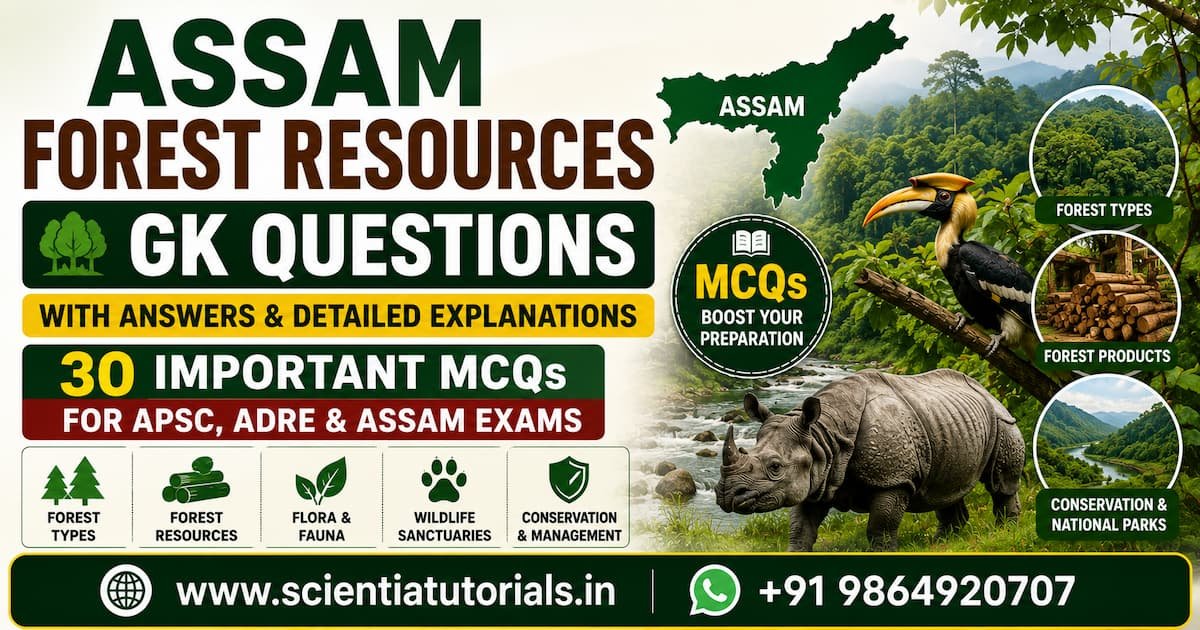
Assam Forest Resources GK Questions with Answers and Detailed Explanations | 30 Important MCQs for APSC, ADRE & Assam Exams
Assam Forest Resources GK Questions with Answers and Detailed Explanations
Part 1 (Questions 1–10)
The following 30 Multiple Choice Questions (MCQs) on Assam Forest Resources are designed for APSC, ADRE, Assam Police, Assam TET, Grade III & Grade IV, SSC, Railway, Banking, and other competitive examinations. Each question includes the correct answer along with a concept-clearing explanation.
1. Approximately what percentage of Assam’s geographical area is under forest cover?
A. About 18%
B. About 36%
C. About 55%
D. About 72%
✅ Correct Answer: B. About 36%
Explanation:
According to the India State of Forest Report (ISFR), forests cover roughly 36% of Assam’s geographical area, although the exact percentage may vary slightly between editions of the report.
- Option A: Too low.
- Option B: Correct.
- Option C: Much higher than the actual figure.
- Option D: Incorrect.
Exam Tip: Assam has one of the highest proportions of forest cover among the states of northeastern India.
2. Which department is primarily responsible for forest conservation in Assam?
A. Agriculture Department
B. Assam Forest Department
C. Rural Development Department
D. Water Resources Department
✅ Correct Answer: B. Assam Forest Department
Explanation:
The Assam Forest Department is responsible for protecting forests, wildlife, biodiversity, and implementing conservation and afforestation programmes across the state.
- Option A: Focuses on agriculture.
- Option B: Correct.
- Option C: Rural development.
- Option D: Water management.
3. Which is the State Tree of Assam?
A. Sal
B. Hollong
C. Teak
D. Bamboo
✅ Correct Answer: B. Hollong
Explanation:
Hollong (Dipterocarpus macrocarpus) is the State Tree of Assam. It is a tall evergreen tree commonly found in tropical evergreen forests and is valued for its timber.
- Option A: Common forest tree but not the state tree.
- Option B: Correct.
- Option C: Widely planted timber tree.
- Option D: State grass of many discussions, but not the state tree.
4. Which type of forest is most widespread in Assam?
A. Tropical Thorn Forest
B. Tropical Moist Deciduous Forest
C. Alpine Forest
D. Desert Forest
✅ Correct Answer: B. Tropical Moist Deciduous Forest
Explanation:
The warm and humid climate of Assam supports mainly Tropical Moist Deciduous Forests, although tropical evergreen and semi-evergreen forests are also found.
- Option A: Found in dry regions.
- Option B: Correct.
- Option C: Himalayan high-altitude forests.
- Option D: Not found in Assam.
5. Which valuable forest product is Assam internationally famous for?
A. Sandalwood
B. Muga Silk
C. Saffron
D. Walnut
✅ Correct Answer: B. Muga Silk
Explanation:
Muga Silk is unique to Assam. It is produced by silkworms that feed on host plants growing in Assam’s forests and agroforestry systems. The silk is known for its natural golden colour and durability.
- Option A: Mainly Karnataka.
- Option B: Correct.
- Option C: Jammu & Kashmir.
- Option D: Himalayan regions.
6. Which of the following is a major non-timber forest product (NTFP) of Assam?
A. Iron Ore
B. Bamboo
C. Limestone
D. Coal
✅ Correct Answer: B. Bamboo
Explanation:
Bamboo is one of Assam’s most important Non-Timber Forest Products (NTFPs). It is extensively used for housing, handicrafts, paper, furniture, and household items.
- Option A: Mineral.
- Option B: Correct.
- Option C: Mineral.
- Option D: Fossil fuel.
7. Which district of Assam is well known for extensive forest resources and biodiversity?
A. Dhubri
B. Tinsukia
C. Dima Hasao
D. Barpeta
✅ Correct Answer: C. Dima Hasao
Explanation:
Dima Hasao is one of Assam’s most forested districts. It contains rich tropical forests, wildlife habitats, and diverse plant species.
- Option A: Limited forest area.
- Option B: Forests present but not the most extensive.
- Option C: Correct.
- Option D: Mostly plains.
8. Which tree species is commonly found in Assam’s evergreen forests?
A. Hollong
B. Babul
C. Khejri
D. Acacia nilotica
✅ Correct Answer: A. Hollong
Explanation:
Hollong dominates many evergreen forests in Upper Assam and is one of the tallest native tree species.
- Option A: Correct.
- Option B: Dry regions.
- Option C: Desert regions.
- Option D: Dry deciduous forests.
9. Which forest product of Assam is widely used for making furniture and handicrafts?
A. Bamboo
B. Coal
C. Granite
D. Gypsum
✅ Correct Answer: A. Bamboo
Explanation:
Assam is renowned for its bamboo-based industries. Bamboo is used to manufacture furniture, baskets, mats, handicrafts, musical instruments, and construction materials.
- Option A: Correct.
- Option B: Fuel.
- Option C: Mineral.
- Option D: Mineral.
10. Which Act provides legal protection to forests in India?
A. Forest (Conservation) Act, 1980
B. Companies Act, 2013
C. Motor Vehicles Act, 1988
D. RTI Act, 2005
✅ Correct Answer: A. Forest (Conservation) Act, 1980
Explanation:
The Forest (Conservation) Act, 1980 regulates the diversion of forest land for non-forest purposes and aims to conserve forest resources across India.
- Option A: Correct.
- Option B: Corporate law.
- Option C: Road transport law.
- Option D: Transparency law.
Assam Forest Resources GK Questions with Answers and Detailed Explanations
Part 2 (Questions 11–20)
These MCQs are designed for APSC, ADRE, Assam Police, Assam TET, Grade III & Grade IV, SSC, Railway, Banking, and other competitive examinations.
11. Which category of forest receives the highest level of legal protection under the Indian Forest Act, 1927?
A. Village Forest
B. Protected Forest
C. Reserved Forest
D. Community Forest
✅ Correct Answer: C. Reserved Forest
Explanation:
A Reserved Forest enjoys the highest level of legal protection under the Indian Forest Act, 1927. Activities such as grazing, hunting, tree felling, and cultivation are prohibited unless specifically permitted by the government.
- Option A: Managed for local community use.
- Option B: Protected but with comparatively fewer restrictions.
- Option C: ✅ Correct.
- Option D: Not a legal category under the Act.
12. Which forest type occupies the largest area in Assam?
A. Tropical Evergreen Forest
B. Tropical Moist Deciduous Forest
C. Alpine Forest
D. Thorn Forest
✅ Correct Answer: B. Tropical Moist Deciduous Forest
Explanation:
Due to Assam’s tropical monsoon climate, Tropical Moist Deciduous Forests cover the largest forest area. Major tree species include Sal, Hollong, Teak (plantations), and Gamari.
- Option A: Found mainly in high-rainfall areas.
- Option B: ✅ Correct.
- Option C: Not found in Assam.
- Option D: Characteristic of arid regions.
13. Which of the following is an important timber tree found in Assam?
A. Hollong
B. Coconut
C. Date Palm
D. Apple
✅ Correct Answer: A. Hollong
Explanation:
Hollong (Dipterocarpus macrocarpus) is one of Assam’s most valuable timber trees and the State Tree. It is widely used in construction, furniture making, and plywood industries.
- Option A: ✅ Correct.
- Option B: Coastal tree.
- Option C: Desert and dry areas.
- Option D: Temperate regions.
14. Social Forestry primarily aims to:
A. Increase industrial mining
B. Promote afforestation with community participation
C. Expand urban infrastructure
D. Increase river navigation
✅ Correct Answer: B. Promote afforestation with community participation
Explanation:
Social Forestry encourages local communities to plant and protect trees on village lands, roadsides, canal banks, schools, and degraded lands to meet local needs for fuelwood, fodder, and timber.
- Option A: Not related.
- Option B: ✅ Correct.
- Option C: Urban planning.
- Option D: Water transport.
15. Which of the following is a major cause of forest degradation in Assam?
A. Controlled tourism
B. Illegal logging and encroachment
C. Scientific forestry
D. Wildlife conservation
✅ Correct Answer: B. Illegal logging and encroachment
Explanation:
Illegal felling of trees, encroachment, shifting cultivation in certain areas, and infrastructure development are among the major threats to Assam’s forests.
- Option A: Usually regulated.
- Option B: ✅ Correct.
- Option C: Helps conservation.
- Option D: Protects forests.
16. Joint Forest Management (JFM) mainly encourages:
A. Private ownership of forests
B. Participation of local communities in forest protection
C. Mining inside forests
D. Commercial hunting
✅ Correct Answer: B. Participation of local communities in forest protection
Explanation:
Joint Forest Management (JFM) is a participatory approach where local communities and the Forest Department jointly protect and manage forest resources while sharing benefits.
- Option A: Incorrect.
- Option B: ✅ Correct.
- Option C: Damages forests.
- Option D: Illegal.
17. Which of the following is classified as a Non-Timber Forest Product (NTFP)?
A. Bamboo
B. Cement
C. Coal
D. Granite
✅ Correct Answer: A. Bamboo
Explanation:
Non-Timber Forest Products include bamboo, cane, medicinal plants, honey, lac, resins, and various edible forest products.
- Option A: ✅ Correct.
- Option B: Manufactured product.
- Option C: Fossil fuel.
- Option D: Mineral.
18. Which organisation conducts the India State of Forest Report (ISFR)?
A. Zoological Survey of India
B. Forest Survey of India (FSI)
C. Botanical Survey of India
D. Wildlife Institute of India
✅ Correct Answer: B. Forest Survey of India (FSI)
Explanation:
The Forest Survey of India (FSI) prepares the India State of Forest Report (ISFR) every two years using satellite imagery and field verification.
- Option A: Animal research.
- Option B: ✅ Correct.
- Option C: Plant research.
- Option D: Wildlife research.
19. Which forest ecosystem of Assam provides habitat to the One-Horned Rhinoceros?
A. Mangrove Forest
B. Floodplain Grassland Forest Ecosystem
C. Alpine Forest
D. Thorn Forest
✅ Correct Answer: B. Floodplain Grassland Forest Ecosystem
Explanation:
Kaziranga, Orang, and Pobitora are characterized by floodplain grasslands, interspersed with wetlands and forests, which form the ideal habitat for the Greater One-Horned Rhinoceros.
- Option A: Coastal ecosystem.
- Option B: ✅ Correct.
- Option C: High mountains.
- Option D: Dry regions.
20. Which of the following contributes most to increasing forest cover?
A. Deforestation
B. Afforestation and Reforestation
C. Mining Activities
D. Urban Expansion
✅ Correct Answer: B. Afforestation and Reforestation
Explanation:
Planting trees on barren land (afforestation) and restoring forests on degraded land (reforestation) are the most effective methods for increasing forest cover.
- Option A: Decreases forests.
- Option B: ✅ Correct.
- Option C: Causes forest loss.
- Option D: Reduces forest area.
Assam Forest Resources GK Questions with Answers and Detailed Explanations
Part 3 (Questions 21–30)
21. Which national park in Assam contains extensive tropical forests and is also a UNESCO World Heritage Site?
A. Dibru-Saikhowa National Park
B. Manas National Park
C. Raimona National Park
D. Nameri National Park
✅ Correct Answer: B. Manas National Park
Explanation:
Manas National Park is renowned for its dense tropical forests, grasslands, rich biodiversity, and status as a UNESCO World Heritage Site, Tiger Reserve, Biosphere Reserve, and Elephant Reserve.
- Option A: Riverine ecosystem.
- Option B: ✅ Correct.
- Option C: Golden Langur habitat.
- Option D: Famous for birdlife.
22. Which plant is widely known as the “Green Gold of Assam”?
A. Sal
B. Bamboo
C. Hollong
D. Teak
✅ Correct Answer: B. Bamboo
Explanation:
Bamboo is popularly called “Green Gold” because of its economic, ecological, and cultural importance. Assam is one of India’s leading bamboo-producing states.
- Option A: Valuable timber.
- Option B: ✅ Correct.
- Option C: State tree.
- Option D: Timber species.
23. Which mission promotes bamboo cultivation and value addition in India?
A. Green India Mission
B. National Bamboo Mission
C. National Afforestation Programme
D. Project Tiger
✅ Correct Answer: B. National Bamboo Mission
Explanation:
The National Bamboo Mission (NBM) promotes bamboo cultivation, processing, marketing, and entrepreneurship to improve livelihoods and strengthen the bamboo sector.
- Option A: General afforestation.
- Option B: ✅ Correct.
- Option C: Forest regeneration.
- Option D: Tiger conservation.
24. Forests play an important role in preventing:
A. Soil Erosion
B. Rainfall
C. Photosynthesis
D. Biodiversity
✅ Correct Answer: A. Soil Erosion
Explanation:
Tree roots bind the soil, reducing erosion by wind and water. Forests also regulate water flow, maintain soil fertility, and reduce the impact of floods.
- Option A: ✅ Correct.
- Option B: Forests help support rainfall.
- Option C: Forests perform photosynthesis.
- Option D: Forests conserve biodiversity.
25. Which of the following is an important cane product of Assam?
A. Steel Furniture
B. Cane and Bamboo Handicrafts
C. Plastic Chairs
D. Cement Blocks
✅ Correct Answer: B. Cane and Bamboo Handicrafts
Explanation:
Assam is internationally known for its traditional cane and bamboo handicrafts, including baskets, mats, furniture, decorative items, and utility products.
- Option A: Industrial product.
- Option B: ✅ Correct.
- Option C: Synthetic product.
- Option D: Construction material.
26. Which constitutional provision directs the State to protect forests and wildlife?
A. Article 14
B. Article 21
C. Article 48A
D. Article 370
✅ Correct Answer: C. Article 48A
Explanation:
Article 48A of the Directive Principles of State Policy directs the State to protect and improve the environment and safeguard forests and wildlife.
- Option A: Equality before law.
- Option B: Right to life.
- Option C: ✅ Correct.
- Option D: Former special provision for Jammu & Kashmir.
27. Which Fundamental Duty asks every citizen to protect the environment?
A. Article 19
B. Article 51A(g)
C. Article 356
D. Article 324
✅ Correct Answer: B. Article 51A(g)
Explanation:
Article 51A(g) makes it the duty of every citizen to protect and improve the natural environment, including forests, lakes, rivers, and wildlife.
- Option A: Freedom rights.
- Option B: ✅ Correct.
- Option C: President’s Rule.
- Option D: Election Commission.
28. Which of the following is the most effective method of conserving Assam’s forest resources?
A. Illegal tree felling
B. Sustainable Forest Management
C. Excessive mining
D. Unplanned urbanization
✅ Correct Answer: B. Sustainable Forest Management
Explanation:
Sustainable Forest Management balances ecological conservation with responsible use of forest resources, ensuring that forests remain productive for future generations.
- Option A: Damages forests.
- Option B: ✅ Correct.
- Option C: Leads to degradation.
- Option D: Causes habitat loss.
29. Forests are often called the “lungs of the Earth” because they:
A. Produce minerals
B. Release oxygen and absorb carbon dioxide
C. Generate electricity
D. Increase pollution
✅ Correct Answer: B. Release oxygen and absorb carbon dioxide
Explanation:
Through photosynthesis, forests absorb carbon dioxide and release oxygen, helping regulate the Earth’s climate and maintain atmospheric balance.
- Option A: Incorrect.
- Option B: ✅ Correct.
- Option C: Incorrect.
- Option D: Opposite of their role.
30. Which statement best describes sustainable use of forest resources?
A. Using forests without restrictions
B. Using forest resources wisely while ensuring regeneration and conservation
C. Cutting all mature trees immediately
D. Ignoring biodiversity during development
✅ Correct Answer: B. Using forest resources wisely while ensuring regeneration and conservation
Explanation:
Sustainable use means harvesting forest resources in a manner that does not reduce their availability for future generations. It combines environmental protection, economic development, and community participation, which is a key principle in modern forest management.
- Option A: Unsustainable exploitation.
- Option B: ✅ Correct.
- Option C: Causes long-term ecological damage.
- Option D: Contrary to sustainable development.
Quick Revision for Competitive Exams
Important Forest Facts of Assam
- Approximate Forest Cover: Around 36% of the geographical area (as reported in recent editions of the India State of Forest Report; exact figures may vary by edition).
- State Tree: Hollong (Dipterocarpus macrocarpus)
- Major Forest Type: Tropical Moist Deciduous Forest
- Major Non-Timber Forest Products: Bamboo, Cane, Medicinal Plants, Honey
- “Green Gold” of Assam: Bamboo
- Highest Legal Forest Category: Reserved Forest
- Forest Survey Agency: Forest Survey of India (FSI)
Important Laws and Constitutional Provisions
- Indian Forest Act: 1927
- Forest (Conservation) Act: 1980
- Environment (Protection) Act: 1986
- Wildlife (Protection) Act: 1972
- Article 48A: Protection and improvement of the environment
- Article 51A(g): Fundamental duty to protect forests and wildlife
These 30 MCQs provide comprehensive coverage of Assam Forest Resources, including forest types, conservation laws, biodiversity, sustainable forest management, bamboo resources, and constitutional provisions, making them highly relevant for APSC, ADRE, Assam Police, Assam TET, Grade III & Grade IV, SSC, Railway, Banking, and other competitive examinations.