
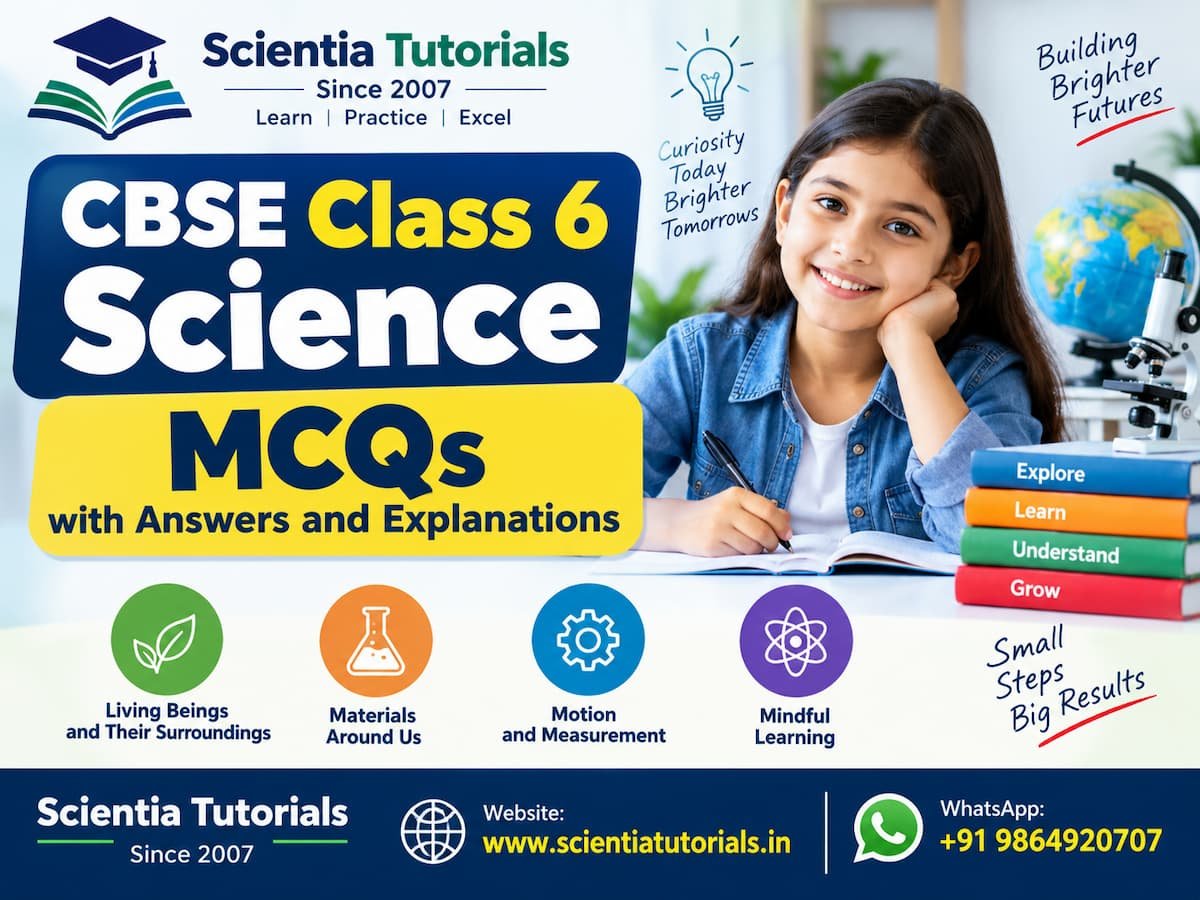
CBSE Class 6 Science – MCQs with Answers and Explanations
Course Overview: CBSE Class 6 Science – MCQs with Answers and Explanations The CBSE Class 6 Science – MCQs with Answers and Explanations course is designed to help students build a strong foundation in basic scientific concepts through chapter-wise multiple choice questions. Aligned with the latest CBSE syllabus and NCERT …
Overview
Course Overview: CBSE Class 6 Science – MCQs with Answers and Explanations
The CBSE Class 6 Science – MCQs with Answers and Explanations course is designed to help students build a strong foundation in basic scientific concepts through chapter-wise multiple choice questions. Aligned with the latest CBSE syllabus and NCERT guidelines, this course provides a structured and exam-oriented approach to learning Science in an engaging and practice-driven format.
-
CBSE Class 6 Science MCQs with Answers
-
Class 6 Science Objective Questions CBSE
-
NCERT Class 6 Science MCQ Practice
-
CBSE Grade 6 Science Quiz with Explanations
-
Class 6 Science Chapter-wise MCQs
📘 What This Course Offers
- Chapter-wise MCQs: Covers all chapters from the CBSE Class 6 Science textbook.
- Detailed Explanations: Each question is supported with clear, easy-to-understand explanations to strengthen conceptual clarity.
- Exam Preparation: Helps students prepare for school exams, unit tests, and Olympiads.
- Concept Reinforcement: MCQs are designed to test understanding, application, and analytical skills.
- Self-Assessment: Ideal for practice, revision, and performance evaluation.
👩🎓 Who Should Enroll?
- CBSE Class 6 students
- Students preparing for school assessments
- Parents and teachers looking for structured practice material
- Learners aiming to strengthen Science fundamentals early
Curriculum
- 14 Sections
- 42 Lessons
- Lifetime
- 🟢 Section 1: Food & Nutrition3 ItemsThis section introduces the basic concepts of food, its sources, and the importance of nutrition for healthy living. Students learn about plant and animal food sources, components of food (carbohydrates, proteins, fats, vitamins, minerals), balanced diet, and deficiency diseases. MCQs in this section help reinforce understanding of healthy eating habits and the role of nutrients in growth, energy, and body maintenance.
- 🧵 Section 2: Fibre & Fabric3 ItemsThis section explains the sources and types of fibres used to make fabrics. Students learn about natural fibres such as cotton, jute, wool, and silk, and how fibres are spun into yarn and woven or knitted into fabric. MCQs focus on fibre sources, fabric-making processes, and the uses of different textiles in daily life.
- 🪨 Section 3: Materials Around Us3 ItemsThis section introduces different materials found in our surroundings and their properties. Students learn to classify materials based on appearance, hardness, solubility, transparency, and other physical characteristics. MCQs help reinforce understanding of how materials are grouped and their practical uses in everyday life.
- 🔄 Section 4: Changes Around Us3 ItemsThis section explains the different types of changes occurring in our surroundings. Students learn about reversible and irreversible changes, physical and chemical changes, and changes caused by heating, cooling, or mixing substances. MCQs strengthen understanding of everyday examples and the science behind these transformations.
- 🌱 Section 5: Plant World3 ItemsThis section explores the diversity and structure of plants. Students learn about types of plants, parts of a plant, leaf functions, and the process of photosynthesis. MCQs help reinforce knowledge of plant classification, functions, and their importance in sustaining life.
- 🦴 Section 6: Human Body & Movement3 ItemsThis section introduces the basic structure of the human body and how it moves. Students learn about bones, joints, muscles, and the skeletal system, along with different types of body movements in humans and animals. MCQs help reinforce understanding of body support, posture, and coordination.
- 🌍 Section 7: Living Organisms & Habitat3 ItemsThis section focuses on the characteristics of living organisms and their habitats. Students learn about adaptation, types of habitats (terrestrial and aquatic), and how plants and animals survive in different environments. MCQs reinforce understanding of life processes, surroundings, and survival needs.
- 📏 Section 8: Motion & Measurement3 ItemsThis section introduces basic concepts of motion and standard methods of measurement. Students learn about types of motion, measuring length using standard units, and simple measuring tools. MCQs help reinforce understanding of accurate measurement and everyday applications of motion.
- 💡 Section 9: Light & Optics3 ItemsThis section introduces the basic properties of light and how we see objects. Students learn about sources of light, reflection, shadows, mirrors, and transparent, translucent, and opaque materials. MCQs help reinforce understanding of light behavior and its everyday applications.
- 🔌 Section 10: Electricity3 ItemsThis section introduces the basics of electricity and simple electric circuits. Students learn about electric cells, bulbs, switches, conductors, and insulators, and how electric current flows. MCQs reinforce understanding of circuit components and safe use of electricity in daily life.
- 🧲 Section 11: Magnetism3 ItemsThis section introduces the basic properties and uses of magnets. Students learn about magnetic and non-magnetic materials, poles of a magnet, attraction and repulsion, and everyday applications of magnetism. MCQs help reinforce understanding of magnetic behavior and simple experiments.
- 💧 Section 12: Water3 ItemsThis section highlights the importance and properties of water. Students learn about sources of water, states of water, the water cycle, and methods of conservation. MCQs reinforce understanding of water’s role in daily life and the need for its sustainable use.
- 🌬️ Section 13: Air & Environment3 ItemsThis section explains the composition and importance of air and its role in the environment. Students learn about gases in air, uses of air, wind, and the impact of air on living organisms. MCQs reinforce understanding of environmental balance and the importance of clean air.
- ♻️ Section 14: Waste Management3 ItemsThis section focuses on types of waste and their proper disposal. Students learn about biodegradable and non-biodegradable waste, recycling, composting, and the importance of reducing pollution. MCQs reinforce awareness of cleanliness, sustainability, and responsible waste handling.
You May Like

CBSE Class 9 Science – MCQs with Answers and Explanations
Course Overview: CBSE Class 9 Science – MCQs with Answers and Explanations The CBSE Class 9 Science – MCQs with Answers and Explanations course is...

CBSE Class 8 Science – MCQs with Answers and Explanations
Course Overview: CBSE Class 8 Science – MCQs with Answers and Explanations The CBSE Class 8 Science – MCQs with Answers and Explanations course is...

CBSE Class 7 Science – MCQs with Answers and Explanations
CBSE Class 7 Science – MCQs with Answers and Explanations Course Overview The CBSE Class 7 Science – MCQs with Answers and Explanations course is...
CBSE Class 6 Science – Chapter Wise Study Materials Based on NCERT
CBSE Class 6 Science – Chapter Wise Study Materials Based on NCERT The CBSE Class 6 Science – Chapter Wise Study Materials Based on NCERT...
CBSE Class 6 Science MCQs – Online Practice Test – Basic Level
Build a strong foundation with CBSE Class 6 Science MCQs – Online Practice Test – Basic Level. Designed strictly as per the NCERT syllabus, this...
Course Features
- Lectures 42
- Quiz 0
- Duration Lifetime access
- Skill level All levels
- Language English
- Students 0
- Assessments Yes