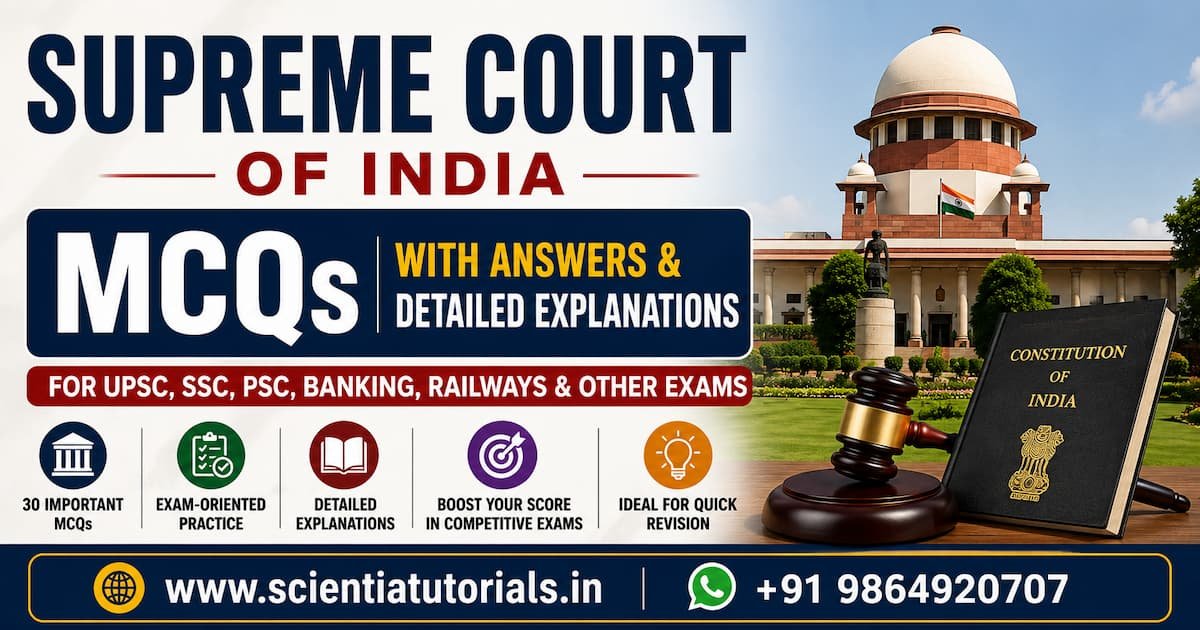
Supreme Court of India MCQs with Answers and Detailed Explanations for UPSC, SSC & PSC Exams
Supreme Court of India MCQs for UPSC and SSC Exams
The following 30 Multiple Choice Questions (MCQs) are designed for UPSC, SSC, Banking, Railways, State PSC, CDS, CAPF, NDA, Assam PSC, ADRE, and other competitive examinations in India. Each question includes the correct answer along with a detailed explanation to strengthen conceptual understanding of the Supreme Court of India.
1. Which Part of the Constitution deals with the Supreme Court of India?
A. Part III
B. Part IV
C. Part V
D. Part VI
Answer: ✅ C. Part V
Explanation:
The Supreme Court is provided under Part V (The Union) of the Constitution. Articles 124 to 147 deal with the organization, powers, jurisdiction, and functioning of the Supreme Court.
2. Which Article provides for the establishment of the Supreme Court of India?
A. Article 120
B. Article 123
C. Article 124
D. Article 126
Answer: ✅ C. Article 124
Explanation:
Article 124 establishes the Supreme Court of India and lays down provisions regarding the appointment, qualifications, tenure, and removal of judges.
3. The Supreme Court of India came into existence on:
A. 26 January 1950
B. 28 January 1950
C. 15 August 1947
D. 26 November 1949
Answer: ✅ B. 28 January 1950
Explanation:
The Supreme Court was inaugurated on 28 January 1950, replacing the Federal Court of India established under the Government of India Act, 1935.
4. The Supreme Court of India is located in:
A. Mumbai
B. Kolkata
C. New Delhi
D. Chennai
Answer: ✅ C. New Delhi
Explanation:
The permanent seat of the Supreme Court is in New Delhi, although under Article 130, it may sit at other places as decided by the Chief Justice of India with the President’s approval.
5. The Chief Justice of India is appointed by the:
A. Prime Minister
B. President of India
C. Parliament
D. Vice-President
Answer: ✅ B. President of India
Explanation:
The President appoints the Chief Justice of India. By convention, the senior-most Supreme Court judge is appointed as the Chief Justice.
6. Judges of the Supreme Court are appointed by the:
A. Parliament
B. Prime Minister
C. President of India
D. Governor
Answer: ✅ C. President of India
Explanation:
Under Article 124, Supreme Court judges are appointed by the President after consultation as per the Collegium system evolved through Supreme Court judgments.
7. The retirement age of a Supreme Court Judge is:
A. 60 years
B. 62 years
C. 65 years
D. 70 years
Answer: ✅ C. 65 years
Explanation:
Supreme Court judges retire at 65 years, while High Court judges retire at 62 years.
8. A person must have attained at least what age to become a Supreme Court Judge?
A. 35 years
B. 40 years
C. 45 years
D. No minimum age is prescribed
Answer: ✅ D. No minimum age is prescribed
Explanation:
The Constitution specifies qualifications related to legal experience or judicial office but does not prescribe a minimum age.
9. Which of the following is a qualification for appointment as a Supreme Court Judge?
A. Must be at least 35 years old
B. Must have been a High Court Judge for at least five years
C. Must have served as Governor
D. Must be a Member of Parliament
Answer: ✅ B. Must have been a High Court Judge for at least five years
Explanation:
A person is eligible if they:
- Have been a High Court Judge for at least five years, or
- Have been an advocate of a High Court for at least ten years, or
- Are, in the President’s opinion, a distinguished jurist.
10. Who administers the oath of office to the Chief Justice of India?
A. Prime Minister
B. Vice-President
C. President of India
D. Speaker of Lok Sabha
Answer: ✅ C. President of India
Explanation:
The President administers the oath to the Chief Justice under the Third Schedule of the Constitution.
11. Supreme Court judges can be removed by:
A. President alone
B. Prime Minister
C. Parliament through impeachment
D. Chief Justice of India
Answer: ✅ C. Parliament through impeachment
Explanation:
Judges can be removed only on grounds of proved misbehaviour or incapacity through a special majority in both Houses of Parliament.
12. Which Article deals with the removal of Supreme Court Judges?
A. Article 122
B. Article 124(4)
C. Article 130
D. Article 136
Answer: ✅ B. Article 124(4)
Explanation:
Article 124(4) provides the constitutional procedure for removal of Supreme Court judges.
13. The Supreme Court is known as the:
A. Executive Court
B. Apex Court of India
C. Revenue Court
D. District Court
Answer: ✅ B. Apex Court of India
Explanation:
It is the highest judicial authority in India and the final court of appeal.
14. Which Article provides the Supreme Court’s Original Jurisdiction?
A. Article 131
B. Article 132
C. Article 136
D. Article 143
Answer: ✅ A. Article 131
Explanation:
Article 131 gives exclusive original jurisdiction over disputes between the Union and States or between States.
15. Original Jurisdiction mainly relates to disputes between:
A. Citizens and Government
B. Union and States
C. Private Companies
D. District Courts
Answer: ✅ B. Union and States
Explanation:
Only specific federal disputes involving governments come under Article 131.
16. Which Article empowers the Supreme Court to hear appeals in constitutional matters?
A. Article 131
B. Article 132
C. Article 143
D. Article 144
Answer: ✅ B. Article 132
Explanation:
Article 132 deals with appeals involving substantial constitutional questions.
17. Which Article provides Special Leave to Appeal?
A. Article 129
B. Article 134
C. Article 136
D. Article 142
Answer: ✅ C. Article 136
Explanation:
Article 136 empowers the Supreme Court to grant Special Leave to Appeal against judgments of any court or tribunal (except military courts).
18. The Supreme Court is the guardian of the:
A. Parliament
B. Constitution
C. President
D. Election Commission
Answer: ✅ B. Constitution
Explanation:
The Supreme Court protects the Constitution by ensuring that laws and executive actions conform to constitutional provisions.
19. Which power allows the Supreme Court to declare laws unconstitutional?
A. Executive Review
B. Legislative Review
C. Judicial Review
D. Administrative Review
Answer: ✅ C. Judicial Review
Explanation:
Judicial Review enables the Court to strike down laws violating the Constitution.
20. Which Article empowers the Supreme Court to issue writs for enforcement of Fundamental Rights?
A. Article 30
B. Article 31
C. Article 226
D. Article 32
Answer: ✅ D. Article 32
Explanation:
Article 32, called the “Heart and Soul” of the Constitution by Dr. B.R. Ambedkar, guarantees the right to constitutional remedies.
21. Which of the following writs orders a public authority to perform its duty?
A. Habeas Corpus
B. Certiorari
C. Mandamus
D. Quo Warranto
Answer: ✅ C. Mandamus
Explanation:
Mandamus commands a public authority to perform a legal duty it has failed to perform.
22. Who described Article 32 as the “Heart and Soul of the Constitution”?
A. Jawaharlal Nehru
B. Mahatma Gandhi
C. Dr. B.R. Ambedkar
D. Sardar Patel
Answer: ✅ C. Dr. B.R. Ambedkar
Explanation:
Dr. Ambedkar emphasized Article 32 because it guarantees judicial enforcement of Fundamental Rights.
23. Which Article empowers the President to seek the advisory opinion of the Supreme Court?
A. Article 136
B. Article 140
C. Article 143
D. Article 145
Answer: ✅ C. Article 143
Explanation:
Under Advisory Jurisdiction, the President may refer questions of law or public importance to the Supreme Court.
24. The Advisory Opinion of the Supreme Court is:
A. Always binding
B. Not binding on the President
C. Binding on Parliament only
D. Binding on States only
Answer: ✅ B. Not binding on the President
Explanation:
The President may accept or reject the advisory opinion.
25. Which Article declares the law laid down by the Supreme Court binding on all courts in India?
A. Article 140
B. Article 142
C. Article 141
D. Article 145
Answer: ✅ C. Article 141
Explanation:
Article 141 ensures uniformity in the interpretation and application of law across India.
26. Which Article empowers the Supreme Court to pass orders necessary for complete justice?
A. Article 139
B. Article 141
C. Article 142
D. Article 145
Answer: ✅ C. Article 142
Explanation:
Article 142 allows the Supreme Court to issue any decree or order necessary to ensure complete justice in a case.
27. The Supreme Court is a Court of Record under:
A. Article 127
B. Article 129
C. Article 131
D. Article 133
Answer: ✅ B. Article 129
Explanation:
As a Court of Record, its judgments have evidentiary value and it has the power to punish for contempt.
28. The Supreme Court can punish for:
A. Tax evasion
B. Election offences
C. Contempt of Court
D. Criminal offences only
Answer: ✅ C. Contempt of Court
Explanation:
Article 129 gives the Supreme Court the power to punish for civil and criminal contempt to uphold the dignity of the judiciary.
29. Public Interest Litigation (PIL) became popular in India mainly to:
A. Increase government revenue
B. Make justice accessible to the public
C. Conduct elections
D. Appoint judges
Answer: ✅ B. Make justice accessible to the public
Explanation:
PIL allows any public-spirited individual or organization to approach the Court for matters affecting public interest, especially for disadvantaged sections of society.
30. Which of the following is NOT a jurisdiction of the Supreme Court?
A. Original Jurisdiction
B. Appellate Jurisdiction
C. Advisory Jurisdiction
D. Revenue Jurisdiction
Answer: ✅ D. Revenue Jurisdiction
Explanation:
The Supreme Court exercises:
- Original Jurisdiction (Article 131)
- Appellate Jurisdiction (Articles 132–136)
- Advisory Jurisdiction (Article 143)
- Judicial Review and Writ Jurisdiction (Article 32)
It does not have a separate constitutional “Revenue Jurisdiction.”
Quick Revision for Competitive Exams
| Topic | Key Fact |
|---|---|
| Constitutional Articles | 124–147 |
| Established Under | Article 124 |
| Inaugurated On | 28 January 1950 |
| Seat | New Delhi |
| Retirement Age | 65 Years |
| Original Jurisdiction | Article 131 |
| Appellate Jurisdiction | Articles 132–136 |
| Special Leave Petition (SLP) | Article 136 |
| Court of Record | Article 129 |
| Law Binding on All Courts | Article 141 |
| Complete Justice | Article 142 |
| Advisory Jurisdiction | Article 143 |
| Right to Constitutional Remedies | Article 32 |
| Removal of Judges | Article 124(4) |
| Guardian of Constitution | Supreme Court of India |
These MCQs comprehensively cover the constitutional provisions, powers, jurisdiction, composition, appointments, judicial review, writs, and landmark constitutional concepts related to the Supreme Court of India, making them highly relevant for UPSC, SSC, Banking, Railways, PSC, State Exams, and other competitive examinations.