
CBSE Class 8 Social Science – MCQs with Answers and Explanations
Course Overview: CBSE Class 8 Social Science – MCQs with Answers and Explanations The CBSE Class 8 Social Science – MCQs with Answers and Explanations course is designed to help students strengthen conceptual understanding, improve exam readiness, and practice objective-type …

Overview
Course Overview: CBSE Class 8 Social Science – MCQs with Answers and Explanations
The CBSE Class 8 Social Science – MCQs with Answers and Explanations course is designed to help students strengthen conceptual understanding, improve exam readiness, and practice objective-type questions as per the latest CBSE syllabus and exam pattern.
-
Class 8 Social Science MCQs with Answers
-
CBSE Class 8 SST Objective Questions
-
NCERT Class 8 Social Science MCQ Quiz
-
Class 8 History Geography Civics MCQs
-
CBSE Class 8 Social Science Chapter-wise MCQs
📝 Key Features
- Chapter-wise MCQs based on NCERT
- Detailed answers with explanations
- Exam-oriented question patterns
- Mix of easy, moderate, and HOTS questions
- Useful for revision and self-assessment
👩🎓 Who Should Use This Course?
- CBSE Class 8 students
- Students preparing for Olympiads / scholarship exams
- Teachers creating worksheets or tests
- Parents supporting home revision
Curriculum
- 3 Sections
- 25 Lessons
- Lifetime
- 📘 Section 1: HISTORY – Our Pasts IIIHistory – Our Pasts III introduces students to India’s modern history, focusing on the period of British rule and the struggle for independence. It covers key events such as the expansion of the East India Company, the Revolt of 1857, tribal and peasant movements, social reform initiatives, and the rise of the national movement. The section helps learners understand how colonial policies impacted Indian society, economy, and governance, leading to India’s freedom and nation-building process.9
- 1.1How, When and Where MCQs with Answers – Class 8 History
- 1.2From Trade to Territory MCQs – East India Company Expansion
- 1.3Ruling the Countryside MCQs – Revenue Policies & Peasants
- 1.4Tribals, Dikus and the Vision of a Golden Age MCQs
- 1.5When People Rebel 1857 Revolt MCQs with Answers
- 1.6Civilising the “Native”, Educating the Nation MCQs
- 1.7Women, Caste and Reform MCQs – Social Reform Movements
- 1.8The Making of the National Movement MCQs
- 1.9India After Independence MCQs – Nation Building
- 🌍 Section 2: GEOGRAPHY – Resources and DevelopmentGeography – Resources and Development helps students understand the types, distribution, and importance of natural and human resources. It covers topics such as land, soil, water, natural vegetation, wildlife, minerals, power resources, agriculture, industries, and human resources. The section focuses on sustainable use of resources and how they support human life and economic development.6
- 2.1Resources MCQs – Types, Development and Conservation
- 2.2Land, Soil, Water, Natural Vegetation and Wildlife MCQs
- 2.3Mineral and Power Resources MCQs with Answers
- 2.4Agriculture MCQs – Farming Types and Crops
- 2.5Industries MCQs – Types, Factors and Distribution
- 2.6Human Resources MCQs – Population & Human Development
- 🏛️ Section 3: CIVICS – Social and Political Life IIICivics – Social and Political Life III explains the functioning of Indian democracy and the role of government in ensuring justice and equality. It covers the Constitution, secularism, Parliament, laws, judiciary, criminal justice system, marginalised groups, public facilities, and social justice. The section helps students understand citizens’ rights, duties, and the importance of democratic values in society.10
- 3.1The Indian Constitution MCQs with Answers
- 3.2Understanding Secularism MCQs – Indian Secular State
- 3.3Why Do We Need a Parliament MCQs
- 3.4Understanding Laws MCQs – Rule of Law
- 3.5Judiciary MCQs – Courts and Justice System
- 3.6Understanding Our Criminal Justice System MCQs
- 3.7Understanding Marginalisation MCQs
- 3.8Confronting Marginalisation MCQs
- 3.9Public Facilities MCQs – Government Services
- 3.10Law and Social Justice MCQs with Answers
You May Like
CBSE Class 8 Social Science MCQs – Online Practice Test – Basic Level
Strengthen your preparation with CBSE Class 8 Social Science MCQs – Online Practice Test – Basic Level. This online test is designed in line with...
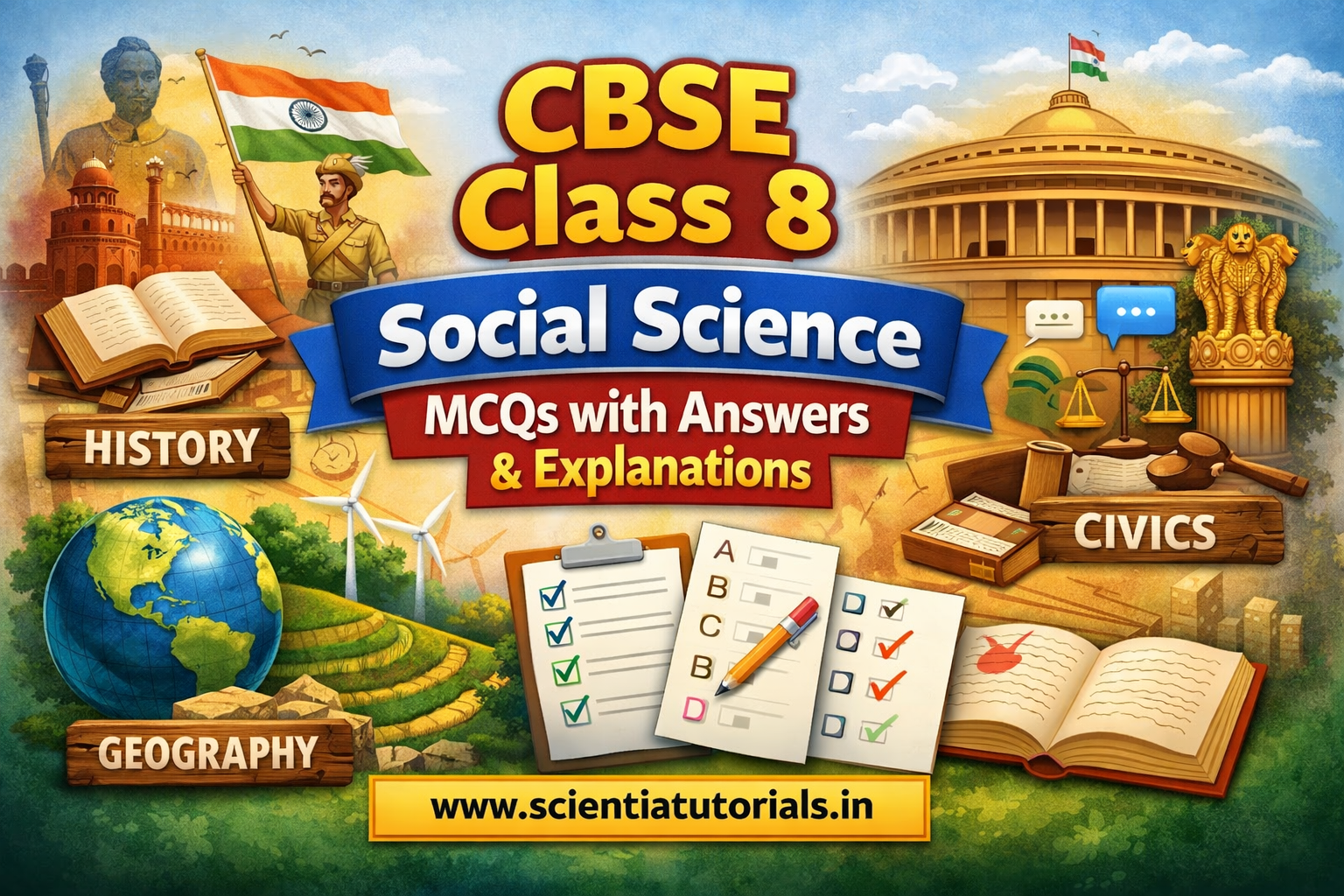
Course Features
- Lectures 25
- Quiz 0
- Duration Lifetime access
- Skill level All levels
- Language English
- Students 0
- Assessments Yes