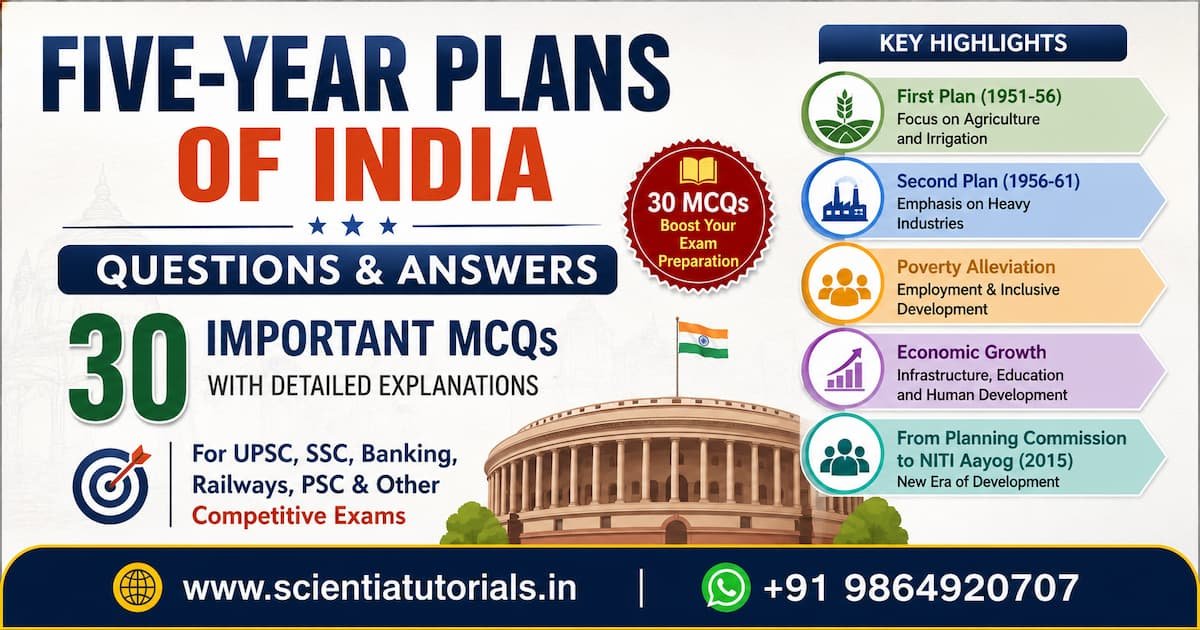
Five-Year Plans of India Questions and Answers | Important MCQs with Detailed Explanations for UPSC, SSC & Banking Exams
Five-Year Plans of India – 30 Multiple Choice Questions (MCQs) with Answers and Detailed Explanations
The following MCQs are designed for UPSC, SSC, Banking, Railways, PSC, State PCS, CDS, CAPF, CUET, Teaching Exams, and other competitive examinations. Each question includes the correct answer along with an easy-to-understand explanation for concept clarity.
1. When was the First Five-Year Plan launched in India?
A. 1947
B. 1950
C. 1951
D. 1952
Answer: ✅ C. 1951
Explanation:
The First Five-Year Plan was launched in 1951 and continued till 1956. It mainly focused on the development of agriculture because India was suffering from food shortages after Independence and Partition.
- A is incorrect because India became independent in 1947.
- B is incorrect because the Planning Commission was established in 1950.
- C is correct.
- D is incorrect because the plan had already begun.
2. Which Prime Minister introduced the First Five-Year Plan?
A. Lal Bahadur Shastri
B. Jawaharlal Nehru
C. Indira Gandhi
D. Rajiv Gandhi
Answer: ✅ B. Jawaharlal Nehru
Explanation:
Jawaharlal Nehru, India’s first Prime Minister, strongly believed in planned economic development. Under his leadership, India adopted Five-Year Plans based largely on the Soviet model.
- Nehru is called the architect of India’s planned economy.
- The Planning Commission was also formed during his tenure.
3. Which sector received the highest priority in the First Five-Year Plan?
A. Heavy industries
B. Defence
C. Agriculture and Irrigation
D. Information Technology
Answer: ✅ C. Agriculture and Irrigation
Explanation:
The First Plan gave maximum importance to agriculture, irrigation, and power generation to solve food shortages and improve rural livelihoods.
Major projects included:
- Bhakra-Nangal Dam
- Hirakud Dam
- Damodar Valley Project
4. The First Five-Year Plan was based on which economic model?
A. Mahalanobis Model
B. Harrod-Domar Model
C. Keynesian Model
D. Lewis Model
Answer: ✅ B. Harrod-Domar Model
Explanation:
The First Plan was based on the Harrod-Domar Growth Model, which emphasised increasing savings and investments to accelerate economic growth.
The Mahalanobis Model was introduced later in the Second Plan.
5. The Second Five-Year Plan mainly emphasized:
A. Agriculture
B. Heavy Industries
C. Tourism
D. IT Sector
Answer: ✅ B. Heavy Industries
Explanation:
The Second Plan (1956–1961) focused on rapid industrialisation through the establishment of heavy industries such as steel, engineering, and machine-building industries.
Examples:
- Bhilai Steel Plant
- Rourkela Steel Plant
- Durgapur Steel Plant
6. Which economist designed the Second Five-Year Plan?
A. Amartya Sen
B. P.C. Mahalanobis
C. Jagdish Bhagwati
D. V.K.R.V. Rao
Answer: ✅ B. P.C. Mahalanobis
Explanation:
Professor Prasanta Chandra Mahalanobis designed the Second Five-Year Plan. His model stressed investment in capital goods industries for long-term economic growth.
This is known as the Mahalanobis Model.
7. Which Five-Year Plan is known as the “Gadgil Plan”?
A. Second Plan
B. Third Plan
C. Fourth Plan
D. Fifth Plan
Answer: ✅ B. Third Plan
Explanation:
The Third Five-Year Plan (1961–1966) is associated with the Gadgil Strategy, named after economist D.R. Gadgil.
Its objectives included:
- Self-reliance
- Agricultural development
- Expansion of basic industries
8. The Third Five-Year Plan was adversely affected by:
A. Global recession only
B. Indo-China War, Indo-Pak War and droughts
C. COVID-19 pandemic
D. Green Revolution
Answer: ✅ B. Indo-China War, Indo-Pak War and droughts
Explanation:
The Third Plan failed mainly because of:
- 1962 Indo-China War
- 1965 Indo-Pak War
- Severe droughts (1965–66)
These events diverted resources away from development.
9. Between the Third and Fourth Plans, India experienced:
A. Emergency
B. Annual Plans
C. Rolling Plans
D. Liberalisation
Answer: ✅ B. Annual Plans
Explanation:
Due to economic instability after the Third Plan, India implemented three Annual Plans (1966–69) instead of a Five-Year Plan.
10. Which Five-Year Plan introduced the slogan “Growth with Stability”?
A. Third Plan
B. Fourth Plan
C. Fifth Plan
D. Sixth Plan
Answer: ✅ B. Fourth Plan
Explanation:
The Fourth Five-Year Plan (1969–1974) aimed at:
- Growth with Stability
- Progressive achievement of self-reliance
It also promoted family planning and poverty reduction.
11. Which Five-Year Plan introduced the slogan “Garibi Hatao”?
A. Third Plan
B. Fourth Plan
C. Fifth Plan
D. Sixth Plan
Answer: ✅ C. Fifth Plan
Explanation:
The Fifth Plan (1974–1979) emphasised:
- Removal of poverty (Garibi Hatao)
- Self-reliance
This slogan became closely associated with Prime Minister Indira Gandhi.
12. The Fifth Five-Year Plan was terminated by:
A. Rajiv Gandhi
B. Morarji Desai Government
C. Jawaharlal Nehru
D. Lal Bahadur Shastri
Answer: ✅ B. Morarji Desai Government
Explanation:
The Janata Government under Morarji Desai ended the Fifth Plan one year before its scheduled completion in 1978.
13. Which Five-Year Plan introduced the concept of the Rolling Plan?
A. Third Plan
B. Fourth Plan
C. Rolling Plan by Janata Government
D. Ninth Plan
Answer: ✅ C. Rolling Plan by Janata Government
Explanation:
The Rolling Plan (1978–1980) was introduced by the Janata Government. Instead of fixed five-year targets, it revised plans every year.
14. Which Five-Year Plan focused on poverty alleviation and employment generation?
A. Sixth Plan
B. Second Plan
C. First Plan
D. Third Plan
Answer: ✅ A. Sixth Plan
Explanation:
The Sixth Plan (1980–1985) concentrated on:
- Poverty reduction
- Employment generation
- Modernisation
- Technological development
15. Which Prime Minister reintroduced the Five-Year Plans after the Rolling Plan?
A. Atal Bihari Vajpayee
B. Rajiv Gandhi
C. Indira Gandhi
D. Morarji Desai
Answer: ✅ C. Indira Gandhi
Explanation:
After returning to power in 1980, Indira Gandhi discontinued the Rolling Plan and launched the Sixth Five-Year Plan.
16. Which Five-Year Plan stressed “Food, Work and Productivity”?
A. Seventh Plan
B. Sixth Plan
C. Fourth Plan
D. Ninth Plan
Answer: ✅ A. Seventh Plan
Explanation:
The Seventh Plan (1985–1990) emphasised:
- Food production
- Employment
- Productivity
- Social justice
17. The Seventh Five-Year Plan was launched during the tenure of:
A. Rajiv Gandhi
B. Indira Gandhi
C. P.V. Narasimha Rao
D. V.P. Singh
Answer: ✅ A. Rajiv Gandhi
Explanation:
Rajiv Gandhi promoted technological advancement, telecommunications, and modernisation during the Seventh Plan.
18. Between the Seventh and Eighth Plans, India again had:
A. Rolling Plans
B. Annual Plans
C. Ten-Year Plans
D. Perspective Plans
Answer: ✅ B. Annual Plans
Explanation:
Due to political instability, India implemented Annual Plans (1990–1992) before launching the Eighth Plan.
19. Which Five-Year Plan coincided with India’s economic liberalisation?
A. Sixth Plan
B. Seventh Plan
C. Eighth Plan
D. Ninth Plan
Answer: ✅ C. Eighth Plan
Explanation:
The Eighth Plan (1992–1997) began after the 1991 economic reforms initiated under Prime Minister P.V. Narasimha Rao and Finance Minister Dr. Manmohan Singh.
20. The Eighth Five-Year Plan mainly focused on:
A. Human Development
B. Heavy Industries only
C. Defence Expansion
D. Nuclear Research
Answer: ✅ A. Human Development
Explanation:
The Eighth Plan emphasised:
- Education
- Health
- Employment
- Infrastructure
- Human resource development
21. Which Five-Year Plan adopted the objective of “Growth with Social Justice and Equality”?
A. Ninth Plan
B. Fifth Plan
C. Fourth Plan
D. Third Plan
Answer: ✅ A. Ninth Plan
Explanation:
The Ninth Plan (1997–2002) aimed at balanced growth with social justice and equitable distribution of benefits.
22. The Tenth Five-Year Plan targeted an average GDP growth of:
A. 5%
B. 6%
C. 7%
D. 8%
Answer: ✅ D. 8%
Explanation:
The Tenth Plan (2002–2007) targeted an annual GDP growth rate of 8% and emphasised measurable outcomes in education, health, and poverty reduction.
23. Which Five-Year Plan achieved the highest average GDP growth among all Five-Year Plans?
A. Ninth Plan
B. Tenth Plan
C. Eleventh Plan
D. Twelfth Plan
Answer: ✅ C. Eleventh Plan
Explanation:
The Eleventh Plan (2007–2012) achieved an average GDP growth of around 8%, making it one of the highest-performing plans despite the global financial crisis.
24. The theme of the Eleventh Five-Year Plan was:
A. Faster and More Inclusive Growth
B. Garibi Hatao
C. Self-Reliance
D. Industrial Growth
Answer: ✅ A. Faster and More Inclusive Growth
Explanation:
The Eleventh Plan focused on ensuring that the benefits of economic growth reached all sections of society.
25. The Twelfth Five-Year Plan covered which period?
A. 2007–2012
B. 2010–2015
C. 2012–2017
D. 2015–2020
Answer: ✅ C. 2012–2017
Explanation:
The Twelfth Plan was India’s last Five-Year Plan and ran from 2012 to 2017.
26. The main theme of the Twelfth Five-Year Plan was:
A. Inclusive Growth
B. Faster, Sustainable and More Inclusive Growth
C. Green Revolution
D. Industrial Revolution
Answer: ✅ B. Faster, Sustainable and More Inclusive Growth
Explanation:
The Twelfth Plan sought to combine rapid economic growth with environmental sustainability and inclusive development.
27. Which institution replaced the Planning Commission in 2015?
A. Finance Commission
B. NITI Aayog
C. Reserve Bank of India
D. National Development Council
Answer: ✅ B. NITI Aayog
Explanation:
On 1 January 2015, the Government of India replaced the Planning Commission with NITI Aayog to promote cooperative and competitive federalism and a more flexible policy approach.
28. The Planning Commission of India was established in:
A. 1947
B. 1949
C. 1950
D. 1951
Answer: ✅ C. 1950
Explanation:
The Planning Commission was established on 15 March 1950 by a resolution of the Government of India to formulate and oversee national development plans.
29. How many Five-Year Plans were implemented in India?
A. 10
B. 11
C. 12
D. 13
Answer: ✅ C. 12
Explanation:
India implemented 12 Five-Year Plans from 1951 to 2017. After 2017, the Five-Year Plan system was discontinued, and policy planning has been guided by NITI Aayog.
30. Which statement about India’s Five-Year Plans is correct?
A. They continue even today.
B. They were constitutional provisions.
C. They were prepared by the Planning Commission until it was replaced by NITI Aayog.
D. They were introduced after 1991 reforms.
Answer: ✅ C. They were prepared by the Planning Commission until it was replaced by NITI Aayog.
Explanation:
The Five-Year Plans were formulated by the Planning Commission from 1951 to 2014. In 2015, the Planning Commission was replaced by NITI Aayog, and the Five-Year Plan framework was discontinued after the Twelfth Plan (2012–2017).
- Option A is incorrect because the Five-Year Plan system ended after 2017.
- Option B is incorrect because the Planning Commission was created by an executive resolution, not by the Constitution.
- Option C is correct.
- Option D is incorrect because the Five-Year Plans began in 1951, long before the 1991 economic reforms.
Quick Revision Table
| Plan | Period | Major Focus |
|---|---|---|
| First | 1951–56 | Agriculture & Irrigation |
| Second | 1956–61 | Heavy Industries (Mahalanobis Model) |
| Third | 1961–66 | Self-Reliance & Agriculture |
| Annual Plans | 1966–69 | Transitional Period |
| Fourth | 1969–74 | Growth with Stability |
| Fifth | 1974–79 | Garibi Hatao & Self-Reliance |
| Rolling Plan | 1978–80 | Annual Revision of Targets |
| Sixth | 1980–85 | Poverty Alleviation & Employment |
| Seventh | 1985–90 | Food, Work & Productivity |
| Annual Plans | 1990–92 | Political Transition |
| Eighth | 1992–97 | Human Development & Liberalisation |
| Ninth | 1997–2002 | Growth with Social Justice |
| Tenth | 2002–07 | 8% GDP Growth Target |
| Eleventh | 2007–12 | Faster and More Inclusive Growth |
| Twelfth | 2012–17 | Faster, Sustainable & More Inclusive Growth |
| Since 2015 | — | NITI Aayog replaced Planning Commission |