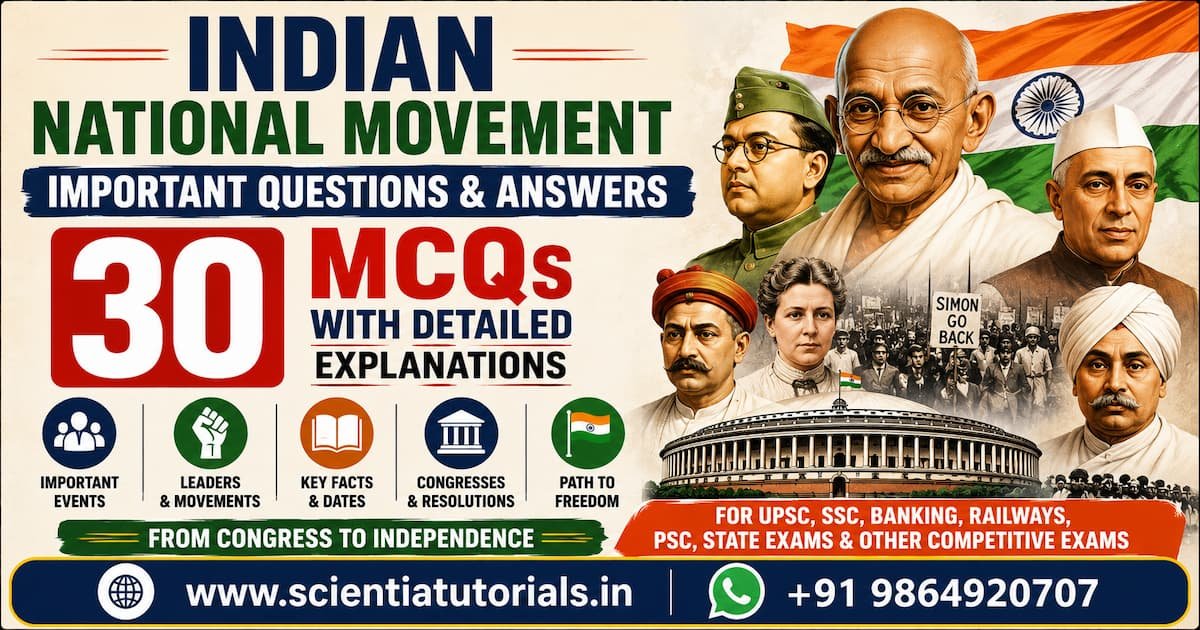
Indian National Movement Important Questions and Answers | 30 MCQs with Detailed Explanations for Competitive Exams
Indian National Movement Important Questions and Answers – 30 Important MCQs with Detailed Explanations for Competitive Exams
The following 30 Multiple Choice Questions (MCQs) are designed for UPSC Civil Services, SSC CGL, CHSL, Banking (IBPS, SBI, RBI), Railways, State PSC, CDS, CAPF, Insurance, CUET, and other competitive examinations in India. Each question includes the correct answer along with easy-to-understand, concept-clearing explanations.
1. Which organisation played the most significant role in leading India’s national movement against British rule?
A. Muslim League
B. Indian National Congress (INC)
C. Ghadar Party
D. Swaraj Party
✅ Answer: B. Indian National Congress (INC)
Explanation:
The Indian National Congress (INC), founded in 1885, became the principal political organisation leading India’s freedom struggle through constitutional methods, mass movements, and negotiations.
Option Analysis
- A. Muslim League – Founded later in 1906.
- B. Indian National Congress – Correct.
- C. Ghadar Party – Revolutionary organisation.
- D. Swaraj Party – Formed in 1923 within the nationalist movement.
2. The Indian National Congress was founded in:
A. 1857
B. 1885
C. 1905
D. 1919
✅ Answer: B. 1885
Explanation:
The Indian National Congress was established on 28 December 1885 in Bombay with Womesh Chandra Bonnerjee (W. C. Bonnerjee) as its first President.
3. Who founded the Indian National Congress?
A. Dadabhai Naoroji
B. A. O. Hume
C. Bal Gangadhar Tilak
D. Surendranath Banerjee
✅ Answer: B. A. O. Hume
Explanation:
Allan Octavian (A. O.) Hume, a retired British civil servant, founded the Indian National Congress with support from Indian leaders.
4. Who was the first President of the Indian National Congress?
A. Dadabhai Naoroji
B. W. C. Bonnerjee
C. Gopal Krishna Gokhale
D. Badruddin Tyabji
✅ Answer: B. W. C. Bonnerjee
Explanation:
Womesh Chandra Bonnerjee presided over the first session of the INC held in Bombay in 1885.
5. The early phase of the Indian National Congress (1885–1905) is known as the period of:
A. Revolutionaries
B. Moderates
C. Extremists
D. Socialists
✅ Answer: B. Moderates
Explanation:
Moderate leaders believed in constitutional reforms, petitions, discussions, and peaceful methods to secure political rights.
6. Which leader is known as the “Grand Old Man of India”?
A. Bal Gangadhar Tilak
B. Dadabhai Naoroji
C. Bipin Chandra Pal
D. Lala Lajpat Rai
✅ Answer: B. Dadabhai Naoroji
Explanation:
Dadabhai Naoroji earned this title for his immense contribution to India’s political awakening and for proposing the Drain Theory.
7. The Drain Theory was proposed by:
A. Mahatma Gandhi
B. Dadabhai Naoroji
C. Gopal Krishna Gokhale
D. Annie Besant
✅ Answer: B. Dadabhai Naoroji
Explanation:
The Drain Theory explained how British economic policies transferred India’s wealth to Britain.
8. The Partition of Bengal took place in:
A. 1885
B. 1905
C. 1919
D. 1930
✅ Answer: B. 1905
Explanation:
Lord Curzon partitioned Bengal in 1905, triggering widespread protests and the Swadeshi Movement.
9. The Swadeshi Movement encouraged Indians to:
A. Buy only imported goods
B. Promote indigenous goods and boycott foreign products
C. Leave India
D. Stop agriculture
✅ Answer: B. Promote indigenous goods and boycott foreign products
Explanation:
The Swadeshi Movement promoted self-reliance by encouraging the use of Indian-made goods and discouraging the purchase of British products.
10. Which Viceroy partitioned Bengal?
A. Lord Ripon
B. Lord Curzon
C. Lord Canning
D. Lord Wellesley
✅ Answer: B. Lord Curzon
Explanation:
Lord Curzon announced the Partition of Bengal in 1905, which became a turning point in the freedom movement.
11. The famous slogan “Swaraj is my birthright and I shall have it” was given by:
A. Mahatma Gandhi
B. Bal Gangadhar Tilak
C. Jawaharlal Nehru
D. Lala Lajpat Rai
✅ Answer: B. Bal Gangadhar Tilak
Explanation:
Tilak inspired millions with his demand for self-rule (Swaraj).
12. The Surat Split of the Indian National Congress occurred in:
A. 1885
B. 1907
C. 1919
D. 1920
✅ Answer: B. 1907
Explanation:
The Congress split into Moderates and Extremists at the Surat Session due to ideological differences.
13. The Home Rule Movement was launched by:
A. Mahatma Gandhi only
B. Annie Besant and Bal Gangadhar Tilak
C. Subhas Chandra Bose
D. Bhagat Singh
✅ Answer: B. Annie Besant and Bal Gangadhar Tilak
Explanation:
The Home Rule Movement (1916) demanded self-government within the British Empire.
14. The Lucknow Pact was signed in:
A. 1905
B. 1916
C. 1919
D. 1930
✅ Answer: B. 1916
Explanation:
The Lucknow Pact marked cooperation between the Indian National Congress and the All India Muslim League.
15. The Rowlatt Act was passed in:
A. 1915
B. 1919
C. 1922
D. 1935
✅ Answer: B. 1919
Explanation:
The Act allowed detention without trial and led to nationwide protests.
16. The Jallianwala Bagh Massacre occurred on:
A. 13 April 1919
B. 15 August 1947
C. 8 August 1942
D. 26 January 1930
✅ Answer: A. 13 April 1919
Explanation:
General Reginald Dyer ordered troops to fire on an unarmed gathering at Jallianwala Bagh in Amritsar.
17. The Non-Cooperation Movement was launched in:
A. 1905
B. 1920
C. 1930
D. 1942
✅ Answer: B. 1920
Explanation:
Mahatma Gandhi launched the movement to peacefully resist British rule through non-cooperation.
18. Which incident led Mahatma Gandhi to suspend the Non-Cooperation Movement?
A. Simon Commission
B. Chauri Chaura Incident
C. Dandi March
D. Partition of Bengal
✅ Answer: B. Chauri Chaura Incident
Explanation:
After protesters turned violent at Chauri Chaura in 1922, Gandhi suspended the movement to uphold non-violence.
19. The Civil Disobedience Movement began with:
A. Quit India Movement
B. Salt (Dandi) March
C. Swadeshi Movement
D. Home Rule Movement
✅ Answer: B. Salt (Dandi) March
Explanation:
The Dandi March (1930) challenged the British monopoly on salt and marked the beginning of the Civil Disobedience Movement.
20. The Salt March ended at:
A. Delhi
B. Dandi
C. Lahore
D. Kolkata
✅ Answer: B. Dandi
Explanation:
Gandhi marched about 390 km from Sabarmati Ashram to Dandi, where he broke the Salt Law.
21. The Lahore Session of the Congress (1929) declared:
A. Dominion Status
B. Purna Swaraj (Complete Independence)
C. Separate Electorates
D. Home Rule
✅ Answer: B. Purna Swaraj (Complete Independence)
Explanation:
Under the presidency of Jawaharlal Nehru, the Congress adopted Complete Independence as its goal.
22. The Quit India Movement was launched in:
A. 1935
B. 1942
C. 1945
D. 1947
✅ Answer: B. 1942
Explanation:
On 8 August 1942, the Congress launched the Quit India Movement demanding immediate British withdrawal.
23. Which slogan is associated with the Quit India Movement?
A. Jai Hind
B. Do or Die
C. Vande Mataram
D. Inquilab Zindabad
✅ Answer: B. Do or Die
Explanation:
Mahatma Gandhi gave the “Do or Die” call during the Quit India Movement.
24. Who gave the slogan “Jai Hind”?
A. Bhagat Singh
B. Subhas Chandra Bose
C. Jawaharlal Nehru
D. Mahatma Gandhi
✅ Answer: B. Subhas Chandra Bose
Explanation:
Subhas Chandra Bose popularised the patriotic slogan “Jai Hind”, which later became a national salute.
25. Who founded the Forward Bloc?
A. Jawaharlal Nehru
B. Mahatma Gandhi
C. Subhas Chandra Bose
D. Sardar Patel
✅ Answer: C. Subhas Chandra Bose
Explanation:
The Forward Bloc was founded by Bose in 1939 after differences with the Congress leadership.
26. The Indian National Army (INA) is associated with:
A. Bhagat Singh
B. Subhas Chandra Bose
C. Tilak
D. Rajendra Prasad
✅ Answer: B. Subhas Chandra Bose
Explanation:
Subhas Chandra Bose reorganised and led the INA to fight British rule.
27. India attained Independence on:
A. 26 January 1950
B. 15 August 1947
C. 26 November 1949
D. 23 March 1931
✅ Answer: B. 15 August 1947
Explanation:
India became independent from British rule on 15 August 1947.
28. The Constitution of India came into force on:
A. 15 August 1947
B. 26 January 1950
C. 26 November 1949
D. 2 October 1948
✅ Answer: B. 26 January 1950
Explanation:
India became a Republic on 26 January 1950 when the Constitution came into effect.
29. Which of the following leaders was popularly known as “Mahatma”?
A. Jawaharlal Nehru
B. Mahatma Gandhi
C. Subhas Chandra Bose
D. Sardar Patel
✅ Answer: B. Mahatma Gandhi
Explanation:
Mahatma Gandhi led several major mass movements based on the principles of truth (Satya) and non-violence (Ahimsa).
30. Which statement best summarises the Indian National Movement?
A. It was fought only through armed revolution.
B. It was a broad-based struggle involving constitutional methods, mass movements, revolutionary activities, social reforms, and political negotiations that ultimately led to India’s Independence.
C. It was confined only to one region of India.
D. It ended after the Revolt of 1857.
✅ Answer: B. It was a broad-based struggle involving constitutional methods, mass movements, revolutionary activities, social reforms, and political negotiations that ultimately led to India’s Independence.
Explanation:
The Indian National Movement united people from different regions, religions, languages, and social backgrounds. It evolved through the contributions of Moderates, Extremists, Revolutionaries, Gandhian mass movements, labour and peasant organisations, and many other groups. This sustained national effort culminated in India’s Independence on 15 August 1947.
Quick Revision Table
| Topic | Key Fact |
|---|---|
| Indian National Congress Founded | 1885 |
| Founder of INC | A. O. Hume |
| First INC President | W. C. Bonnerjee |
| Moderate Phase | 1885–1905 |
| Partition of Bengal | 1905 |
| Swadeshi Movement | 1905 |
| Surat Split | 1907 |
| Home Rule Movement | 1916 |
| Lucknow Pact | 1916 |
| Rowlatt Act | 1919 |
| Jallianwala Bagh Massacre | 13 April 1919 |
| Non-Cooperation Movement | 1920 |
| Chauri Chaura Incident | 1922 |
| Civil Disobedience Movement | 1930 |
| Dandi (Salt) March | 1930 |
| Purna Swaraj Resolution | Lahore Session, 1929 |
| Quit India Movement | 1942 |
| “Do or Die” | Mahatma Gandhi |
| Indian Independence | 15 August 1947 |
| Constitution Enforced | 26 January 1950 |