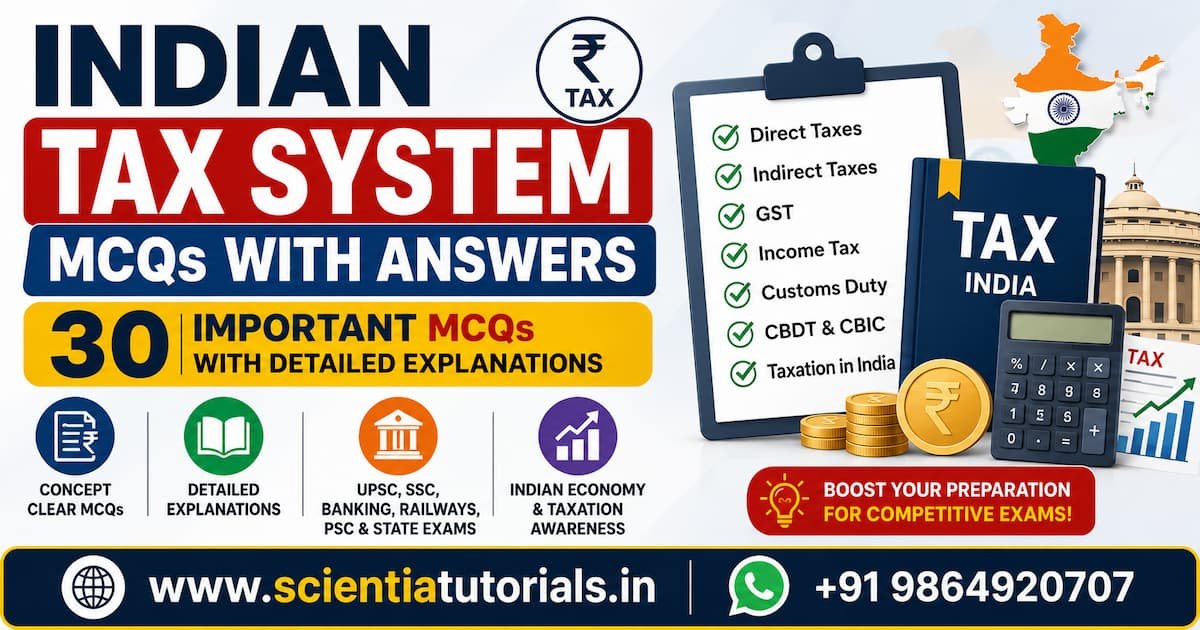
Indian Tax System MCQs with Answers | 30 Important Questions with Detailed Explanations for Competitive Exams
Indian Tax System MCQs with Answers – 30 Important Multiple Choice Questions (MCQs) with Detailed Explanations
The following 30 exam-oriented Multiple Choice Questions (MCQs) are designed for UPSC, SSC, Banking, Railways, PSC, State PCS, IBPS, SBI, RBI, Insurance, CDS, CAPF, CUET, and other competitive examinations in India. Each question includes the correct answer and a detailed, concept-clearing explanation.
1. What is a tax?
A. A voluntary donation to the Government
B. A compulsory financial charge imposed by the Government
C. A bank loan
D. A subsidy provided by the Government
✅ Answer: B. A compulsory financial charge imposed by the Government
Explanation:
A tax is a compulsory contribution collected by the Government from individuals and businesses to finance public services such as education, healthcare, defence, infrastructure, and welfare schemes.
Option Analysis
- A is incorrect because taxes are mandatory.
- B is correct.
- C refers to borrowing.
- D refers to financial assistance from the Government.
2. Which authority has the power to levy taxes in India?
A. Reserve Bank of India
B. Parliament and State Legislatures as per the Constitution
C. Supreme Court
D. Election Commission
✅ Answer: B. Parliament and State Legislatures as per the Constitution
Explanation:
The Constitution of India divides taxation powers between the Union Government and State Governments through the Union List, State List, and Concurrent List (where applicable).
3. Which Article of the Constitution states that no tax shall be levied or collected except by authority of law?
A. Article 110
B. Article 265
C. Article 280
D. Article 324
✅ Answer: B. Article 265
Explanation:
Article 265 provides that “No tax shall be levied or collected except by authority of law.” This protects citizens from arbitrary taxation.
4. Taxes in India are broadly classified into:
A. National and International Taxes
B. Direct and Indirect Taxes
C. Personal and Business Taxes
D. Urban and Rural Taxes
✅ Answer: B. Direct and Indirect Taxes
Explanation:
The Indian tax system is primarily divided into:
- Direct Taxes – paid directly to the Government.
- Indirect Taxes – collected through the sale of goods and services.
5. Which of the following is a direct tax?
A. GST
B. Customs Duty
C. Income Tax
D. Excise Duty
✅ Answer: C. Income Tax
Explanation:
Income Tax is paid directly by individuals or entities on their taxable income and cannot be shifted to another person.
6. Which of the following is an indirect tax?
A. Income Tax
B. Corporation Tax
C. GST
D. Capital Gains Tax
✅ Answer: C. GST
Explanation:
Goods and Services Tax (GST) is collected on the supply of goods and services and is ultimately borne by the consumer.
7. Which tax is imposed on the profits earned by companies?
A. Income Tax
B. GST
C. Corporation Tax
D. Customs Duty
✅ Answer: C. Corporation Tax
Explanation:
Corporation Tax is a direct tax levied on the taxable profits of companies.
8. Which tax is levied on imported goods?
A. Income Tax
B. Customs Duty
C. Property Tax
D. Professional Tax
✅ Answer: B. Customs Duty
Explanation:
Customs Duty is imposed on goods imported into India to regulate trade and generate revenue.
9. GST was introduced in India on:
A. 15 August 1947
B. 1 April 2016
C. 1 July 2017
D. 26 January 1950
✅ Answer: C. 1 July 2017
Explanation:
GST came into force on 1 July 2017, replacing several indirect taxes with a unified tax system.
10. GST stands for:
A. General Sales Tax
B. Goods and Services Tax
C. Government Sales Tax
D. Gross Service Tax
✅ Answer: B. Goods and Services Tax
Explanation:
GST is a destination-based indirect tax levied on the supply of goods and services.
11. Which Constitutional Amendment introduced GST?
A. 42nd Amendment
B. 73rd Amendment
C. 101st Amendment
D. 44th Amendment
✅ Answer: C. 101st Amendment
Explanation:
The Constitution (101st Amendment) Act, 2016 enabled the introduction of GST in India.
12. Which body makes recommendations regarding GST?
A. Finance Commission
B. GST Council
C. RBI
D. NITI Aayog
✅ Answer: B. GST Council
Explanation:
The GST Council recommends GST rates, exemptions, and policy changes to ensure uniform implementation.
13. Who is the Chairperson of the GST Council?
A. Prime Minister
B. Finance Minister of India
C. RBI Governor
D. President of India
✅ Answer: B. Finance Minister of India
Explanation:
The Union Finance Minister serves as the Chairperson of the GST Council.
14. GST is a:
A. Origin-based tax
B. Destination-based tax
C. Wealth tax
D. Income tax
✅ Answer: B. Destination-based tax
Explanation:
GST revenue accrues to the State where the goods or services are consumed.
15. Which tax was largely subsumed into GST?
A. Income Tax
B. Corporation Tax
C. VAT
D. Property Tax
✅ Answer: C. VAT
Explanation:
State Value Added Tax (VAT) on most goods was subsumed into GST, although some items such as petroleum products remain outside GST for now.
16. Which tax is levied on personal income?
A. GST
B. Customs Duty
C. Income Tax
D. Excise Duty
✅ Answer: C. Income Tax
Explanation:
Income Tax is charged on the taxable income of individuals, Hindu Undivided Families (HUFs), firms, and certain other entities.
17. Which authority administers direct taxes in India?
A. GST Council
B. Central Board of Direct Taxes (CBDT)
C. RBI
D. SEBI
✅ Answer: B. Central Board of Direct Taxes (CBDT)
Explanation:
CBDT functions under the Department of Revenue, Ministry of Finance, and administers direct tax laws.
18. Which authority administers indirect taxes such as GST and Customs?
A. RBI
B. Central Board of Indirect Taxes and Customs (CBIC)
C. Finance Commission
D. NITI Aayog
✅ Answer: B. Central Board of Indirect Taxes and Customs (CBIC)
Explanation:
CBIC administers GST, Customs, and other indirect tax laws under the Ministry of Finance.
19. Which tax is generally collected from the final consumer?
A. Income Tax
B. Corporation Tax
C. GST
D. Capital Gains Tax
✅ Answer: C. GST
Explanation:
Although businesses collect GST and remit it to the Government, the tax burden is ultimately borne by the consumer.
20. Customs Duty mainly applies to:
A. Salaries
B. Imports and exports
C. Agricultural income
D. Pension income
✅ Answer: B. Imports and exports
Explanation:
Customs Duty is imposed primarily on imports and, in limited situations, on exports to regulate trade and protect domestic industries.
21. Which tax encourages compliance through the Input Tax Credit (ITC) mechanism?
A. Income Tax
B. GST
C. Wealth Tax
D. Property Tax
✅ Answer: B. GST
Explanation:
The Input Tax Credit mechanism allows businesses to claim credit for GST paid on inputs, reducing cascading of taxes.
22. Which of the following is not a direct tax?
A. Corporation Tax
B. Income Tax
C. GST
D. Capital Gains Tax
✅ Answer: C. GST
Explanation:
GST is an indirect tax, whereas Income Tax, Corporation Tax, and Capital Gains Tax are direct taxes.
23. Which Ministry oversees tax administration in India?
A. Ministry of Commerce
B. Ministry of Finance
C. Ministry of Home Affairs
D. Ministry of Corporate Affairs
✅ Answer: B. Ministry of Finance
Explanation:
The Department of Revenue under the Ministry of Finance oversees tax administration through CBDT and CBIC.
24. Which level of government can levy Stamp Duty on certain transactions under the constitutional scheme?
A. Only the Union Government
B. Only the State Governments
C. Both the Union and the States, depending on the subject and law
D. Panchayats only
✅ Answer: C. Both the Union and the States, depending on the subject and law
Explanation:
The Constitution distributes legislative powers relating to stamp duties. Depending on the nature of the instrument and applicable law, both the Union and the States have roles.
25. Which tax helps the Government redistribute income and reduce inequality?
A. Progressive Income Tax
B. GST only
C. Customs Duty only
D. Stamp Duty only
✅ Answer: A. Progressive Income Tax
Explanation:
A progressive income tax imposes higher tax rates on higher income levels, helping reduce income inequality.
26. Which statement about direct taxes is correct?
A. They can always be shifted to consumers.
B. They are paid directly by the taxpayer to the Government.
C. They apply only to imported goods.
D. They are collected only by State Governments.
✅ Answer: B. They are paid directly by the taxpayer to the Government.
Explanation:
The burden of direct taxes generally cannot be transferred to another person.
27. Which statement about indirect taxes is correct?
A. They are never included in prices.
B. They are generally included in the price of goods and services.
C. They are paid only by companies.
D. They apply only to income.
✅ Answer: B. They are generally included in the price of goods and services.
Explanation:
Consumers pay indirect taxes as part of the purchase price, while sellers collect and remit them to the Government.
28. Why are taxes important for a country?
A. Only to increase imports
B. To finance public expenditure and development
C. Only to reduce exports
D. Only to regulate elections
✅ Answer: B. To finance public expenditure and development
Explanation:
Tax revenue funds infrastructure, education, healthcare, defence, social welfare, and other essential public services.
29. Which of the following is a major objective of the Indian tax system?
A. Revenue generation only
B. Revenue generation, economic development, and social equity
C. Promoting inflation
D. Reducing international trade only
✅ Answer: B. Revenue generation, economic development, and social equity
Explanation:
The tax system aims to raise revenue, promote economic growth, encourage investment, and support equitable distribution of resources.
30. Which statement best describes the Indian tax system?
A. It consists only of direct taxes.
B. It consists only of indirect taxes.
C. It includes both direct and indirect taxes administered under constitutional and statutory provisions.
D. It is managed solely by the Reserve Bank of India.
✅ Answer: C. It includes both direct and indirect taxes administered under constitutional and statutory provisions.
Explanation:
India has a comprehensive tax system comprising direct taxes (such as Income Tax and Corporation Tax) and indirect taxes (such as GST and Customs Duty). Taxation powers are distributed between the Union and the States under the Constitution, and tax administration is primarily handled by the CBDT (direct taxes) and CBIC (indirect taxes and customs).
Quick Revision Table
| Topic | Key Fact |
|---|---|
| Constitutional Provision | Article 265 – No tax except by authority of law |
| Types of Taxes | Direct Taxes and Indirect Taxes |
| Major Direct Tax | Income Tax |
| Tax on Company Profits | Corporation Tax |
| Major Indirect Tax | Goods and Services Tax (GST) |
| GST Launch Date | 1 July 2017 |
| GST Constitutional Amendment | 101st Constitutional Amendment Act, 2016 |
| GST Policy Body | GST Council |
| GST Council Chairperson | Union Finance Minister |
| GST Nature | Destination-based tax |
| Direct Tax Administration | Central Board of Direct Taxes (CBDT) |
| Indirect Tax & Customs Administration | Central Board of Indirect Taxes and Customs (CBIC) |
| Customs Duty | Tax on imports (and certain exports) |
| Main Objective of Taxation | Revenue, development, and social equity |
| Ministry Responsible | Ministry of Finance |