Medieval Indian History MCQs with Answers
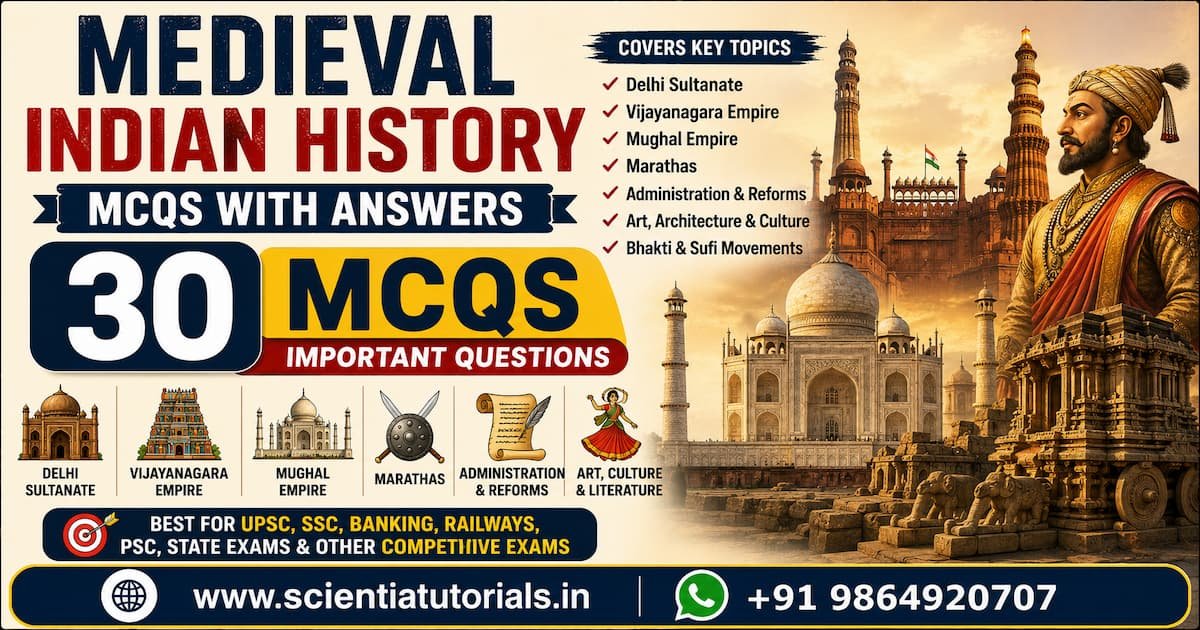
Medieval Indian History MCQs with Answers – 30 Important Questions with Detailed Explanations
The following 30 Multiple Choice Questions (MCQs) are designed for UPSC Civil Services, SSC CGL/CHSL, Banking (IBPS, SBI, RBI), Railways, State PSC, CDS, CAPF, Insurance, CUET, and other competitive examinations in India. Each question includes the correct answer along with a concept-clearing, easy-to-understand explanation.
1. Which ruler is regarded as the founder of the Delhi Sultanate?
A. Qutb-ud-din Aibak
B. Muhammad Ghori
C. Iltutmish
D. Balban
✅ Answer: A. Qutb-ud-din Aibak
Explanation:
After the death of Muhammad Ghori in 1206 CE, Qutb-ud-din Aibak established the Mamluk (Slave) Dynasty, marking the beginning of the Delhi Sultanate.
Option Analysis
- A. Qutb-ud-din Aibak – Correct.
- B. Muhammad Ghori – Defeated Prithviraj Chauhan but did not establish the Sultanate.
- C. Iltutmish – Consolidated the Sultanate.
- D. Balban – Strengthened the monarchy later.
2. The Qutub Minar was started by:
A. Iltutmish
B. Alauddin Khalji
C. Qutb-ud-din Aibak
D. Balban
✅ Answer: C. Qutb-ud-din Aibak
Explanation:
Qutb-ud-din Aibak began the construction of the Qutub Minar, and it was completed by Iltutmish.
3. Who is known as the real consolidator of the Delhi Sultanate?
A. Razia Sultan
B. Iltutmish
C. Balban
D. Alauddin Khalji
✅ Answer: B. Iltutmish
Explanation:
Iltutmish firmly established the Delhi Sultanate by defeating rivals, organising administration, and securing recognition from the Abbasid Caliph.
4. Who was the first woman ruler of the Delhi Sultanate?
A. Chand Bibi
B. Razia Sultan
C. Nur Jahan
D. Rani Durgavati
✅ Answer: B. Razia Sultan
Explanation:
Razia Sultan (1236–1240 CE) was the first and only woman to rule the Delhi Sultanate.
5. The famous group of forty Turkish nobles was known as:
A. Mansabdars
B. Chahalgani
C. Jagirdars
D. Ulema
✅ Answer: B. Chahalgani
Explanation:
The Chahalgani (Group of Forty) was an influential body of Turkish nobles formed during Iltutmish’s reign.
6. Which Sultan introduced the policy of “Blood and Iron”?
A. Balban
B. Alauddin Khalji
C. Muhammad bin Tughlaq
D. Sikandar Lodi
✅ Answer: A. Balban
Explanation:
Balban adopted the policy of Blood and Iron to strengthen the authority of the Sultan and suppress rebellions.
7. Alauddin Khalji is best known for:
A. Shifting the capital to Daulatabad
B. Market Control Reforms
C. Building Fatehpur Sikri
D. Din-i-Ilahi
✅ Answer: B. Market Control Reforms
Explanation:
Alauddin Khalji introduced strict market regulations to maintain low prices for essential commodities and military supplies.
8. Which ruler introduced the market control system?
A. Iltutmish
B. Alauddin Khalji
C. Balban
D. Sher Shah Suri
✅ Answer: B. Alauddin Khalji
Explanation:
His reforms included price control, rationing, and supervision of traders.
9. Muhammad bin Tughlaq shifted his capital from Delhi to:
A. Agra
B. Lahore
C. Daulatabad
D. Kannauj
✅ Answer: C. Daulatabad
Explanation:
Muhammad bin Tughlaq transferred the capital to Daulatabad, but the experiment ultimately failed due to practical difficulties.
10. Muhammad bin Tughlaq introduced:
A. Silver Coins
B. Token Currency
C. Paper Currency
D. Gold Coins Only
✅ Answer: B. Token Currency
Explanation:
He introduced copper token currency, but widespread counterfeiting led to its failure.
11. Who founded the Vijayanagara Empire?
A. Harihara I and Bukka Raya I
B. Krishnadevaraya and Achyuta Raya
C. Pulakeshin II
D. Rajaraja Chola I
✅ Answer: A. Harihara I and Bukka Raya I
Explanation:
The Vijayanagara Empire was founded in 1336 CE by Harihara I and Bukka Raya I.
12. The greatest ruler of the Vijayanagara Empire was:
A. Devaraya II
B. Harihara I
C. Krishnadevaraya
D. Bukka Raya I
✅ Answer: C. Krishnadevaraya
Explanation:
Krishnadevaraya’s reign is regarded as the golden age of the Vijayanagara Empire.
13. Which traveller visited the court of Krishnadevaraya?
A. Ibn Battuta
B. Domingo Paes
C. Fa-Hien
D. Al-Biruni
✅ Answer: B. Domingo Paes
Explanation:
The Portuguese traveller Domingo Paes described the prosperity of Vijayanagara.
14. The Mughal Empire was founded by:
A. Humayun
B. Babur
C. Akbar
D. Sher Shah Suri
✅ Answer: B. Babur
Explanation:
Babur founded the Mughal Empire after defeating Ibrahim Lodi in the First Battle of Panipat (1526).
15. The First Battle of Panipat was fought in:
A. 1498
B. 1526
C. 1556
D. 1576
✅ Answer: B. 1526
Explanation:
The battle marked the beginning of Mughal rule in India.
16. Humayun lost his kingdom to:
A. Akbar
B. Sher Shah Suri
C. Babur
D. Jahangir
✅ Answer: B. Sher Shah Suri
Explanation:
Sher Shah Suri defeated Humayun in the Battles of Chausa (1539) and Kannauj (1540).
17. Sher Shah Suri is famous for constructing:
A. Red Fort
B. Grand Trunk Road
C. Buland Darwaza
D. Gol Gumbaz
✅ Answer: B. Grand Trunk Road
Explanation:
Sher Shah Suri improved and extended the Grand Trunk Road, boosting administration and trade.
18. Akbar became emperor in:
A. 1526
B. 1556
C. 1605
D. 1707
✅ Answer: B. 1556
Explanation:
Akbar ascended the throne after Humayun’s death and later expanded the Mughal Empire significantly.
19. Akbar’s religious policy was based on:
A. Religious Intolerance
B. Sulh-i-Kul (Universal Peace)
C. Forced Conversion
D. Jizya Expansion
✅ Answer: B. Sulh-i-Kul (Universal Peace)
Explanation:
Akbar promoted harmony among different religions through Sulh-i-Kul.
20. The Mansabdari System was introduced by:
A. Babur
B. Akbar
C. Jahangir
D. Shah Jahan
✅ Answer: B. Akbar
Explanation:
The Mansabdari System organised military and civil administration based on rank.
21. Who wrote the Akbarnama?
A. Birbal
B. Abul Fazl
C. Faizi
D. Todar Mal
✅ Answer: B. Abul Fazl
Explanation:
Abul Fazl was Akbar’s court historian and authored the Akbarnama and Ain-i-Akbari.
22. The Battle of Haldighati (1576) was fought between:
A. Akbar and Shivaji
B. Maharana Pratap and Akbar’s forces
C. Babur and Ibrahim Lodi
D. Sher Shah and Humayun
✅ Answer: B. Maharana Pratap and Akbar’s forces
Explanation:
The battle was fought between Maharana Pratap and the Mughal army led by Raja Man Singh.
23. Shah Jahan built the Taj Mahal in memory of:
A. Jahanara Begum
B. Mumtaz Mahal
C. Nur Jahan
D. Roshanara Begum
✅ Answer: B. Mumtaz Mahal
Explanation:
The Taj Mahal in Agra is one of the finest examples of Mughal architecture.
24. Which Mughal emperor built the Red Fort in Delhi?
A. Akbar
B. Shah Jahan
C. Jahangir
D. Aurangzeb
✅ Answer: B. Shah Jahan
Explanation:
The Red Fort became the new seat of Mughal power after Shah Jahan shifted the capital to Shahjahanabad.
25. Aurangzeb reimposed which tax on non-Muslims?
A. Zakat
B. Kharaj
C. Jizya
D. Ushr
✅ Answer: C. Jizya
Explanation:
Aurangzeb reintroduced the Jizya tax in 1679, reversing Akbar’s earlier policy.
26. Shivaji founded the:
A. Vijayanagara Empire
B. Maratha Kingdom
C. Mughal Empire
D. Bahmani Sultanate
✅ Answer: B. Maratha Kingdom
Explanation:
Shivaji established an independent Maratha state in western India.
27. Shivaji was crowned at:
A. Raigad Fort
B. Agra Fort
C. Daulatabad
D. Chittorgarh
✅ Answer: A. Raigad Fort
Explanation:
Shivaji’s coronation took place at Raigad in 1674, marking the formal establishment of the Maratha Kingdom.
28. Guru Gobind Singh founded the Khalsa in:
A. 1469
B. 1556
C. 1699
D. 1707
✅ Answer: C. 1699
Explanation:
Guru Gobind Singh established the Khalsa to strengthen the Sikh community.
29. Which traveller wrote Kitab-ul-Hind?
A. Marco Polo
B. Ibn Battuta
C. Al-Biruni
D. Niccolò Manucci
✅ Answer: C. Al-Biruni
Explanation:
Al-Biruni’s Kitab-ul-Hind provides valuable insights into Indian society, religion, and science during the early medieval period.
30. Which statement best describes Medieval Indian History?
A. It includes only the Delhi Sultanate.
B. It covers the rise and decline of the Delhi Sultanate, regional kingdoms, the Vijayanagara Empire, the Mughal Empire, the Marathas, religious movements, art, architecture, administration, and cultural developments from roughly the 8th to the 18th century.
C. It begins with the Indus Valley Civilisation.
D. It deals only with European colonial rule.
✅ Answer: B. It covers the rise and decline of the Delhi Sultanate, regional kingdoms, the Vijayanagara Empire, the Mughal Empire, the Marathas, religious movements, art, architecture, administration, and cultural developments from roughly the 8th to the 18th century.
Explanation:
Medieval Indian History encompasses the emergence of the Delhi Sultanate, regional powers such as the Vijayanagara and Bahmani kingdoms, the rise of the Mughal Empire, the growth of the Maratha Kingdom, the Bhakti and Sufi movements, developments in administration, architecture, literature, trade, and culture. These themes are frequently tested in UPSC, SSC, Banking, Railways, State PSC, and other competitive examinations.
Quick Revision Table
| Topic | Key Fact |
|---|---|
| Founder of Delhi Sultanate | Qutb-ud-din Aibak |
| Qutub Minar Started By | Qutb-ud-din Aibak |
| Consolidator of Delhi Sultanate | Iltutmish |
| First Woman Sultan | Razia Sultan |
| Group of Forty | Chahalgani |
| Blood and Iron Policy | Balban |
| Market Reforms | Alauddin Khalji |
| Token Currency | Muhammad bin Tughlaq |
| Vijayanagara Founders | Harihara I & Bukka Raya I |
| Greatest Vijayanagara Ruler | Krishnadevaraya |
| Founder of Mughal Empire | Babur |
| First Battle of Panipat | 1526 |
| Grand Trunk Road | Sher Shah Suri |
| Sulh-i-Kul | Akbar |
| Mansabdari System | Akbar |
| Akbarnama Author | Abul Fazl |
| Battle of Haldighati | 1576 |
| Taj Mahal | Shah Jahan |
| Red Fort | Shah Jahan |
| Khalsa Founded | Guru Gobind Singh (1699) |