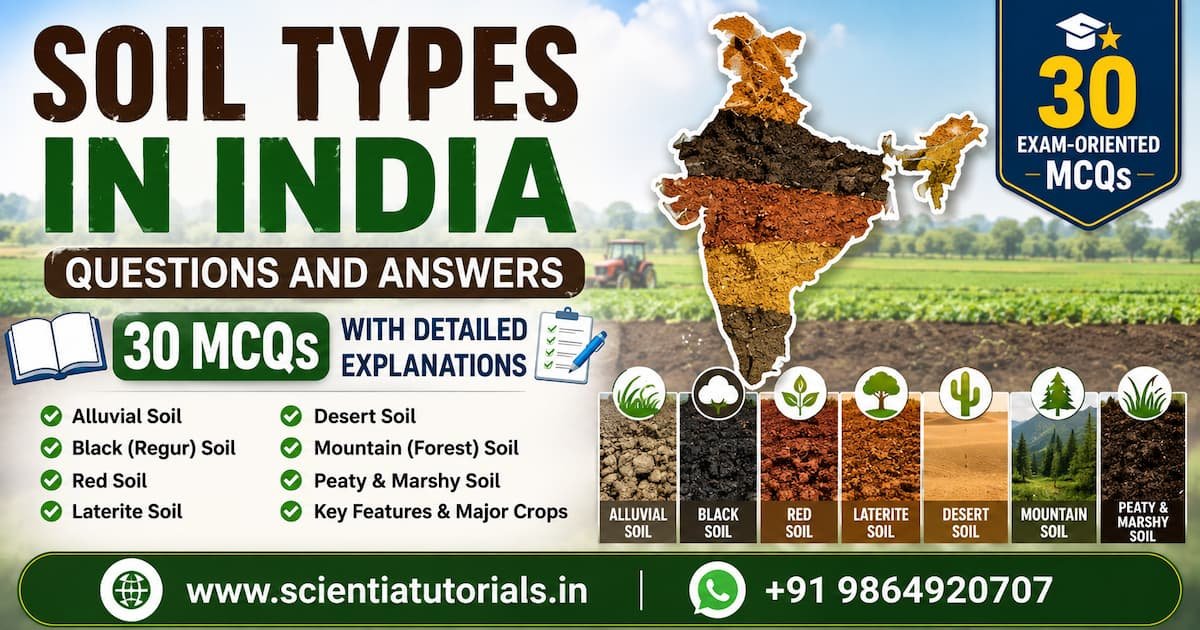
Soil Types in India Questions and Answers | 30 MCQs with Detailed Explanations
Soil Types in India Questions and Answers
30 Multiple Choice Questions (MCQs) with Answers and Detailed Explanations
Exam Focus: UPSC • SSC • Banking • Railways • PSC • State Government Exams • CDS • CAPF • NDA • Other Competitive Exams
MCQ 1. Which of the following is the most widespread soil type in India?
A. Black Soil
B. Red Soil
C. Alluvial Soil
D. Laterite Soil
✅ Correct Answer: C. Alluvial Soil
Explanation:
Alluvial Soil is the most extensive soil type in India, covering nearly 40% of the country’s land area. It is mainly found in the Indo-Gangetic-Brahmaputra Plains and is highly fertile, making it ideal for agriculture.
- A. Black soil is mainly confined to the Deccan Plateau.
- B. Red soil is widespread but covers less area than alluvial soil.
- C. Correct.
- D. Laterite soil occurs mainly in high rainfall regions.
MCQ 2. Alluvial soil is mainly formed by the deposition of sediments carried by:
A. Wind
B. Rivers
C. Volcanoes
D. Glaciers
✅ Correct Answer: B. Rivers
Explanation:
Alluvial soils are formed by the deposition of sand, silt, clay, and gravel brought by rivers over thousands of years. These soils are highly productive and support intensive farming.
MCQ 3. Which crop is best suited to alluvial soil?
A. Wheat
B. Rice
C. Sugarcane
D. All of the Above
✅ Correct Answer: D. All of the Above
Explanation:
Alluvial soils support a wide range of crops due to their fertility, including:
- Wheat
- Rice
- Sugarcane
- Maize
- Pulses
- Oilseeds
MCQ 4. Black soil is also known as:
A. Regur Soil
B. Desert Soil
C. Mountain Soil
D. Peaty Soil
✅ Correct Answer: A. Regur Soil
Explanation:
Black soil is popularly called Regur Soil or Black Cotton Soil because it is ideal for cotton cultivation.
MCQ 5. Black soil is mainly found in:
A. Indo-Gangetic Plain
B. Deccan Plateau
C. Himalayan Region
D. Coastal Plains
✅ Correct Answer: B. Deccan Plateau
Explanation:
Black soil occurs extensively in:
- Maharashtra
- Madhya Pradesh
- Gujarat
- Telangana
- Parts of Karnataka
It develops from basaltic lava rocks.
MCQ 6. Which crop is most suitable for Black Soil?
A. Tea
B. Cotton
C. Coconut
D. Apple
✅ Correct Answer: B. Cotton
Explanation:
Black soil retains moisture for a long time and is rich in lime, iron, magnesium, and potash, making it ideal for cotton cultivation.
MCQ 7. Black soil is formed from the weathering of:
A. Granite
B. Basalt
C. Limestone
D. Sandstone
✅ Correct Answer: B. Basalt
Explanation:
Black soil originates from the weathering of Deccan Trap basaltic rocks, which are volcanic in origin.
MCQ 8. Red soil derives its colour mainly due to the presence of:
A. Calcium Carbonate
B. Iron Oxides
C. Humus
D. Mica
✅ Correct Answer: B. Iron Oxides
Explanation:
Iron oxide imparts the characteristic red colour to red soil. The intensity of the colour depends on the amount of iron present.
MCQ 9. Red soil is mainly found in:
A. Rajasthan
B. Peninsular India
C. Punjab
D. Jammu & Kashmir
✅ Correct Answer: B. Peninsular India
Explanation:
Red soil is widely distributed across:
- Tamil Nadu
- Karnataka
- Andhra Pradesh
- Telangana
- Odisha
- Chhattisgarh
MCQ 10. Which nutrient is generally deficient in Red Soil?
A. Nitrogen
B. Potash
C. Iron
D. Aluminium
✅ Correct Answer: A. Nitrogen
Explanation:
Red soils are generally poor in:
- Nitrogen
- Phosphorus
- Humus
However, they are comparatively rich in iron.
MCQ 11. Laterite soil develops under conditions of:
A. Low Rainfall
B. Heavy Rainfall and High Temperature
C. Snowfall
D. Desert Climate
✅ Correct Answer: B. Heavy Rainfall and High Temperature
Explanation:
Laterite soil forms due to intense leaching under high rainfall and high temperatures.
MCQ 12. Laterite soil is mainly found in:
A. Western Ghats and Eastern Ghats
B. Punjab Plains
C. Thar Desert
D. Indo-Gangetic Plain
✅ Correct Answer: A. Western Ghats and Eastern Ghats
Explanation:
Laterite soils occur in:
- Kerala
- Karnataka
- Tamil Nadu
- Odisha
- Maharashtra
- Assam hills
MCQ 13. Which crop grows well in Laterite Soil after proper manuring?
A. Tea
B. Coffee
C. Rubber
D. All of the Above
✅ Correct Answer: D. All of the Above
Explanation:
Although naturally less fertile, laterite soils support tea, coffee, rubber, coconut, and cashew with proper fertilization.
MCQ 14. Desert soil is mainly found in:
A. Rajasthan
B. Kerala
C. Bihar
D. Assam
✅ Correct Answer: A. Rajasthan
Explanation:
Desert soils occur mainly in:
- Rajasthan
- Gujarat
- Parts of Haryana and Punjab
They have high sand content and low moisture.
MCQ 15. Desert soil generally contains high amounts of:
A. Organic Matter
B. Moisture
C. Soluble Salts
D. Humus
✅ Correct Answer: C. Soluble Salts
Explanation:
Desert soils often contain high levels of soluble salts due to high evaporation and low rainfall.
MCQ 16. Mountain (Forest) soils are mainly found in:
A. Himalayan Region
B. Coastal Plains
C. Deccan Plateau
D. Rajasthan Desert
✅ Correct Answer: A. Himalayan Region
Explanation:
Mountain soils develop on hill slopes under forest cover and vary with altitude.
MCQ 17. Which crop is commonly grown in Mountain soils?
A. Tea
B. Apple
C. Spices
D. All of the Above
✅ Correct Answer: D. All of the Above
Explanation:
Mountain soils support:
- Tea
- Coffee (in hills)
- Apples
- Temperate fruits
- Spices
MCQ 18. Peaty and Marshy soils contain abundant:
A. Sand
B. Organic Matter
C. Lime
D. Basalt
✅ Correct Answer: B. Organic Matter
Explanation:
Peaty soils are rich in decomposed organic matter and are dark in colour.
MCQ 19. Peaty soils are generally found in:
A. Kerala
B. West Bengal
C. Odisha
D. All of the Above
✅ Correct Answer: D. All of the Above
Explanation:
Peaty soils occur in waterlogged and marshy regions, particularly in Kerala, West Bengal, Odisha, and parts of Tamil Nadu.
MCQ 20. Which soil is ideal for sugarcane cultivation?
A. Alluvial Soil
B. Black Soil
C. Desert Soil
D. Mountain Soil
✅ Correct Answer: A. Alluvial Soil
Explanation:
Sugarcane grows best in fertile alluvial soils with adequate irrigation.
MCQ 21. Which soil has high moisture-retaining capacity?
A. Black Soil
B. Desert Soil
C. Red Soil
D. Laterite Soil
✅ Correct Answer: A. Black Soil
Explanation:
Black soil develops deep cracks during summer but retains moisture exceptionally well.
MCQ 22. Which soil is highly suitable for rice cultivation?
A. Alluvial Soil
B. Desert Soil
C. Rocky Soil
D. Mountain Soil
✅ Correct Answer: A. Alluvial Soil
Explanation:
Rice grows well in fertile alluvial soils under adequate water supply.
MCQ 23. Which soil is formed due to intense leaching?
A. Black Soil
B. Laterite Soil
C. Red Soil
D. Desert Soil
✅ Correct Answer: B. Laterite Soil
Explanation:
Heavy rainfall removes silica and bases, leaving iron and aluminium oxides behind.
MCQ 24. Which soil is naturally rich in iron and aluminium?
A. Desert Soil
B. Laterite Soil
C. Peaty Soil
D. Mountain Soil
✅ Correct Answer: B. Laterite Soil
Explanation:
Laterite soils contain abundant iron and aluminium oxides due to leaching.
MCQ 25. Which pair is correctly matched?
A. Black Soil — Cotton
B. Desert Soil — Tea
C. Laterite Soil — Wheat
D. Mountain Soil — Cotton
✅ Correct Answer: A. Black Soil — Cotton
Explanation:
Black soil is famous for cotton cultivation because of its moisture retention and mineral content.
MCQ 26. Which soil type is most suitable for wheat cultivation?
A. Alluvial Soil
B. Desert Soil
C. Laterite Soil
D. Mountain Soil
✅ Correct Answer: A. Alluvial Soil
Explanation:
The fertile alluvial plains of Punjab, Haryana, and Uttar Pradesh are India’s major wheat-growing regions.
MCQ 27. Which soil is commonly called Black Cotton Soil?
A. Laterite Soil
B. Regur Soil
C. Red Soil
D. Desert Soil
✅ Correct Answer: B. Regur Soil
Explanation:
Regur is another name for black soil because of its suitability for cotton cultivation.
MCQ 28. Which of the following is correctly matched?
A. Laterite Soil — Heavy Rainfall Areas
B. Desert Soil — High Humus Content
C. Red Soil — Rich in Nitrogen
D. Black Soil — Low Moisture Retention
✅ Correct Answer: A. Laterite Soil — Heavy Rainfall Areas
Explanation:
- Laterite forms under heavy rainfall. ✅
- Desert soil has low humus.
- Red soil is poor in nitrogen.
- Black soil has excellent moisture retention.
MCQ 29. Which factor plays the most important role in soil formation?
A. Parent Rock
B. Climate
C. Relief
D. All of the Above
✅ Correct Answer: D. All of the Above
Explanation:
Soil formation depends on:
- Parent rock
- Climate
- Relief
- Organisms
- Time
These are the major soil-forming factors.
MCQ 30. Which one of the following statements about Indian soils is correct?
A. Alluvial soil is the most widespread soil in India.
B. Black soil is poor for cotton cultivation.
C. Laterite soil forms under low rainfall conditions.
D. Desert soil is rich in humus.
✅ Correct Answer: A. Alluvial soil is the most widespread soil in India.
Explanation:
- Alluvial soil covers the largest area and is highly fertile. ✅
- Black soil is excellent for cotton cultivation.
- Laterite soil forms under heavy rainfall and high temperatures.
- Desert soil has very low humus content.
Exam Tip
For UPSC, SSC, Banking, Railways, PSC, and other competitive examinations, remember the Soil Type – Formation – Distribution – Characteristics – Nutrient Content – Suitable Crops – Parent Rock. Questions on Alluvial Soil, Black (Regur) Soil, Red Soil, Laterite Soil, Desert Soil, Mountain (Forest) Soil, and Peaty & Marshy Soil, along with their major crops, deficiencies, and geographical distribution, are among the most frequently asked topics in Indian Geography, Agriculture, Environment, and General Awareness.