
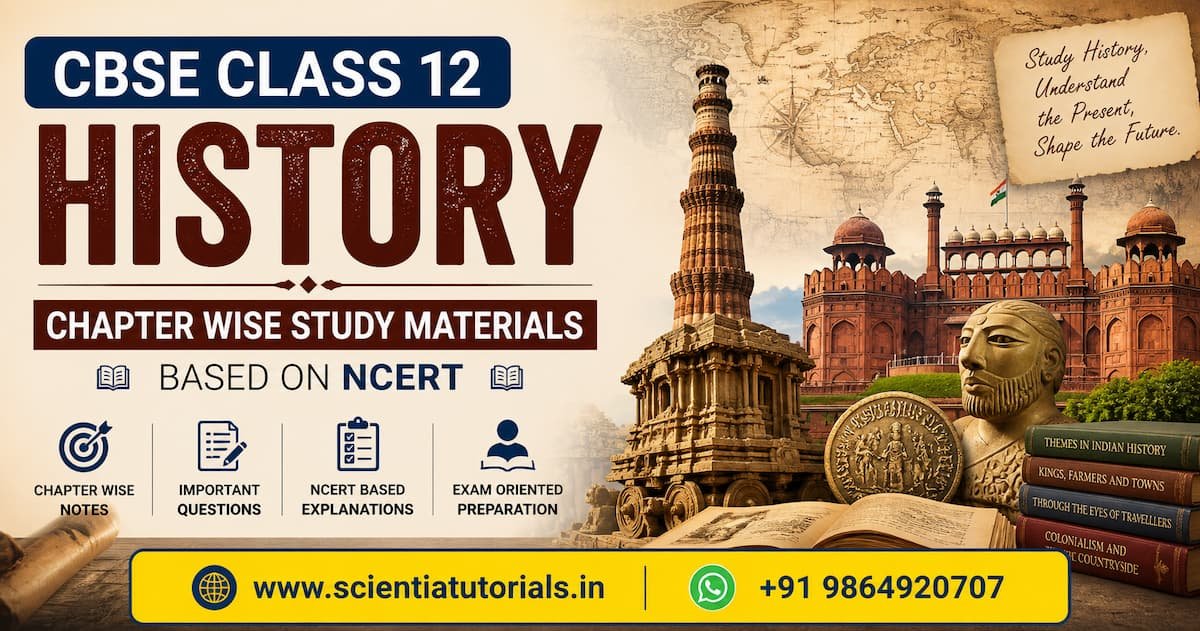
CBSE Class 12 History – Chapter Wise Study Materials Based on NCERT
CBSE Class 12 History – Chapter Wise Study Materials Based on NCERT CBSE Class 12 History – Chapter Wise Study Materials Based on NCERT are designed to help students understand historical themes, sources, and interpretations in a clear, exam-focused manner. These resources are developed strictly according to the latest NCERT …

Overview
CBSE Class 12 History – Chapter Wise Study Materials Based on NCERT
CBSE Class 12 History – Chapter Wise Study Materials Based on NCERT are designed to help students understand historical themes, sources, and interpretations in a clear, exam-focused manner. These resources are developed strictly according to the latest NCERT syllabus, ensuring complete alignment with CBSE Class 12 History board exam standards.
📘 What the Study Materials Include
-
Study Modules with Revision Notes covering themes, timelines, and key concepts
-
Very Short Answer Type Questions for quick factual recall
-
Short Answer Type Questions focusing on explanations and significance
-
Long Answer Type Questions framed as per CBSE marking schemes
-
Source-Based Questions with Answers to enhance analytical and interpretative skills
-
MCQs with Answers and Explanations for concept reinforcement
⭐ Why These Materials Are Ideal
-
100% NCERT-based content
-
Chapter-wise, structured preparation
-
Student-friendly and exam-oriented
-
Perfect for CBSE Class 12 History board exam preparation
These study materials support effective revision, conceptual clarity, and confidence to excel in History examinations.
-
CBSE Class 12 History NCERT notes
-
Class 12 History chapter wise study material
-
NCERT History Class 12 MCQs
-
CBSE Class 12 History online tests
-
NCERT based History revision notes
Curriculum
- 15 Sections
- 90 Lessons
- Lifetime
- Chapter 1: Bricks, Beads and Bones – The Harappan Civilisation6 ItemsChapter 1: Bricks, Beads and Bones – The Harappan Civilisation Core Themes Early urban cultures Harappan archaeology and interpretation Key Focus Areas Discovery and excavation of Harappan sites Town planning, drainage, architecture Subsistence strategies (agriculture, pastoralism) Craft production, trade, seals Social and religious life Decline of the civilisation Archaeologists’ interpretations Historical Skills Archaeological evidence analysis Source-based interpretation
- Chapter 2: Kings, Farmers and Towns – Early States and Economies (c. 600 BCE–600 CE)6 ItemsChapter 2: Kings, Farmers and Towns – Early States and Economies (c. 600 BCE–600 CE) Core Themes Political formations Agrarian expansion Key Focus Areas Mahajanapadas and early kingdoms Role of land grants Peasants, chiefs, and kings Towns, trade routes, and coins Administrative systems Historical sources: inscriptions, texts
- Chapter 3: Kinship, Caste and Class – Early Societies6 ItemsChapter 3: Kinship, Caste and Class – Early Societies Core Themes Social structures in early India Key Focus Areas Family and kinship systems Varna and caste hierarchy Gender roles and patriarchy Slavery and social inequalities The Mahabharata as a historical source
- Chapter 4: Thinkers, Beliefs and Buildings – Cultural Developments (c. 600 BCE–600 CE)6 ItemsChapter 4: Thinkers, Beliefs and Buildings – Cultural Developments (c. 600 BCE–600 CE) Core Themes Religious and philosophical traditions Key Focus Areas Buddhism, Jainism, and Brahmanism Sangha and monastic traditions Stupas, viharas, and temples Art, architecture, and symbolism Role of patrons
- Chapter 5: Through the Eyes of Travellers – Perceptions of Society6 ItemsChapter 5: Through the Eyes of Travellers – Perceptions of Society Core Themes Foreign accounts of India Key Focus Areas Accounts of Al-Biruni, Ibn Battuta, François Bernier Social customs and economy Religious practices Strengths and limitations of travelogues
- Chapter 6: Bhakti–Sufi Traditions – Changes in Religious Beliefs and Devotional Texts6 ItemsChapter 6: Bhakti–Sufi Traditions – Changes in Religious Beliefs and Devotional Texts Core Themes Devotional movements Key Focus Areas Bhakti saints and philosophies Sufi silsilas Regional languages and literature Social impact of devotional traditions
- Chapter 7: An Imperial Capital – Vijayanagara6 ItemsChapter 7: An Imperial Capital – Vijayanagara Core Themes State formation and urbanisation Key Focus Areas Foundation and rulers City planning and architecture Economy and trade Religious and cultural life Foreign travellers’ descriptions
- Chapter 8: Peasants, Zamindars and the State – Agrarian Society and the Mughal Empire6 ItemsChapter 8: Peasants, Zamindars and the State – Agrarian Society and the Mughal Empire Core Themes Agrarian relations Key Focus Areas Peasant communities Zamindari system Land revenue administration Mughal state and rural society
- Chapter 9: Kings and Chronicles – The Mughal Courts6 ItemsChapter 9: Kings and Chronicles – The Mughal Courts Core Themes Mughal political culture Key Focus Areas Court historians and chronicles Imperial ideology Administration and governance Relationship between power and history writing
- Chapter 10: Colonialism and the Countryside – Exploring Official Archives6 ItemsChapter 10: Colonialism and the Countryside – Exploring Official Archives Core Themes British agrarian policies Key Focus Areas Permanent Settlement Indigo revolt Impact on peasants Colonial records as historical sources
- Chapter 11: Rebels and the Raj – The Revolt of 18576 ItemsChapter 11: Rebels and the Raj – The Revolt of 1857 Core Themes Resistance to colonial rule Key Focus Areas Causes of the revolt Spread and leaders British suppression Historiography of 1857
- Chapter 12: Colonial Cities – The Urbanisation of the Imperial Capital6 ItemsChapter 12: Colonial Cities – The Urbanisation of the Imperial Capital Core Themes Urban history Key Focus Areas Growth of colonial cities Planning and segregation Architecture and public spaces Social life in cities
- Chapter 13: Mahatma Gandhi and the Nationalist Movement6 ItemsChapter 13: Mahatma Gandhi and the Nationalist Movement Core Themes Indian nationalism Key Focus Areas Gandhian ideology Mass movements Role of peasants, workers, women Civil Disobedience and Quit India
- Chapter 14: Understanding Partition6 ItemsChapter 14: Understanding Partition Core Themes Partition and independence Key Focus Areas Causes of Partition Communal politics Human cost and migration Oral histories and memories
- Chapter 15: Framing the Constitution – The Beginning of a New Era6 ItemsChapter 15: Framing the Constitution – The Beginning of a New Era Core Themes Nation-building Key Focus Areas Constituent Assembly Debates and discussions Federalism, rights, and citizenship Vision of independent India
You May Like
CBSE Class 11 History – Chapter Wise Study Materials Based on NCERT
CBSE Class 11 History – Chapter Wise Study Materials Based on NCERT CBSE Class 11 History – Chapter Wise Study Materials Based on NCERT are...
Course Features
- Lectures 90
- Quiz 0
- Duration Lifetime access
- Skill level All levels
- Language English
- Students 0
- Assessments Yes