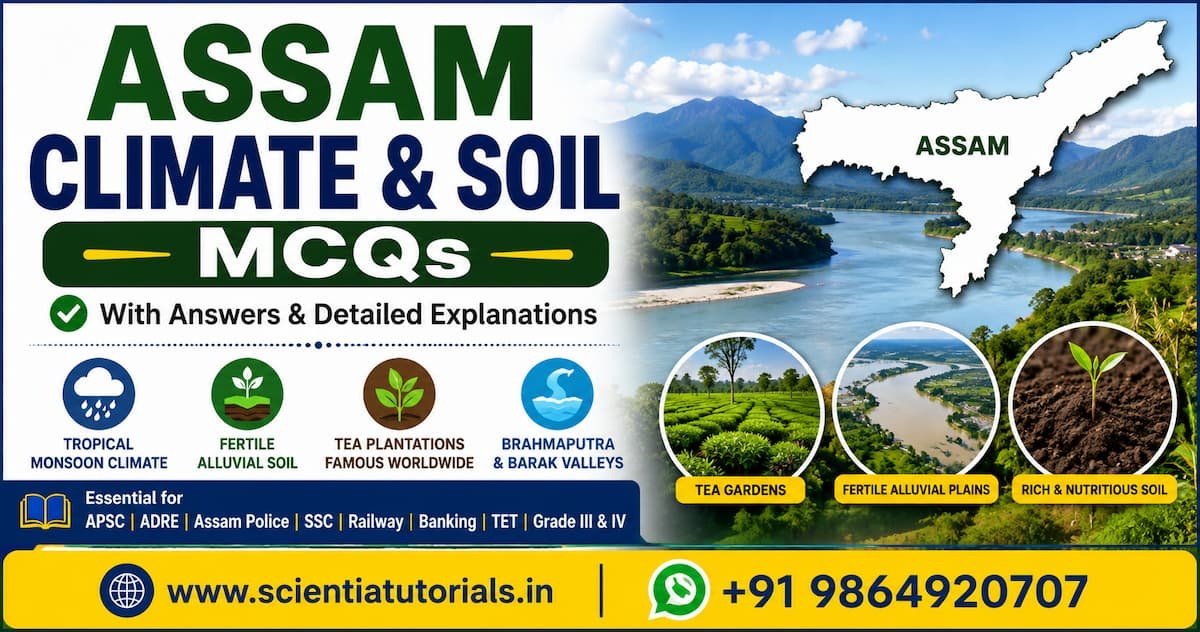
Assam Climate and Soil MCQs with Answers and Detailed Explanations for Competitive Exams
Assam Climate and Soil MCQs with Explanations
MCQ 1
Which type of climate predominantly prevails in Assam?
A. Desert Climate
B. Mediterranean Climate
C. Tropical Monsoon Climate
D. Tundra Climate
Answer: C. Tropical Monsoon Climate
Explanation: Assam experiences a tropical monsoon climate characterized by high rainfall, high humidity, and moderate temperatures. The southwest monsoon brings heavy rainfall from June to September. Desert and tundra climates are absent in Assam, while the Mediterranean climate is found mainly around the Mediterranean Sea.
MCQ 2
The average annual rainfall in Assam is approximately:
A. 500 mm
B. 1,000 mm
C. 2,000–3,000 mm
D. 5000 mm
Answer: C. 2,000–3,000 mm
Explanation: Assam is one of the wettest regions of India. Most parts receive between 2,000 and 3,000 mm of rainfall annually, while some areas receive even more. This abundant rainfall supports rich biodiversity and agriculture.
MCQ 3
Which winds are mainly responsible for rainfall in Assam?
A. Northeast Trade Winds
B. Southwest Monsoon Winds
C. Westerlies
D. Polar Winds
Answer: B. Southwest Monsoon Winds
Explanation: Moisture-laden southwest monsoon winds from the Bay of Bengal strike the hills surrounding Assam, causing heavy rainfall through the orographic effect.
MCQ 4
The rainiest season in Assam is:
A. Winter
B. Spring
C. Monsoon
D. Autumn
Answer: C. Monsoon
Explanation: The monsoon season extends from June to September and accounts for the majority of Assam’s annual rainfall. Floods often occur during this period due to intense precipitation.
MCQ 5
Which month generally records the highest rainfall in Assam?
A. January
B. April
C. July
D. November
Answer: C. July
Explanation: July is typically the wettest month because the southwest monsoon is at its peak intensity during this period.
MCQ 6
What is the major climatic characteristic of Assam during summer?
A. Dry and Cool
B. Hot and Humid
C. Cold and Dry
D. Extremely Cold
Answer: B. Hot and Humid
Explanation: Summers in Assam are warm with temperatures around 25°C–35°C and high humidity due to moisture-rich air.
MCQ 7
The winter season in Assam is generally experienced from:
A. March to May
B. June to September
C. October to November
D. December to February
Answer: D. December to February
Explanation: Winters in Assam are mild and pleasant, with temperatures usually ranging between 8°C and 25°C.
MCQ 8
Which factor contributes most to the high humidity of Assam?
A. Desert Influence
B. Distance from Rivers
C. Abundant Rainfall and Dense Vegetation
D. Snowfall
Answer: C. Abundant Rainfall and Dense Vegetation
Explanation: High rainfall, numerous rivers, wetlands, and extensive vegetation maintain high humidity levels throughout the year.
MCQ 9
The Brahmaputra Valley receives heavy rainfall mainly because of:
A. Cyclones from Arabian Sea
B. Western Disturbances
C. Monsoon Winds and Surrounding Hills
D. Desert Storms
Answer: C. Monsoon Winds and Surrounding Hills
Explanation: Hills surrounding the valley force moisture-laden monsoon winds to rise, resulting in heavy rainfall.
MCQ 10
Which district of Assam is known for receiving exceptionally high rainfall?
A. Dhubri
B. Karbi Anglong
C. Dima Hasao
D. Cachar
Answer: C. Dima Hasao
Explanation: Due to its hilly terrain, Dima Hasao receives significant rainfall through orographic precipitation.
MCQ 11
The most extensive soil type found in Assam is:
A. Black Soil
B. Alluvial Soil
C. Desert Soil
D. Laterite Soil
Answer: B. Alluvial Soil
Explanation: Alluvial soil deposited by the Brahmaputra and Barak rivers covers large parts of Assam and is highly fertile.
MCQ 12
Alluvial soil in Assam is mainly deposited by:
A. Wind Action
B. Volcanic Activity
C. Rivers
D. Glaciers
Answer: C. Rivers
Explanation: Floods and river currents deposit fertile sediments across the plains of Assam.
MCQ 13
Which crop grows best in Assam’s alluvial soil?
A. Cotton
B. Rice
C. Groundnut
D. Bajra
Answer: B. Rice
Explanation: Fertile alluvial soil and abundant rainfall make Assam ideal for rice cultivation.
MCQ 14
The tea-growing areas of Assam are mainly associated with which type of soil?
A. Sandy Soil
B. Clay Soil
C. Red Loamy Soil
D. Saline Soil
Answer: C. Red Loamy Soil
Explanation: Tea plantations thrive in well-drained red loamy soils rich in organic matter.
MCQ 15
Which soil type is commonly found in the hill regions of Assam?
A. Mountain Soil
B. Black Soil
C. Desert Soil
D. Saline Soil
Answer: A. Mountain Soil
Explanation: Hilly regions such as Karbi Anglong and Dima Hasao have mountain soils formed through weathering of rocks.
MCQ 16
Soil erosion in Assam is mainly caused by:
A. Low Rainfall
B. Heavy Rainfall and Floods
C. Snowstorms
D. Volcanic Eruptions
Answer: B. Heavy Rainfall and Floods
Explanation: Intense rainfall and recurrent floods wash away fertile topsoil, causing erosion.
MCQ 17
Which river contributes most to the formation of Assam’s alluvial plains?
A. Godavari
B. Krishna
C. Brahmaputra
D. Narmada
Answer: C. Brahmaputra
Explanation: The Brahmaputra and its tributaries deposit vast quantities of sediment, creating fertile plains.
MCQ 18
What is the major advantage of alluvial soil?
A. High Salinity
B. Low Fertility
C. Rich Nutrient Content
D. Rocky Nature
Answer: C. Rich Nutrient Content
Explanation: Alluvial soil contains minerals and nutrients necessary for agriculture, making it highly productive.
MCQ 19
Which soil is most suitable for tea cultivation in Assam?
A. Waterlogged Soil
B. Sandy Desert Soil
C. Acidic Well-Drained Soil
D. Saline Soil
Answer: C. Acidic Well-Drained Soil
Explanation: Tea plants grow best in slightly acidic soils with good drainage and organic content.
MCQ 20
The Barak Valley is located in which part of Assam?
A. Northern Assam
B. Western Assam
C. Southern Assam
D. Eastern Assam
Answer: C. Southern Assam
Explanation: The Barak Valley consists mainly of Cachar, Hailakandi, and Karimganj districts in southern Assam.
MCQ 21
Floodplain soils of Assam are renewed frequently by:
A. Earthquakes
B. River Floods
C. Volcanoes
D. Glaciers
Answer: B. River Floods
Explanation: Floods deposit fresh layers of nutrient-rich sediments, maintaining soil fertility.
MCQ 22
Which soil characteristic is beneficial for rice cultivation in Assam?
A. Poor Water Retention
B. High Water-Holding Capacity
C. Rocky Structure
D. Salinity
Answer: B. High Water-Holding Capacity
Explanation: Rice requires standing water; therefore soils with good moisture retention are highly suitable.
MCQ 23
Assam’s climate is greatly influenced by which geographical feature?
A. Thar Desert
B. Himalayan Range and Surrounding Hills
C. Western Ghats
D. Aravalli Hills
Answer: B. Himalayan Range and Surrounding Hills
Explanation: These barriers intercept monsoon winds, resulting in heavy rainfall across Assam.
MCQ 24
Which of the following is a major problem caused by excessive rainfall in Assam?
A. Desertification
B. Salinity
C. Flooding
D. Snowfall
Answer: C. Flooding
Explanation: Heavy monsoon rains frequently cause floods in the Brahmaputra and Barak valleys.
MCQ 25
The pH of tea-growing soils in Assam is generally:
A. Highly Alkaline
B. Neutral
C. Slightly Acidic
D. Highly Saline
Answer: C. Slightly Acidic
Explanation: Tea plants require acidic soils, usually with a pH range of about 4.5 to 5.5.
MCQ 26
Which natural process continuously enriches Assam’s agricultural land?
A. Sandstorms
B. River Sedimentation
C. Volcanic Activity
D. Glaciation
Answer: B. River Sedimentation
Explanation: Rivers deposit fresh alluvium during floods, replenishing nutrients in the soil.
MCQ 27
The climate of Assam is best described as:
A. Arid
B. Semi-Arid
C. Humid Sub-Tropical with Monsoon Influence
D. Polar
Answer: C. Humid Sub-Tropical with Monsoon Influence
Explanation: Assam experiences humid conditions, moderate temperatures, and strong monsoon rainfall.
MCQ 28
Which agricultural activity is internationally famous in Assam due to its soil and climate?
A. Coffee Plantation
B. Tea Plantation
C. Olive Farming
D. Date Cultivation
Answer: B. Tea Plantation
Explanation: Assam Tea is globally renowned because of favorable rainfall, humidity, and soil conditions.
MCQ 29
Why is Assam considered agriculturally rich?
A. Presence of Deserts
B. Fertile Alluvial Soil and Adequate Rainfall
C. Low Population
D. Lack of Rivers
Answer: B. Fertile Alluvial Soil and Adequate Rainfall
Explanation: The combination of fertile soils and abundant rainfall supports diverse agricultural activities.
MCQ 30
Which statement about Assam’s soil and climate is correct?
A. Assam has a dry desert climate.
B. Most soils are infertile.
C. Heavy monsoon rainfall and fertile alluvial soil support agriculture.
D. Snowfall is the main source of water.
Answer: C. Heavy monsoon rainfall and fertile alluvial soil support agriculture.
Explanation: Assam’s economy is strongly dependent on agriculture because fertile alluvial soils and abundant monsoon rainfall create excellent farming conditions. This combination supports rice, tea, jute, mustard, and many horticultural crops.
Quick Revision Points
• Assam has a Tropical Monsoon Climate.
• Average annual rainfall: 2,000–3,000 mm.
• Southwest Monsoon is the main source of rainfall.
• Brahmaputra and Barak valleys dominate Assam’s geography.
• Alluvial Soil is the most widespread soil type.
• Tea grows best in acidic, well-drained red loamy soils.
• Rice is the principal crop of Assam.
• Floods and soil erosion are major environmental challenges.
• Brahmaputra River plays a key role in soil formation.
• Assam is one of India’s leading tea-producing states.