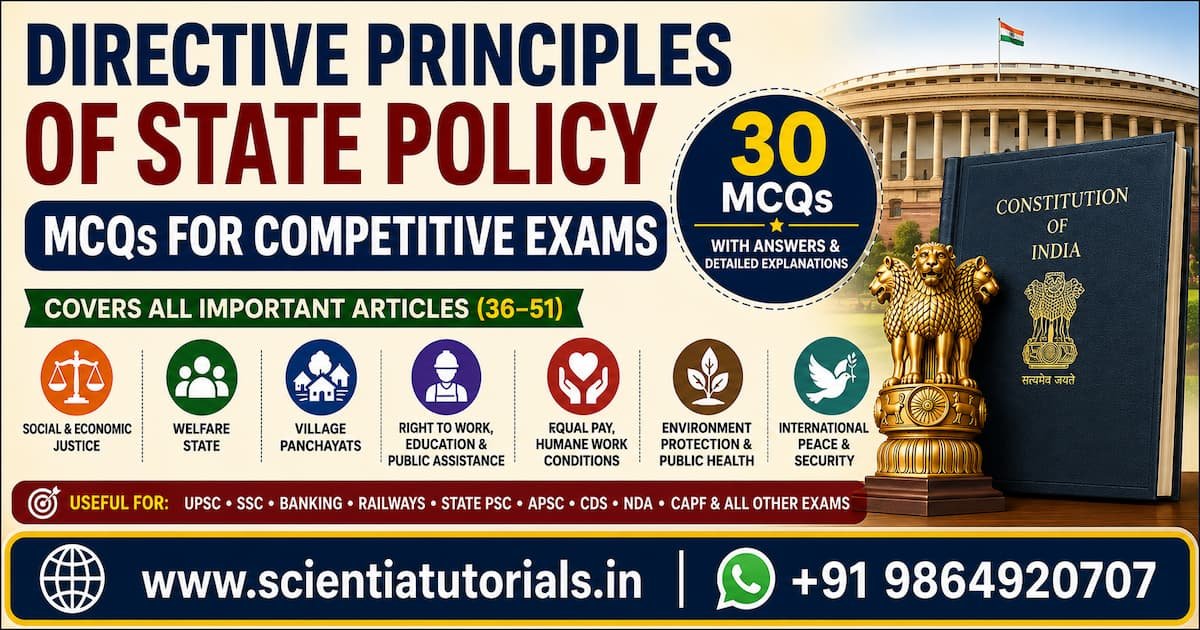
Directive Principles of State Policy MCQs for Competitive Exams | Questions with Answers & Detailed Explanations
Directive Principles of State Policy (DPSP) MCQs for Competitive Exams
These 30 Multiple Choice Questions (MCQs) are designed for UPSC, SSC, Banking, Railways, APSC, State PSC, CDS, NDA, CAPF, CUET, and other competitive examinations in India. Each question includes the correct answer and a detailed explanation to strengthen conceptual understanding of the Directive Principles of State Policy (DPSPs) under the Constitution of India.
1. The Directive Principles of State Policy (DPSPs) are contained in:
A. Part II
B. Part III
C. Part IV
D. Part IVA
✅ Answer: C. Part IV
Explanation:
The Directive Principles of State Policy are contained in Part IV (Articles 36–51) of the Constitution of India.
- A. Part II deals with Citizenship.
- B. Part III contains Fundamental Rights.
- C. Correct.
- D. Part IVA contains Fundamental Duties.
2. The concept of Directive Principles of State Policy was borrowed from the Constitution of:
A. United Kingdom
B. Ireland
C. United States
D. Canada
✅ Answer: B. Ireland
Explanation:
The framers of the Indian Constitution borrowed the concept of Directive Principles from the Constitution of Ireland, which itself drew inspiration from the Spanish Constitution.
3. Which Article defines the term “State” for the purposes of Part IV?
A. Article 35
B. Article 36
C. Article 37
D. Article 38
✅ Answer: B. Article 36
Explanation:
Article 36 states that the term “State” in Part IV has the same meaning as in Article 12.
4. Which Article declares that the Directive Principles are not enforceable by any court?
A. Article 36
B. Article 37
C. Article 38
D. Article 39
✅ Answer: B. Article 37
Explanation:
Article 37 states that although DPSPs are non-justiciable, they are fundamental in the governance of the country and must guide the State in making laws.
5. The main objective of the Directive Principles is to establish:
A. Political Democracy
B. Social and Economic Democracy
C. Military Rule
D. Religious State
✅ Answer: B. Social and Economic Democracy
Explanation:
DPSPs aim to establish a welfare state by promoting social, economic, and political justice.
6. Which Article directs the State to promote the welfare of the people?
A. Article 38
B. Article 39
C. Article 40
D. Article 41
✅ Answer: A. Article 38
Explanation:
Article 38 requires the State to promote the welfare of the people by securing a social order based on justice.
7. Equal pay for equal work for both men and women is provided under:
A. Article 38
B. Article 39(d)
C. Article 40
D. Article 42
✅ Answer: B. Article 39(d)
Explanation:
Article 39(d) directs the State to ensure equal pay for equal work for both men and women.
8. Which Article directs the State to organize Village Panchayats?
A. Article 39
B. Article 40
C. Article 41
D. Article 42
✅ Answer: B. Article 40
Explanation:
Article 40 directs the State to organize village panchayats and strengthen local self-government.
9. Right to work, education, and public assistance is provided under:
A. Article 40
B. Article 41
C. Article 42
D. Article 43
✅ Answer: B. Article 41
Explanation:
Article 41 directs the State to provide the right to work, education, and assistance in cases of unemployment, old age, sickness, and disability.
10. Provision for just and humane conditions of work and maternity relief is contained in:
A. Article 41
B. Article 42
C. Article 43
D. Article 44
✅ Answer: B. Article 42
Explanation:
Article 42 directs the State to ensure humane working conditions and maternity relief.
11. Which Article promotes a living wage and decent standard of life for workers?
A. Article 42
B. Article 43
C. Article 44
D. Article 45
✅ Answer: B. Article 43
Explanation:
Article 43 directs the State to secure a living wage and decent conditions of work for all workers.
12. The Uniform Civil Code is mentioned in:
A. Article 43
B. Article 44
C. Article 45
D. Article 46
✅ Answer: B. Article 44
Explanation:
Article 44 directs the State to strive for a Uniform Civil Code for all citizens.
13. Which Article relates to early childhood care and education?
A. Article 44
B. Article 45
C. Article 46
D. Article 47
✅ Answer: B. Article 45
Explanation:
Article 45 directs the State to provide early childhood care and education for children below six years.
14. Promotion of educational and economic interests of Scheduled Castes, Scheduled Tribes, and weaker sections is provided under:
A. Article 45
B. Article 46
C. Article 47
D. Article 48
✅ Answer: B. Article 46
Explanation:
Article 46 aims to protect and promote the interests of weaker sections, especially SCs and STs.
15. Raising the level of nutrition and public health is provided under:
A. Article 46
B. Article 47
C. Article 48
D. Article 48A
✅ Answer: B. Article 47
Explanation:
Article 47 directs the State to improve public health and nutrition and prohibit intoxicating drinks and harmful drugs.
16. Which Article deals with the organization of agriculture and animal husbandry?
A. Article 47
B. Article 48
C. Article 48A
D. Article 49
✅ Answer: B. Article 48
Explanation:
Article 48 promotes scientific agriculture, animal husbandry, and preservation of cattle.
17. Protection and improvement of the environment is mentioned in:
A. Article 48
B. Article 48A
C. Article 49
D. Article 50
✅ Answer: B. Article 48A
Explanation:
Article 48A was added by the 42nd Constitutional Amendment Act, 1976 and directs the State to protect forests and wildlife.
18. Protection of monuments of national importance is provided under:
A. Article 48A
B. Article 49
C. Article 50
D. Article 51
✅ Answer: B. Article 49
Explanation:
Article 49 requires the State to protect monuments and places of artistic or historic importance.
19. Separation of the judiciary from the executive is provided under:
A. Article 49
B. Article 50
C. Article 51
D. Article 52
✅ Answer: B. Article 50
Explanation:
Article 50 directs the State to separate the judiciary from the executive to ensure judicial independence.
20. Promotion of international peace and security is contained in:
A. Article 49
B. Article 50
C. Article 51
D. Article 52
✅ Answer: C. Article 51
Explanation:
Article 51 promotes international peace, respect for international law, and peaceful settlement of disputes.
21. DPSPs are:
A. Justiciable
B. Legally enforceable
C. Non-justiciable
D. Temporary provisions
✅ Answer: C. Non-justiciable
Explanation:
Courts cannot enforce DPSPs, but they serve as guiding principles for governance.
22. Which Constitutional Amendment added Article 48A?
A. 24th Amendment
B. 42nd Amendment
C. 44th Amendment
D. 52nd Amendment
✅ Answer: B. 42nd Amendment
Explanation:
The 42nd Amendment (1976) inserted Article 48A relating to environmental protection.
23. Directive Principles are primarily intended to create a:
A. Police State
B. Welfare State
C. Socialist Republic only
D. Federal State
✅ Answer: B. Welfare State
Explanation:
The DPSPs guide the State toward achieving social and economic justice through a welfare-oriented governance system.
24. Which committee recommended the inclusion of Directive Principles during the framing of the Constitution?
A. Drafting Committee
B. Advisory Committee on Fundamental Rights, Minorities and Tribal Areas
C. Union Powers Committee
D. States Committee
✅ Answer: B. Advisory Committee on Fundamental Rights, Minorities and Tribal Areas
Explanation:
The Advisory Committee chaired by Sardar Vallabhbhai Patel considered constitutional safeguards, while the Constituent Assembly adopted DPSPs inspired by Irish constitutional principles.
25. Which of the following is not a Directive Principle?
A. Uniform Civil Code
B. Equal Pay for Equal Work
C. Freedom of Speech
D. Village Panchayats
✅ Answer: C. Freedom of Speech
Explanation:
Freedom of Speech is a Fundamental Right under Article 19(1)(a), not a Directive Principle.
26. DPSPs mainly impose obligations upon:
A. Citizens
B. President
C. State
D. Judiciary
✅ Answer: C. State
Explanation:
Directive Principles are directives to the State for policy formulation and governance.
27. Which Article encourages workers’ participation in the management of industries?
A. Article 43A
B. Article 44
C. Article 45
D. Article 46
✅ Answer: A. Article 43A
Explanation:
Article 43A, added by the 42nd Amendment, directs the State to ensure workers’ participation in industrial management.
28. Which Article promotes free legal aid and equal justice?
A. Article 39A
B. Article 41
C. Article 43
D. Article 45
✅ Answer: A. Article 39A
Explanation:
Article 39A mandates equal justice and free legal aid, ensuring that economic or social disabilities do not prevent access to justice.
29. Which among the following correctly matches the category of DPSP?
A. Gandhian Principles – Uniform Civil Code
B. Socialist Principles – Equal Pay for Equal Work
C. Liberal-Intellectual Principles – Village Panchayats
D. Socialist Principles – International Peace
✅ Answer: B. Socialist Principles – Equal Pay for Equal Work
Explanation:
- Socialist Principles: Articles 38, 39, 39A, 41, 42, 43, 43A, 47.
- Gandhian Principles: Village Panchayats, cottage industries, prohibition, promotion of weaker sections.
- Liberal-Intellectual Principles: Uniform Civil Code, judiciary separation, environmental protection, international peace.
30. Which statement about Directive Principles of State Policy is correct?
A. They are enforceable by courts like Fundamental Rights.
B. They are inferior to ordinary laws.
C. They are fundamental in the governance of the country and guide the State in policy-making.
D. They apply only during emergencies.
✅ Answer: C. They are fundamental in the governance of the country and guide the State in policy-making.
Explanation:
Article 37 clearly states that although the Directive Principles are not enforceable by courts, they are fundamental in the governance of the country and should guide the State in framing laws and policies aimed at establishing social, economic, and political justice.
- A. Incorrect. They are non-justiciable.
- B. Incorrect. They hold constitutional significance.
- C. Correct.
- D. Incorrect. They apply at all times.
Quick Revision Facts
- Directive Principles of State Policy (DPSPs): Part IV (Articles 36–51)
- Borrowed From: Constitution of Ireland
- Nature: Non-justiciable (Article 37)
- Objective: Establish a Welfare State
- Article 38: Social order and welfare
- Article 39: Equal pay, livelihood, distribution of resources
- Article 39A: Equal justice and free legal aid
- Article 40: Village Panchayats
- Article 41: Right to work, education, and public assistance
- Article 42: Humane working conditions and maternity relief
- Article 43: Living wage
- Article 43A: Workers’ participation in management
- Article 44: Uniform Civil Code
- Article 45: Early childhood care and education
- Article 46: Welfare of SCs, STs, and weaker sections
- Article 47: Nutrition, public health, prohibition
- Article 48: Agriculture and animal husbandry
- Article 48A: Environment and wildlife protection (42nd Amendment)
- Article 49: Protection of monuments
- Article 50: Separation of judiciary from executive
- Article 51: International peace and security
These 30 MCQs comprehensively cover the Directive Principles of State Policy, including their constitutional provisions, objectives, classifications, important articles, amendments, and governance role, making them highly useful for UPSC, SSC, Banking, Railways, APSC, State PSC, CDS, NDA, CAPF, and other competitive examinations in India.