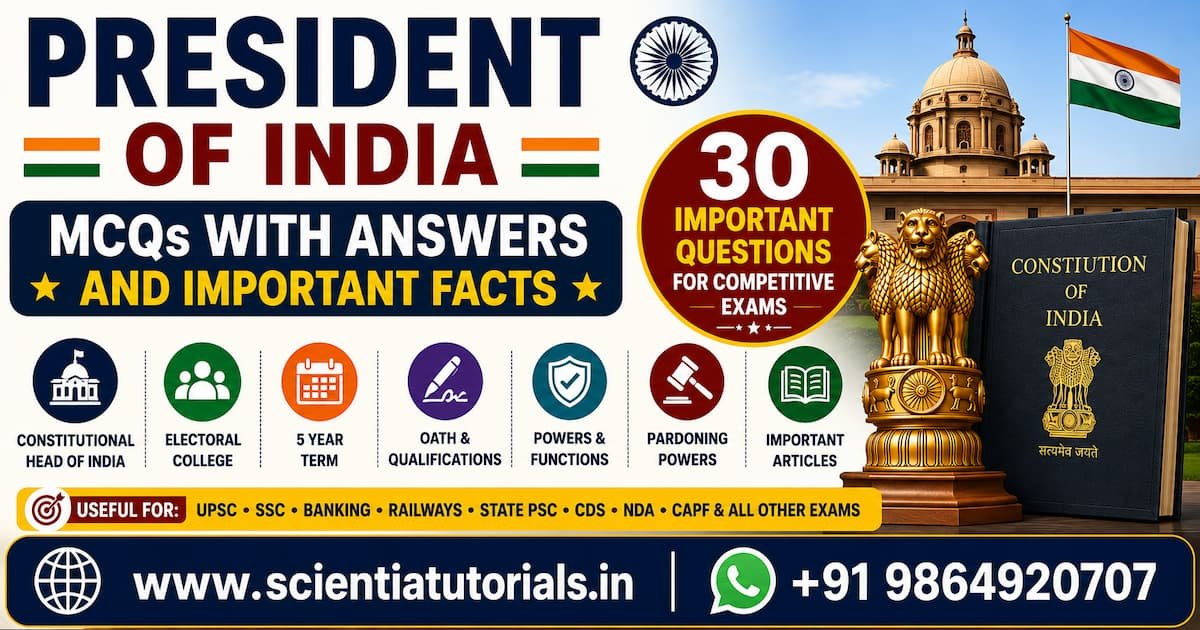
President of India MCQs with Answers and Important Facts | Important Questions for Competitive Exams
President of India MCQs with Answers and Important Facts
These 30 Multiple Choice Questions (MCQs) are designed for UPSC, SSC, Banking, Railways, APSC, State PSC, CDS, NDA, CAPF, CUET, and other competitive examinations in India. Each question includes the correct answer and a detailed explanation to strengthen conceptual understanding of the President of India, constitutional provisions, powers, functions, election process, and related articles.
1. Which Article of the Constitution provides for the office of the President of India?
A. Article 50
B. Article 52
C. Article 54
D. Article 56
✅ Answer: B. Article 52
Explanation:
Article 52 states that there shall be a President of India.
- A. Article 50 deals with the separation of the judiciary from the executive.
- B. Correct.
- C. Article 54 deals with the election of the President.
- D. Article 56 deals with the term of office.
2. The executive power of the Union is vested in the:
A. Prime Minister
B. Parliament
C. President
D. Supreme Court
✅ Answer: C. President
Explanation:
Under Article 53, the executive power of the Union is vested in the President and is exercised directly or through officers subordinate to the President in accordance with the Constitution.
3. The President of India is elected by:
A. Members of Parliament only
B. Members of State Legislative Assemblies only
C. An Electoral College
D. Direct election by the people
✅ Answer: C. An Electoral College
Explanation:
The President is elected by an Electoral College consisting of:
- Elected members of both Houses of Parliament.
- Elected members of the Legislative Assemblies of the States.
- Elected members of the Legislative Assemblies of the Union Territories of Delhi and Puducherry.
4. Which Article deals with the election of the President?
A. Article 52
B. Article 53
C. Article 54
D. Article 55
✅ Answer: C. Article 54
Explanation:
Article 54 specifies the composition of the Electoral College for the election of the President.
5. The election of the President is conducted according to the system of:
A. First-Past-the-Post
B. Proportional Representation by Single Transferable Vote
C. Open Ballot
D. Simple Majority
✅ Answer: B. Proportional Representation by Single Transferable Vote
Explanation:
The President is elected by proportional representation through the single transferable vote, and voting is by secret ballot.
6. The minimum age required to become the President of India is:
A. 30 years
B. 35 years
C. 40 years
D. 45 years
✅ Answer: B. 35 years
Explanation:
A person must:
- Be a citizen of India.
- Have completed 35 years of age.
- Be qualified to be elected as a member of the Lok Sabha.
7. The term of office of the President is:
A. Four years
B. Five years
C. Six years
D. Seven years
✅ Answer: B. Five years
Explanation:
Under Article 56, the President holds office for five years from the date of entering office.
8. Which Article prescribes the qualifications for the office of the President?
A. Article 57
B. Article 58
C. Article 59
D. Article 60
✅ Answer: B. Article 58
Explanation:
Article 58 lays down the qualifications required to become the President.
9. The President can be re-elected:
A. Only once
B. Twice only
C. Unlimited number of times
D. Three times only
✅ Answer: C. Unlimited number of times
Explanation:
The Constitution places no limit on the number of terms a person may serve as President.
10. The oath of office to the President is administered by the:
A. Prime Minister
B. Vice-President
C. Chief Justice of India
D. Speaker of the Lok Sabha
✅ Answer: C. Chief Justice of India
Explanation:
Under Article 60, the oath is administered by the Chief Justice of India, or in the CJI’s absence, the senior-most judge of the Supreme Court.
11. The President may resign by addressing the resignation to the:
A. Prime Minister
B. Speaker of Lok Sabha
C. Vice-President
D. Chief Justice of India
✅ Answer: C. Vice-President
Explanation:
The resignation of the President is addressed to the Vice-President of India.
12. The President can be removed from office through:
A. Vote of No Confidence
B. Impeachment
C. Judicial Review
D. General Election
✅ Answer: B. Impeachment
Explanation:
The President can be removed only through impeachment for violation of the Constitution, as provided under Article 61.
13. Which House of Parliament can initiate impeachment proceedings?
A. Lok Sabha only
B. Rajya Sabha only
C. Either House of Parliament
D. State Legislative Assembly
✅ Answer: C. Either House of Parliament
Explanation:
Impeachment proceedings may be initiated in either House of Parliament.
14. The President summons and prorogues:
A. Supreme Court
B. Parliament
C. Election Commission
D. NITI Aayog
✅ Answer: B. Parliament
Explanation:
The President summons, prorogues, and may dissolve the Lok Sabha under constitutional provisions.
15. Which Article empowers the President to promulgate Ordinances?
A. Article 111
B. Article 123
C. Article 143
D. Article 148
✅ Answer: B. Article 123
Explanation:
When Parliament is not in session, the President may promulgate an Ordinance having the same force as an Act of Parliament.
16. The President is the Supreme Commander of the:
A. Police Forces
B. Armed Forces of India
C. Paramilitary Forces only
D. National Disaster Response Force
✅ Answer: B. Armed Forces of India
Explanation:
The President is the Supreme Commander of the Army, Navy, and Air Force.
17. Which Article empowers the President to grant pardons?
A. Article 72
B. Article 74
C. Article 75
D. Article 76
✅ Answer: A. Article 72
Explanation:
Article 72 empowers the President to grant pardon, reprieve, respite, remission, suspension, or commutation of sentences in specified cases.
18. The President acts on the advice of the:
A. Parliament
B. Council of Ministers headed by the Prime Minister
C. Supreme Court
D. Attorney General
✅ Answer: B. Council of Ministers headed by the Prime Minister
Explanation:
Under Article 74, the President acts on the aid and advice of the Council of Ministers headed by the Prime Minister.
19. Financial Emergency is proclaimed under:
A. Article 352
B. Article 356
C. Article 360
D. Article 365
✅ Answer: C. Article 360
Explanation:
The President may proclaim a Financial Emergency under Article 360.
20. National Emergency is declared under:
A. Article 352
B. Article 356
C. Article 360
D. Article 365
✅ Answer: A. Article 352
Explanation:
Article 352 provides for National Emergency in cases of war, external aggression, or armed rebellion.
21. President’s Rule in a State is imposed under:
A. Article 352
B. Article 356
C. Article 360
D. Article 365
✅ Answer: B. Article 356
Explanation:
Article 356 empowers the President to impose President’s Rule when the constitutional machinery in a State fails.
22. The President appoints the:
A. Prime Minister
B. Governors
C. Chief Justice of India
D. All of the above
✅ Answer: D. All of the above
Explanation:
The President appoints:
- Prime Minister
- Governors
- Chief Justice of India and Supreme Court judges
- Attorney General
- Comptroller and Auditor General (CAG)
- Election Commissioners (as provided by law)
23. Which Article provides for the Council of Ministers?
A. Article 72
B. Article 74
C. Article 75
D. Article 76
✅ Answer: B. Article 74
Explanation:
Article 74 provides that there shall be a Council of Ministers to aid and advise the President.
24. Which President of India served two full terms?
A. Dr. Rajendra Prasad
B. Dr. S. Radhakrishnan
C. Dr. Zakir Husain
D. A. P. J. Abdul Kalam
✅ Answer: A. Dr. Rajendra Prasad
Explanation:
Dr. Rajendra Prasad remains the only President of India to have served two full consecutive terms.
25. Who was the first President of India?
A. Dr. B. R. Ambedkar
B. Dr. Rajendra Prasad
C. Jawaharlal Nehru
D. Sardar Vallabhbhai Patel
✅ Answer: B. Dr. Rajendra Prasad
Explanation:
Dr. Rajendra Prasad became the first President of India on 26 January 1950.
26. Who is known as the Constitutional Head of the Union?
A. Prime Minister
B. President
C. Chief Justice of India
D. Vice-President
✅ Answer: B. President
Explanation:
The President is the constitutional (nominal) head of the Union, while the Prime Minister is the real executive head.
27. A Money Bill can be introduced in Parliament only with the:
A. Approval of the President
B. Approval of the Prime Minister only
C. Approval of the Speaker only
D. Recommendation of the Finance Commission
✅ Answer: A. Approval of the President
Explanation:
A Money Bill can be introduced in the Lok Sabha only on the President’s recommendation, as required by the Constitution.
28. Which of the following is not a legislative power of the President?
A. Summoning Parliament
B. Addressing Parliament
C. Dissolving the Lok Sabha
D. Declaring war independently without constitutional procedure
✅ Answer: D. Declaring war independently without constitutional procedure
Explanation:
The President’s powers are exercised according to the Constitution and the advice of the Council of Ministers. Declaring war is not an independent discretionary legislative power.
29. The President can seek the opinion of the Supreme Court under:
A. Article 123
B. Article 143
C. Article 148
D. Article 280
✅ Answer: B. Article 143
Explanation:
Under Article 143, the President may refer questions of law or public importance to the Supreme Court for its advisory opinion.
30. Which statement about the President of India is correct?
A. The President exercises all executive powers independently.
B. The President is directly elected by the people.
C. The President is the constitutional head of the Union and normally acts on the aid and advice of the Council of Ministers.
D. The President is a member of either House of Parliament while in office.
✅ Answer: C. The President is the constitutional head of the Union and normally acts on the aid and advice of the Council of Ministers.
Explanation:
The President occupies the highest constitutional office in India and generally acts on the aid and advice of the Council of Ministers headed by the Prime Minister, except in a few limited situations recognized by the Constitution.
- A. Incorrect. The President does not ordinarily act independently.
- B. Incorrect. The President is elected by an Electoral College.
- C. Correct.
- D. Incorrect. A President cannot be a member of Parliament while holding office.
Quick Revision Facts
- Article 52 – Office of the President
- Article 53 – Executive power of the Union
- Article 54 – Election of the President
- Article 55 – Manner of election
- Article 56 – Five-year term
- Article 58 – Qualifications
- Article 60 – Oath of office
- Article 61 – Impeachment
- Article 72 – Pardoning powers
- Article 74 – Council of Ministers to aid and advise
- Article 123 – Ordinance-making power
- Article 143 – Advisory jurisdiction of the Supreme Court
- Article 352 – National Emergency
- Article 356 – President’s Rule
- Article 360 – Financial Emergency
- Election Method – Proportional Representation by Single Transferable Vote (Secret Ballot)
- Minimum Age – 35 years
- Term – 5 years
- First President – Dr. Rajendra Prasad
- Only President to Serve Two Full Terms – Dr. Rajendra Prasad
These 30 MCQs comprehensively cover the President of India, including constitutional articles, election, qualifications, powers, functions, emergencies, appointments, pardoning powers, impeachment, and important constitutional facts, making them highly valuable for UPSC, SSC, Banking, Railways, APSC, State PSC, CDS, NDA, CAPF, and other competitive examinations in India.