Election Commission of India MCQs with Answers and Detailed Explanations for UPSC, SSC & PSC Exams
Election Commission of India MCQs with Answers
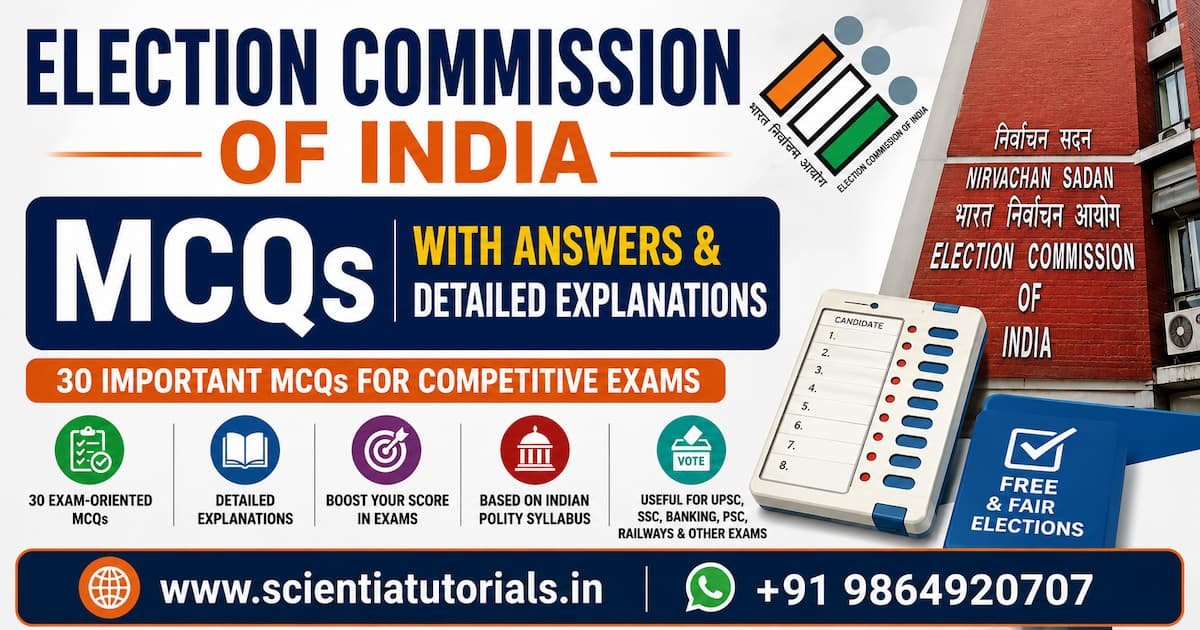
The following 30 Multiple Choice Questions (MCQs) are designed for UPSC, SSC, Banking, Railways, State PSC, CDS, CAPF, NDA, Assam PSC, ADRE, and other competitive examinations in India. Each question includes the correct answer along with a detailed explanation to help build a strong conceptual understanding of the Election Commission of India (ECI).
1. Which Article of the Constitution provides for the Election Commission of India?
A. Article 320
B. Article 323
C. Article 324
D. Article 326
Answer: ✅ C. Article 324
Explanation:
Article 324 vests the superintendence, direction, and control of elections to Parliament, State Legislatures, and the offices of the President and Vice-President in the Election Commission of India (ECI).
2. The Election Commission of India is a:
A. Statutory Body
B. Constitutional Body
C. Judicial Body
D. Advisory Body
Answer: ✅ B. Constitutional Body
Explanation:
The ECI is established directly by the Constitution under Article 324, making it a constitutional body. This ensures greater independence and authority compared to statutory bodies.
3. The Election Commission of India came into existence on:
A. 15 August 1947
B. 26 January 1950
C. 25 January 1950
D. 26 November 1949
Answer: ✅ C. 25 January 1950
Explanation:
The Election Commission was established on 25 January 1950, which is celebrated every year as National Voters’ Day (since 2011) to promote voter awareness and participation.
4. Who appoints the Chief Election Commissioner (CEC)?
A. Prime Minister
B. President of India
C. Parliament
D. Chief Justice of India
Answer: ✅ B. President of India
Explanation:
Under Article 324, the President appoints the Chief Election Commissioner and the Election Commissioners.
5. The Election Commission of India currently consists of:
A. One Chief Election Commissioner only
B. One Chief Election Commissioner and one Election Commissioner
C. One Chief Election Commissioner and two Election Commissioners
D. Five Election Commissioners
Answer: ✅ C. One Chief Election Commissioner and two Election Commissioners
Explanation:
The ECI is presently a three-member body, consisting of:
- One Chief Election Commissioner (CEC)
- Two Election Commissioners (ECs)
All three members have equal decision-making powers.
6. The Election Commission conducts elections to:
A. Parliament only
B. Parliament and State Legislatures only
C. President and Vice-President only
D. Parliament, State Legislatures, President, and Vice-President
Answer: ✅ D. Parliament, State Legislatures, President, and Vice-President
Explanation:
The ECI supervises elections to:
- Lok Sabha
- Rajya Sabha
- State Legislative Assemblies
- State Legislative Councils (where applicable)
- President
- Vice-President
It does not conduct local body elections.
7. Elections to Panchayats and Municipalities are conducted by:
A. Election Commission of India
B. State Election Commission
C. Ministry of Home Affairs
D. Governor
Answer: ✅ B. State Election Commission
Explanation:
Under the 73rd and 74th Constitutional Amendments, State Election Commissions conduct elections to Panchayats and Municipalities.
8. Which Constitutional Amendment gave constitutional status to State Election Commissions?
A. 42nd Amendment
B. 44th Amendment
C. 73rd and 74th Amendments
D. 86th Amendment
Answer: ✅ C. 73rd and 74th Amendments
Explanation:
The 73rd and 74th Constitutional Amendments established State Election Commissions to oversee elections to local self-government institutions.
9. The Election Commission is responsible for preparing:
A. Union Budget
B. Census Reports
C. Electoral Rolls
D. Finance Commission Report
Answer: ✅ C. Electoral Rolls
Explanation:
The ECI supervises the preparation and revision of electoral rolls to ensure that all eligible citizens can vote.
10. Which Article of the Constitution provides for adult suffrage?
A. Article 324
B. Article 325
C. Article 326
D. Article 327
Answer: ✅ C. Article 326
Explanation:
Article 326 provides for elections based on universal adult suffrage, allowing every eligible citizen aged 18 years or above to vote, subject to legal qualifications.
11. The voting age in India is:
A. 21 years
B. 18 years
C. 20 years
D. 25 years
Answer: ✅ B. 18 years
Explanation:
The voting age was reduced from 21 years to 18 years by the 61st Constitutional Amendment Act, 1988.
12. The Election Commission recognizes:
A. Political Parties only
B. National Parties only
C. National and State Political Parties
D. Cooperative Societies
Answer: ✅ C. National and State Political Parties
Explanation:
The ECI grants recognition to political parties as National or State Parties based on criteria such as vote share and seats won.
13. Which of the following is NOT a function of the Election Commission?
A. Conducting elections
B. Recognizing political parties
C. Allotting election symbols
D. Conducting Census
Answer: ✅ D. Conducting Census
Explanation:
The Census is conducted by the Office of the Registrar General and Census Commissioner, not by the Election Commission.
14. The Election Commission allots:
A. Government jobs
B. Election Symbols
C. Budget grants
D. Tax exemptions
Answer: ✅ B. Election Symbols
Explanation:
The ECI allocates election symbols to recognized political parties and independent candidates under the Election Symbols (Reservation and Allotment) Order.
15. The Election Commission enforces the:
A. Official Secrets Act
B. Model Code of Conduct
C. RTI Act
D. GST Act
Answer: ✅ B. Model Code of Conduct
Explanation:
The Model Code of Conduct (MCC) ensures free and fair elections by regulating the conduct of political parties and candidates during elections.
16. The Model Code of Conduct comes into force:
A. On polling day
B. From the date election schedule is announced
C. After counting of votes
D. After the new government takes office
Answer: ✅ B. From the date election schedule is announced
Explanation:
The MCC becomes effective immediately after the Election Commission announces the election schedule and remains in force until the election process concludes.
17. Which voting system is currently used in Indian elections?
A. Ballot Papers only
B. Electronic Voting Machines (EVMs)
C. Online Voting
D. Postal Ballot only
Answer: ✅ B. Electronic Voting Machines (EVMs)
Explanation:
India primarily uses Electronic Voting Machines (EVMs) along with Voter Verifiable Paper Audit Trail (VVPAT) to enhance transparency.
18. VVPAT stands for:
A. Verified Voting Process and Audit Technology
B. Voter Verifiable Paper Audit Trail
C. Voting Verification Process Audit Test
D. Voter Validation Paper Assessment Tool
Answer: ✅ B. Voter Verifiable Paper Audit Trail
Explanation:
VVPAT enables voters to verify that their vote has been recorded for the chosen candidate by displaying a printed slip briefly.
19. The Election Commission conducts elections under the principle of:
A. Proportional Representation for Lok Sabha
B. Free and Fair Elections
C. Nomination by President
D. Judicial Review
Answer: ✅ B. Free and Fair Elections
Explanation:
The constitutional objective of the ECI is to ensure elections that are free, fair, transparent, and impartial.
20. Which body decides disputes regarding recognition of political parties?
A. Parliament
B. Supreme Court
C. Election Commission of India
D. President
Answer: ✅ C. Election Commission of India
Explanation:
The ECI has the authority to recognize political parties and settle disputes regarding party recognition and election symbols under the relevant laws and orders.
21. Which Constitutional Article empowers Parliament to make laws relating to elections?
A. Article 324
B. Article 326
C. Article 327
D. Article 329
Answer: ✅ C. Article 327
Explanation:
Article 327 empowers Parliament to enact laws concerning elections to Parliament and State Legislatures.
22. Which Article bars judicial interference in electoral matters before completion of elections?
A. Article 326
B. Article 327
C. Article 329
D. Article 330
Answer: ✅ C. Article 329
Explanation:
Article 329 generally prohibits courts from interfering in the election process before it is completed, except as provided through election petitions after the results.
23. The Chief Election Commissioner can be removed in the same manner as the:
A. Prime Minister
B. Governor
C. Judge of the Supreme Court
D. Attorney General
Answer: ✅ C. Judge of the Supreme Court
Explanation:
The CEC enjoys security of tenure and can be removed only through a process similar to that for removing a Supreme Court judge, ensuring independence.
24. Election Commissioners other than the CEC can be removed:
A. By the Prime Minister alone
B. By Parliament directly
C. By the President on the recommendation of the Chief Election Commissioner
D. By the Supreme Court
Answer: ✅ C. By the President on the recommendation of the Chief Election Commissioner
Explanation:
This safeguard protects the independence of Election Commissioners while maintaining institutional balance.
25. Which election is NOT conducted by the Election Commission of India?
A. Lok Sabha Election
B. Presidential Election
C. Rajya Sabha Election
D. Municipal Corporation Election
Answer: ✅ D. Municipal Corporation Election
Explanation:
Municipal and Panchayat elections are conducted by the respective State Election Commissions, not the ECI.
26. National Voters’ Day is observed on:
A. 26 January
B. 25 January
C. 15 August
D. 2 October
Answer: ✅ B. 25 January
Explanation:
National Voters’ Day is celebrated on 25 January to mark the foundation day of the Election Commission and encourage voter participation.
27. Which of the following is a major objective of the Election Commission?
A. Increasing tax collection
B. Framing the Union Budget
C. Ensuring free and fair elections
D. Conducting the Census
Answer: ✅ C. Ensuring free and fair elections
Explanation:
The ECI works to maintain electoral integrity by conducting impartial elections and enforcing election laws.
28. Which law primarily governs the conduct of elections in India?
A. Indian Penal Code
B. Representation of the People Acts, 1950 and 1951
C. Civil Procedure Code
D. Companies Act
Answer: ✅ B. Representation of the People Acts, 1950 and 1951
Explanation:
These Acts govern electoral rolls, qualifications, disqualifications, election conduct, and the resolution of election disputes.
29. Universal Adult Suffrage means:
A. Voting only by educated citizens
B. Voting only by taxpayers
C. Every eligible adult citizen has the right to vote without discrimination
D. Voting only by government employees
Answer: ✅ C. Every eligible adult citizen has the right to vote without discrimination
Explanation:
Universal Adult Suffrage ensures equal voting rights for all eligible citizens irrespective of religion, caste, gender, language, or economic status.
30. Which of the following statements about the Election Commission of India is correct?
A. It is a statutory body established by Parliament.
B. It conducts Panchayat elections.
C. It prepares the Union Budget.
D. It is an independent constitutional body responsible for conducting free and fair elections.
Answer: ✅ D. It is an independent constitutional body responsible for conducting free and fair elections.
Explanation:
The Election Commission derives its authority directly from the Constitution and plays a vital role in safeguarding democracy by conducting free, fair, and transparent elections.
Quick Revision for Competitive Exams
| Topic | Key Fact |
|---|---|
| Constitutional Provision | Article 324 |
| Nature | Constitutional Body |
| Established On | 25 January 1950 |
| Appointing Authority | President of India |
| Present Composition | CEC + 2 Election Commissioners |
| Voting Age | 18 Years |
| Voting Age Amendment | 61st Constitutional Amendment Act, 1988 |
| Adult Suffrage | Article 326 |
| Parliament’s Power on Elections | Article 327 |
| Bar on Judicial Interference | Article 329 |
| Local Body Elections | State Election Commission |
| Major Election Laws | Representation of the People Acts, 1950 & 1951 |
| National Voters’ Day | 25 January |
| Election Principle | Free and Fair Elections |
These MCQs comprehensively cover the constitutional provisions, composition, powers, functions, independence, electoral process, political party recognition, Model Code of Conduct, EVMs, VVPAT, and key constitutional articles related to the Election Commission of India, making them highly valuable for UPSC, SSC, Banking, Railways, PSC, State Exams, ADRE, and other competitive examinations in India.