Indian History MCQs with Answers for UPSC, SSC and State PSC | Important Questions Explained
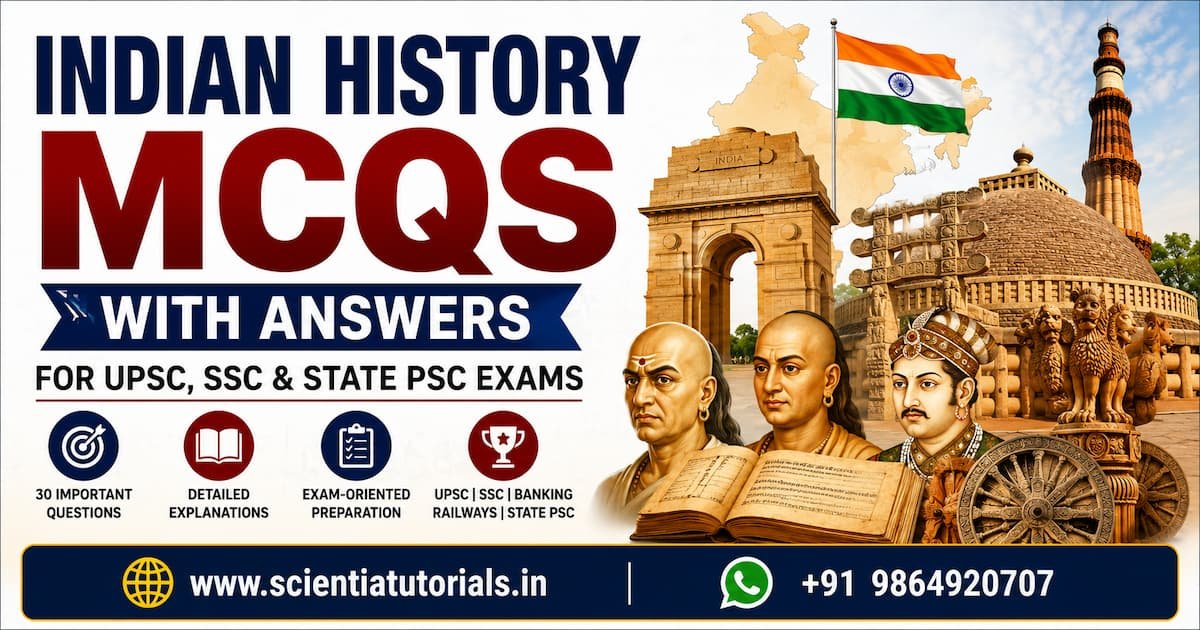
Indian History MCQs with Answers for UPSC, SSC and State PSC
These Multiple Choice Questions (MCQs) are designed for UPSC Civil Services, SSC CGL/CHSL, Banking, Railways, State PSC, CDS, CAPF, NDA, CUET, and other competitive examinations in India. Each question includes the correct answer and a detailed explanation to strengthen conceptual understanding.
1. Which is considered the oldest civilization in the Indian subcontinent?
A. Vedic Civilization
B. Indus Valley Civilization
C. Mauryan Civilization
D. Gupta Civilization
Answer: ✅ B. Indus Valley Civilization
Explanation:
The Indus Valley Civilization (c. 2600–1900 BCE) was one of the world’s earliest urban civilizations, flourishing along the Indus River and its tributaries.
- A: Incorrect. Vedic Civilization developed after the decline of the Indus Civilization.
- B: Correct. It featured planned cities like Harappa and Mohenjo-daro.
- C: Incorrect. Mauryan Empire emerged around 322 BCE.
- D: Incorrect. Gupta Empire flourished between the 4th and 6th centuries CE.
2. Which Indus Valley city is famous for its Great Bath?
A. Harappa
B. Lothal
C. Mohenjo-daro
D. Kalibangan
Answer: ✅ C. Mohenjo-daro
Explanation:
The Great Bath at Mohenjo-daro is considered one of the earliest known public water tanks.
- A: Harappa is known for granaries.
- B: Lothal is famous for its dockyard.
- C: Correct.
- D: Kalibangan is known for fire altars and ploughed fields.
3. The Rigveda mainly contains:
A. Medical knowledge
B. Hymns dedicated to gods
C. Political laws
D. Astronomical calculations
Answer: ✅ B. Hymns dedicated to gods
Explanation:
The Rigveda is the oldest Veda and consists primarily of hymns praising various deities such as Indra, Agni, and Varuna.
- A: Medical knowledge is mainly associated with Atharvaveda.
- B: Correct.
- C: Laws are discussed in Dharmashastras.
- D: Astronomy appears in later Vedic literature.
4. The capital of Magadha during Bimbisara’s reign was:
A. Pataliputra
B. Rajagriha
C. Vaishali
D. Ujjain
Answer: ✅ B. Rajagriha
Explanation:
Bimbisara ruled from Rajagriha (Rajgir). Later, Udayin shifted the capital to Pataliputra.
- A: Became capital later.
- B: Correct.
- C: Capital of Vajji Confederacy.
- D: Capital of Avanti.
5. Gautama Buddha attained enlightenment at:
A. Sarnath
B. Kushinagar
C. Bodh Gaya
D. Lumbini
Answer: ✅ C. Bodh Gaya
Explanation:
Buddha attained enlightenment under the Bodhi Tree at Bodh Gaya.
- A: First sermon.
- B: Mahaparinirvana.
- C: Correct.
- D: Birthplace.
6. Mahavira was the:
A. Founder of Jainism
B. 24th Tirthankara
C. Buddhist monk
D. Mauryan ruler
Answer: ✅ B. 24th Tirthankara
Explanation:
Jainism existed before Mahavira. He was the 24th and last Tirthankara, who reorganized and spread the religion.
- A: Incorrect.
- B: Correct.
- C: Incorrect.
- D: Incorrect.
7. Who founded the Mauryan Empire?
A. Ashoka
B. Bindusara
C. Chandragupta Maurya
D. Pushyamitra Shunga
Answer: ✅ C. Chandragupta Maurya
Explanation:
Chandragupta Maurya established the Mauryan Empire in 322 BCE with the guidance of Chanakya.
8. Chanakya is also known as:
A. Kalidasa
B. Vishnugupta
C. Patanjali
D. Panini
Answer: ✅ B. Vishnugupta
Explanation:
Chanakya, Kautilya, and Vishnugupta refer to the same scholar, credited with authoring the Arthashastra.
9. Which Mauryan ruler embraced Buddhism after the Kalinga War?
A. Chandragupta Maurya
B. Bindusara
C. Ashoka
D. Dasharatha
Answer: ✅ C. Ashoka
Explanation:
The devastation of the Kalinga War transformed Ashoka into a follower of Buddhism and promoter of Dhamma.
10. Ashoka’s inscriptions were mainly written in:
A. Sanskrit
B. Pali
C. Prakrit
D. Tamil
Answer: ✅ C. Prakrit
Explanation:
Most Ashokan edicts were written in Prakrit using the Brahmi script, though regional variations existed.
11. Which dynasty followed the Mauryas in North India?
A. Gupta
B. Kushan
C. Shunga
D. Satavahana
Answer: ✅ C. Shunga
Explanation:
Pushyamitra Shunga established the Shunga Dynasty after overthrowing the last Mauryan ruler.
12. Who is called the “Napoleon of India”?
A. Samudragupta
B. Chandragupta I
C. Chandragupta II
D. Harsha
Answer: ✅ A. Samudragupta
Explanation:
Historian V.A. Smith described Samudragupta as the “Napoleon of India” because of his extensive military campaigns.
13. The Gupta Age is known as the:
A. Iron Age
B. Golden Age of India
C. Stone Age
D. Copper Age
Answer: ✅ B. Golden Age of India
Explanation:
The Gupta period witnessed remarkable achievements in literature, science, mathematics, art, and architecture.
14. Aryabhata is famous for contributions to:
A. Medicine
B. Astronomy and Mathematics
C. Architecture
D. Politics
Answer: ✅ B. Astronomy and Mathematics
Explanation:
Aryabhata proposed that the Earth rotates on its axis and made significant mathematical discoveries.
15. Who wrote the play “Abhijnanasakuntalam”?
A. Banabhatta
B. Kalidasa
C. Vishakhadatta
D. Bharavi
Answer: ✅ B. Kalidasa
Explanation:
Kalidasa is regarded as one of the greatest Sanskrit poets and dramatists.
16. Harshavardhana belonged to the:
A. Vardhana Dynasty
B. Gupta Dynasty
C. Maurya Dynasty
D. Chola Dynasty
Answer: ✅ A. Vardhana Dynasty
Explanation:
Harsha ruled North India from Thanesar and later Kannauj during the 7th century CE.
17. Who visited India during Harsha’s reign?
A. Fa-Hien
B. Ibn Battuta
C. Xuanzang (Hiuen Tsang)
D. Megasthenes
Answer: ✅ C. Xuanzang (Hiuen Tsang)
Explanation:
The Chinese Buddhist monk Xuanzang documented Indian society, education, and religion during Harsha’s rule.
18. The famous Brihadeshwara Temple was built by:
A. Pallavas
B. Cholas
C. Rashtrakutas
D. Guptas
Answer: ✅ B. Cholas
Explanation:
Rajaraja I constructed the Brihadeshwara Temple at Thanjavur.
19. Which Chola ruler undertook a naval expedition to Southeast Asia?
A. Rajendra I
B. Rajaraja I
C. Vijayalaya
D. Kulothunga I
Answer: ✅ A. Rajendra I
Explanation:
Rajendra I expanded Chola influence across Southeast Asia through successful naval campaigns.
20. The Qutub Minar was started by:
A. Iltutmish
B. Qutb-ud-din Aibak
C. Alauddin Khalji
D. Balban
Answer: ✅ B. Qutb-ud-din Aibak
Explanation:
Construction began under Aibak and was completed by Iltutmish.
21. Who introduced the market control policy during the Delhi Sultanate?
A. Muhammad bin Tughlaq
B. Alauddin Khalji
C. Firoz Shah Tughlaq
D. Balban
Answer: ✅ B. Alauddin Khalji
Explanation:
His market reforms controlled prices, regulated trade, and ensured supplies for the army.
22. Ibn Battuta visited India during the reign of:
A. Alauddin Khalji
B. Muhammad bin Tughlaq
C. Balban
D. Sikandar Lodi
Answer: ✅ B. Muhammad bin Tughlaq
Explanation:
The Moroccan traveler served as a judge in Muhammad bin Tughlaq’s court.
23. Who founded the Mughal Empire?
A. Humayun
B. Akbar
C. Babur
D. Sher Shah
Answer: ✅ C. Babur
Explanation:
Babur defeated Ibrahim Lodi in the First Battle of Panipat (1526), establishing Mughal rule.
24. Akbar’s revenue system was developed by:
A. Birbal
B. Raja Todar Mal
C. Abul Fazl
D. Man Singh
Answer: ✅ B. Raja Todar Mal
Explanation:
Todar Mal introduced the Zabt revenue system based on systematic land measurement.
25. The religious policy of Sulh-i-Kul was associated with:
A. Babur
B. Humayun
C. Akbar
D. Aurangzeb
Answer: ✅ C. Akbar
Explanation:
Sulh-i-Kul means “Universal Peace” and emphasized religious tolerance.
26. The Battle of Plassey was fought in:
A. 1757
B. 1761
C. 1764
D. 1773
Answer: ✅ A. 1757
Explanation:
The British East India Company defeated Siraj-ud-Daulah, paving the way for British political dominance.
27. The Battle of Buxar took place in:
A. 1757
B. 1764
C. 1775
D. 1782
Answer: ✅ B. 1764
Explanation:
The British defeated the combined forces of Mir Qasim, Shuja-ud-Daulah, and Shah Alam II.
28. Who introduced the Permanent Settlement of Bengal?
A. Lord Wellesley
B. Lord Cornwallis
C. Lord Dalhousie
D. Warren Hastings
Answer: ✅ B. Lord Cornwallis
Explanation:
Introduced in 1793, the Permanent Settlement fixed land revenue and recognized zamindars as landowners.
29. The Revolt of 1857 began at:
A. Delhi
B. Kanpur
C. Meerut
D. Lucknow
Answer: ✅ C. Meerut
Explanation:
The revolt started on 10 May 1857 at Meerut and soon spread to northern and central India.
30. The Indian National Congress was founded in:
A. 1880
B. 1882
C. 1885
D. 1905
Answer: ✅ C. 1885
Explanation:
The Indian National Congress was founded in 1885 by A.O. Hume, with W.C. Bonnerjee serving as its first President.
- A: Incorrect.
- B: Incorrect.
- C: Correct.
- D: Incorrect.
Quick Revision Facts
- Indus Valley Civilization – c. 2600–1900 BCE
- Great Bath – Mohenjo-daro
- Founder of Mauryan Empire – Chandragupta Maurya
- Arthashastra – Chanakya (Kautilya/Vishnugupta)
- Kalinga War – 261 BCE
- Golden Age of India – Gupta Period
- Napoleon of India – Samudragupta
- Brihadeshwara Temple – Rajaraja I (Chola)
- First Battle of Panipat – 1526
- Battle of Plassey – 1757
- Battle of Buxar – 1764
- Revolt of 1857 – Meerut
- Indian National Congress – 1885
These 30 MCQs provide a strong conceptual foundation in Ancient, Medieval, and Modern Indian History and are highly relevant for UPSC, SSC, Banking, Railways, State PSC, CDS, NDA, CAPF, and other competitive examinations.