Indian Polity MCQs with Answers and Detailed Explanations for UPSC, SSC & State PSC | Important Questions
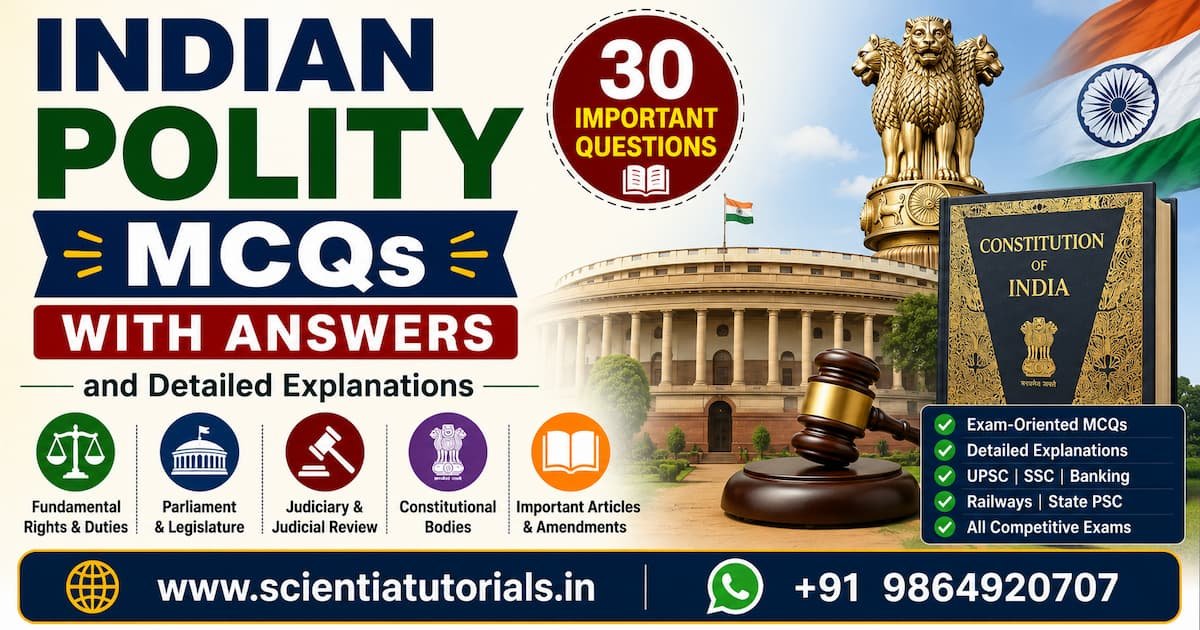
Indian Polity MCQs with Answers and Detailed Explanations
These 30 Multiple Choice Questions (MCQs) are designed for UPSC Civil Services, SSC CGL/CHSL, Banking, Railways, State PSC, CDS, NDA, CAPF, CUET, and other competitive examinations in India. Each question includes the correct answer along with an easy-to-understand explanation to strengthen conceptual clarity.
1. When did the Constitution of India come into force?
A. 15 August 1947
B. 26 January 1950
C. 26 November 1949
D. 2 October 1950
✅ Answer: B. 26 January 1950
Explanation:
The Constitution of India was adopted on 26 November 1949 and came into force on 26 January 1950, celebrated as Republic Day.
- A. Independence Day; incorrect.
- B. Correct.
- C. Adoption date.
- D. Incorrect.
2. Who is known as the ‘Father of the Indian Constitution’?
A. Jawaharlal Nehru
B. Dr. B. R. Ambedkar
C. Sardar Vallabhbhai Patel
D. Rajendra Prasad
✅ Answer: B. Dr. B. R. Ambedkar
Explanation:
Dr. B. R. Ambedkar chaired the Drafting Committee and played a pivotal role in framing the Constitution.
3. Which part of the Constitution deals with Fundamental Rights?
A. Part II
B. Part III
C. Part IV
D. Part V
✅ Answer: B. Part III
Explanation:
Fundamental Rights are provided under Articles 12–35 in Part III.
4. Which Article guarantees Equality before Law?
A. Article 14
B. Article 19
C. Article 21
D. Article 32
✅ Answer: A. Article 14
Explanation:
Article 14 guarantees Equality before Law and Equal Protection of Laws.
5. Which Fundamental Right was described by Dr. B. R. Ambedkar as the “Heart and Soul” of the Constitution?
A. Right to Equality
B. Right to Freedom
C. Right to Constitutional Remedies
D. Right against Exploitation
✅ Answer: C. Right to Constitutional Remedies
Explanation:
Article 32 empowers citizens to approach the Supreme Court for enforcement of Fundamental Rights.
6. Which Article provides protection of life and personal liberty?
A. Article 19
B. Article 20
C. Article 21
D. Article 22
✅ Answer: C. Article 21
Explanation:
Article 21 states that no person shall be deprived of life or personal liberty except according to procedure established by law.
7. Which Part of the Constitution contains the Directive Principles of State Policy (DPSPs)?
A. Part II
B. Part III
C. Part IV
D. Part IVA
✅ Answer: C. Part IV
Explanation:
The DPSPs are contained in Articles 36–51 under Part IV and guide the State in policymaking.
8. Fundamental Duties were added by which Constitutional Amendment?
A. 24th Amendment
B. 42nd Amendment
C. 44th Amendment
D. 52nd Amendment
✅ Answer: B. 42nd Amendment
Explanation:
The 42nd Constitutional Amendment Act, 1976 inserted Part IVA containing Fundamental Duties.
9. How many Fundamental Duties are currently listed in the Constitution?
A. 10
B. 11
C. 12
D. 13
✅ Answer: B. 11
Explanation:
Originally there were 10 duties. The 86th Amendment (2002) added the 11th duty relating to children’s education.
10. India is described as a ______ Republic in the Preamble.
A. Federal
B. Democratic
C. Parliamentary
D. Presidential
✅ Answer: B. Democratic
Explanation:
The Preamble declares India a Sovereign, Socialist, Secular, Democratic Republic.
11. The Preamble was amended by the:
A. 24th Amendment
B. 42nd Amendment
C. 44th Amendment
D. 52nd Amendment
✅ Answer: B. 42nd Amendment
Explanation:
The words Socialist, Secular, and Integrity were added through the 42nd Amendment.
12. The President of India is elected by:
A. Members of Parliament only
B. Members of State Legislatures only
C. An Electoral College
D. Direct election by the people
✅ Answer: C. An Electoral College
Explanation:
The Electoral College includes elected MPs and elected MLAs of states and certain Union Territories.
13. The minimum age to become the President of India is:
A. 30 years
B. 35 years
C. 40 years
D. 45 years
✅ Answer: B. 35 years
Explanation:
A presidential candidate must be at least 35 years old.
14. The real executive authority in India rests with the:
A. President
B. Prime Minister and Council of Ministers
C. Chief Justice of India
D. Parliament
✅ Answer: B. Prime Minister and Council of Ministers
Explanation:
India follows the parliamentary system where the President is the constitutional head, while the Prime Minister and Council of Ministers exercise real executive power.
15. Who appoints the Prime Minister of India?
A. Chief Justice of India
B. Speaker of Lok Sabha
C. President of India
D. Vice-President
✅ Answer: C. President of India
Explanation:
The President appoints the leader who is most likely to command the confidence of the Lok Sabha.
16. The maximum strength of the Lok Sabha as per the Constitution is:
A. 545
B. 550
C. 552
D. 560
✅ Answer: C. 552
Explanation:
The Constitution provides for a maximum strength of 552 members (though the current elected strength differs).
17. The Rajya Sabha is a:
A. Temporary House
B. Permanent House
C. Joint House
D. Judicial House
✅ Answer: B. Permanent House
Explanation:
Rajya Sabha is a permanent chamber; one-third of its members retire every two years.
18. Money Bills can be introduced only in:
A. Rajya Sabha
B. Lok Sabha
C. Joint Sitting
D. State Legislature
✅ Answer: B. Lok Sabha
Explanation:
Money Bills can only originate in the Lok Sabha with the President’s recommendation.
19. Who presides over the Rajya Sabha?
A. President
B. Prime Minister
C. Vice-President
D. Speaker
✅ Answer: C. Vice-President
Explanation:
The Vice-President of India is the ex officio Chairman of the Rajya Sabha.
20. The Speaker is the presiding officer of:
A. Rajya Sabha
B. Lok Sabha
C. State Assembly
D. Supreme Court
✅ Answer: B. Lok Sabha
Explanation:
The Speaker conducts the proceedings of the Lok Sabha.
21. Which is the highest judicial body in India?
A. High Court
B. Supreme Court
C. District Court
D. National Green Tribunal
✅ Answer: B. Supreme Court
Explanation:
The Supreme Court is the highest constitutional court and the final court of appeal.
22. Judicial Review in India means:
A. Parliament reviewing laws
B. Judiciary examining constitutional validity of laws
C. President reviewing court judgments
D. Governor reviewing state laws
✅ Answer: B. Judiciary examining constitutional validity of laws
Explanation:
Judicial Review enables courts to strike down unconstitutional laws and executive actions.
23. Which Article empowers the Supreme Court to issue writs?
A. Article 32
B. Article 226
C. Article 356
D. Article 370
✅ Answer: A. Article 32
Explanation:
Article 32 empowers the Supreme Court to issue writs for enforcing Fundamental Rights.
24. Which constitutional body conducts elections in India?
A. UPSC
B. Finance Commission
C. Election Commission of India
D. NITI Aayog
✅ Answer: C. Election Commission of India
Explanation:
The Election Commission is an independent constitutional body responsible for conducting free and fair elections.
25. The Finance Commission is constituted under:
A. Article 280
B. Article 324
C. Article 356
D. Article 370
✅ Answer: A. Article 280
Explanation:
Article 280 provides for the constitution of the Finance Commission.
26. Which emergency is declared under Article 352?
A. Financial Emergency
B. National Emergency
C. President’s Rule
D. Constitutional Emergency
✅ Answer: B. National Emergency
Explanation:
Article 352 deals with National Emergency due to war, external aggression, or armed rebellion.
27. President’s Rule in a State is imposed under:
A. Article 352
B. Article 356
C. Article 360
D. Article 368
✅ Answer: B. Article 356
Explanation:
Article 356 provides for President’s Rule when constitutional machinery in a state fails.
28. Financial Emergency is provided under:
A. Article 352
B. Article 356
C. Article 360
D. Article 370
✅ Answer: C. Article 360
Explanation:
Article 360 empowers the President to declare a Financial Emergency.
29. Constitutional amendments are dealt with under:
A. Article 324
B. Article 368
C. Article 280
D. Article 370
✅ Answer: B. Article 368
Explanation:
Article 368 prescribes the procedure for amending the Constitution.
30. Which Schedule of the Constitution contains the list of recognized official languages?
A. Sixth Schedule
B. Seventh Schedule
C. Eighth Schedule
D. Ninth Schedule
✅ Answer: C. Eighth Schedule
Explanation:
The Eighth Schedule recognizes 22 official languages of India. These languages receive constitutional recognition and support for their development.
- A. Sixth Schedule – Deals with administration of tribal areas in certain northeastern states.
- B. Seventh Schedule – Contains the Union, State, and Concurrent Lists.
- C. Eighth Schedule – Correct.
- D. Ninth Schedule – Contains laws protected from judicial review, subject to later constitutional interpretation.
Quick Revision Facts
- Constitution adopted – 26 November 1949
- Constitution enforced – 26 January 1950
- Father of the Constitution – Dr. B. R. Ambedkar
- Fundamental Rights – Part III (Articles 12–35)
- Directive Principles – Part IV (Articles 36–51)
- Fundamental Duties – Part IVA
- Equality before Law – Article 14
- Right to Constitutional Remedies – Article 32
- Right to Life – Article 21
- President elected by – Electoral College
- Real Executive – Prime Minister & Council of Ministers
- Money Bill introduced in – Lok Sabha only
- Chairman of Rajya Sabha – Vice-President
- Speaker presides over – Lok Sabha
- Judicial Review – Supreme Court & High Courts
- Election Commission – Article 324
- Finance Commission – Article 280
- National Emergency – Article 352
- President’s Rule – Article 356
- Financial Emergency – Article 360
- Constitutional Amendment – Article 368
- Official Languages – Eighth Schedule (22 languages)
These 30 MCQs cover the Constitution of India, Fundamental Rights, Directive Principles, Fundamental Duties, Union Executive, Parliament, Judiciary, Constitutional Bodies, Emergency Provisions, Constitutional Amendments, and Schedules, making them highly relevant for UPSC, SSC, Banking, Railways, State PSC, CDS, NDA, CAPF, and other competitive examinations in India.