Prime Minister of India Questions and Answers | Important MCQs for UPSC, SSC & Competitive Exams
Prime Minister of India Questions and Answers
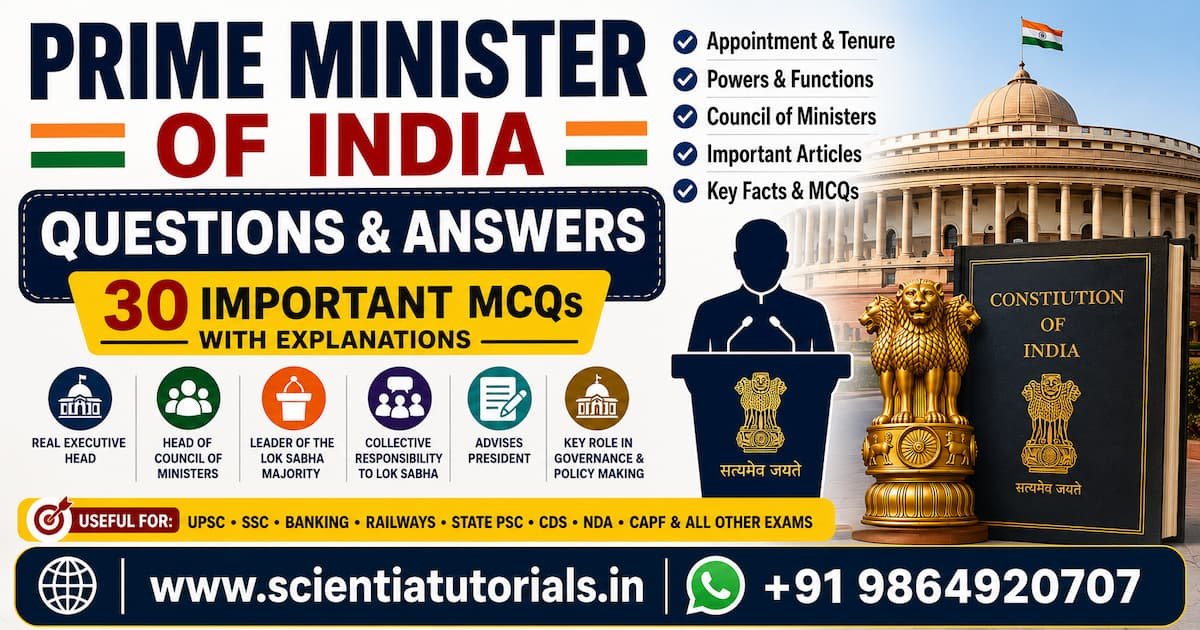
These 30 Multiple Choice Questions (MCQs) are designed for UPSC, SSC, Banking, Railways, APSC, State PSC, CDS, NDA, CAPF, CUET, and other competitive examinations in India. Each question includes the correct answer and a detailed explanation to strengthen conceptual understanding of the Prime Minister of India, constitutional provisions, powers, functions, appointment, Council of Ministers, and important facts.
1. Which Article of the Constitution provides for the office of the Prime Minister?
A. Article 72
B. Article 74
C. Article 75
D. Article 76
✅ Answer: B. Article 74
Explanation:
Article 74 provides that there shall be a Council of Ministers headed by the Prime Minister to aid and advise the President.
- A. Article 72 relates to the President’s pardoning power.
- B. Correct.
- C. Article 75 deals with the appointment and tenure of ministers.
- D. Article 76 deals with the Attorney General of India.
2. The Prime Minister of India is appointed by the:
A. Chief Justice of India
B. President of India
C. Speaker of the Lok Sabha
D. Vice-President
✅ Answer: B. President of India
Explanation:
Under Article 75, the President appoints the Prime Minister. Normally, the leader of the majority party or coalition in the Lok Sabha is appointed.
3. The Prime Minister must ordinarily be:
A. Leader of the majority in the Lok Sabha
B. Governor of a State
C. Chief Justice of India
D. Attorney General
✅ Answer: A. Leader of the majority in the Lok Sabha
Explanation:
In the parliamentary system, the Prime Minister is usually the leader of the political party or coalition commanding the majority in the Lok Sabha.
4. Which Article deals with the appointment of Ministers?
A. Article 73
B. Article 74
C. Article 75
D. Article 76
✅ Answer: C. Article 75
Explanation:
Article 75 provides for the appointment, tenure, salaries, and collective responsibility of the Council of Ministers.
5. The Council of Ministers is collectively responsible to the:
A. President
B. Rajya Sabha
C. Lok Sabha
D. Supreme Court
✅ Answer: C. Lok Sabha
Explanation:
Under Article 75(3), the Council of Ministers is collectively responsible to the Lok Sabha, ensuring parliamentary accountability.
6. The Prime Minister is the:
A. Head of State
B. Constitutional Head
C. Real Executive Head of the Government
D. Head of Judiciary
✅ Answer: C. Real Executive Head of the Government
Explanation:
The President is the constitutional head, while the Prime Minister is the real executive head who leads the government.
7. Who appoints the other ministers?
A. Parliament
B. President on the advice of the Prime Minister
C. Chief Justice of India
D. Election Commission
✅ Answer: B. President on the advice of the Prime Minister
Explanation:
The President appoints ministers on the advice of the Prime Minister.
8. A person who is not a Member of Parliament can become Prime Minister, provided that he or she gets elected to either House within:
A. Three months
B. Six months
C. Nine months
D. One year
✅ Answer: B. Six months
Explanation:
A non-member appointed as Prime Minister must become a member of either House of Parliament within six months, failing which the person must resign.
9. The Prime Minister serves:
A. For a fixed five-year term
B. During the pleasure of the President only
C. As long as he or she enjoys the confidence of the Lok Sabha
D. Until retirement at the age of 65
✅ Answer: C. As long as he or she enjoys the confidence of the Lok Sabha
Explanation:
Although ministers formally hold office during the pleasure of the President, in practice the Prime Minister remains in office only while enjoying the confidence of the Lok Sabha.
10. Which schedule of the Constitution contains the oath of office for the Prime Minister?
A. Second Schedule
B. Third Schedule
C. Fourth Schedule
D. Fifth Schedule
✅ Answer: B. Third Schedule
Explanation:
The forms of oath for Union Ministers, including the Prime Minister, are prescribed in the Third Schedule.
11. The oath of office is administered to the Prime Minister by the:
A. Chief Justice of India
B. President of India
C. Vice-President
D. Speaker of the Lok Sabha
✅ Answer: B. President of India
Explanation:
The President administers the oath of office and secrecy to the Prime Minister.
12. Which Prime Minister was the first Prime Minister of independent India?
A. Lal Bahadur Shastri
B. Jawaharlal Nehru
C. Sardar Vallabhbhai Patel
D. Morarji Desai
✅ Answer: B. Jawaharlal Nehru
Explanation:
Jawaharlal Nehru became India’s first Prime Minister on 15 August 1947.
13. Who chairs the meetings of the Union Cabinet?
A. President
B. Vice-President
C. Prime Minister
D. Home Minister
✅ Answer: C. Prime Minister
Explanation:
The Prime Minister presides over Cabinet meetings and coordinates government policies.
14. Which Article makes it the duty of the Prime Minister to communicate Cabinet decisions to the President?
A. Article 74
B. Article 75
C. Article 78
D. Article 80
✅ Answer: C. Article 78
Explanation:
Article 78 requires the Prime Minister to keep the President informed about government decisions and legislative proposals.
15. The Prime Minister is the ex-officio Chairperson of the:
A. Finance Commission
B. NITI Aayog
C. Election Commission
D. UPSC
✅ Answer: B. NITI Aayog
Explanation:
The Prime Minister serves as the Chairperson of NITI Aayog, which replaced the Planning Commission in 2015.
16. Which of the following is not a function of the Prime Minister?
A. Allocation of portfolios among ministers
B. Advising the President on ministerial appointments
C. Conducting elections to Parliament
D. Coordinating the work of different ministries
✅ Answer: C. Conducting elections to Parliament
Explanation:
Conducting elections is the responsibility of the Election Commission of India, not the Prime Minister.
17. The Prime Minister recommends the dissolution of:
A. Rajya Sabha
B. Lok Sabha
C. Supreme Court
D. State Legislative Councils
✅ Answer: B. Lok Sabha
Explanation:
The Prime Minister may advise the President to dissolve the Lok Sabha before the expiry of its term.
18. Who acts as the principal channel of communication between the President and the Council of Ministers?
A. Home Minister
B. Cabinet Secretary
C. Prime Minister
D. Attorney General
✅ Answer: C. Prime Minister
Explanation:
The Prime Minister communicates Cabinet decisions and policy matters to the President.
19. Which constitutional office is described as the “Keystone of the Cabinet Arch”?
A. President
B. Prime Minister
C. Speaker of Lok Sabha
D. Vice-President
✅ Answer: B. Prime Minister
Explanation:
The Prime Minister is often called the “Keystone of the Cabinet Arch” because the Cabinet functions under the Prime Minister’s leadership.
20. The Prime Minister can be a member of:
A. Lok Sabha only
B. Rajya Sabha only
C. Either Lok Sabha or Rajya Sabha
D. Neither House
✅ Answer: C. Either Lok Sabha or Rajya Sabha
Explanation:
The Constitution permits the Prime Minister to be a member of either House of Parliament.
21. Which Prime Minister served the longest tenure in India?
A. Indira Gandhi
B. Jawaharlal Nehru
C. Atal Bihari Vajpayee
D. P. V. Narasimha Rao
✅ Answer: B. Jawaharlal Nehru
Explanation:
Jawaharlal Nehru served from 1947 to 1964, making him the longest-serving Prime Minister of India.
22. The Council of Ministers is headed by the:
A. President
B. Vice-President
C. Prime Minister
D. Speaker
✅ Answer: C. Prime Minister
Explanation:
The Prime Minister leads the Council of Ministers and directs government policy.
23. Which body is directly accountable to the Lok Sabha?
A. President
B. Supreme Court
C. Council of Ministers
D. Election Commission
✅ Answer: C. Council of Ministers
Explanation:
The Council of Ministers is collectively responsible to the Lok Sabha.
24. The Prime Minister advises the President regarding the appointment of:
A. Union Ministers
B. Governors
C. Attorney General
D. All of the above (as provided under the Constitution and law)
✅ Answer: D. All of the above (as provided under the Constitution and law)
Explanation:
The President makes several constitutional appointments on the advice of the Prime Minister and the Council of Ministers.
25. Which Prime Minister was the first non-Congress Prime Minister to complete a full five-year term?
A. Morarji Desai
B. Atal Bihari Vajpayee
C. Charan Singh
D. H. D. Deve Gowda
✅ Answer: B. Atal Bihari Vajpayee
Explanation:
Atal Bihari Vajpayee completed a full five-year term from 1999 to 2004.
26. The resignation of the Prime Minister results in the:
A. Dissolution of Parliament automatically
B. Dissolution of the Council of Ministers
C. Dissolution of the Supreme Court
D. Dissolution of Rajya Sabha
✅ Answer: B. Dissolution of the Council of Ministers
Explanation:
Since the Prime Minister is the head of the Council of Ministers, the resignation of the Prime Minister results in the resignation of the entire Council.
27. Which of the following statements is correct?
A. The Prime Minister is elected directly by the people.
B. The Prime Minister is appointed by the President.
C. The Prime Minister is appointed by Parliament.
D. The Prime Minister is appointed by the Supreme Court.
✅ Answer: B. The Prime Minister is appointed by the President.
Explanation:
The President appoints the Prime Minister, generally selecting the leader who commands majority support in the Lok Sabha.
28. The Prime Minister plays the most significant role in:
A. Framing and implementing government policies
B. Conducting judicial proceedings
C. Auditing government accounts
D. Conducting elections
✅ Answer: A. Framing and implementing government policies
Explanation:
The Prime Minister leads policy formulation, governance, and coordination among ministries.
29. Which Article empowers the Council of Ministers to aid and advise the President?
A. Article 74
B. Article 75
C. Article 76
D. Article 78
✅ Answer: A. Article 74
Explanation:
Article 74 provides for a Council of Ministers headed by the Prime Minister to aid and advise the President.
30. Which statement regarding the Prime Minister of India is correct?
A. The Prime Minister is the ceremonial head of the State.
B. The Prime Minister is the real executive head and leader of the Council of Ministers.
C. The Prime Minister is elected by the Rajya Sabha.
D. The Prime Minister has a fixed constitutional tenure of five years.
✅ Answer: B. The Prime Minister is the real executive head and leader of the Council of Ministers.
Explanation:
The Prime Minister is the real executive authority in India’s parliamentary system, heading the Council of Ministers and directing government policy. The President is the constitutional head, while the Prime Minister exercises executive powers through the Council of Ministers.
- A. Incorrect. The President is the ceremonial head of State.
- B. Correct.
- C. Incorrect. The Prime Minister is appointed by the President.
- D. Incorrect. The tenure depends on retaining the confidence of the Lok Sabha.
Quick Revision Facts
- Article 74 – Council of Ministers headed by the Prime Minister
- Article 75 – Appointment, tenure, salaries, and collective responsibility of ministers
- Article 78 – Duties of the Prime Minister towards the President
- Appointed By – President of India
- Real Executive Head – Prime Minister
- Collective Responsibility – To the Lok Sabha
- Minimum Membership Requirement – Must become a Member of Parliament within six months if not already one
- Oath Administered By – President of India
- Chairperson of NITI Aayog – Prime Minister
- First Prime Minister – Jawaharlal Nehru
- Longest-Serving Prime Minister – Jawaharlal Nehru
- First Non-Congress Prime Minister to Complete a Full Five-Year Term – Atal Bihari Vajpayee
These 30 MCQs comprehensively cover the Prime Minister of India, including constitutional provisions, appointment, powers, functions, Council of Ministers, important articles, and notable facts, making them highly valuable for UPSC, SSC, Banking, Railways, APSC, State PSC, CDS, NDA, CAPF, and other competitive examinations in India.