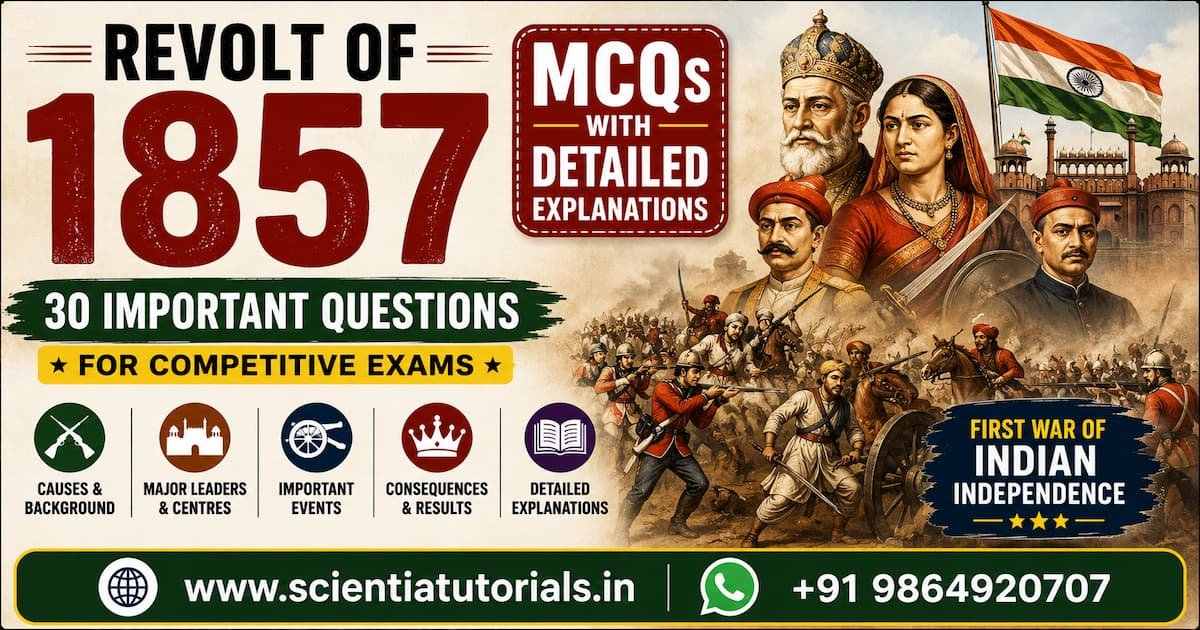
Revolt of 1857 MCQs with Detailed Explanations | 30 Important Questions for Competitive Exams
Revolt of 1857 MCQs with Detailed Explanations – 30 Important Questions for Competitive Exams
The following 30 Multiple Choice Questions (MCQs) are designed for UPSC Civil Services, SSC CGL, CHSL, Banking (IBPS, SBI, RBI), Railways, State PSC, CDS, CAPF, Insurance, CUET, and other competitive examinations in India. Each question includes the correct answer along with an easy-to-understand, concept-clearing explanation.
1. The Revolt of 1857 began at:
A. Delhi
B. Meerut
C. Kanpur
D. Lucknow
✅ Answer: B. Meerut
Explanation:
The Revolt of 1857 started on 10 May 1857 at Meerut when Indian soldiers (sepoys) revolted against the British East India Company. They later marched to Delhi and declared Bahadur Shah Zafar as their leader.
Option Analysis
- A. Delhi – Became the centre of the revolt but not the starting point.
- B. Meerut – Correct.
- C. Kanpur – Revolt spread here later.
- D. Lucknow – Also became a major centre later.
2. The Revolt of 1857 is popularly known as:
A. Indigo Revolt
B. First War of Indian Independence
C. Civil Disobedience Movement
D. Quit India Movement
✅ Answer: B. First War of Indian Independence
Explanation:
The Revolt of 1857 is widely regarded as the First War of Indian Independence, a term popularised by V. D. Savarkar.
3. Who was the last Mughal Emperor proclaimed as the leader of the Revolt?
A. Akbar II
B. Bahadur Shah Zafar
C. Shah Alam II
D. Aurangzeb
✅ Answer: B. Bahadur Shah Zafar
Explanation:
Bahadur Shah Zafar became the symbolic leader of the revolt after the rebels captured Delhi.
4. The immediate cause of the Revolt of 1857 was:
A. Doctrine of Lapse
B. Introduction of Enfield rifle cartridges
C. Subsidiary Alliance
D. Permanent Settlement
✅ Answer: B. Introduction of Enfield rifle cartridges
Explanation:
The new Enfield rifle cartridges were rumoured to be greased with cow and pig fat, offending both Hindu and Muslim soldiers.
5. Which Governor-General introduced the Doctrine of Lapse?
A. Lord Dalhousie
B. Lord Canning
C. Lord Wellesley
D. Lord Curzon
✅ Answer: A. Lord Dalhousie
Explanation:
Lord Dalhousie annexed several princely states under the Doctrine of Lapse, creating widespread resentment.
6. Who was the Governor-General of India during the Revolt of 1857?
A. Lord Curzon
B. Lord Canning
C. Lord Dalhousie
D. Lord Ripon
✅ Answer: B. Lord Canning
Explanation:
Lord Canning served as Governor-General during the revolt and later became the first Viceroy of India.
7. Which leader led the revolt at Kanpur?
A. Tantia Tope
B. Nana Sahib
C. Rani Lakshmibai
D. Kunwar Singh
✅ Answer: B. Nana Sahib
Explanation:
Nana Sahib led the revolt in Kanpur and challenged British authority in the region.
8. Who led the revolt in Jhansi?
A. Begum Hazrat Mahal
B. Rani Lakshmibai
C. Rani Avantibai
D. Annie Besant
✅ Answer: B. Rani Lakshmibai
Explanation:
Rani Lakshmibai fought bravely against British forces and became one of the greatest heroes of the revolt.
9. Who led the revolt in Lucknow?
A. Begum Hazrat Mahal
B. Sarojini Naidu
C. Aruna Asaf Ali
D. Kasturba Gandhi
✅ Answer: A. Begum Hazrat Mahal
Explanation:
Begum Hazrat Mahal assumed leadership in Awadh after the annexation of the kingdom by the British.
10. Kunwar Singh was associated with:
A. Bihar
B. Punjab
C. Gujarat
D. Kerala
✅ Answer: A. Bihar
Explanation:
Kunwar Singh, the zamindar of Jagdishpur, led the revolt in Bihar despite being over 80 years old.
11. Which city became the political centre of the Revolt?
A. Kolkata
B. Delhi
C. Mumbai
D. Chennai
✅ Answer: B. Delhi
Explanation:
After capturing Delhi, the rebels declared Bahadur Shah Zafar as Emperor, making Delhi the symbolic centre of the revolt.
12. Mangal Pandey is associated with:
A. Kanpur
B. Barrackpore
C. Meerut
D. Lucknow
✅ Answer: B. Barrackpore
Explanation:
Mangal Pandey attacked British officers at Barrackpore in March 1857 and is regarded as one of the earliest revolutionaries of the uprising.
13. Mangal Pandey belonged to:
A. Madras Regiment
B. 34th Bengal Native Infantry
C. Bombay Infantry
D. Sikh Regiment
✅ Answer: B. 34th Bengal Native Infantry
Explanation:
He served in the 34th Bengal Native Infantry of the East India Company.
14. Which British policy deeply angered Indian rulers before the revolt?
A. Green Revolution
B. Doctrine of Lapse
C. Liberalisation Policy
D. Permanent Settlement of 1950
✅ Answer: B. Doctrine of Lapse
Explanation:
The Doctrine of Lapse allowed the British to annex princely states without a natural male heir.
15. Which social issue contributed to dissatisfaction among Indians before the revolt?
A. Introduction of railways only
B. Fear of forced religious conversion
C. Expansion of irrigation
D. Growth of industries
✅ Answer: B. Fear of forced religious conversion
Explanation:
Many Indians feared that British social reforms and missionary activities threatened their religious traditions.
16. Which class suffered due to British land revenue policies?
A. Farmers and zamindars
B. Industrialists only
C. Scientists
D. Lawyers only
✅ Answer: A. Farmers and zamindars
Explanation:
Heavy taxation and exploitative land revenue systems caused economic hardship among peasants and landlords.
17. Which of the following was NOT a cause of the Revolt of 1857?
A. Political annexations
B. Economic exploitation
C. Religious concerns
D. Introduction of GST
✅ Answer: D. Introduction of GST
Explanation:
GST was introduced in 2017 and has no connection with the Revolt of 1857.
18. Which famous military commander assisted Nana Sahib?
A. Tantia Tope
B. Baji Rao II
C. Lala Lajpat Rai
D. Bipin Chandra Pal
✅ Answer: A. Tantia Tope
Explanation:
Tantia Tope emerged as one of the most capable military leaders of the revolt.
19. The Revolt of 1857 mainly remained confined to:
A. Southern India
B. Northern and Central India
C. North-East India only
D. Entire India equally
✅ Answer: B. Northern and Central India
Explanation:
The revolt was strongest in present-day Uttar Pradesh, Delhi, Bihar, Madhya Pradesh, and parts of Rajasthan.
20. Which group largely remained loyal to the British during the revolt?
A. Sikh rulers and many princely states
B. All Indian rulers
C. Every Indian soldier
D. All peasants
✅ Answer: A. Sikh rulers and many princely states
Explanation:
Several princely states and Sikh forces supported the British, helping suppress the revolt.
21. Why did the Revolt of 1857 ultimately fail?
A. Lack of leadership and coordination
B. Superior British military resources
C. Limited geographical spread
D. All of the above
✅ Answer: D. All of the above
Explanation:
The revolt lacked unified leadership, modern weapons, nationwide participation, and coordination, while the British had better organisation and military strength.
22. After suppressing the revolt, the British abolished the rule of:
A. British Parliament
B. East India Company
C. Indian National Congress
D. Mughal Empire only
✅ Answer: B. East India Company
Explanation:
The Government of India Act, 1858 ended Company rule, transferring power directly to the British Crown.
23. Which Act transferred power from the East India Company to the British Crown?
A. Government of India Act, 1858
B. Regulating Act, 1773
C. Pitt’s India Act, 1784
D. Indian Councils Act, 1909
✅ Answer: A. Government of India Act, 1858
Explanation:
The Act marked the beginning of direct Crown rule in India.
24. Who became the first Viceroy of India?
A. Lord Curzon
B. Lord Canning
C. Lord Dalhousie
D. Lord Ripon
✅ Answer: B. Lord Canning
Explanation:
After the Government of India Act, 1858, Lord Canning became the first Viceroy.
25. Which title of Bahadur Shah Zafar ended after the Revolt?
A. Nawab of Bengal
B. Mughal Emperor
C. Peshwa
D. Sultan of Mysore
✅ Answer: B. Mughal Emperor
Explanation:
The Mughal dynasty officially came to an end after Bahadur Shah Zafar was exiled to Rangoon.
26. Bahadur Shah Zafar was exiled to:
A. London
B. Rangoon (Yangon)
C. Kabul
D. Singapore
✅ Answer: B. Rangoon (Yangon)
Explanation:
Following the suppression of the revolt, Bahadur Shah Zafar was exiled to Rangoon, where he died in 1862.
27. Which of the following was an important consequence of the Revolt?
A. End of Company rule
B. Beginning of Crown rule
C. Reorganisation of the Indian Army
D. All of the above
✅ Answer: D. All of the above
Explanation:
The revolt led to major administrative, military, and political reforms by the British.
28. The Revolt of 1857 inspired:
A. Later nationalist movements
B. Only industrial development
C. Space research
D. Cooperative farming
✅ Answer: A. Later nationalist movements
Explanation:
Although unsuccessful, the revolt inspired future generations of freedom fighters and laid the foundation for the organised national movement.
29. Which statement best describes the Revolt of 1857?
A. It was only a military mutiny.
B. It involved soldiers, rulers, peasants, and civilians in many regions of India.
C. It was fought only in South India.
D. It had no political causes.
✅ Answer: B. It involved soldiers, rulers, peasants, and civilians in many regions of India.
Explanation:
The revolt had military, political, economic, religious, and social causes and drew support from diverse sections of society, though participation varied across regions.
30. Which statement correctly summarises the significance of the Revolt of 1857?
A. It immediately ended British rule in India.
B. It was unsuccessful militarily but marked a major turning point in India’s struggle against British rule.
C. It had no impact on British policies.
D. It was fought only for higher salaries.
✅ Answer: B. It was unsuccessful militarily but marked a major turning point in India’s struggle against British rule.
Explanation:
Although the Revolt of 1857 did not succeed in overthrowing British rule, it profoundly changed British governance in India. It ended the rule of the East India Company, established direct Crown rule, reorganised the army, altered administrative policies, and became a lasting symbol of resistance. For these reasons, it is widely regarded as the First War of Indian Independence and an important milestone in the evolution of the Indian freedom movement.
Quick Revision Table
| Topic | Key Fact |
|---|---|
| Revolt Began | 10 May 1857 |
| Starting Place | Meerut |
| Immediate Cause | Enfield rifle cartridges |
| Last Mughal Emperor | Bahadur Shah Zafar |
| Governor-General | Lord Canning |
| Doctrine of Lapse | Lord Dalhousie |
| Kanpur Leader | Nana Sahib |
| Jhansi Leader | Rani Lakshmibai |
| Lucknow Leader | Begum Hazrat Mahal |
| Bihar Leader | Kunwar Singh |
| Military Leader | Tantia Tope |
| Early Revolutionary | Mangal Pandey |
| Mangal Pandey’s Regiment | 34th Bengal Native Infantry |
| Political Centre | Delhi |
| End of Company Rule | Government of India Act, 1858 |
| First Viceroy | Lord Canning |
| Bahadur Shah Zafar Exiled To | Rangoon (Yangon) |
| Major Outcome | Direct British Crown Rule |
| Historical Significance | First War of Indian Independence |