UNESCO World Heritage Sites in India MCQs
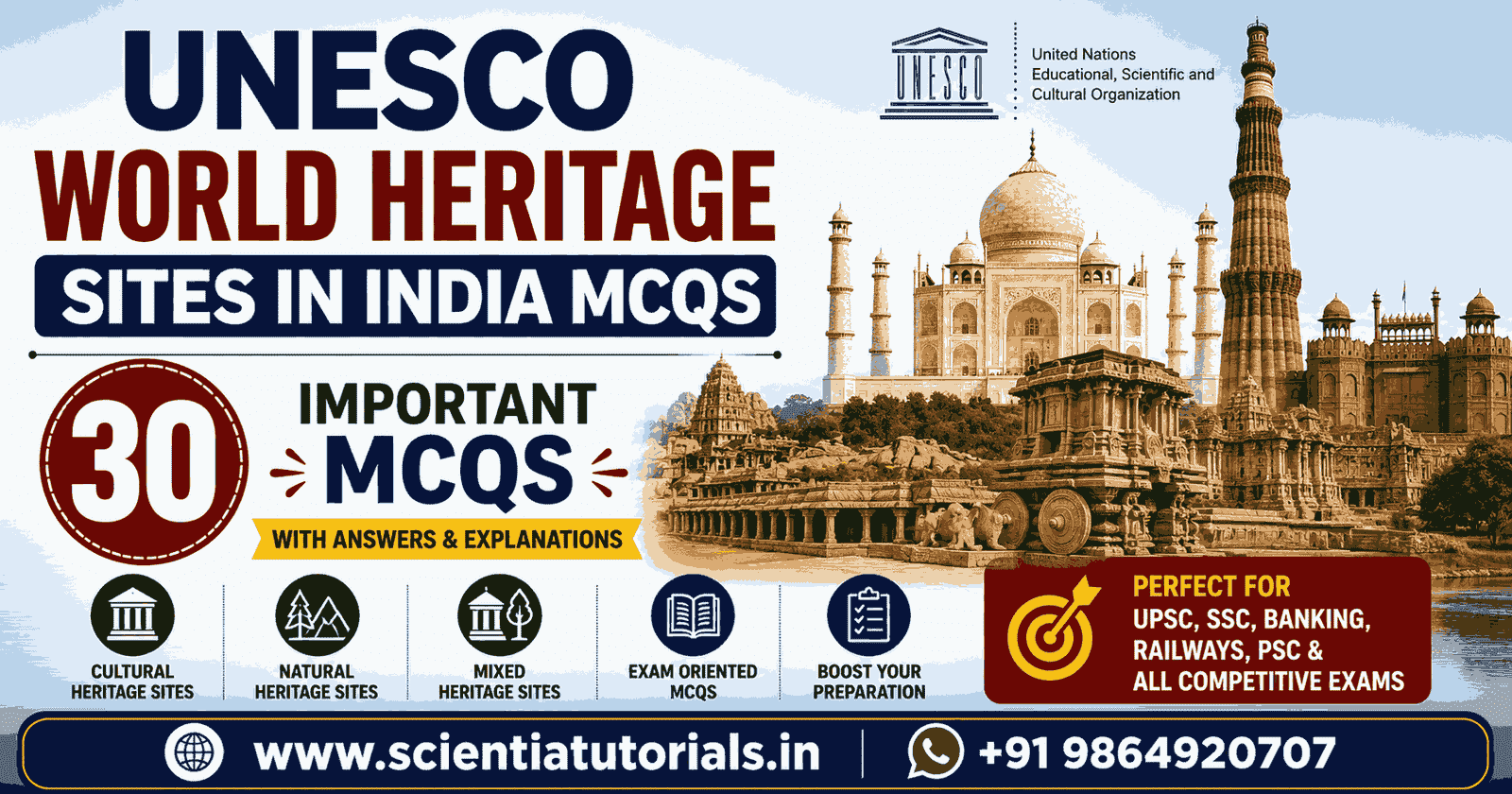
UNESCO World Heritage Sites in India MCQs – 30 Important Questions with Answers and Detailed Explanations
The following 30 Multiple Choice Questions (MCQs) are specially designed for UPSC Civil Services, SSC CGL/CHSL, Banking (IBPS, SBI, RBI), Railways (RRB), State PSC, CDS, CAPF, Insurance, CUET, CTET, TET, and other competitive examinations in India. Each question is accompanied by the correct answer and an easy-to-understand, concept-clearing explanation to strengthen your knowledge of UNESCO World Heritage Sites in India.
1. What is the primary objective of UNESCO’s World Heritage Convention?
A. To promote tourism only
B. To identify and protect cultural and natural heritage of outstanding universal value
C. To preserve endangered wildlife only
D. To regulate international trade
✅ Answer: B. To identify and protect cultural and natural heritage of outstanding universal value
Explanation:
The UNESCO World Heritage Convention (1972) aims to identify, protect, conserve, and transmit to future generations cultural and natural heritage sites of Outstanding Universal Value (OUV).
Option Analysis
- A. Tourism is a benefit but not the primary objective.
- B. ✅ Correct.
- C. Wildlife conservation is only one aspect of natural heritage.
- D. UNESCO does not regulate trade.
2. UNESCO stands for:
A. United Nations Educational, Scientific and Cultural Organization
B. United Nations Economic and Social Council
C. Universal Nations Science Council
D. United Nations Environment Commission
✅ Answer: A. United Nations Educational, Scientific and Cultural Organization
Explanation:
UNESCO is a specialised agency of the United Nations established in 1945 to promote education, science, culture, and international cooperation.
3. The UNESCO World Heritage Convention was adopted in:
A. 1945
B. 1956
C. 1972
D. 1992
✅ Answer: C. 1972
Explanation:
The Convention Concerning the Protection of the World Cultural and Natural Heritage was adopted in 1972, creating the World Heritage programme.
4. Which of the following is India’s first UNESCO World Heritage Site?
A. Taj Mahal
B. Agra Fort
C. Ajanta Caves
D. Kaziranga National Park
✅ Answer: C. Ajanta Caves
Explanation:
Among India’s earliest inscriptions, the Ajanta Caves were inscribed on the UNESCO World Heritage List in 1983. In the same year, Ellora Caves, Agra Fort, and the Taj Mahal were also inscribed.
5. The Ajanta Caves are located in:
A. Maharashtra
B. Karnataka
C. Madhya Pradesh
D. Odisha
✅ Answer: A. Maharashtra
Explanation:
The Ajanta Caves in Maharashtra are renowned for their magnificent Buddhist murals and rock-cut architecture dating from the 2nd century BCE to the 6th century CE.
6. Which UNESCO World Heritage Site is famous for rock-cut Hindu, Buddhist, and Jain monuments?
A. Ellora Caves
B. Hampi
C. Konark Sun Temple
D. Mahabalipuram
✅ Answer: A. Ellora Caves
Explanation:
The Ellora Caves in Maharashtra feature 34 rock-cut caves representing Buddhism, Hinduism, and Jainism, symbolising religious harmony.
7. The Taj Mahal is located in:
A. Delhi
B. Agra
C. Jaipur
D. Lucknow
✅ Answer: B. Agra
Explanation:
The Taj Mahal, built by Emperor Shah Jahan in memory of Mumtaz Mahal, is located in Agra, Uttar Pradesh, and is one of the Seven Wonders of the World.
8. Which emperor built the Taj Mahal?
A. Akbar
B. Shah Jahan
C. Jahangir
D. Aurangzeb
✅ Answer: B. Shah Jahan
Explanation:
The Taj Mahal was constructed between 1632 and 1653 under the patronage of Mughal Emperor Shah Jahan.
9. Kaziranga National Park, a UNESCO World Heritage Site, is located in:
A. Assam
B. Meghalaya
C. Arunachal Pradesh
D. West Bengal
✅ Answer: A. Assam
Explanation:
Kaziranga National Park in Assam is internationally recognised for its population of the Greater One-Horned Rhinoceros.
10. Kaziranga National Park is especially famous for conserving:
A. Asiatic Lion
B. One-Horned Rhinoceros
C. Snow Leopard
D. Wild Yak
✅ Answer: B. One-Horned Rhinoceros
Explanation:
Kaziranga supports the world’s largest population of the Greater One-Horned Rhinoceros and is also a tiger reserve.
11. Keoladeo National Park is located in:
A. Rajasthan
B. Gujarat
C. Punjab
D. Haryana
✅ Answer: A. Rajasthan
Explanation:
Located at Bharatpur, Keoladeo National Park is one of India’s most famous bird sanctuaries and an important wetland.
12. The Sun Temple at Konark is situated in:
A. Odisha
B. Gujarat
C. Tamil Nadu
D. Karnataka
✅ Answer: A. Odisha
Explanation:
The 13th-century Konark Sun Temple, dedicated to the Sun God, is renowned for its chariot-shaped architecture.
13. The Group of Monuments at Hampi is located in:
A. Karnataka
B. Andhra Pradesh
C. Telangana
D. Kerala
✅ Answer: A. Karnataka
Explanation:
Hampi was the capital of the Vijayanagara Empire and is known for its temples, bazaars, and stone architecture.
14. Which UNESCO World Heritage Site served as the capital of the Vijayanagara Empire?
A. Hampi
B. Pattadakal
C. Badami
D. Belur
✅ Answer: A. Hampi
Explanation:
Hampi flourished during the 14th–16th centuries and remains one of India’s greatest archaeological sites.
15. The Group of Monuments at Mahabalipuram is located in:
A. Tamil Nadu
B. Kerala
C. Andhra Pradesh
D. Goa
✅ Answer: A. Tamil Nadu
Explanation:
Mahabalipuram is famous for its shore temples, monolithic rock-cut temples, and sculptures built during the Pallava period.
16. The Great Living Chola Temples are found in:
A. Tamil Nadu
B. Karnataka
C. Kerala
D. Odisha
✅ Answer: A. Tamil Nadu
Explanation:
This UNESCO site includes the Brihadisvara Temple (Thanjavur), Gangaikondacholisvaram, and Airavatesvara Temple.
17. Which UNESCO site is known for Ashokan inscriptions and Buddhist stupas?
A. Sanchi
B. Nalanda
C. Ajanta
D. Ellora
✅ Answer: A. Sanchi
Explanation:
The Buddhist Monuments at Sanchi in Madhya Pradesh include the famous Great Stupa built under Emperor Ashoka.
18. The Qutub Minar is located in:
A. Delhi
B. Agra
C. Jaipur
D. Lucknow
✅ Answer: A. Delhi
Explanation:
The Qutub Minar Complex is one of Delhi’s most iconic historical monuments and a UNESCO World Heritage Site.
19. The Red Fort Complex is situated in:
A. Delhi
B. Agra
C. Jaipur
D. Hyderabad
✅ Answer: A. Delhi
Explanation:
Built by Shah Jahan, the Red Fort served as the main residence of Mughal emperors.
20. Which UNESCO World Heritage Site is famous for stepwells?
A. Rani ki Vav
B. Adalaj Stepwell
C. Chand Baori
D. Agrasen ki Baoli
✅ Answer: A. Rani ki Vav
Explanation:
Located in Patan, Gujarat, Rani ki Vav is an intricately designed stepwell built in the 11th century.
21. Rani ki Vav is located in:
A. Gujarat
B. Rajasthan
C. Maharashtra
D. Madhya Pradesh
✅ Answer: A. Gujarat
Explanation:
Rani ki Vav is celebrated for its architectural brilliance and elaborate sculptures.
22. Which UNESCO World Heritage Site is associated with the Kakatiya dynasty?
A. Ramappa Temple
B. Brihadisvara Temple
C. Mahabalipuram
D. Hampi
✅ Answer: A. Ramappa Temple
Explanation:
The Ramappa Temple in Telangana was inscribed in 2021 and is known for its lightweight floating bricks and intricate carvings.
23. Dholavira is an archaeological site of which civilisation?
A. Indus Valley Civilisation
B. Vedic Civilisation
C. Mauryan Empire
D. Gupta Empire
✅ Answer: A. Indus Valley Civilisation
Explanation:
Dholavira in Gujarat is one of the best-preserved urban centres of the Harappan Civilisation.
24. Dholavira is located in:
A. Gujarat
B. Rajasthan
C. Haryana
D. Punjab
✅ Answer: A. Gujarat
Explanation:
Dholavira is situated on Khadir Island in the Rann of Kutch.
25. Which UNESCO World Heritage Site in India is famous for the mountain railway?
A. Mountain Railways of India
B. Konkan Railway
C. Delhi Metro
D. Nilgiri Express
✅ Answer: A. Mountain Railways of India
Explanation:
This serial UNESCO site includes the Darjeeling Himalayan Railway, Nilgiri Mountain Railway, and Kalka–Shimla Railway.
26. Which UNESCO site includes the Darjeeling Himalayan Railway?
A. Mountain Railways of India
B. Indian Rail Museum
C. Konkan Railway
D. Nilgiri Biosphere
✅ Answer: A. Mountain Railways of India
Explanation:
The Darjeeling Himalayan Railway was the first Indian mountain railway to receive UNESCO recognition.
27. Which Indian state has the UNESCO site “Khangchendzonga National Park”?
A. Sikkim
B. Himachal Pradesh
C. Uttarakhand
D. Arunachal Pradesh
✅ Answer: A. Sikkim
Explanation:
Khangchendzonga National Park is India’s first mixed World Heritage Site, recognised for both cultural and natural significance.
28. Which UNESCO World Heritage Site is a mixed heritage site?
A. Khangchendzonga National Park
B. Kaziranga National Park
C. Taj Mahal
D. Ajanta Caves
✅ Answer: A. Khangchendzonga National Park
Explanation:
Mixed heritage sites satisfy both cultural and natural criteria. Khangchendzonga National Park is India’s first such site.
29. Which of the following is a Natural UNESCO World Heritage Site in India?
A. Manas Wildlife Sanctuary
B. Qutub Minar
C. Sanchi Stupa
D. Hampi
✅ Answer: A. Manas Wildlife Sanctuary
Explanation:
Manas Wildlife Sanctuary in Assam is renowned for its biodiversity and is a UNESCO Natural World Heritage Site.
30. Which statement best describes UNESCO World Heritage Sites in India?
A. They include only historical monuments.
B. They include cultural, natural, and mixed heritage sites recognised for their Outstanding Universal Value and protected for future generations.
C. They include only national parks.
D. They are selected solely based on tourist popularity.
✅ Answer: B. They include cultural, natural, and mixed heritage sites recognised for their Outstanding Universal Value and protected for future generations.
Explanation:
UNESCO World Heritage Sites in India represent the country’s rich history, architecture, archaeology, biodiversity, and cultural traditions. They are classified into:
- Cultural Heritage Sites (e.g., Taj Mahal, Hampi, Qutub Minar)
- Natural Heritage Sites (e.g., Kaziranga National Park, Manas Wildlife Sanctuary)
- Mixed Heritage Sites (e.g., Khangchendzonga National Park)
These sites are of Outstanding Universal Value and are protected through international cooperation and national conservation efforts. Questions on UNESCO World Heritage Sites are frequently asked in UPSC, SSC, Banking, Railways, State PSC, CDS, CAPF, and other competitive examinations.
Quick Revision Table
| Topic | Key Fact |
|---|---|
| UNESCO | United Nations Educational, Scientific and Cultural Organization |
| World Heritage Convention | 1972 |
| First Indian UNESCO inscriptions (1983) | Ajanta Caves, Ellora Caves, Agra Fort, Taj Mahal |
| Taj Mahal | Agra, Uttar Pradesh |
| Kaziranga National Park | Assam |
| Famous Animal | Greater One-Horned Rhinoceros |
| Konark Sun Temple | Odisha |
| Hampi | Vijayanagara Empire |
| Mahabalipuram | Tamil Nadu |
| Great Living Chola Temples | Tamil Nadu |
| Sanchi | Madhya Pradesh |
| Qutub Minar | Delhi |
| Red Fort | Delhi |
| Rani ki Vav | Gujarat |
| Dholavira | Indus Valley Civilisation |
| Ramappa Temple | Telangana |
| Mountain Railways | Darjeeling, Nilgiri, Kalka–Shimla |
| Khangchendzonga National Park | Sikkim (Mixed Heritage Site) |
| Manas Wildlife Sanctuary | Assam (Natural Heritage Site) |
| UNESCO Categories | Cultural, Natural, Mixed |