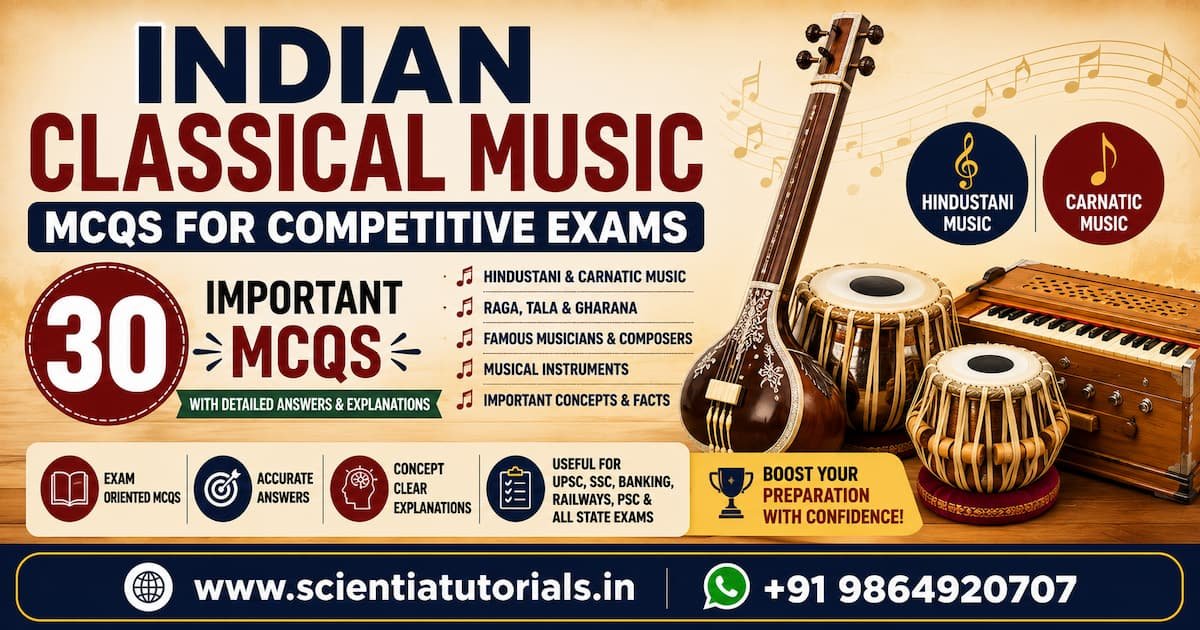
Indian Classical Music MCQs for Competitive Exams
Indian Classical Music MCQs for Competitive Exams – 30 Important Questions with Answers and Detailed Explanations
The following 30 Multiple Choice Questions (MCQs) are designed for UPSC Civil Services, SSC CGL/CHSL, Banking (IBPS, SBI, RBI), Railways (RRB), State PSC, CDS, CAPF, Insurance, CUET, CTET, TET, and other competitive examinations in India. Each question includes the correct answer along with an easy-to-understand, concept-clearing explanation to strengthen your knowledge of Indian Classical Music.
1. Indian Classical Music is broadly divided into which two major traditions?
A. Carnatic and Hindustani
B. Folk and Tribal
C. Devotional and Film
D. Ghazal and Qawwali
✅ Answer: A. Carnatic and Hindustani
Explanation:
Indian Classical Music has two principal traditions:
- Hindustani Classical Music (North India)
- Carnatic Classical Music (South India)
Both share ancient roots but differ in style, compositions, and performance techniques.
Option Analysis
- A. Carnatic and Hindustani – Correct.
- B. Folk and Tribal – Traditional but not classical.
- C. Devotional and Film – Musical genres.
- D. Ghazal and Qawwali – Vocal forms, not classical traditions.
2. Hindustani Classical Music primarily flourished in:
A. North India
B. South India
C. North-East India
D. Andaman Islands
✅ Answer: A. North India
Explanation:
Hindustani music developed in North India and evolved under the influence of Persian and Mughal cultures while retaining its ancient Indian foundations.
3. Carnatic Classical Music is mainly associated with:
A. Northern India
B. Southern India
C. Western India
D. Eastern India
✅ Answer: B. Southern India
Explanation:
Carnatic music is the classical music tradition of South India and is especially popular in Tamil Nadu, Karnataka, Andhra Pradesh, Telangana, and Kerala.
4. The ancient treatise “Natya Shastra” was written by:
A. Kalidasa
B. Bharata Muni
C. Panini
D. Patanjali
✅ Answer: B. Bharata Muni
Explanation:
The Natya Shastra is one of the earliest texts on Indian performing arts, covering music, dance, drama, rhythm, and stagecraft.
5. The ancient text “Sangeet Ratnakara” was written by:
A. Sharngadeva
B. Tansen
C. Amir Khusrau
D. Tyagaraja
✅ Answer: A. Sharngadeva
Explanation:
Sharngadeva’s Sangeet Ratnakara (13th century) is regarded as one of the most important treatises on Indian music.
6. Which Mughal emperor’s court was associated with Tansen?
A. Babur
B. Akbar
C. Jahangir
D. Shah Jahan
✅ Answer: B. Akbar
Explanation:
Tansen was one of the Navaratnas (Nine Gems) in Emperor Akbar’s court and is regarded as one of India’s greatest musicians.
7. Tansen is particularly associated with:
A. Hindustani Classical Music
B. Carnatic Music
C. Folk Music
D. Rabindra Sangeet
✅ Answer: A. Hindustani Classical Music
Explanation:
Tansen played a major role in developing the Hindustani classical tradition during the Mughal era.
8. Which musical instrument is associated with Pandit Ravi Shankar?
A. Sarod
B. Tabla
C. Sitar
D. Veena
✅ Answer: C. Sitar
Explanation:
Pandit Ravi Shankar popularised the sitar across the world and significantly contributed to the global recognition of Indian classical music.
9. Ustad Bismillah Khan was a legendary exponent of:
A. Tabla
B. Flute
C. Shehnai
D. Santoor
✅ Answer: C. Shehnai
Explanation:
Ustad Bismillah Khan elevated the shehnai to the status of a respected classical concert instrument.
10. Pandit Hariprasad Chaurasia is famous for playing the:
A. Flute (Bansuri)
B. Violin
C. Sarangi
D. Tabla
✅ Answer: A. Flute (Bansuri)
Explanation:
Pandit Hariprasad Chaurasia is one of the world’s greatest bansuri maestros.
11. The tabla consists of:
A. One drum
B. Two drums
C. Three drums
D. Four drums
✅ Answer: B. Two drums
Explanation:
The tabla consists of two drums:
- Dayan (right-hand drum)
- Bayan (left-hand drum)
12. Which instrument is mainly associated with Ustad Amjad Ali Khan?
A. Santoor
B. Sarod
C. Veena
D. Sitar
✅ Answer: B. Sarod
Explanation:
Ustad Amjad Ali Khan is among the most celebrated sarod players of India.
13. The Santoor is primarily associated with:
A. Jammu and Kashmir
B. Rajasthan
C. Odisha
D. Tamil Nadu
✅ Answer: A. Jammu and Kashmir
Explanation:
The santoor originated in the Kashmir Valley and was later adapted for Indian classical music by maestros such as Pandit Shivkumar Sharma.
14. Which instrument is traditionally associated with Goddess Saraswati?
A. Tabla
B. Veena
C. Sitar
D. Sarod
✅ Answer: B. Veena
Explanation:
The veena symbolises knowledge, wisdom, music, and learning and is traditionally depicted in the hands of Goddess Saraswati.
15. Carnatic music compositions are mainly known as:
A. Khayal
B. Kriti
C. Ghazal
D. Qawwali
✅ Answer: B. Kriti
Explanation:
The Kriti is the principal compositional form in Carnatic music.
16. The “Trinity of Carnatic Music” includes:
A. Tyagaraja, Muthuswami Dikshitar, Syama Sastri
B. Tansen, Amir Khusrau, Baiju Bawra
C. Ravi Shankar, Ali Akbar Khan, Bismillah Khan
D. Purandaradasa, Tansen, Tyagaraja
✅ Answer: A. Tyagaraja, Muthuswami Dikshitar, Syama Sastri
Explanation:
These three composers laid the foundation of modern Carnatic music.
17. Purandaradasa is known as:
A. Father of Carnatic Music
B. Father of Hindustani Music
C. King of Ghazals
D. Creator of Tabla
✅ Answer: A. Father of Carnatic Music
Explanation:
Purandaradasa standardised the teaching methods of Carnatic music.
18. Which vocal form is most popular in Hindustani Classical Music?
A. Khayal
B. Kriti
C. Thumri only
D. Bhajan
✅ Answer: A. Khayal
Explanation:
Khayal is the dominant vocal style of modern Hindustani classical music.
19. Dhrupad is regarded as:
A. The oldest form of Hindustani Classical vocal music
B. A folk dance
C. A Carnatic composition
D. A devotional hymn only
✅ Answer: A. The oldest form of Hindustani Classical vocal music
Explanation:
Dhrupad is one of the oldest surviving forms of Hindustani classical vocal music.
20. Which musical instrument accompanies most Hindustani vocal performances?
A. Harmonium
B. Guitar
C. Piano
D. Drum Set
✅ Answer: A. Harmonium
Explanation:
The harmonium commonly provides melodic accompaniment during Hindustani vocal performances.
21. Which instrument is primarily used to maintain the drone in Indian classical music?
A. Tanpura
B. Tabla
C. Santoor
D. Violin
✅ Answer: A. Tanpura
Explanation:
The tanpura provides a continuous drone that establishes the tonal foundation of a performance.
22. A “Raga” primarily refers to:
A. A rhythmic cycle
B. A melodic framework
C. A musical instrument
D. A dance posture
✅ Answer: B. A melodic framework
Explanation:
A raga is a structured melodic framework used for improvisation and composition in Indian classical music.
23. A “Tala” refers to:
A. Melody
B. Rhythm or rhythmic cycle
C. Instrument
D. Vocal style
✅ Answer: B. Rhythm or rhythmic cycle
Explanation:
Tala provides the rhythmic structure within which compositions are performed.
24. Which of the following is a famous Hindustani vocalist?
A. Pandit Bhimsen Joshi
B. Tyagaraja
C. Muthuswami Dikshitar
D. Purandaradasa
✅ Answer: A. Pandit Bhimsen Joshi
Explanation:
Pandit Bhimsen Joshi was one of the greatest exponents of the Kirana Gharana.
25. M. S. Subbulakshmi was renowned for:
A. Hindustani Vocal Music
B. Carnatic Vocal Music
C. Instrumental Music
D. Tabla
✅ Answer: B. Carnatic Vocal Music
Explanation:
M. S. Subbulakshmi was one of the greatest Carnatic vocalists and the first musician to receive the Bharat Ratna.
26. The concept of “Gharana” is mainly associated with:
A. Hindustani Classical Music
B. Folk Music
C. Tribal Music
D. Carnatic Music only
✅ Answer: A. Hindustani Classical Music
Explanation:
A gharana represents a distinctive school or lineage of musical training and performance in Hindustani music.
27. Which award is India’s highest civilian honour received by several legendary musicians?
A. Padma Shri
B. Padma Bhushan
C. Bharat Ratna
D. Arjuna Award
✅ Answer: C. Bharat Ratna
Explanation:
Legendary musicians such as M. S. Subbulakshmi, Pandit Ravi Shankar, Ustad Bismillah Khan, and Pandit Bhimsen Joshi have been honoured with the Bharat Ratna.
28. Which of the following is correctly matched?
A. Ravi Shankar – Sitar
B. Bismillah Khan – Tabla
C. Hariprasad Chaurasia – Veena
D. Amjad Ali Khan – Santoor
✅ Answer: A. Ravi Shankar – Sitar
Explanation:
Pandit Ravi Shankar is internationally recognised as one of the greatest sitar virtuosos.
29. Indian Classical Music primarily emphasises:
A. Melody, rhythm, improvisation, and spiritual expression
B. Electronic sound effects
C. Western orchestration only
D. Modern film songs
✅ Answer: A. Melody, rhythm, improvisation, and spiritual expression
Explanation:
Indian classical music is built on the concepts of raga, tala, improvisation, and emotional expression (rasa), often with spiritual and devotional significance.
30. Which statement best describes Indian Classical Music?
A. It consists only of devotional songs.
B. It is an ancient system of music based on raga and tala, developed into Hindustani and Carnatic traditions, representing India’s rich cultural heritage.
C. It originated during British rule.
D. It is confined to North India only.
✅ Answer: B. It is an ancient system of music based on raga and tala, developed into Hindustani and Carnatic traditions, representing India’s rich cultural heritage.
Explanation:
Indian Classical Music is among the world’s oldest living musical traditions. Rooted in ancient treatises such as the Natya Shastra and Sangeet Ratnakara, it has evolved into the Hindustani and Carnatic systems. It encompasses vocal and instrumental music, emphasises raga (melody) and tala (rhythm), and remains a vital component of India’s cultural heritage. Questions on Indian Classical Music frequently appear in UPSC, SSC, Banking, Railways, State PSC, CDS, CAPF, CTET, and other competitive examinations.
Quick Revision Table
| Topic | Key Fact |
|---|---|
| Two Classical Music Traditions | Hindustani & Carnatic |
| Natya Shastra | Bharata Muni |
| Sangeet Ratnakara | Sharngadeva |
| Tansen | Court of Akbar |
| Father of Carnatic Music | Purandaradasa |
| Carnatic Trinity | Tyagaraja, Muthuswami Dikshitar, Syama Sastri |
| Hindustani Vocal Form | Khayal |
| Oldest Vocal Form | Dhrupad |
| Raga | Melodic framework |
| Tala | Rhythmic cycle |
| Drone Instrument | Tanpura |
| Ravi Shankar | Sitar |
| Bismillah Khan | Shehnai |
| Hariprasad Chaurasia | Bansuri |
| Amjad Ali Khan | Sarod |
| Shivkumar Sharma | Santoor |
| M. S. Subbulakshmi | Carnatic Vocal Music |
| Bhimsen Joshi | Hindustani Vocal Music |
| Gharana | Hindustani music lineage |
| Highest Civilian Honour | Bharat Ratna |