Dr. Bhupen Hazarika GK MCQs with Answers for APSC, ADRE, Assam Police & Competitive Exams
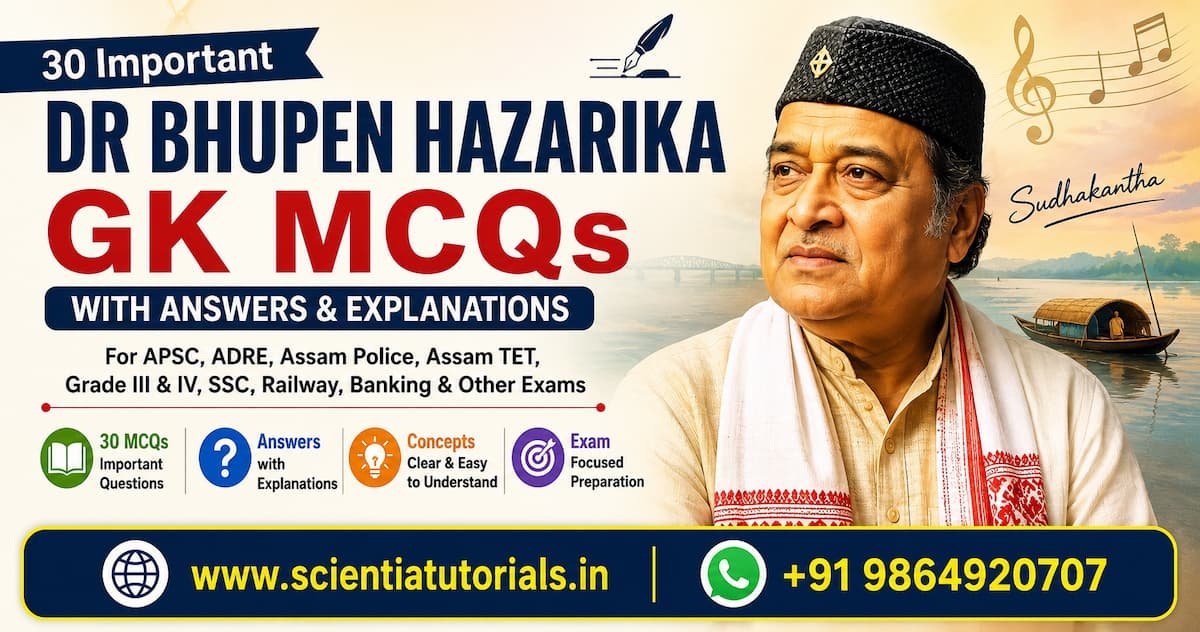
Dr. Bhupen Hazarika GK MCQs with Answers
Dr. Bhupen Hazarika was one of the greatest cultural icons of Assam and India. He was a legendary singer, lyricist, composer, poet, filmmaker, and social activist whose songs promoted humanity, unity, and social justice. The following 30 MCQs are designed for APSC, ADRE, Assam Police, Assam TET, Grade III & IV, SSC, Railway, Banking, and other competitive examinations.
1. Dr. Bhupen Hazarika was popularly known as the ______.
A. Bharat Ratna Singer
B. Sudhakantha
C. Kalaguru
D. Gandhiji of Assam
Answer: B. Sudhakantha
Explanation: “Sudhakantha” means “Nightingale of Assam.” This title was given to Bhupen Hazarika due to his melodious voice and immense contribution to Assamese music and culture.
2. Dr. Bhupen Hazarika was born on:
A. 8 September 1926
B. 8 September 1928
C. 10 October 1926
D. 5 January 1930
Answer: A. 8 September 1926
Explanation: Bhupen Hazarika was born on 8 September 1926, and this date is celebrated as an important day in Assamese cultural history.
3. Bhupen Hazarika was born in which district of Assam?
A. Kamrup
B. Nagaon
C. Tinsukia
D. Sivasagar
Answer: C. Tinsukia
Explanation: He was born in Sadiya, which is presently located in Tinsukia district of Assam.
4. What was the name of Bhupen Hazarika’s birthplace?
A. Tezpur
B. Sadiya
C. Jorhat
D. Nalbari
Answer: B. Sadiya
Explanation: Sadiya is a historic town of Assam known for its cultural heritage and is the birthplace of Dr. Bhupen Hazarika.
5. Bhupen Hazarika completed his graduation from:
A. Cotton College
B. Gauhati University
C. Banaras Hindu University
D. Delhi University
Answer: C. Banaras Hindu University
Explanation: He earned his Bachelor’s degree and later his Master’s degree in Political Science from Banaras Hindu University (BHU).
6. Bhupen Hazarika obtained his Ph.D. from:
A. Harvard University
B. Columbia University
C. Oxford University
D. Yale University
Answer: B. Columbia University
Explanation: He received a Ph.D. in Mass Communication from Columbia University, USA, becoming one of the first Assamese scholars to do so.
7. Which subject was the focus of his doctoral research?
A. Economics
B. Political Science
C. Mass Communication
D. Sociology
Answer: C. Mass Communication
Explanation: His research dealt with the role of audio-visual techniques in adult education, highlighting his interest in communication and social development.
8. At what age did Bhupen Hazarika record his first song?
A. 6 years
B. 10 years
C. 12 years
D. 15 years
Answer: B. 10 years
Explanation: Bhupen Hazarika recorded his first song at the age of ten, showing extraordinary musical talent from childhood.
9. In which Assamese film did young Bhupen Hazarika first appear?
A. Era Bator Sur
B. Indramalati
C. Shakuntala
D. Pioli Phukan
Answer: B. Indramalati
Explanation: Indramalati (1939), directed by Jyoti Prasad Agarwala, was the first Assamese film in which Bhupen Hazarika acted as a child artist.
10. Who directed the film “Indramalati”?
A. Bishnu Prasad Rabha
B. Phani Sarma
C. Jyoti Prasad Agarwala
D. Nip Barua
Answer: C. Jyoti Prasad Agarwala
Explanation: Jyoti Prasad Agarwala, known as the “Rupkonwar of Assam,” directed Indramalati.
11. Bhupen Hazarika was deeply influenced by which Assamese cultural icon?
A. Lakshminath Bezbaroa
B. Bishnu Prasad Rabha
C. Homen Borgohain
D. Birinchi Kumar Barua
Answer: B. Bishnu Prasad Rabha
Explanation: Bishnu Rabha’s revolutionary ideas and cultural activism greatly influenced Bhupen Hazarika.
12. Which famous song of Bhupen Hazarika is associated with the river Brahmaputra?
A. Dil Hoom Hoom Kare
B. Bistirno Parore
C. Ganga Amar Maa
D. Moi Eti Jajabor
Answer: B. Bistirno Parore
Explanation: “Bistirno Parore” is one of his most celebrated songs, expressing concern for social inequality through the metaphor of the mighty river.
13. “Bistirno Parore” was inspired by a song of which international singer?
A. Elvis Presley
B. Bob Dylan
C. Paul Robeson
D. Michael Jackson
Answer: C. Paul Robeson
Explanation: The song was inspired by Paul Robeson’s famous song “Ol’ Man River.”
14. Which river is referred to in the song “Bistirno Parore”?
A. Ganga
B. Yamuna
C. Brahmaputra
D. Barak
Answer: C. Brahmaputra
Explanation: The Brahmaputra symbolizes both the beauty and struggles of Assam in the song.
15. Which song of Bhupen Hazarika became nationally famous through the film “Rudaali”?
A. Bistirno Parore
B. Ganga Behti Ho Kyun
C. Dil Hoom Hoom Kare
D. Manuhe Manuhor Babe
Answer: C. Dil Hoom Hoom Kare
Explanation: This song became immensely popular across India and remains one of his most recognized works.
16. Bhupen Hazarika received the Dadasaheb Phalke Award in:
A. 1985
B. 1992
C. 2000
D. 2010
Answer: B. 1992
Explanation: The Dadasaheb Phalke Award is India’s highest award in cinema, recognizing his outstanding contribution to Indian films.
17. Which civilian award was conferred on Bhupen Hazarika in 2001?
A. Padma Shri
B. Padma Bhushan
C. Padma Vibhushan
D. Bharat Ratna
Answer: B. Padma Bhushan
Explanation: He was awarded the Padma Bhushan for his remarkable contribution to arts and culture.
18. Bhupen Hazarika was posthumously awarded the Bharat Ratna in:
A. 2017
B. 2018
C. 2019
D. 2020
Answer: C. 2019
Explanation: India’s highest civilian award, Bharat Ratna, was conferred upon him posthumously in 2019.
19. Which is the highest civilian award of India?
A. Padma Shri
B. Padma Bhushan
C. Padma Vibhushan
D. Bharat Ratna
Answer: D. Bharat Ratna
Explanation: Bharat Ratna is India’s highest civilian honour, awarded for exceptional service or performance of the highest order.
20. Bhupen Hazarika served as a member of which legislative body?
A. Rajya Sabha
B. Lok Sabha
C. Assam Legislative Assembly
D. Legislative Council
Answer: C. Assam Legislative Assembly
Explanation: He was elected to the Assam Legislative Assembly from the Naoboicha constituency.
21. Bhupen Hazarika represented which constituency in the Assam Legislative Assembly?
A. Dispur
B. Naoboicha
C. Jorhat
D. Mariani
Answer: B. Naoboicha
Explanation: He won the election from Naoboicha constituency and served as an MLA.
22. Which of the following songs promotes universal brotherhood?
A. Dil Hoom Hoom Kare
B. Bistirno Parore
C. Manuhe Manuhor Babe
D. Samay O Dheere Chalo
Answer: C. Manuhe Manuhor Babe
Explanation: The song emphasizes human values, love, and equality among all people.
23. The famous line “Manuhe Manuhor Babe” means:
A. River for River
B. Human for Humanity
C. Country for Country
D. Music for Music
Answer: B. Human for Humanity
Explanation: The song teaches compassion, mutual respect, and service to fellow human beings.
24. Bhupen Hazarika was associated with which field?
A. Sports only
B. Politics only
C. Music, Literature, and Cinema
D. Science and Technology
Answer: C. Music, Literature, and Cinema
Explanation: He excelled in multiple fields including singing, songwriting, poetry, filmmaking, and cultural activism.
25. Which language was NOT commonly used by Bhupen Hazarika in his songs?
A. Assamese
B. Bengali
C. Hindi
D. German
Answer: D. German
Explanation: He composed and sang in Assamese, Hindi, Bengali, and several other Indian languages, but not in German.
26. Bhupen Hazarika’s songs mainly focused on:
A. Social justice and humanity
B. Space science
C. Military strategy
D. Agriculture only
Answer: A. Social justice and humanity
Explanation: His songs often highlighted social issues, peace, equality, and human dignity.
27. Bhupen Hazarika passed away on:
A. 5 November 2010
B. 5 November 2011
C. 5 December 2011
D. 15 August 2011
Answer: B. 5 November 2011
Explanation: He passed away in Mumbai on 5 November 2011, leaving behind a rich cultural legacy.
28. Bhupen Hazarika is regarded as a cultural ambassador of:
A. Punjab
B. Rajasthan
C. Assam and Northeast India
D. Kerala
Answer: C. Assam and Northeast India
Explanation: Through his music and films, he introduced the culture and traditions of Assam and Northeast India to the world.
29. Which award is India’s highest honour in cinema?
A. National Film Award
B. Filmfare Award
C. Dadasaheb Phalke Award
D. Padma Shri
Answer: C. Dadasaheb Phalke Award
Explanation: The Dadasaheb Phalke Award recognizes lifetime contribution to Indian cinema.
30. Why is Dr. Bhupen Hazarika remembered today?
A. Only as a politician
B. Only as a singer
C. For his contributions to music, cinema, literature, and humanity
D. Only as a filmmaker
Answer: C. For his contributions to music, cinema, literature, and humanity
Explanation: Bhupen Hazarika’s legacy extends beyond music. His songs inspired social change, cultural unity, and human values, making him one of the greatest personalities in Indian cultural history.
Quick Revision Facts
- Birth: 8 September 1926
- Birthplace: Sadiya, Tinsukia, Assam
- Popular Title: Sudhakantha
- Graduation & Master’s: Banaras Hindu University
- Ph.D.: Columbia University (Mass Communication)
- First Film: Indramalati
- Famous Songs: Bistirno Parore, Manuhe Manuhor Babe, Dil Hoom Hoom Kare
- MLA Constituency: Naoboicha
- Dadasaheb Phalke Award: 1992
- Padma Bhushan: 2001
- Bharat Ratna (Posthumous): 2019
- Death: 5 November 2011
These MCQs cover important factual and conceptual points frequently asked in APSC, ADRE, Assam Police, Assam TET, Grade III & IV, SSC, Railway, and Banking examinations.