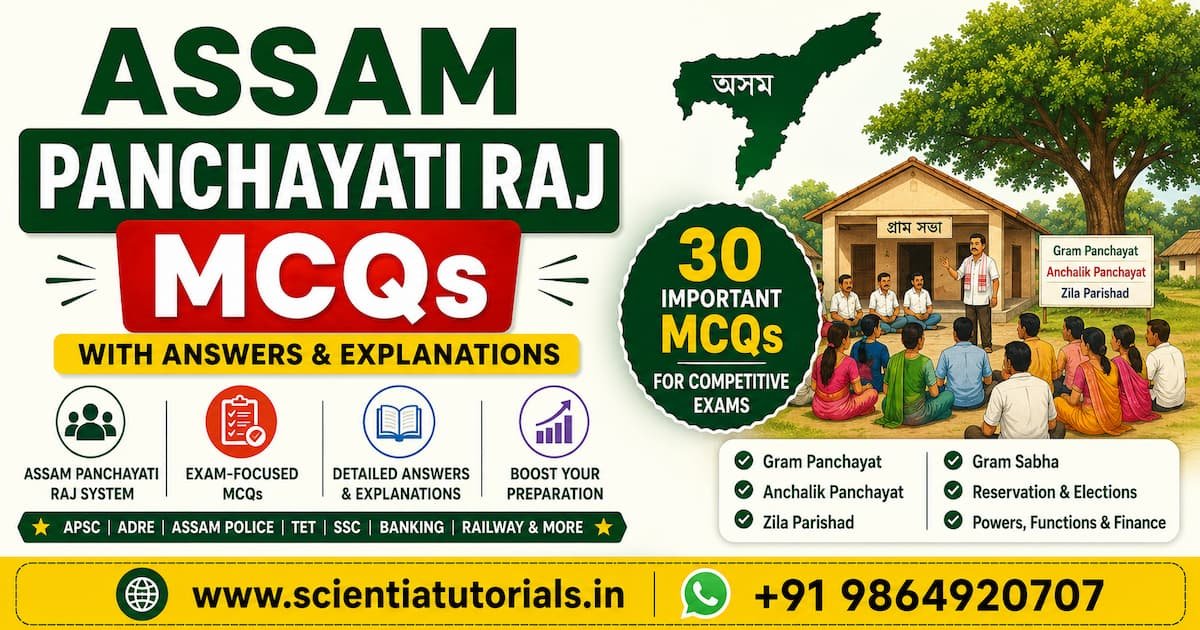
Assam Panchayati Raj MCQs with Answers for APSC, ADRE & Assam Competitive Exams
Assam Panchayati Raj MCQs with Answers
1. What is the primary objective of the Panchayati Raj system in Assam?
A. Centralized administration
B. Judicial administration
C. Rural local self-government
D. Revenue collection only
Answer: C. Rural local self-government
Explanation: Panchayati Raj is a system of rural local self-government aimed at decentralizing power and involving people in decision-making at the grassroots level. It promotes democratic participation and rural development.
2. The Panchayati Raj system in Assam is based on which Constitutional Amendment?
A. 42nd Amendment
B. 44th Amendment
C. 73rd Amendment
D. 74th Amendment
Answer: C. 73rd Amendment
Explanation: The 73rd Constitutional Amendment Act, 1992 gave constitutional status to Panchayati Raj Institutions (PRIs) and came into effect on 24 April 1993. It established a uniform structure for rural local governance across India.
3. Which Article of the Constitution deals with Panchayats?
A. Article 243
B. Article 356
C. Article 324
D. Article 280
Answer: A. Article 243
Explanation: Part IX of the Constitution, beginning with Article 243, contains provisions relating to Panchayats, their composition, powers, elections, and finances.
4. Assam follows which type of Panchayati Raj structure?
A. One-tier
B. Two-tier
C. Three-tier
D. Four-tier
Answer: C. Three-tier
Explanation: Assam has a three-tier Panchayati Raj system consisting of Gram Panchayat, Anchalik Panchayat, and Zila Parishad.
5. Which is the lowest tier of Panchayati Raj in Assam?
A. Zila Parishad
B. Anchalik Panchayat
C. Gram Panchayat
D. District Council
Answer: C. Gram Panchayat
Explanation: The Gram Panchayat is the village-level institution and forms the foundation of rural local governance.
6. Which is the intermediate level in the Assam Panchayati Raj system?
A. Gram Sabha
B. Gram Panchayat
C. Anchalik Panchayat
D. Zila Parishad
Answer: C. Anchalik Panchayat
Explanation: The Anchalik Panchayat operates at the development block level and serves as the intermediate tier between Gram Panchayats and Zila Parishads.
7. Which is the highest tier of Panchayati Raj in Assam?
A. Gram Sabha
B. Gram Panchayat
C. Anchalik Panchayat
D. Zila Parishad
Answer: D. Zila Parishad
Explanation: The Zila Parishad functions at the district level and coordinates development activities across the district.
8. The Gram Sabha consists of:
A. Elected Panchayat members only
B. Government officials only
C. All registered voters in a village
D. Village elders only
Answer: C. All registered voters in a village
Explanation: The Gram Sabha is the general body comprising all registered voters of a village. It is considered the foundation of democratic decentralization.
9. The term of a Panchayat in Assam is:
A. 3 years
B. 4 years
C. 5 years
D. 6 years
Answer: C. 5 years
Explanation: As per the Constitution, every Panchayat has a five-year term unless dissolved earlier according to law.
10. Elections to Panchayati Raj Institutions in Assam are conducted by:
A. Election Commission of India
B. Governor
C. Assam Public Service Commission
D. Assam State Election Commission
Answer: D. Assam State Election Commission
Explanation: The State Election Commission is responsible for conducting free and fair elections to Panchayats and Urban Local Bodies.
11. Reservation of seats for Scheduled Castes and Scheduled Tribes in Panchayats is provided under:
A. Constitutional provisions
B. Governor’s orders
C. Parliament only
D. State Cabinet decision only
Answer: A. Constitutional provisions
Explanation: The Constitution mandates reservation of seats for SCs and STs in proportion to their population in the Panchayat area.
12. What percentage of seats are reserved for women in Panchayats in Assam?
A. 25%
B. 33%
C. Not less than 50%
D. 10%
Answer: C. Not less than 50%
Explanation: Assam provides at least 50% reservation for women in Panchayati Raj Institutions, promoting gender equality and political participation.
13. The Panchayati Raj system is based on the principle of:
A. Centralization
B. Decentralization
C. Privatization
D. Nationalization
Answer: B. Decentralization
Explanation: Decentralization means transferring powers and responsibilities from higher levels of government to local bodies.
14. Which committee recommended the three-tier Panchayati Raj system in India?
A. Sarkaria Committee
B. Balwant Rai Mehta Committee
C. Ashok Mehta Committee
D. Punchhi Commission
Answer: B. Balwant Rai Mehta Committee
Explanation: The Balwant Rai Mehta Committee (1957) recommended democratic decentralization through a three-tier Panchayati Raj structure.
15. Panchayati Raj Institutions mainly function in:
A. Urban areas
B. Rural areas
C. Industrial zones
D. Metropolitan cities
Answer: B. Rural areas
Explanation: Panchayati Raj Institutions are designed specifically for rural local governance and development.
16. The main source of income for Panchayats includes:
A. Local taxes and grants
B. Customs duty
C. Income tax
D. Corporate tax
Answer: A. Local taxes and grants
Explanation: Panchayats receive funds through local taxes, fees, state government grants, and centrally sponsored schemes.
17. The State Finance Commission is constituted every:
A. 3 years
B. 4 years
C. 5 years
D. 10 years
Answer: C. 5 years
Explanation: The State Finance Commission reviews the financial position of Panchayats and recommends resource-sharing arrangements every five years.
18. Which Schedule of the Constitution contains subjects assigned to Panchayats?
A. Tenth Schedule
B. Eleventh Schedule
C. Twelfth Schedule
D. Ninth Schedule
Answer: B. Eleventh Schedule
Explanation: The Eleventh Schedule contains 29 subjects that may be entrusted to Panchayats, including agriculture, health, education, and rural development.
19. Which of the following is NOT a Panchayati Raj Institution?
A. Gram Panchayat
B. Anchalik Panchayat
C. Zila Parishad
D. Municipal Corporation
Answer: D. Municipal Corporation
Explanation: Municipal Corporations are urban local bodies governed under the 74th Constitutional Amendment, not Panchayati Raj Institutions.
20. Who elects the members of the Gram Panchayat?
A. Governor
B. Village voters
C. District Commissioner
D. Chief Minister
Answer: B. Village voters
Explanation: Members of the Gram Panchayat are directly elected by the eligible voters of the village.
21. The Panchayati Raj system aims to strengthen:
A. Grassroots democracy
B. Military administration
C. Judicial control
D. Corporate governance
Answer: A. Grassroots democracy
Explanation: Panchayati Raj empowers people at the local level and ensures citizen participation in governance.
22. Which body prepares local development plans at the village level?
A. Parliament
B. Gram Panchayat
C. High Court
D. Rajya Sabha
Answer: B. Gram Panchayat
Explanation: The Gram Panchayat identifies local needs and prepares plans for village development.
23. The head of a Gram Panchayat is generally known as:
A. Mayor
B. President
C. Sarpanch/President
D. Governor
Answer: C. Sarpanch/President
Explanation: The elected head of the Gram Panchayat is known as the President or Sarpanch depending on state terminology.
24. Panchayati Raj Institutions help implement:
A. Rural development schemes
B. International treaties
C. Defence policies
D. Foreign trade agreements
Answer: A. Rural development schemes
Explanation: Panchayats play a major role in implementing government schemes related to rural welfare and development.
25. The district-level Panchayat body is called:
A. Gram Sabha
B. Anchalik Panchayat
C. Municipal Board
D. Zila Parishad
Answer: D. Zila Parishad
Explanation: The Zila Parishad is the apex Panchayati Raj Institution at the district level.
26. Which constitutional amendment relates to Urban Local Bodies?
A. 42nd Amendment
B. 44th Amendment
C. 73rd Amendment
D. 74th Amendment
Answer: D. 74th Amendment
Explanation: The 74th Constitutional Amendment Act provides constitutional status to Municipalities and Urban Local Bodies.
27. Gram Sabha meetings are important because they:
A. Encourage public participation
B. Collect income tax
C. Appoint judges
D. Conduct parliamentary elections
Answer: A. Encourage public participation
Explanation: Gram Sabha meetings provide a platform for villagers to discuss issues and monitor local development activities.
28. Which institution coordinates development among Panchayats within a district?
A. Governor’s Office
B. Zila Parishad
C. High Court
D. State Secretariat
Answer: B. Zila Parishad
Explanation: The Zila Parishad supervises and coordinates development programs among Panchayats in the district.
29. The concept of democratic decentralization is most closely associated with:
A. Panchayati Raj
B. Judiciary
C. Parliament
D. Election Commission
Answer: A. Panchayati Raj
Explanation: Democratic decentralization means transferring power to local elected bodies, which is the core principle of Panchayati Raj.
30. The ultimate objective of Panchayati Raj Institutions is:
A. Centralized control
B. Rural development and people’s participation
C. Increasing bureaucracy
D. Judicial administration
Answer: B. Rural development and people’s participation
Explanation: Panchayati Raj seeks to ensure inclusive rural development through local participation, accountability, and democratic governance.
Quick Revision Facts
- Constitutional Amendment: 73rd Amendment Act, 1992
- Constitutional Status Effective From: 24 April 1993
- Relevant Constitutional Part: Part IX
- Relevant Articles: Article 243 to Article 243-O
- Assam Panchayati Raj Structure: Three-Tier
- Village Level: Gram Panchayat
- Block Level: Anchalik Panchayat
- District Level: Zila Parishad
- Election Authority: Assam State Election Commission
- Panchayat Term: 5 Years
- Women Reservation: Not less than 50%
- Subjects Assigned: 29 Subjects (Eleventh Schedule)
These MCQs are highly useful for APSC, ADRE, Assam Police, Assam TET, Grade III & Grade IV, SSC, Railway, Banking, and various other competitive examinations.