Assam Government and Administration MCQs with Answers for APSC, ADRE & Assam Competitive Exams
Assam Government and Administration MCQs
1. Who is the constitutional head of the Government of Assam?
A. Chief Minister
B. Governor
C. Speaker
D. Chief Secretary
Answer: B. Governor
Explanation: The Governor is the constitutional head of the State of Assam under Article 153 of the Constitution of India. Although executive powers are vested in the Governor, they are generally exercised on the advice of the Council of Ministers headed by the Chief Minister. The Chief Minister is the real executive authority.
2. Who is the real executive head of the Government of Assam?
A. Governor
B. Chief Secretary
C. Chief Minister
D. Speaker
Answer: C. Chief Minister
Explanation: The Chief Minister is the real executive head of the state government. He or she leads the Council of Ministers and is responsible for formulating and implementing government policies.
3. The Governor of Assam is appointed by the:
A. Prime Minister
B. Parliament
C. President of India
D. Chief Minister
Answer: C. President of India
Explanation: According to Article 155 of the Constitution, the Governor of a State is appointed by the President of India and holds office during the pleasure of the President.
4. What is the normal tenure of the Governor of Assam?
A. 4 years
B. 5 years
C. 6 years
D. 7 years
Answer: B. 5 years
Explanation: The Governor normally holds office for five years. However, the Governor may continue beyond this period until a successor assumes office and serves at the pleasure of the President.
5. The Council of Ministers in Assam is headed by the:
A. Governor
B. Speaker
C. Chief Minister
D. Chief Secretary
Answer: C. Chief Minister
Explanation: The Chief Minister heads the Council of Ministers and coordinates the functioning of various departments of the state government.
6. The Council of Ministers is collectively responsible to the:
A. Governor
B. President
C. Assam Legislative Assembly
D. High Court
Answer: C. Assam Legislative Assembly
Explanation: Collective responsibility means that the Council of Ministers remains in office only as long as it enjoys the confidence of the Legislative Assembly.
7. Which authority administers the oath of office to the Chief Minister of Assam?
A. President of India
B. Governor
C. Chief Justice of India
D. Speaker
Answer: B. Governor
Explanation: The Governor administers the oath of office and secrecy to the Chief Minister and other ministers.
8. The highest-ranking civil servant in Assam is the:
A. District Commissioner
B. Director General of Police
C. Chief Secretary
D. Secretary to the Governor
Answer: C. Chief Secretary
Explanation: The Chief Secretary is the senior-most civil servant in the state administration and acts as the principal adviser to the Chief Minister and the government.
9. The administrative head of a district in Assam is the:
A. Superintendent of Police
B. District Commissioner (Deputy Commissioner)
C. Circle Officer
D. Block Development Officer
Answer: B. District Commissioner (Deputy Commissioner)
Explanation: The District Commissioner (DC) is responsible for revenue administration, law and order coordination, development activities, and implementation of government policies in the district.
10. Assam currently functions under which form of government?
A. Presidential System
B. Parliamentary System
C. Monarchical System
D. Federal Council System
Answer: B. Parliamentary System
Explanation: Assam follows the parliamentary form of government, where the executive is accountable to the elected legislature.
11. Which article of the Constitution provides for a Governor for each state?
A. Article 153
B. Article 356
C. Article 280
D. Article 324
Answer: A. Article 153
Explanation: Article 153 states that there shall be a Governor for each State. One person may also be appointed Governor of two or more states.
12. The Advocate General of Assam is appointed by the:
A. President
B. Chief Minister
C. Governor
D. High Court
Answer: C. Governor
Explanation: The Advocate General is the highest law officer of the state and advises the government on legal matters.
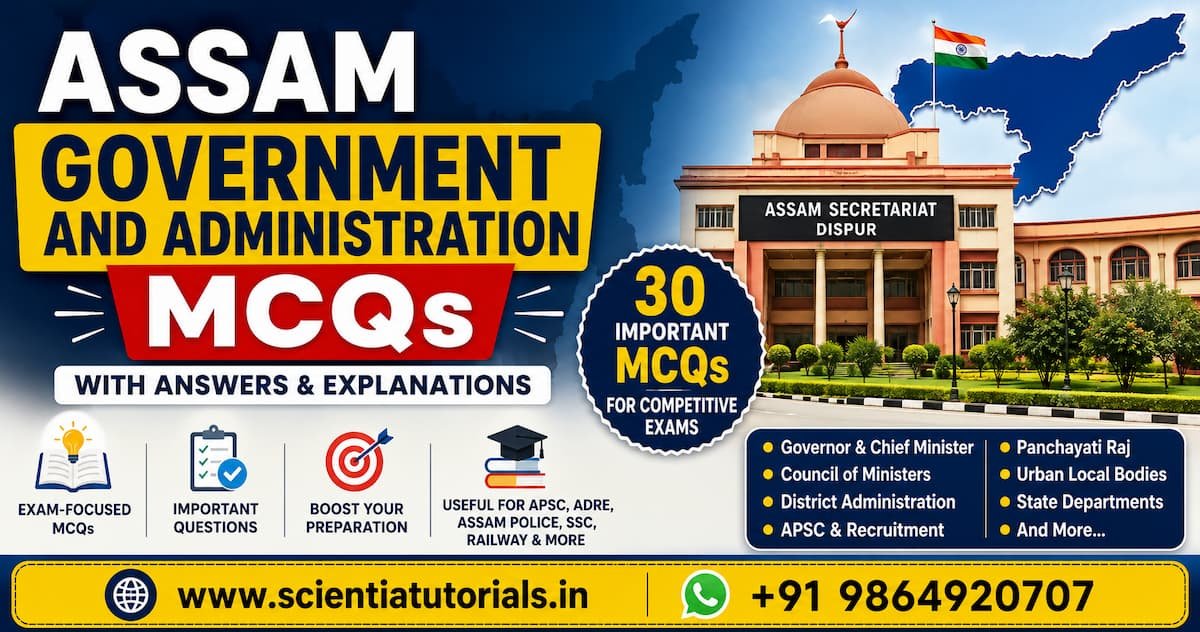
13. The Assam Secretariat is located at:
A. Jorhat
B. Silchar
C. Dibrugarh
D. Dispur
Answer: D. Dispur
Explanation: The Assam Secretariat, which houses major government departments, is situated in Dispur, the capital of Assam.
14. The Assam Public Service Commission (APSC) is responsible for:
A. Conducting state-level recruitment examinations
B. Conducting Lok Sabha elections
C. Preparing the state budget
D. Passing state laws
Answer: A. Conducting state-level recruitment examinations
Explanation: APSC recruits officers and staff for various civil services and government posts in Assam through competitive examinations.
15. The Assam Public Service Commission is established under:
A. Article 315
B. Article 324
C. Article 356
D. Article 368
Answer: A. Article 315
Explanation: Article 315 provides for Public Service Commissions for the Union and the States.
16. Which department is primarily responsible for maintaining law and order in Assam?
A. Education Department
B. Finance Department
C. Home Department
D. Agriculture Department
Answer: C. Home Department
Explanation: The Home Department supervises law enforcement agencies, public safety, internal security, and disaster management.
17. The head of the Assam Police is the:
A. Inspector General of Police
B. Director General of Police (DGP)
C. Superintendent of Police
D. Deputy Inspector General
Answer: B. Director General of Police (DGP)
Explanation: The DGP is the highest-ranking police officer in the state and oversees the entire police administration.
18. Which institution audits the accounts of the Assam Government?
A. Election Commission
B. UPSC
C. Comptroller and Auditor General (CAG)
D. RBI
Answer: C. Comptroller and Auditor General (CAG)
Explanation: The CAG audits government accounts to ensure accountability and transparency in public expenditure.
19. The smallest administrative unit in rural Assam is generally:
A. District
B. Circle
C. Village
D. Division
Answer: C. Village
Explanation: The village forms the basic unit of rural administration and local self-government.
20. Panchayati Raj Institutions in Assam are related to:
A. Urban administration
B. Rural local self-government
C. Judicial administration
D. Revenue administration
Answer: B. Rural local self-government
Explanation: Panchayati Raj Institutions facilitate democratic decentralization and local governance in rural areas.
21. The three-tier Panchayati Raj system in Assam includes:
A. Gram Panchayat, Anchalik Panchayat, Zila Parishad
B. Village Council, District Board, Municipal Board
C. Gram Sabha, Municipal Board, Zila Parishad
D. Panchayat, Corporation, Municipality
Answer: A. Gram Panchayat, Anchalik Panchayat, Zila Parishad
Explanation: Assam follows the three-tier Panchayati Raj system for rural administration.
22. Urban local governance in Assam is mainly carried out by:
A. Panchayats
B. Municipal Boards and Municipal Corporations
C. Village Councils
D. Revenue Circles
Answer: B. Municipal Boards and Municipal Corporations
Explanation: Urban areas are administered through Municipal Boards and Municipal Corporations under the Assam Municipal Act.
23. Which is the largest Municipal Corporation in Assam?
A. Silchar Municipal Corporation
B. Dibrugarh Municipal Corporation
C. Guwahati Municipal Corporation
D. Tezpur Municipal Corporation
Answer: C. Guwahati Municipal Corporation
Explanation: Guwahati Municipal Corporation (GMC) governs the largest urban area in Assam and provides civic services to residents.
24. The District Commissioner works under the supervision of the:
A. Governor
B. State Government
C. President
D. Supreme Court
Answer: B. State Government
Explanation: The District Commissioner implements state government policies and coordinates district-level administration.
25. The Finance Department of Assam is primarily responsible for:
A. Law and Order
B. Revenue Collection and Budget Management
C. Judicial Functions
D. Education Policies
Answer: B. Revenue Collection and Budget Management
Explanation: The Finance Department prepares budgets, manages state finances, and oversees expenditure and revenue.
26. Which body recommends candidates for state civil services in Assam?
A. UPSC
B. Election Commission
C. Assam Public Service Commission
D. State Secretariat
Answer: C. Assam Public Service Commission
Explanation: APSC conducts examinations and interviews to recruit personnel for various state government services.
27. Who can recommend President’s Rule in Assam?
A. Chief Minister
B. Speaker
C. Governor
D. Chief Secretary
Answer: C. Governor
Explanation: If constitutional machinery fails in the state, the Governor may submit a report to the President recommending President’s Rule under Article 356.
28. The Assam State Election Commission conducts elections to:
A. Lok Sabha
B. Rajya Sabha
C. Panchayats and Urban Local Bodies
D. Legislative Assembly
Answer: C. Panchayats and Urban Local Bodies
Explanation: The State Election Commission conducts elections to local self-government institutions, while Assembly and Parliamentary elections are conducted by the Election Commission of India.
29. Which of the following is NOT a function of the District Commissioner?
A. Revenue Collection
B. Coordination of Development Activities
C. Conduct of Elections
D. Interpretation of the Constitution
Answer: D. Interpretation of the Constitution
Explanation: Constitutional interpretation is the responsibility of the judiciary, particularly the High Courts and Supreme Court, not the District Commissioner.
30. The primary objective of government administration in Assam is to:
A. Generate profit
B. Ensure public welfare and good governance
C. Promote private business only
D. Conduct elections only
Answer: B. Ensure public welfare and good governance
Explanation: The fundamental purpose of state administration is to promote public welfare, maintain law and order, provide public services, implement development programs, and ensure effective governance for all citizens.
Quick Revision Facts
- Capital of Assam: Dispur
- Constitutional Head: Governor
- Real Executive Head: Chief Minister
- Highest Civil Servant: Chief Secretary
- District Administrative Head: District Commissioner (DC)
- Highest Law Officer: Advocate General
- Highest Police Officer: Director General of Police (DGP)
- Recruitment Agency: Assam Public Service Commission (APSC)
- Rural Governance: Gram Panchayat – Anchalik Panchayat – Zila Parishad
- Largest Urban Local Body: Guwahati Municipal Corporation (GMC)
These MCQs are highly useful for APSC, ADRE, Assam Police, Assam TET, Grade III & Grade IV, SSC, Railway, Banking, and other competitive examinations.