Assam Polity MCQs with Answers and Explanations for APSC, ADRE & Assam Police Exams
Assam Polity MCQs with Answers and Explanations
1. Assam is represented in the Indian Parliament through:
A. Lok Sabha only
B. Rajya Sabha only
C. Both Lok Sabha and Rajya Sabha
D. Legislative Assembly only
Answer: C. Both Lok Sabha and Rajya Sabha
Explanation:
Assam sends representatives to both Houses of Parliament. Members of the Lok Sabha are directly elected by the people, while Rajya Sabha members are elected by the elected members of the Assam Legislative Assembly. This ensures Assam’s representation at the national level.
2. Who is the constitutional head of Assam?
A. Chief Minister
B. Governor
C. Speaker
D. Chief Secretary
Answer: B. Governor
Explanation:
The Governor is the constitutional head of the state and acts as the representative of the President of India. While the Governor has certain discretionary powers, the actual executive authority is exercised by the Council of Ministers headed by the Chief Minister.
3. The Governor of Assam is appointed by:
A. Prime Minister of India
B. Chief Minister of Assam
C. President of India
D. Parliament of India
Answer: C. President of India
Explanation:
Under Article 155 of the Constitution, the Governor of a state is appointed by the President of India and holds office during the President’s pleasure.
4. What is the normal tenure of the Assam Legislative Assembly?
A. 4 years
B. 5 years
C. 6 years
D. 7 years
Answer: B. 5 years
Explanation:
The Legislative Assembly of Assam has a normal term of five years from the date of its first meeting unless dissolved earlier.
5. Assam has a:
A. Bicameral Legislature
B. Tricameral Legislature
C. Unicameral Legislature
D. Federal Legislature
Answer: C. Unicameral Legislature
Explanation:
Assam has only one legislative house, the Legislative Assembly (Vidhan Sabha). Therefore, it is called a unicameral legislature.
6. The Assam Legislative Assembly is located at:
A. Dibrugarh
B. Silchar
C. Guwahati (Dispur)
D. Jorhat
Answer: C. Guwahati (Dispur)
Explanation:
Dispur, the capital of Assam, houses the Assam Legislative Assembly where laws and policies are debated and enacted.
7. Who is the real executive head of the Assam Government?
A. Governor
B. President of India
C. Chief Minister
D. Speaker
Answer: C. Chief Minister
Explanation:
The Chief Minister heads the Council of Ministers and exercises actual executive powers. The Governor acts mainly on the advice of the Council of Ministers.
8. Which Article of the Constitution deals with the Governor of a State?
A. Article 52
B. Article 153
C. Article 280
D. Article 368
Answer: B. Article 153
Explanation:
Article 153 provides that there shall be a Governor for each state. One person may also be appointed Governor of two or more states.
9. Who administers the oath of office to the Governor of Assam?
A. Chief Minister
B. Speaker
C. Chief Justice of the High Court
D. President
Answer: C. Chief Justice of the High Court
Explanation:
The Governor takes the oath before the Chief Justice of the High Court or, in his absence, the senior-most judge available.
10. Which High Court has jurisdiction over Assam?
A. Calcutta High Court
B. Gauhati High Court
C. Delhi High Court
D. Meghalaya High Court
Answer: B. Gauhati High Court
Explanation:
The Gauhati High Court is the principal High Court for Assam and also had jurisdiction over several northeastern states when established.
11. The minimum age required to become a member of the Assam Legislative Assembly is:
A. 18 years
B. 21 years
C. 25 years
D. 30 years
Answer: C. 25 years
Explanation:
According to the Constitution, a person must be at least 25 years old to contest elections to a State Legislative Assembly.
12. Who appoints the Chief Minister of Assam?
A. President of India
B. Speaker
C. Governor
D. Election Commission
Answer: C. Governor
Explanation:
The Governor appoints the leader of the majority party or coalition in the Legislative Assembly as the Chief Minister.
13. The Council of Ministers in Assam is collectively responsible to:
A. Governor
B. President
C. Legislative Assembly
D. Supreme Court
Answer: C. Legislative Assembly
Explanation:
The Council of Ministers remains in office as long as it enjoys the confidence of the Legislative Assembly.
14. Which constitutional provision grants special safeguards to tribal areas of Assam?
A. Fifth Schedule
B. Sixth Schedule
C. Seventh Schedule
D. Ninth Schedule
Answer: B. Sixth Schedule
Explanation:
The Sixth Schedule provides for Autonomous District Councils in tribal areas of Assam, Meghalaya, Tripura, and Mizoram to protect tribal interests and self-governance.
15. Which of the following is an Autonomous Council under the Sixth Schedule in Assam?
A. Karbi Anglong Autonomous Council
B. Delhi Municipal Corporation
C. Kolkata Municipal Corporation
D. Mumbai Municipal Corporation
Answer: A. Karbi Anglong Autonomous Council
Explanation:
Karbi Anglong Autonomous Council is one of the important autonomous councils functioning under the Sixth Schedule.
16. The Speaker of the Assam Legislative Assembly is elected by:
A. Governor
B. President
C. Members of the Legislative Assembly
D. Chief Minister
Answer: C. Members of the Legislative Assembly
Explanation:
The Speaker is elected by the members of the Assembly and presides over its proceedings.
17. Which body conducts elections to the Assam Legislative Assembly?
A. UPSC
B. State Election Commission
C. Election Commission of India
D. NITI Aayog
Answer: C. Election Commission of India
Explanation:
The Election Commission of India conducts elections to Parliament, State Legislatures, and the offices of the President and Vice-President.
18. Panchayati Raj institutions in Assam are related to:
A. Urban Governance
B. Rural Local Self-Government
C. Judiciary
D. Parliament
Answer: B. Rural Local Self-Government
Explanation:
Panchayati Raj Institutions promote democratic decentralization and local self-governance in rural areas.
19. The head of a Gram Panchayat is known as:
A. Mayor
B. Commissioner
C. President/Pradhan
D. Governor
Answer: C. President/Pradhan
Explanation:
The elected head of a Gram Panchayat is generally called the President or Pradhan, depending on state laws.
20. Which Constitutional Amendment gave constitutional status to Panchayati Raj Institutions?
A. 42nd Amendment
B. 44th Amendment
C. 73rd Amendment
D. 86th Amendment
Answer: C. 73rd Amendment
Explanation:
The 73rd Constitutional Amendment Act, 1992 strengthened rural local self-government by granting constitutional status to Panchayats.
21. Municipalities in Assam are related to:
A. Rural Administration
B. Tribal Councils
C. Urban Local Governance
D. Judiciary
Answer: C. Urban Local Governance
Explanation:
Municipalities manage civic amenities and local administration in urban areas such as towns and cities.
22. The constitutional status of Municipalities was provided through:
A. 61st Amendment
B. 73rd Amendment
C. 74th Amendment
D. 86th Amendment
Answer: C. 74th Amendment
Explanation:
The 74th Constitutional Amendment Act, 1992 established Urban Local Bodies as constitutional entities.
23. The Assam Public Service Commission (APSC) is responsible for:
A. Conducting elections
B. Recruiting civil servants for state services
C. Making laws
D. Managing courts
Answer: B. Recruiting civil servants for state services
Explanation:
APSC conducts examinations and recruitment processes for various state government services and posts.
24. Who appoints the Chairman of the Assam Public Service Commission?
A. President of India
B. Prime Minister
C. Governor of Assam
D. Chief Minister
Answer: C. Governor of Assam
Explanation:
The Chairman and Members of the State Public Service Commission are appointed by the Governor.
25. The Advocate General of Assam is appointed by:
A. President
B. Governor
C. Chief Justice of India
D. Parliament
Answer: B. Governor
Explanation:
The Advocate General is the highest law officer of the state and advises the government on legal matters.
26. Which Article of the Constitution deals with the Advocate General of a State?
A. Article 76
B. Article 165
C. Article 280
D. Article 324
Answer: B. Article 165
Explanation:
Article 165 provides for the appointment and duties of the Advocate General of a State.
27. Which constitutional body supervises elections in Assam at the state legislative level?
A. State Election Commission
B. Election Commission of India
C. Finance Commission
D. NITI Aayog
Answer: B. Election Commission of India
Explanation:
The Election Commission of India supervises elections to Parliament and State Legislatures, including Assam.
28. Which district council in Assam functions under the Sixth Schedule?
A. Bodoland Territorial Region Council
B. Karbi Anglong Autonomous Council
C. Dima Hasao Autonomous Council
D. All of the above
Answer: D. All of the above
Explanation:
The Bodoland Territorial Region, Karbi Anglong, and Dima Hasao areas enjoy special administrative arrangements to protect tribal interests.
29. The Assam Legislative Assembly makes laws on subjects listed in the:
A. Union List only
B. State List and Concurrent List
C. Union List and State List
D. Residuary List only
Answer: B. State List and Concurrent List
Explanation:
State Legislatures can legislate on subjects in the State List and, along with Parliament, on subjects in the Concurrent List.
30. Why is Assam Polity important for competitive examinations?
A. It has no relevance to exams
B. Questions are frequently asked about the Constitution, Governor, Chief Minister, Legislature, Panchayati Raj, and Autonomous Councils
C. It is useful only for law students
D. It relates only to Parliament
Answer: B. Questions are frequently asked about the Constitution, Governor, Chief Minister, Legislature, Panchayati Raj, and Autonomous Councils
Explanation:
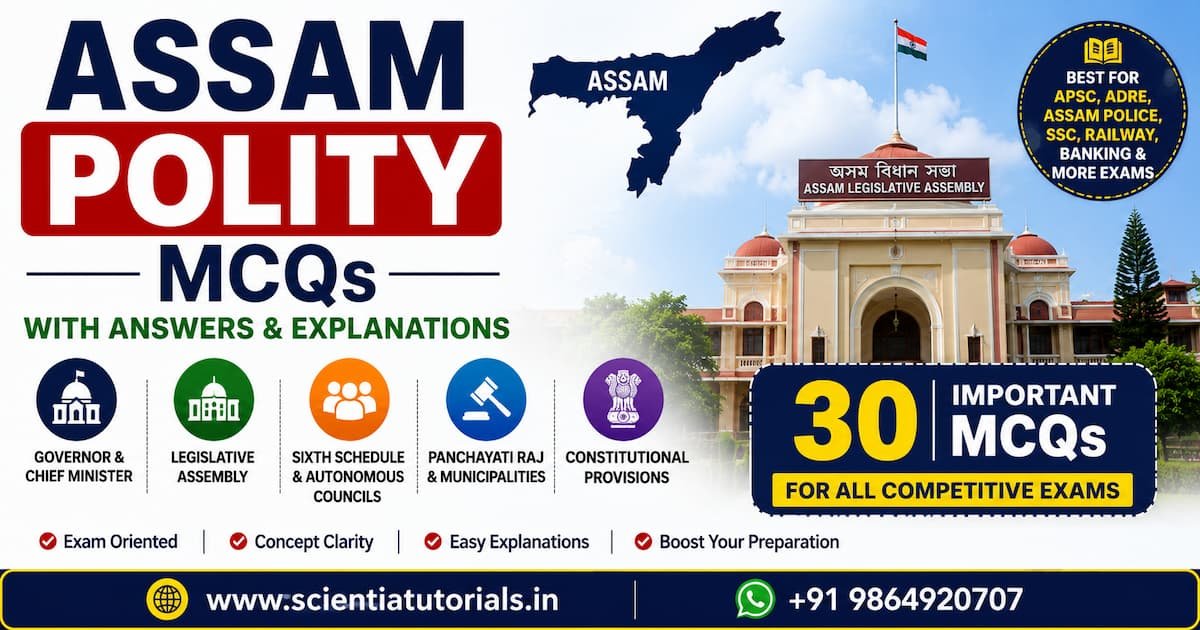
Assam Polity is a crucial section of Assam GK and General Studies. Topics such as the Governor, Legislative Assembly, Sixth Schedule, Panchayati Raj Institutions, Municipalities, APSC, and Constitutional provisions are frequently asked in APSC, ADRE, Assam Police, Assam TET, SSC, Railway, Banking, and other competitive examinations. Understanding these concepts strengthens both static GK and polity preparation.