Assam Legislative Assembly GK MCQs with Answers for APSC, ADRE & Assam Competitive Exams
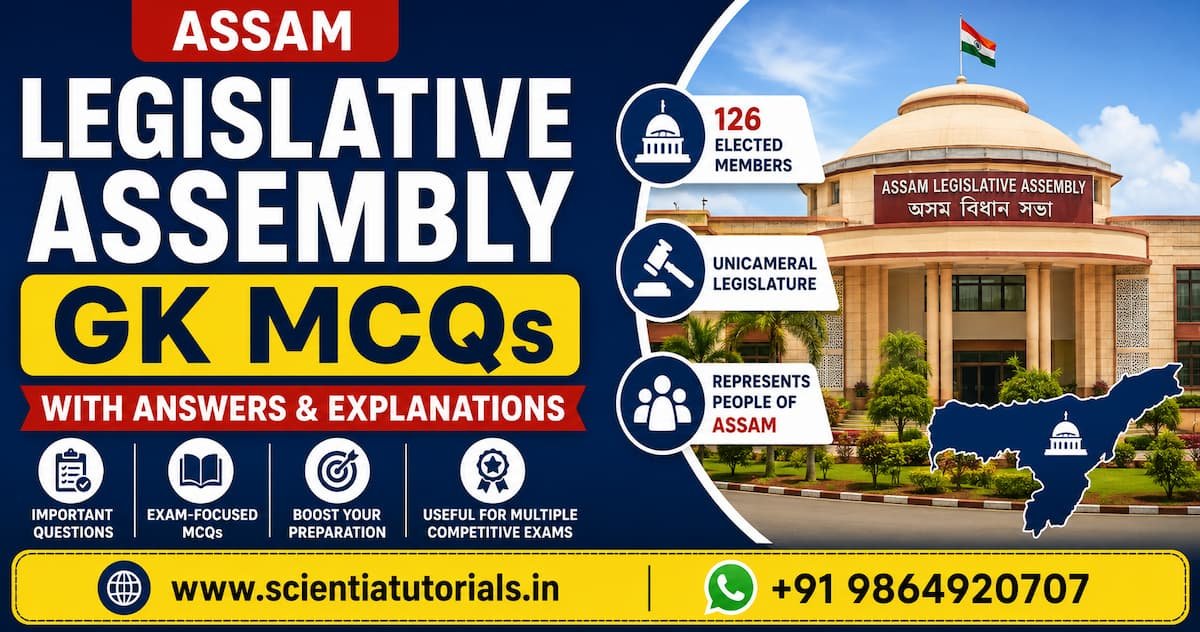
Assam Legislative Assembly GK MCQs with Answers
1. The Assam Legislative Assembly is the ______ house of the state legislature.
A. Upper
B. Lower
C. Only legislative house
D. Advisory house
Answer: C. Only legislative house
Explanation: Assam has a unicameral legislature, meaning it has only one legislative chamber called the Assam Legislative Assembly (Vidhan Sabha). States with two houses have a Legislative Council as the upper house, but Assam does not have one. Therefore, the Assam Legislative Assembly is the sole law-making body of the state.
2. How many elected members are there in the Assam Legislative Assembly?
A. 120
B. 126
C. 130
D. 140
Answer: B. 126
Explanation: The Assam Legislative Assembly consists of 126 elected members, each representing a constituency. These members are elected directly by the people through adult franchise. This is an important fact frequently asked in competitive examinations.
3. The term of the Assam Legislative Assembly is normally:
A. 4 years
B. 5 years
C. 6 years
D. 7 years
Answer: B. 5 years
Explanation: Under Article 172 of the Constitution of India, the normal term of a State Legislative Assembly is five years from its first sitting unless dissolved earlier. During a national emergency, the term may be extended by Parliament.
4. The Assam Legislative Assembly is located at:
A. Jorhat
B. Dibrugarh
C. Silchar
D. Dispur
Answer: D. Dispur
Explanation: The Assam Legislative Assembly building is situated in Dispur, which is the capital of Assam. Most important state government offices are also located in Dispur.
5. Who presides over the meetings of the Assam Legislative Assembly?
A. Governor
B. Chief Minister
C. Speaker
D. Chief Secretary
Answer: C. Speaker
Explanation: The Speaker is the presiding officer of the Legislative Assembly. The Speaker maintains order, conducts proceedings, and ensures that legislative business is carried out according to the rules.
6. The Speaker of the Assam Legislative Assembly is elected by:
A. Governor
B. Chief Minister
C. Members of the Assembly
D. President of India
Answer: C. Members of the Assembly
Explanation: The Speaker is elected by the members of the Legislative Assembly from among themselves. The Speaker acts impartially after election and safeguards the dignity of the House.
7. Who summons the session of the Assam Legislative Assembly?
A. Chief Minister
B. Governor
C. Speaker
D. Chief Justice
Answer: B. Governor
Explanation: Under Article 174 of the Constitution, the Governor summons, prorogues, and dissolves the Legislative Assembly. However, these actions are generally taken on the advice of the Council of Ministers.
8. The constitutional head of Assam is the:
A. Chief Minister
B. Speaker
C. Governor
D. Advocate General
Answer: C. Governor
Explanation: The Governor is the constitutional head of the state, while the Chief Minister is the real executive head. The Governor plays an important role in legislative matters.
9. Which article of the Indian Constitution deals with the State Legislature?
A. Articles 168–212
B. Articles 52–78
C. Articles 324–329
D. Articles 356–360
Answer: A. Articles 168–212
Explanation: Articles 168 to 212 of the Constitution deal with State Legislatures, including their composition, powers, procedures, and privileges.
10. The minimum age required to become a member of the Assam Legislative Assembly is:
A. 21 years
B. 25 years
C. 30 years
D. 35 years
Answer: B. 25 years
Explanation: According to the Constitution of India, a person must be at least 25 years old to contest elections to a State Legislative Assembly.
11. The Governor can nominate members to the Assam Legislative Assembly from:
A. Anglo-Indian community
B. Scheduled Tribes
C. Women category
D. No community currently
Answer: D. No community currently
Explanation: Earlier, Governors could nominate one member from the Anglo-Indian community if inadequately represented. This provision was abolished by the 104th Constitutional Amendment Act, 2019.
12. The Chief Minister of Assam is appointed by the:
A. President
B. Speaker
C. Governor
D. Chief Justice
Answer: C. Governor
Explanation: The Governor appoints the Chief Minister, usually the leader of the majority party or coalition in the Legislative Assembly.
13. The Council of Ministers in Assam is collectively responsible to:
A. Governor
B. President
C. Legislative Assembly
D. Rajya Sabha
Answer: C. Legislative Assembly
Explanation: The Council of Ministers remains in office as long as it enjoys the confidence of the Legislative Assembly. This is known as collective responsibility.
14. Which of the following is a major function of the Assam Legislative Assembly?
A. Conducting elections to Lok Sabha only
B. Making laws for the state
C. Appointing judges
D. Declaring war
Answer: B. Making laws for the state
Explanation: The primary function of the Legislative Assembly is to enact laws on subjects included in the State List and Concurrent List of the Constitution.
15. Money Bills in Assam can be introduced only in:
A. Governor’s office
B. Legislative Assembly
C. High Court
D. Parliament
Answer: B. Legislative Assembly
Explanation: Since Assam has only one legislative chamber, Money Bills are introduced and passed in the Legislative Assembly. Prior recommendation of the Governor is necessary.
16. Who decides whether a bill is a Money Bill in the Assam Legislative Assembly?
A. Governor
B. Chief Minister
C. Speaker
D. Advocate General
Answer: C. Speaker
Explanation: The Speaker’s decision regarding whether a bill is a Money Bill is final.
17. Elections to the Assam Legislative Assembly are conducted by:
A. Governor
B. Election Commission of India
C. Chief Minister
D. State Election Commission
Answer: B. Election Commission of India
Explanation: The Election Commission of India supervises and conducts elections to Parliament and State Legislative Assemblies.
18. The quorum required for a sitting of the Assam Legislative Assembly is:
A. One-third of members
B. One-fourth of members
C. One-tenth of members
D. Half of members
Answer: C. One-tenth of members
Explanation: The quorum is one-tenth of the total membership. For the Assam Assembly, at least 13 members are required to conduct proceedings.
19. The first sitting of a newly elected Assam Legislative Assembly is presided over by:
A. Chief Minister
B. Speaker
C. Pro-tem Speaker
D. Governor
Answer: C. Pro-tem Speaker
Explanation: A Pro-tem Speaker is appointed to administer oaths to newly elected members and conduct the election of the Speaker.
20. The legislative assembly constituency of Assam elects:
A. One MLA
B. Two MLAs
C. Three MLAs
D. Four MLAs
Answer: A. One MLA
Explanation: Each Assembly constituency elects one Member of the Legislative Assembly (MLA) through direct elections.
21. The budget of Assam is presented in the Legislative Assembly by the:
A. Governor
B. Finance Minister
C. Speaker
D. Chief Secretary
Answer: B. Finance Minister
Explanation: The annual budget, containing estimates of receipts and expenditures, is usually presented by the state’s Finance Minister.
22. The Governor’s address at the beginning of the first session each year is provided under:
A. Article 168
B. Article 176
C. Article 200
D. Article 356
Answer: B. Article 176
Explanation: Article 176 mandates the Governor’s address to the Legislative Assembly at the commencement of the first session after each general election and the first session every year.
23. A vote of no-confidence is moved against the:
A. Governor
B. Speaker
C. Council of Ministers
D. Election Commission
Answer: C. Council of Ministers
Explanation: If a no-confidence motion is passed, the Council of Ministers must resign because it has lost the confidence of the Assembly.
24. The Assam Legislative Assembly exercises control over the executive through:
A. Question Hour
B. Discussions
C. Motions
D. All of the above
Answer: D. All of the above
Explanation: The Assembly monitors government functioning through Question Hour, debates, motions, and committee reports.
25. Which authority administers the oath to the members of the Assam Legislative Assembly?
A. Governor-appointed Pro-tem Speaker
B. Chief Minister
C. Speaker of Lok Sabha
D. President
Answer: A. Governor-appointed Pro-tem Speaker
Explanation: After elections, the Governor appoints a Pro-tem Speaker who administers the oath to newly elected members.
26. The power to dissolve the Assam Legislative Assembly rests formally with the:
A. Chief Minister
B. Governor
C. Speaker
D. High Court
Answer: B. Governor
Explanation: The Governor formally dissolves the Assembly, generally on the advice of the Chief Minister and Council of Ministers.
27. The Assam Legislative Assembly represents the people of:
A. Assam only
B. Northeast India
C. India
D. Eastern India
Answer: A. Assam only
Explanation: The Assembly is the legislative body representing the people of Assam and makes laws applicable within the state.
28. The legislative powers of the Assam Legislative Assembly extend mainly to subjects in the:
A. Union List only
B. State List and Concurrent List
C. Union and State Lists only
D. Residuary List only
Answer: B. State List and Concurrent List
Explanation: The Assembly can legislate on State List subjects and Concurrent List subjects, subject to constitutional provisions.
29. Which committee examines government expenditure in the Assam Legislative Assembly?
A. Estimates Committee
B. Public Accounts Committee
C. Privileges Committee
D. Ethics Committee
Answer: B. Public Accounts Committee
Explanation: The Public Accounts Committee (PAC) scrutinizes government expenditure and ensures public money is spent according to legislative approval.
30. The Assam Legislative Assembly is an example of:
A. Direct democracy
B. Parliamentary democracy at the state level
C. Presidential system
D. Military government
Answer: B. Parliamentary democracy at the state level
Explanation: Assam follows the parliamentary form of government where the Council of Ministers is responsible to the elected Legislative Assembly. This system reflects democratic governance at the state level and is based on the principles of accountability and collective responsibility.
Exam Quick Facts
- State Capital: Dispur
- Legislature Type: Unicameral
- Total MLAs: 126
- Term of Assembly: 5 Years
- Presiding Officer: Speaker
- Constitutional Head: Governor
- Real Executive Head: Chief Minister
- Quorum: One-tenth of total membership
- Minimum Age for MLA: 25 Years
- Election Conducted By: Election Commission of India
These MCQs are highly useful for APSC, ADRE, Assam Police, Assam TET, Grade III & Grade IV, SSC, Railway, Banking, and other competitive examinations.