
Assassination of Indira Gandhi and Its Aftermath
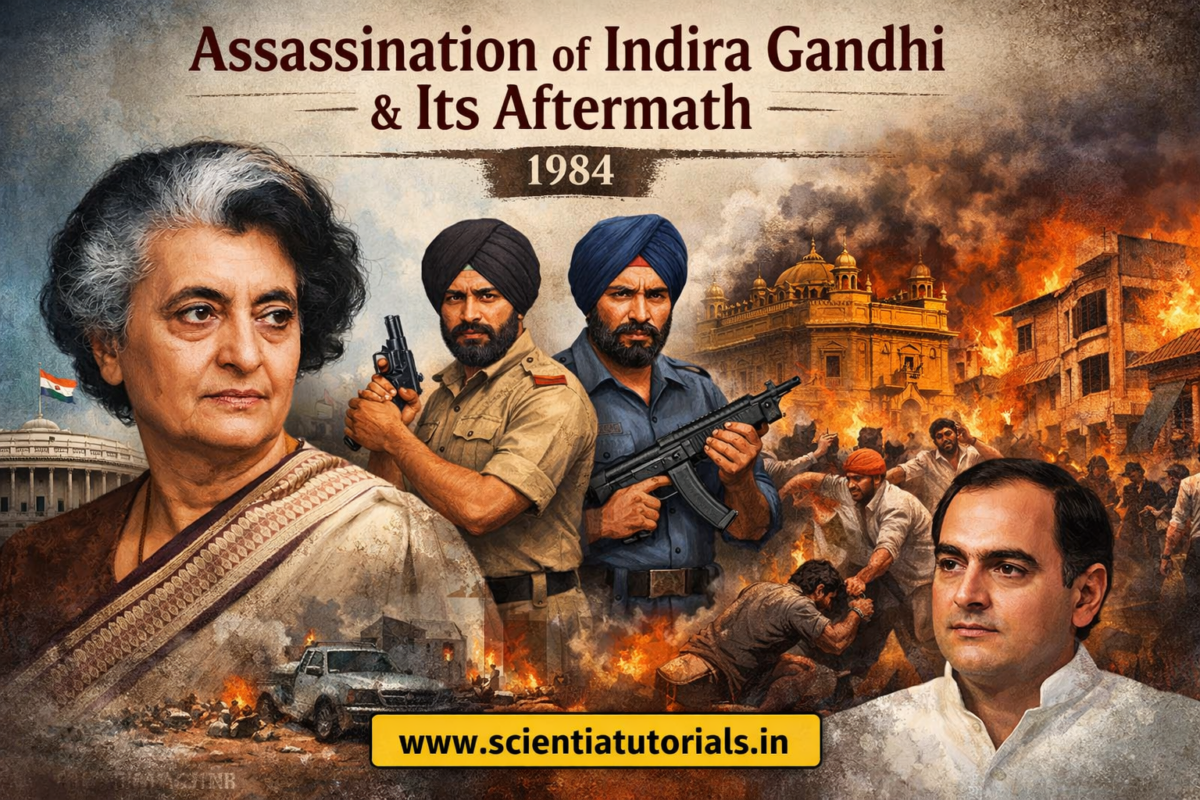

Assassination of Indira Gandhi and Its Aftermath (1984)
Late 20th Century Political Assassinations in India
Course: Most Controversial and Conspiracy Cases in Indian History – A Chronological, Evidence-Based Analysis
Module 9: Late 20th Century Political Assassinations
Timeline: 1980 CE – 2000 CE
Lesson: Assassination of Indira Gandhi and Its Aftermath
1. Lesson Overview and Historical Significance
The assassination of Indira Gandhi on 31 October 1984 stands as one of the most traumatic political events in modern Indian history. Occurring at the height of internal security crises, ethnic tensions, and constitutional centralization, her killing marked not merely the death of a Prime Minister but a turning point that reshaped India’s polity, centre–state relations, minority politics, and democratic discourse.
This lesson examines the assassination chronologically and analytically, situating it within the wider framework of late 20th-century political violence, state authority, insurgency, and conspiracy debates. The aftermath—especially the 1984 anti-Sikh violence—raises critical questions regarding state complicity, breakdown of rule of law, and justice delayed.
2. Political Context of the Early 1980s
2.1 Return of Indira Gandhi to Power (1980)
After her electoral defeat in 1977 following the Emergency, Indira Gandhi returned to power in January 1980, leading a reconstituted Congress (I). Her second tenure was marked by:
- Reassertion of central authority
- Rising regionalism and separatist movements
- Increasing reliance on intelligence agencies and executive decision-making
Unlike the post-independence consensus era, India in the 1980s faced multi-dimensional internal challenges—Punjab, Assam, Kashmir, and the Northeast.
2.2 Punjab Crisis: Roots of Militancy
Punjab emerged as the epicentre of political instability due to:
- Centre–state tensions
- Economic grievances post-Green Revolution
- Rise of religious-political assertion among Sikh youth
- Radicalization around demands such as the Anandpur Sahib Resolution
The charismatic but controversial figure of Jarnail Singh Bhindranwale became a focal point of militancy, operating from the Golden Temple complex in Amritsar.
3. Operation Blue Star (June 1984)
3.1 Decision-Making and Execution
In June 1984, the Indian government launched Operation Blue Star, a military operation aimed at flushing out armed militants from the Golden Temple.
Key features:
- Conducted between 1–10 June 1984
- Army deployed heavy artillery and tanks
- Operation coincided with Guru Arjan Dev’s martyrdom anniversary
3.2 Controversies and Criticism
Operation Blue Star remains one of the most debated state actions in independent India:
- Heavy civilian casualties
- Damage to the Akal Takht, Sikhism’s highest temporal seat
- Perception of sacrilege among Sikhs globally
- Allegations of alternative solutions being ignored
The operation deeply alienated large sections of the Sikh community, including members of the armed forces and security personnel.
4. Assassination of Indira Gandhi (31 October 1984)
4.1 The Event
On the morning of 31 October 1984, Indira Gandhi was assassinated at her residence, 1 Safdarjung Road, New Delhi, by her own Sikh bodyguards:
- Satwant Singh
- Beant Singh
They fired multiple rounds from their service weapons during a routine walk to record an interview.
4.2 Motive and Immediate Reaction
The assassination was widely interpreted as retaliation for Operation Blue Star. Beant Singh reportedly stated, “I have done what I had to do.”
Immediate outcomes:
- Indira Gandhi succumbed to injuries at AIIMS
- National Emergency not declared, but administrative paralysis ensued
- News spread rapidly, triggering mass hysteria
5. Constitutional and Political Transition
5.1 Succession of Rajiv Gandhi
Within hours of the assassination, Rajiv Gandhi was sworn in as Prime Minister, ensuring constitutional continuity.
Key features of transition:
- Smooth transfer of power
- Massive public sympathy wave
- Congress won a historic mandate in the 1984 General Elections (over 400 Lok Sabha seats)
5.2 “Sympathy Wave” Politics
The emotional aftermath consolidated power:
- Opposition marginalized
- Debate on accountability suppressed
- Long-term consequences for democratic checks and balances
6. The 1984 Anti-Sikh Violence
6.1 Nature and Spread of Violence
Following the assassination, 1984 anti-Sikh riots erupted, particularly in Delhi, Kanpur, Bokaro, and other urban centres.
Characteristics:
- Organized mobs targeting Sikh households
- Use of voter lists and identification
- Police inaction or complicity
- Over 3,000 Sikhs killed (unofficial estimates higher)
6.2 State Responsibility and Allegations
The violence raised disturbing questions:
- Role of Congress leaders in instigation
- Failure of police and civil administration
- Absence of immediate army deployment
- Breakdown of constitutional machinery
Rajiv Gandhi’s controversial remark—“When a big tree falls, the earth shakes”—was interpreted by critics as moral justification.
7. Judicial Inquiries and Quest for Justice
7.1 Major Commissions
Over the decades, multiple commissions investigated the violence:
- Ranganath Misra Commission (1985) – Criticized for exonerating political leadership
- Jain–Aggarwal Committee
- Nanavati Commission (2000) – Acknowledged organized nature of violence
Despite findings, convictions remained limited.
7.2 Delayed Justice
- Key accused enjoyed political protection
- Witness intimidation and evidence loss
- Renewed convictions occurred only after 2015–2018
This delay entrenched mistrust among Sikh communities toward state institutions.
8. National and International Repercussions
8.1 Impact on Sikh Identity and Diaspora Politics
- Radicalization of Sikh diaspora abroad
- Increased militancy in Punjab till early 1990s
- Human rights scrutiny of Indian state actions
8.2 Strengthening of Internal Security Laws
Post-1984 period saw:
- Expansion of anti-terror legislation
- Greater surveillance
- Centralization of security decision-making
These trends influenced later responses to insurgency and terrorism.
9. Conspiracy Theories and Historical Debates
9.1 Was the Assassination Preventable?
Scholars debate:
- Ignored intelligence warnings
- Retention of Sikh guards post-Blue Star
- Overconfidence in personal security assessments
9.2 Larger Structural Failure
Rather than a single conspiracy, many historians argue:
- Systemic erosion of trust
- Authoritarian governance style
- Politicization of religion
- Failure of federal accommodation
10. Comparative Perspective
Compared with later assassinations (e.g., Rajiv Gandhi in 1991), Indira Gandhi’s assassination stands out due to:
- Immediate mass communal violence
- State-level complicity allegations
- Long-term impact on secularism discourse
11. Historical Significance in Indian Democracy
The assassination and its aftermath underscore:
- Fragility of democratic institutions under stress
- Dangers of conflating national security with religious identity
- Necessity of institutional accountability
It remains a defining case study for constitutional morality vs political expediency.
The assassination of Indira Gandhi was not an isolated act of vengeance but the culmination of political miscalculations, structural centralization, and unresolved socio-religious tensions. Its aftermath exposed deep flaws in India’s governance framework, especially in protecting minority rights during moments of national trauma.
For students of modern Indian history, this episode offers crucial lessons on power, responsibility, and the enduring cost of political shortcuts in a democratic system.
Assassination of Indira Gandhi and Its Aftermath (1984)
Questions with Answers
Aligned to UPSC, State PSC, UGC-NET, CUET, CBSE, and University Examinations
Q1. Who was assassinated on 31 October 1984, and where did the incident occur?
Answer: Indira Gandhi, the Prime Minister of India, was assassinated at her residence, 1 Safdarjung Road, New Delhi.
Q2. Name the two assassins responsible for Indira Gandhi’s assassination.
Answer: The assassins were Beant Singh and Satwant Singh, both members of her security detail.
Q3. Which military operation is directly linked to the motive behind the assassination?
Answer: Operation Blue Star.
Q4. In which month and year was Operation Blue Star conducted?
Answer: June 1984.
Q5. Which Sikh religious site was the focus of Operation Blue Star?
Answer: The Golden Temple (Harmandir Sahib) in Amritsar.
Q6. Who succeeded Indira Gandhi as Prime Minister after her assassination?
Answer: Rajiv Gandhi succeeded her as Prime Minister.
Q7. Which community was primarily targeted during the violence that followed the assassination?
Answer: The Sikh community.
Q8. In which city were the anti-Sikh riots most severe?
Answer: Delhi.
Q9. Name one judicial commission set up to investigate the 1984 anti-Sikh violence.
Answer: The Ranganath Misra Commission (1985).
Q10. What was the approximate number of Sikh deaths in the 1984 violence (official estimates)?
Answer: Over 3,000 people were officially reported killed.
Q11. Briefly explain the political situation in Punjab in the early 1980s.
Answer: Punjab in the early 1980s witnessed rising political instability due to centre–state tensions, economic grievances after the Green Revolution, and increasing religious assertion. Militancy grew around demands articulated in the Anandpur Sahib Resolution. The presence of armed militants in the Golden Temple complex intensified the crisis. This situation eventually led the central government to consider military intervention.
Q12. Why was Operation Blue Star controversial?
Answer: Operation Blue Star was controversial because it involved military action inside Sikhism’s holiest shrine. Heavy force resulted in civilian casualties and damage to the Akal Takht. The operation was perceived by many Sikhs as an assault on their faith. It caused deep alienation of the Sikh community both in India and abroad.
Q13. How did the assassination affect the 1984 General Elections?
Answer: The assassination created a massive sympathy wave in favor of the Congress party. Rajiv Gandhi led the party to a historic electoral victory with an overwhelming majority in the Lok Sabha. Opposition parties were marginalized during this period. Emotional mobilization overshadowed policy debates.
Q14. What role did the police allegedly play during the 1984 anti-Sikh violence?
Answer: In many areas, the police were accused of remaining passive or even complicit. Reports suggest refusal to register FIRs, disarmament of Sikh victims, and failure to control mobs. This inaction contributed significantly to the scale of violence. It raised serious concerns about institutional accountability.
Q15. Mention two long-term consequences of the 1984 events on Indian politics.
Answer: First, there was increased centralization of power and emphasis on internal security. Second, the events weakened public trust in state institutions and intensified debates on minority rights and secularism.
Q16. Examine the causes that led to the assassination of Indira Gandhi.
Answer: The assassination of Indira Gandhi was the culmination of escalating political and security challenges in the early 1980s. The Punjab crisis, marked by militancy and demands for greater autonomy, posed a major threat to national unity. Operation Blue Star, undertaken to remove militants from the Golden Temple, deeply hurt Sikh religious sentiments. The continued presence of Sikh bodyguards after the operation reflected a complex attempt to avoid communal profiling. However, resentment within sections of the Sikh community intensified. The assassination was thus not an isolated act but rooted in unresolved political, religious, and federal tensions.
Q17. Discuss the immediate aftermath of Indira Gandhi’s assassination.
Answer: Immediately after the assassination, the country was gripped by shock and grief. Rajiv Gandhi was swiftly sworn in as Prime Minister to ensure constitutional continuity. However, widespread anti-Sikh violence erupted, especially in Delhi. Law and order machinery failed to respond effectively. The absence of timely military deployment worsened the situation. The aftermath exposed serious weaknesses in governance during crisis situations.
Q18. Analyze the nature and pattern of the 1984 anti-Sikh violence.
Answer: The 1984 anti-Sikh violence was not spontaneous but largely organized. Mobs used voter lists and local intelligence to identify Sikh homes and businesses. Violence included arson, lynching, and mass killings. Political slogans were used to incite crowds. The systematic nature of attacks indicated planning and coordination. This pattern distinguished the violence from ordinary communal riots.
Q19. Critically evaluate the role of judicial commissions in delivering justice to the victims.
Answer: Multiple commissions were established to investigate the violence, but their effectiveness was limited. Early commissions were criticized for absolving political leaders. Delays, lack of political will, and weak prosecution hampered justice. Some convictions occurred decades later, highlighting systemic failure. Overall, the process reinforced the notion that justice delayed is justice denied.
Q20. “The assassination of Indira Gandhi exposed the fragility of Indian secularism.” Discuss.
Answer: The events of 1984 revealed deep vulnerabilities in India’s secular framework. State institutions failed to protect a minority community during mass violence. Political rhetoric blurred the line between justice and revenge. The selective application of law weakened constitutional morality. These developments challenged the idea of equal citizenship and impartial governance. Thus, secularism emerged more as an ideal than a consistently practiced principle.
Q21. Was Operation Blue Star a strategic necessity or a political miscalculation? Analyze.
Answer: Operation Blue Star can be seen as a strategic response to a deteriorating security situation, but its execution reflected serious political miscalculation. While the state had a duty to restore order, the use of the army inside a sacred religious site proved counterproductive. Alternative political solutions were not exhausted. The operation alienated moderate Sikhs and internationalized the Punjab issue. Hence, while necessary from a security standpoint, it failed politically and socially.
Q22. Assess the constitutional implications of the 1984 crisis for Indian democracy.
Answer: Constitutionally, the swift transfer of power upheld democratic continuity. However, the failure to prevent mass violence represented a breakdown of the rule of law. Fundamental rights, particularly the right to life and equality, were violated. Federal principles were strained by excessive centralization. The crisis thus highlighted both the strengths and weaknesses of India’s constitutional system.
Q23. Compare the assassination of Indira Gandhi with other political assassinations in India in terms of impact.
Answer: Unlike other assassinations, Indira Gandhi’s death was followed by large-scale communal violence. It led to immediate political consolidation rather than instability. The event reshaped internal security policies and minority relations. Its impact on secularism and justice mechanisms was more profound than most other cases. Therefore, its consequences were uniquely far-reaching.
Q24. How did the events of 1984 influence Sikh identity and diaspora politics?
Answer: The events intensified feelings of alienation among Sikhs. Many in the diaspora mobilized politically, raising human rights concerns globally. Radical elements gained temporary support. Over time, however, democratic engagement and reconciliation efforts also emerged. The period significantly shaped modern Sikh political consciousness.
Q25. Do you agree that the assassination of Indira Gandhi was a symptom of systemic failure rather than a mere conspiracy? Justify.
Answer: Yes, the assassination reflected deeper systemic failures. Centralized decision-making, erosion of institutional checks, and politicization of religion created conditions for violence. Intelligence warnings were inadequately addressed. The failure to manage diversity within a federal framework aggravated tensions. Thus, the assassination was less a singular conspiracy and more a manifestation of governance breakdown.
MCQs with Answers: Assassination of Indira Gandhi and Its Aftermath (1984)
Aligned to UPSC, State PSC, UGC-NET, CUET, CBSE, and University Examinations
Course: Most Controversial and Conspiracy Cases in Indian History – A Chronological, Evidence-Based Analysis
Module 9: Late 20th Century Political Assassinations
MCQ 1
The assassination of Indira Gandhi took place on:
A. 25 June 1975
B. 6 June 1984
C. 31 October 1984
D. 20 November 1984
Correct Answer: C
Explanation: Indira Gandhi was assassinated on 31 October 1984 at her official residence in New Delhi. This date marks a major turning point in modern Indian political history.
MCQ 2
Indira Gandhi was assassinated by:
A. Foreign terrorists
B. Opposition party workers
C. Her own Sikh bodyguards
D. Army commandos
Correct Answer: C
Explanation: The assassins were Beant Singh and Satwant Singh, both serving as her personal security guards, making the incident an unprecedented breach of internal security.
MCQ 3
The immediate cause most commonly linked to the assassination was:
A. The Emergency (1975–77)
B. Indo-Pak war of 1971
C. Operation Blue Star
D. Assam agitation
Correct Answer: C
Explanation: The assassination was widely seen as retaliation for Operation Blue Star, which deeply hurt Sikh religious sentiments.
MCQ 4
Operation Blue Star was carried out in:
A. April 1983
B. January 1984
C. June 1984
D. October 1984
Correct Answer: C
Explanation: The operation was conducted in June 1984 to flush out armed militants from the Golden Temple complex in Amritsar.
MCQ 5
The primary religious site affected during Operation Blue Star was the:
A. Jama Masjid
B. Ajmer Sharif
C. Golden Temple (Harmandir Sahib)
D. Anandpur Sahib
Correct Answer: C
Explanation: The Golden Temple is the holiest shrine of Sikhism, and military action inside its premises caused deep emotional and political repercussions.
MCQ 6
Who was sworn in as Prime Minister immediately after Indira Gandhi’s assassination?
A. Zail Singh
B. P. V. Narasimha Rao
C. Rajiv Gandhi
D. V. P. Singh
Correct Answer: C
Explanation: Rajiv Gandhi was sworn in within hours to ensure constitutional continuity and political stability.
MCQ 7
The violence that followed Indira Gandhi’s assassination is commonly referred to as:
A. Punjab riots
B. Emergency riots
C. 1984 anti-Sikh riots
D. Operation Woodrose
Correct Answer: C
Explanation: The post-assassination violence primarily targeted Sikhs and is officially described as the 1984 anti-Sikh riots.
MCQ 8
Which city witnessed the maximum impact of the 1984 anti-Sikh violence?
A. Amritsar
B. Chandigarh
C. Delhi
D. Ludhiana
Correct Answer: C
Explanation: Delhi was the epicenter, with large-scale, organized attacks on Sikh neighborhoods.
MCQ 9
One major criticism of the administration during the 1984 riots was:
A. Excessive military rule
B. Failure of police to act impartially
C. Immediate declaration of Emergency
D. Suspension of Parliament
Correct Answer: B
Explanation: Numerous reports highlighted police inaction or complicity, leading to a breakdown of law and order.
MCQ 10
The official death toll of Sikhs in the 1984 violence is estimated at around:
A. 500
B. 1,000
C. 3,000
D. 10,000
Correct Answer: C
Explanation: Official estimates place the figure at over 3,000, though independent sources suggest higher numbers.
MCQ 11
Which commission was the first major inquiry into the 1984 anti-Sikh violence?
A. Nanavati Commission
B. Liberhan Commission
C. Ranganath Misra Commission
D. Shah Commission
Correct Answer: C
Explanation: The Ranganath Misra Commission (1985) was the earliest inquiry but was criticized for its limited accountability.
MCQ 12
A major criticism of early judicial inquiries into the 1984 riots was that they:
A. Were too harsh
B. Ignored victims completely
C. Failed to fix political responsibility
D. Declared martial law
Correct Answer: C
Explanation: Early commissions were accused of shielding influential political leaders and focusing narrowly on administrative lapses.
MCQ 13
The 1984 General Elections resulted in:
A. A hung Parliament
B. Coalition government
C. A landslide victory for Congress
D. Defeat of Rajiv Gandhi
Correct Answer: C
Explanation: A massive sympathy wave led to one of the largest parliamentary majorities in Indian history.
MCQ 14
The phrase “When a big tree falls, the earth shakes” is associated with:
A. Indira Gandhi
B. Rajiv Gandhi
C. Zail Singh
D. Atal Bihari Vajpayee
Correct Answer: B
Explanation: Rajiv Gandhi’s remark was widely criticized for appearing to justify the violence that followed his mother’s assassination.
MCQ 15
Which of the following best describes the nature of the 1984 violence?
A. Spontaneous mob reaction
B. Border conflict
C. Organized and targeted attacks
D. Military crackdown
Correct Answer: C
Explanation: The use of voter lists and coordinated mobs indicates planning rather than spontaneous rioting.
MCQ 16
The assassination of Indira Gandhi highlighted which major weakness of the Indian state?
A. Foreign policy failure
B. Economic mismanagement
C. Internal security and communal harmony
D. Judicial overreach
Correct Answer: C
Explanation: The event exposed vulnerabilities in internal security arrangements and communal relations.
MCQ 17
Which constitutional value was most severely undermined during the 1984 riots?
A. Federalism
B. Judicial review
C. Right to life and equality before law
D. Freedom of trade
Correct Answer: C
Explanation: Large-scale killings and selective targeting represented a grave violation of fundamental rights.
MCQ 18
The delayed justice in 1984 riot cases is often cited as an example of:
A. Judicial activism
B. Justice delayed is justice denied
C. Executive overreach
D. Popular sovereignty
Correct Answer: B
Explanation: Convictions came decades later, undermining faith in the rule of law.
MCQ 19
Which long-term impact did the 1984 events have on internal security policy?
A. Reduced role of the army
B. Complete decentralization
C. Stronger central security framework
D. Abolition of intelligence agencies
Correct Answer: C
Explanation: The state emphasized counter-insurgency, surveillance, and centralized security responses.
MCQ 20
The events of 1984 contributed most directly to debates on:
A. Language reorganization
B. Land reforms
C. Secularism and minority rights
D. Industrial policy
Correct Answer: C
Explanation: The targeting of a minority community raised fundamental questions about India’s secular character.
MCQ 21
Which of the following best explains the broader cause of Indira Gandhi’s assassination?
A. Personal rivalry
B. Foreign conspiracy
C. Systemic political and institutional failure
D. Economic crisis
Correct Answer: C
Explanation: Historians argue the assassination reflected deeper failures in governance, federalism, and conflict management.
MCQ 22
The Punjab militancy of the 1980s was influenced by:
A. Only religious factors
B. Only economic factors
C. Political, economic, and religious factors combined
D. Foreign invasion alone
Correct Answer: C
Explanation: The crisis was multi-dimensional, involving centre–state relations, identity politics, and economic grievances.
MCQ 23
Which of the following distinguishes Indira Gandhi’s assassination from later political assassinations in India?
A. It occurred abroad
B. It was followed by mass communal violence
C. It ended democracy
D. It led to military rule
Correct Answer: B
Explanation: No other political assassination in India triggered violence on the same scale immediately afterward.
MCQ 24
The Sikh diaspora’s response to the 1984 events included:
A. Complete withdrawal from politics
B. International human rights advocacy
C. Support for Emergency
D. Silence on the issue
Correct Answer: B
Explanation: Sikh groups abroad actively raised the issue in international forums, influencing global perceptions.
MCQ 25
From an examination perspective, the assassination of Indira Gandhi is best studied as:
A. A personal tragedy alone
B. A military failure only
C. A case study in political violence, state power, and democratic crisis
D. An isolated criminal act
Correct Answer: C
Explanation: The episode is crucial for understanding the interaction between governance, security, communalism, and constitutional values in modern India.
-
Indira Gandhi assassination 1984 MCQs
-
Operation Blue Star MCQs with answers
-
1984 anti-Sikh riots MCQs
-
Indira Gandhi assassination UPSC questions
-
Modern Indian history political assassinations
-
Rajiv Gandhi succession 1984 questions
-
Internal security challenges India 1980s
-
Late 20th century Indian political history MCQs
-
Communal violence and Indian democracy questions
-
Constitutional crisis after Indira Gandhi assassination