
High-Profile Political Murder Cases in Contemporary India
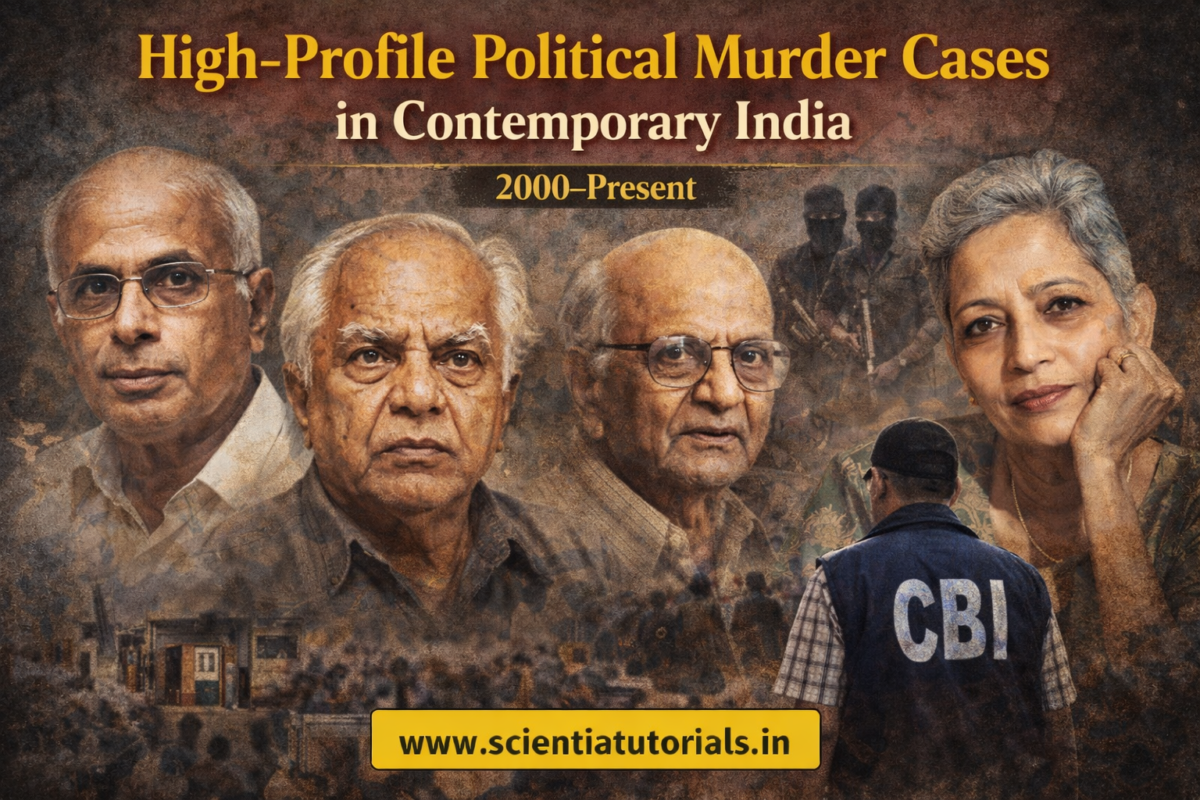

High-Profile Political Murder Cases in Contemporary India
Unresolved Cases & Conspiracy Debates (2000 CE – Present)
Course: Most Controversial and Conspiracy Cases in Indian History – A Chronological, Evidence-Based Analysis
Module 10: Contemporary India – Unresolved Cases & Conspiracy Debates
Timeline: 2000 CE – Present
Lesson: High-Profile Political Murder Cases in Contemporary India
Based on the Lesson followed by the above Module and Course, we have created study materials aligned to the needs of UPSC, State PSC, UGC-NET, CUET, CBSE, and all school, college, and university examinations in India:
- Study Module with Revision Notes,
- Questions with Answers,
- MCQs with Answers and detailed explanations.
Study Module with Revision Notes
1. Lesson Introduction and Contemporary Relevance
The post-2000 period in India has witnessed a disturbing pattern of high-profile political and ideological murders, many of which remain either unresolved or partially resolved despite extensive investigations. Unlike earlier eras dominated by regime change or insurgency-driven violence, contemporary political murders are often targeted assassinations of intellectuals, activists, journalists, and reformers, raising serious concerns about freedom of expression, dissent, rule of law, and democratic resilience.
This lesson critically examines major political murder cases in contemporary India, focusing on established facts, investigative trajectories, judicial outcomes, and unresolved conspiracy debates. It also explores how these cases reflect broader structural challenges—such as radicalization, institutional delays, ideological polarization, and limitations of investigative agencies.
2. Defining “Political Murder” in Contemporary India
In the contemporary Indian context, a political murder is characterized by:
- Targeted killing due to ideological position or public activism
- Elimination of voices critical of dominant narratives
- Use of organized networks rather than spontaneous violence
- Presence of intimidation, surveillance, and planning
- Frequent invocation of conspiracy theories due to incomplete closure
Unlike electoral or insurgency violence, these murders are often symbolic acts meant to instill fear and silence dissent.
3. Structural Context: India after 2000
3.1 Political and Social Environment
Post-liberalization India experienced:
- Expansion of mass media and social media
- Greater visibility of dissent and activism
- Intensification of ideological polarization
- Rise of identity-based politics
- Expansion of national security laws
This environment has shaped both the nature of political violence and public interpretation of such crimes.
4. The Case of Narendra Dabholkar (2013)
4.1 Background and Ideological Position
Narendra Dabholkar was a renowned rationalist and social reformer who campaigned against:
- Superstition
- Black magic
- Exploitative religious practices
He was instrumental in advocating the Maharashtra Anti-Superstition Act.
4.2 The Assassination
- Date: 20 August 2013
- Place: Pune, Maharashtra
- Method: Point-blank shooting during morning walk
The assassination shocked civil society and exposed vulnerabilities in activist protection.
4.3 Investigation and Gaps
- Initially handled by Maharashtra Police
- Later transferred to the CBI
- Arrests made years later
- Alleged links to extremist ideological networks
Despite arrests, mastermind identification and motive mapping remain contested, fueling conspiracy debates.
5. The Case of Govind Pansare (2015)
5.1 Political and Intellectual Profile
Govind Pansare was:
- A left-wing thinker
- Critic of religious extremism
- Advocate of progressive social reform
5.2 Assassination Details
- Date: 16 February 2015
- Place: Kolhapur, Maharashtra
- Method: Motorcycle-borne assailants
He succumbed to injuries days later.
5.3 Investigative Concerns
- Similar weaponry and tactics as Dabholkar case
- Delayed arrests
- Overlapping suspects
The lack of swift justice strengthened perceptions of systemic failure.
6. The Case of M. M. Kalburgi (2015)
6.1 Academic and Ideological Stance
Kalburgi was a distinguished scholar and rationalist who questioned:
- Idol worship
- Scriptural orthodoxy
- Religious dogma
6.2 Murder and Aftermath
- Date: 30 August 2015
- Place: Dharwad, Karnataka
- Method: Shooting at residence
The killing intensified national debate on intellectual freedom and safety of scholars.
6.3 Conspiracy Debates
- Similar modus operandi to previous murders
- Alleged common extremist network
- Absence of conclusive judicial closure
7. The Case of Gauri Lankesh (2017)
7.1 Journalistic Role and Political Voice
Gauri Lankesh was:
- A fearless journalist
- Editor of Lankesh Patrike
- Vocal critic of majoritarian politics and extremism
7.2 Assassination
- Date: 5 September 2017
- Place: Bengaluru, Karnataka
- Method: Point-blank shooting outside residence
The murder triggered nationwide protests and global condemnation.
7.3 Investigation and Charges
- Investigation by SIT
- Arrest of alleged shooters and conspirators
- Allegations of ideological indoctrination and organized planning
However, judicial verdicts are still pending, sustaining unresolved questions.
8. Patterns and Common Threads
Across these cases, common patterns emerge:
- Targeting of rationalist or dissenting voices
- Use of firearms and motorcycle-borne attackers
- Surveillance prior to execution
- Delayed justice and prolonged trials
- Alleged ideological radicalization networks
These similarities have led scholars to argue for organized political violence rather than isolated crimes.
9. Role of Investigative Agencies
9.1 Performance Assessment
Agencies involved include:
- State Police
- Central Bureau of Investigation (CBI)
- Special Investigation Teams (SITs)
Challenges faced:
- Inter-agency coordination issues
- Political pressure allegations
- Evidence decay due to delays
- Witness protection failures
9.2 Judicial Delays
- Trials extending over years
- Repeated adjournments
- Public loss of confidence in justice delivery
This delay fuels conspiracy theories even where arrests are made.
10. Media, Civil Society, and Public Discourse
10.1 Media’s Role
- Sustained attention on unresolved cases
- Counter-narratives to official statements
- International spotlight
10.2 Civil Society Response
- Protest movements
- Demand for fast-track courts
- Calls for legal and institutional reform
11. Conspiracy Theories vs Evidence-Based Analysis
11.1 Sources of Conspiracy Narratives
- Incomplete investigations
- Political polarization
- Social media amplification
- Lack of transparent communication
11.2 Academic Caution
Historians caution against:
- Premature conclusions
- Politicization of justice
- Undermining rule of law
The focus must remain on documented evidence and judicial outcomes.
12. Constitutional and Democratic Implications
These murders pose serious questions:
- Is dissent adequately protected?
- Are institutions neutral and effective?
- Can democracy survive targeted intimidation?
They test India’s commitment to:
- Article 19 (Freedom of Expression)
- Rule of law
- Democratic pluralism
13. Comparative Perspective
| Aspect | Pre-2000 Political Violence | Post-2000 Political Murders |
|---|---|---|
| Nature | Mass or insurgent | Targeted |
| Victims | Political leaders | Intellectuals, journalists |
| Motivation | Power capture | Ideological silencing |
| Resolution | Faster | Prolonged |
14. Examination-Oriented Revision Notes
Key Dates
- 2013 – Dabholkar assassination
- 2015 – Pansare & Kalburgi murders
- 2017 – Gauri Lankesh assassination
Probable Exam Questions
- “Discuss the pattern of political murders in contemporary India.”
- “Why do conspiracy theories emerge in unresolved murder cases?”
- “Examine the role of investigative agencies in high-profile political murders.”
Contemporary Challenges and Democratic Test
High-profile political murders in contemporary India represent not merely criminal acts but a deeper democratic challenge. The persistence of unresolved cases and conspiracy debates underscores institutional limitations, societal polarization, and the urgent need for judicial efficiency.
For students of modern Indian history and polity, these cases serve as critical studies in state accountability, ideological conflict, and the evolving nature of political violence. The ultimate test lies not in speculation but in strengthening institutions to ensure truth, justice, and democratic continuity.
High-Profile Political Murder Cases in Contemporary India (2000 CE – Present)
Questions with Answers
Aligned to UPSC, State PSC, UGC-NET, CUET, CBSE, and University Examinations
Course: Most Controversial and Conspiracy Cases in Indian History – A Chronological, Evidence-Based Analysis
Module 10: Contemporary India – Unresolved Cases & Conspiracy Debates
Q1. What is meant by “high-profile political murder” in contemporary India?
Answer: It refers to targeted killings of public figures—such as activists, journalists, or intellectuals—motivated by ideological or political opposition rather than personal rivalry.
Q2. Which period is covered under contemporary political murder cases in this module?
Answer: The period from 2000 CE to the present.
Q3. Name one major rationalist assassinated in India after 2000.
Answer: Narendra Dabholkar.
Q4. In which city was Narendra Dabholkar assassinated?
Answer: Pune, Maharashtra.
Q5. Who was Govind Pansare?
Answer: Govind Pansare was a left-wing thinker and social reformer critical of religious extremism.
Q6. Which scholar was assassinated in Dharwad in 2015?
Answer: M. M. Kalburgi.
Q7. Which journalist was assassinated in Bengaluru in 2017?
Answer: Gauri Lankesh.
Q8. What method was commonly used in these assassinations?
Answer: Point-blank shooting, often by motorcycle-borne assailants.
Q9. Which constitutional right is most directly threatened by such murders?
Answer: Freedom of speech and expression (Article 19).
Q10. Why do conspiracy theories often emerge in these cases?
Answer: Due to delayed investigations, lack of judicial closure, and political polarization.
Q11. Briefly explain the significance of the Dabholkar assassination.
Answer: Narendra Dabholkar was a leading rationalist campaigning against superstition. His murder in 2013 shocked civil society and highlighted the vulnerability of reformist voices. It exposed weaknesses in activist protection. The case also set a pattern later seen in similar murders.
Q12. Why is the murder of Govind Pansare seen as politically significant?
Answer: Pansare was a vocal critic of religious extremism and a proponent of progressive ideas. His assassination followed the Dabholkar killing, suggesting a pattern. Similar methods and suspects raised concerns of organized ideological violence. The delay in justice intensified public distrust.
Q13. What similarities link the murders of Dabholkar, Pansare, and Kalburgi?
Answer: All three were rationalists critical of orthodoxy. They were killed using firearms at close range. Investigations revealed overlapping suspects and similar weapons. These similarities led to speculation about a common extremist network.
Q14. Discuss the role of investigative agencies in these cases.
Answer: State police, SITs, and central agencies handled investigations. Progress was slow due to coordination issues and evidentiary challenges. Arrests were often made years later. This delay weakened public confidence in justice delivery.
Q15. How did civil society respond to these murders?
Answer: There were nationwide protests and solidarity movements. Writers, journalists, and academics demanded accountability. Civil society called for fast-track courts and stronger witness protection. These responses kept public pressure alive.
Q16. Examine the case of Gauri Lankesh and its wider implications.
Answer: Gauri Lankesh was a prominent journalist and critic of majoritarian politics. Her assassination in 2017 outside her Bengaluru residence drew national and international condemnation. Investigations revealed organized planning and ideological indoctrination of the accused. However, the trial process has been prolonged. The case raised serious concerns about press freedom. It highlighted the risks faced by dissenting journalists. The lack of swift judicial closure continues to fuel debate and mistrust.
Q17. Analyze why many contemporary political murder cases remain unresolved.
Answer: Investigations are often delayed due to poor coordination among agencies. Political sensitivities and pressure complicate inquiries. Evidence collection is slow, and witnesses may be intimidated. Judicial processes take years. These factors together contribute to unresolved cases.
Q18. Discuss the role of ideology in contemporary political murders.
Answer: Ideology plays a central role, as victims often challenge dominant religious or political narratives. The murders aim to silence dissent and create fear. Unlike earlier power-driven assassinations, these are symbolic acts. Ideological radicalization and network-based violence are key features. This makes detection and prosecution more complex.
Q19. Evaluate the constitutional and democratic implications of such murders.
Answer: These killings threaten freedom of expression and democratic pluralism. They undermine citizens’ faith in state protection. Delayed justice weakens the rule of law. Democracy suffers when dissenting voices are silenced. The cases test India’s constitutional commitment to liberty and equality.
Q20. How do these cases differ from political assassinations before 2000?
Answer: Earlier assassinations often involved top political leaders and regime change. Contemporary cases target intellectuals and activists. Motives have shifted from power capture to ideological silencing. Investigations today are more prolonged. The democratic impact is more subtle but deeply corrosive.
Q21. “High-profile political murders in contemporary India represent a new form of political violence.” Discuss.
Answer: These murders differ from mass or insurgent violence. They are targeted, symbolic, and ideologically motivated. The aim is intimidation rather than immediate political gain. They exploit institutional delays. Hence, they represent a new, insidious form of political violence.
Q22. Why do conspiracy debates persist even after arrests are made?
Answer: Arrests do not always lead to convictions. Trials are prolonged and opaque. Communication gaps between agencies and the public persist. Political polarization amplifies suspicion. Thus, conspiracy narratives continue.
Q23. Assess the role of media in shaping public perception of these cases.
Answer: Media ensures sustained attention and accountability. It highlights investigative gaps and judicial delays. However, sensationalism can sometimes fuel speculation. Overall, media acts as a watchdog. It plays a critical role in democratic oversight.
Q24. Suggest institutional reforms to address unresolved political murder cases.
Answer: Fast-track courts are essential. Better inter-agency coordination is needed. Witness protection must be strengthened. Transparency in investigations should improve. These reforms can restore public trust.
Q25. Why are these cases important for competitive examinations?
Answer: They integrate history, polity, ethics, and internal security. They test understanding of democracy and rule of law. The cases are contemporary and relevant. They help analyze state capacity and civil liberties. Hence, they are frequently examined.
MCQs with Answers:
High-Profile Political Murder Cases in Contemporary India (2000 CE – Present)
Aligned to UPSC, State PSC, UGC-NET, CUET, CBSE, and University Examinations
Course: Most Controversial and Conspiracy Cases in Indian History – A Chronological, Evidence-Based Analysis
Module 10: Contemporary India – Unresolved Cases & Conspiracy Debates
MCQ 1
In contemporary India, the term “high-profile political murder” most accurately refers to:
A. Random acts of criminal violence
B. Electoral violence during polling
C. Targeted killing of individuals for ideological or political reasons
D. Insurgent attacks on security forces
Correct Answer: C
Explanation: Contemporary political murders are typically targeted assassinations of activists, journalists, or intellectuals aimed at silencing dissent rather than capturing state power.
MCQ 2
Which period is covered under Module 10 of this course?
A. 1980–2000
B. 1991–2010
C. 2000 CE – Present
D. Post-1947 only
Correct Answer: C
Explanation: Module 10 focuses on unresolved cases and conspiracy debates in contemporary India from 2000 CE onwards.
MCQ 3
Who among the following was assassinated in Pune in 2013 for his rationalist activism?
A. Gauri Lankesh
B. Narendra Dabholkar
C. Govind Pansare
D. M. M. Kalburgi
Correct Answer: B
Explanation: Dabholkar was a leading rationalist campaigning against superstition and was killed in 2013, shocking civil society.
MCQ 4
The assassination of Narendra Dabholkar primarily highlighted:
A. Electoral rivalry
B. Vulnerability of rationalist and reformist voices
C. Caste-based violence
D. Separatist insurgency
Correct Answer: B
Explanation: His killing exposed how reformers challenging entrenched beliefs face serious threats.
MCQ 5
Govind Pansare, assassinated in 2015, was best known as a:
A. Religious preacher
B. Business leader
C. Govind Pansare and social reformer
D. Election official
Correct Answer: C
Explanation: Pansare was a left-wing thinker critical of religious extremism and social inequality.
MCQ 6
Which similarity links the murders of Dabholkar, Pansare, and Kalburgi?
A. Victims were ruling party politicians
B. Crimes occurred during elections
C. Use of firearms and targeted attacks
D. Immediate judicial conviction
Correct Answer: C
Explanation: All were shot at close range, often by motorcycle-borne assailants, suggesting a pattern.
MCQ 7
Who was the scholar assassinated in Dharwad in 2015?
A. Ramachandra Guha
B. Irfan Habib
C. M. M. Kalburgi
D. Romila Thapar
Correct Answer: C
Explanation: Kalburgi was a noted scholar who questioned religious orthodoxy and was killed at his residence.
MCQ 8
The assassination of Gauri Lankesh took place in:
A. Mumbai
B. Hyderabad
C. Bengaluru
D. Chennai
Correct Answer: C
Explanation: Gauri Lankesh was shot outside her Bengaluru home in 2017.
MCQ 9
Gauri Lankesh was primarily known as a:
A. University professor
B. Political party leader
C. Gauri Lankesh and editor
D. Civil servant
Correct Answer: C
Explanation: She was a journalist and editor of Lankesh Patrike, critical of extremism and majoritarian politics.
MCQ 10
Which of the following best explains why conspiracy theories often arise in these cases?
A. Media silence
B. Excessive transparency
C. Delayed investigations and prolonged trials
D. Immediate convictions
Correct Answer: C
Explanation: Lack of timely closure and judicial delays fuel speculation and conspiracy narratives.
MCQ 11
A common constitutional concern raised by these murders relates to:
A. Right to property
B. Right to religion
C. Freedom of speech and expression (Article 19)
D. Right against exploitation
Correct Answer: C
Explanation: These killings directly threaten dissent, debate, and free expression.
MCQ 12
Which agency has frequently taken over investigations in such high-profile cases?
A. Election Commission
B. Comptroller and Auditor General
C. Central Bureau of Investigation (CBI)
D. Finance Commission
Correct Answer: C
Explanation: The CBI has investigated several cases after state-level probes faced criticism.
MCQ 13
The murders discussed in this module are best described as:
A. Spontaneous mob violence
B. Crimes of passion
C. Ideologically motivated targeted killings
D. Accidental deaths
Correct Answer: C
Explanation: Victims were chosen for their ideological positions rather than personal disputes.
MCQ 14
Which factor most distinguishes post-2000 political murders from earlier political assassinations?
A. Use of firearms
B. International involvement
C. Targeting of intellectuals and activists rather than heads of government
D. Absence of investigation
Correct Answer: C
Explanation: Contemporary cases focus on silencing dissenting voices rather than eliminating political rulers.
MCQ 15
The prolonged nature of trials in these cases mainly results in:
A. Faster justice
B. Decline of democracy
C. Erosion of public trust in institutions
D. Increase in voter turnout
Correct Answer: C
Explanation: Judicial delays weaken confidence in the rule of law.
MCQ 16
Which of the following themes best unites the victims discussed in this lesson?
A. Electoral competition
B. Economic liberalization
C. Criticism of religious or ideological orthodoxy
D. Armed rebellion
Correct Answer: C
Explanation: Most victims openly challenged dominant ideological or religious narratives.
MCQ 17
The role of media in these cases has primarily been to:
A. Suppress information
B. Replace the judiciary
C. Sustain public attention and accountability
D. Conduct investigations
Correct Answer: C
Explanation: Media coverage keeps unresolved cases in public discourse.
MCQ 18
Which of the following is a major challenge faced by investigative agencies?
A. Excessive funding
B. Overstaffing
C. Inter-agency coordination and evidence decay
D. Too many convictions
Correct Answer: C
Explanation: Poor coordination and delays weaken evidence and prosecution.
MCQ 19
Why are these murders often described as “symbolic”?
A. Victims were symbolic leaders of parties
B. Murders had no real impact
C. They aim to intimidate and silence broader dissent
D. They occur on symbolic dates
Correct Answer: C
Explanation: The intent is to send a message beyond the individual victim.
MCQ 20
Which democratic value is most directly tested by unresolved political murders?
A. Federalism
B. Separation of powers
C. Rule of law
D. Directive Principles
Correct Answer: C
Explanation: Failure to deliver justice undermines faith in the rule of law.
MCQ 21
Civil society responses to these murders have included:
A. Withdrawal from public life
B. Support for censorship
C. Protests and demands for fast-track justice
D. Silence
Correct Answer: C
Explanation: Writers, activists, and citizens have mobilized to demand accountability.
MCQ 22
Which factor most contributes to the persistence of conspiracy debates?
A. Judicial transparency
B. Clear verdicts
C. Political polarization and social media amplification
D. Lack of public interest
Correct Answer: C
Explanation: Polarization and online narratives magnify doubts and speculation.
MCQ 23
From an examination perspective, these cases are most relevant to which syllabus areas?
A. Ancient Indian history only
B. Geography and environment
C. Modern history, polity, ethics, and internal security
D. Science and technology
Correct Answer: C
Explanation: The cases intersect governance, rights, ethics, and security concerns.
MCQ 24
Which statement best captures the historical significance of these murders?
A. They are isolated criminal acts
B. They ended democracy in India
C. They highlight challenges to dissent and institutional effectiveness
D. They strengthened authoritarianism completely
Correct Answer: C
Explanation: The murders expose democratic vulnerabilities rather than isolated crime trends.
MCQ 25
The most appropriate analytical approach to studying these cases is:
A. Sensationalism
B. Assumption of guilt
C. Evidence-based analysis combined with constitutional values
D. Ignoring political context
Correct Answer: C
Explanation: Academic study requires reliance on facts, judicial processes, and democratic principles.
-
High-profile political murders in India
-
Contemporary political assassinations India
-
Unresolved political murder cases India
-
Gauri Lankesh assassination case
-
Narendra Dabholkar murder case
-
Kalburgi and Pansare assassinations
-
Political violence in contemporary India
-
Freedom of expression and political murders
-
Ideological violence in India after 2000
-
Rule of law and political killings India
-
Internal security challenges India UPSC