
British Intelligence Networks in Colonial India
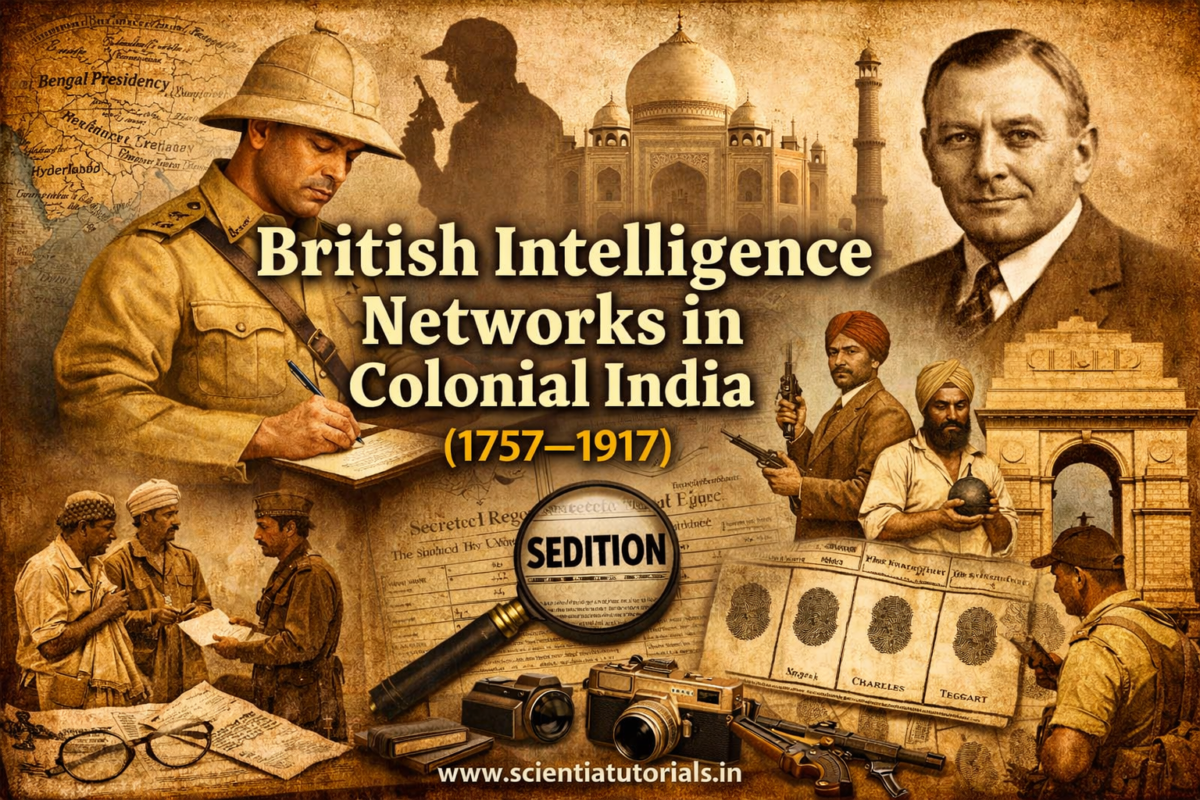

Based on the Lesson followed by the above Module and Course, we have created study materials aligned to the needs of UPSC, State PSC, UGC-NET, CUET, CBSE, and all school, college, and university examinations in India:
- Study Module with Revision Notes,
- Questions with Answers,
- MCQs with Answers and detailed explanations.
- CUET-style Assertion–Reason MCQs
Lesson: British Intelligence Networks in Colonial India
Module 6: Colonial India – Intelligence, Resistance & Cover-Ups
Timeline: c. 1757 CE – 1917 CE
1. Introduction: Intelligence as a Pillar of Colonial Control
After the Battle of Plassey (1757) and especially following the Revolt of 1857, the British realized that military power alone could not secure the Empire. The expansion of rule over linguistically and culturally diverse regions required continuous information about:
- movements of armies and princely courts,
- rural discontent and revenue resistance,
- religious institutions, and
- emerging nationalist politics.
Colonial intelligence therefore developed as an organized system combining police surveillance, military reporting, postal censorship, and the use of informers. For competitive examinations, it is important to view these networks not as a single agency but as an interlinked architecture of information that evolved over phases of British rule.
2. Early Phase: Company-Era Information Networks (1757–1857)
a. Court Spies and Political Vakils
During the East India Company period, intelligence was largely informal. Residents posted in princely states such as Awadh, Hyderabad, and Mysore maintained local agents. These included:
- disgruntled nobles,
- merchants,
- munshis (Persian secretaries), and
- court vakils.
The Company depended on Persian and later Urdu literate intermediaries to translate newsletters (akhbarat). Intelligence helped figures like Warren Hastings monitor the Rohilla chiefs and Awadh politics. The defeat of Tipu Sultan (1799) was preceded by penetration of Mysore court through Mir Sadiq and other collaborators—an early example of intelligence shaping outcomes.
b. Thagi and Dakaiti Department
In the 1830s, William Sleeman organized intelligence to suppress the Thugs. This department created:
- dossiers of criminal gangs,
- genealogies, and
- routes of operation.
Though presented as crime control, it became a model for later political intelligence: systematic record keeping and use of approvers.
c. Limitations of Company Intelligence
Characteristics of this era:
- absence of centralized coordination,
- reliance on personal loyalty to Residents,
- focus on revenue and military threats rather than ideology.
Exam Tip: Note the transition from Persian chronicle-style newsletters to English bureaucratic reports by mid-19th century.
3. Watershed of 1857: Birth of Crown-Led Intelligence (1858–1870s)
The Revolt of 1857 exposed the danger of secret mobilization through chapatis, fakir networks, and cantonment rumors. Post-1857 reforms produced a security state.
a. Reorganization of Police
The Indian Police Act of 1861 created provincial police under Inspectors-General. Alongside visible policing grew “confidential branches” tasked to:
- watch seditious preachers,
- map rebel leaders in Nepal borderlands,
- supervise returned mutineers.
b. Military Intelligence
The Army Headquarters started collecting:
- native press translations,
- cantonment intelligence,
- frontier tribal reports.
The fear of Wahabi conspiracy in Patna and the Ambala trials (1860s) led to surveillance of Islamic madrasas and pilgrimage routes.
c. Vernacular Press Monitoring
Early nationalist writings in Bengali and Marathi convinced officials that the new threat was the printed word. Translators were appointed to prepare daily digests.
For students: Understand 1857 as shift from ad-hoc spying to ideological surveillance.
4. Institutionalization: The Department of Criminal Intelligence (DCI), 1870s Onwards
a. Formation and Objectives
By the 1870s, a semi-central body known as the Department of Criminal Intelligence functioned under the Home Department, Government of India. Its tasks included:
- coordination between provinces,
- compilation of biographies of political activists,
- collection of secret circulars of societies, and
- liaison with Scotland Yard.
b. Methods Employed
- Infiltration of Organizations – Arya Samaj units, Poona Sarvajanik Sabha, and later Congress sessions were attended by secret agents posing as volunteers.
- Use of Informers – school teachers, printing-press workers, and railway employees reported suspicious travel.
- Photography and Anthropometry – following Bertillon system, revolutionary suspects were photographed; fingerprints became routine after 1897.
- Railway and Telegraph Watch – control of communication hubs allowed tracking of coded messages.
c. Intelligence and Famine/Rural Unrest
Reports during the Deccan Riots (1875) and Indigo resistance in Bengal showed that peasant politics were also watched. Intelligence thus linked revenue administration with security.
Analytical Note: The label “criminal” was deliberately used to avoid acknowledging political legitimacy of resistance.
5. Nationalist Challenge and Repressive Laws (1880s–1905)
a. Vernacular Press Act, 1878
Lord Lytton’s Act empowered magistrates to demand securities from Indian newspapers. Intelligence translations identified writers like Surendranath Banerjea and Tilak as dangerous opinion makers.
b. Ilbert Bill Agitation, 1883
The European protest itself was monitored, revealing that intelligence was double-edged—used to study colonizer society too.
c. Bal Gangadhar Tilak Trials, 1897 & 1908
Confidential police reports on Kesari articles, Shivaji festival speeches, and plague rumors formed the basis of prosecution. The DCI prepared case files portraying Tilak as mastermind—illustrating intelligence feeding judicial narratives.
d. Frontier Intelligence
Simultaneously, surveillance in Punjab and NWFP focused on Ghadar-type migration even before its birth.
5-Mark Frame Idea: Intelligence + legitimacy + press bias.
6. Curzon Era: Central Surveillance State (1905–1910)
a. Partition of Bengal and Swadeshi
The boycott movement produced massive expansion of political intelligence:
- postal interception of Anushilan Samiti letters,
- watch over student hostels in Calcutta and Dacca,
- supervision of village volunteers.
b. Special Branches
Provinces created CID Special Branch units. The Calcutta Special Branch under Charles Tegart became legendary for tracking bomb cases of Alipore (1908).
c. Tegart’s Techniques
- shadowing by Anglo-Indian detectives,
- reward money for informers,
- cross-border pursuit into French Chandannagar,
- cooperation with princely police.
d. Intelligence and Cultural Mapping
Curzon’s Archaeological Survey revival also had intelligence angle—temples and maths were mapped as centers of influence.
Revision Point: 1905 marks move to modern undercover operations.
7. Revolutionary Terrorism & Assassination Politics (1910–1917)
a. How Intelligence Tracked Revolutionaries
Cases such as:
- Muzaffarpur bombing (1908),
- Delhi conspiracy case (1912),
- Hardinge bomb,
- Komagata Maru surveillance (1914),
- Lahore conspiracy (1915)
show the working of intelligence in Punjab-Bengal-Burma arc.
b. Charles Tegart and Punjab CID
Tegart in Bengal and O’Dwyer/Tegart-linked officers in Punjab shared blacklists. Intelligence reports described Rash Behari Bose, Sachin Sanyal, Kartar Singh Sarabha as nodes.
c. International Dimension
The First World War created the fear of German-Ghadar alliance. The DCI liaised with:
- British consulates in San Francisco,
- Singapore police (1915 mutiny),
- Rangoon port authorities.
d. Intelligence Bureaucracy and the Rowlatt Committee, 1917
The committee relied heavily on DCI files to argue that emergency powers must continue in peace time, leading to the Rowlatt Acts (1919) just beyond our module timeline.
Exam Insight: Intelligence justified “no sunset clause” on repression.
8. Instruments of Surveillance: Architecture Students Must Remember
a. Informer System
Hierarchy:
- secret agents (A class),
- casual informers (B class),
- approvers after arrest.
Payment registers were kept by CID.
b. Postal Censorship
The Indian Post Office became eyes of Empire. Interception required Home Department sanction. Swadeshi letters often caught due to wax seals and revolutionary poetry.
c. Press Digests
Daily:
- Bengali, Marathi, Urdu, Tamil press notes;
- “Native Newspaper Reports” (NNR) circulated to Viceroy.
d. Police-Judiciary Link
Confidential files converted into evidence via approver testimony—turning intelligence into legal truth.
e. Frontier & Railway Intelligence
Movement control through passes during 1857 and WWI.
9. Bias, Ethics, and Historical Interpretation
Historians today debate:
- To what extent did intelligence exaggerate conspiracies?
- How did the category “sedition” manufacture criminals?
- Were some palace betrayals engineered by Residents?
Examples of Bias
- Alamgirnama-type official histories in colonial era—e.g., Home Department reports—portrayed Congress as elite conspiracy ignoring mass character.
- Revolutionary cases often depended on tortured approvers; later nationalist memoirs contest these.
Cross-Checking Methods
- combine archaeology of meeting halls,
- compare private diaries of Tegart with Indian memoirs,
- analyze court judgments vs CID notes.
10-Mark Analytical Frame: Intelligence and imperial legitimacy.
10. Phase-Wise Characteristics Summary
| Phase | Nature | Key Focus | Institutions |
|---|---|---|---|
| 1757–1857 | Informal Company spies | Revenue, courts, thugs | Residents, Thagi Dept |
| 1858–1870s | Post-1857 security | Wahabi, cantonments | Provincial Police |
| 1870s–1905 | DCI formation | Press, rural riots | Home Dept DCI |
| 1905–1917 | Modern Special Branch | Swadeshi, Ghadar, WWI | Bengal & Punjab CID |
11. Importance for Indian Examinations
UPSC / State PSC
- intelligence as cause behind prosecutions of Tilak, Swadeshi trials, Singapore mutiny.
- link between Rowlatt Committee and CID files.
UGC-NET / Universities
- historiography of conspiracy vs evidence.
- colonial knowledge production.
CBSE / NCERT Link
- chapters on Lytton, Curzon, revolutionary movement—insert intelligence angle in answers.
12. Concluding Understanding
British intelligence networks were not merely secret police; they represented the transformation of information into power. From Company-era munshi spies to Tegart’s photographic dossiers, intelligence shaped:
- wars with princely states,
- suppression of religious movements,
- control of the nationalist press, and
- emergency legislation during World War I.
For learners, the essential takeaway is to interpret colonial records with the same caution applied to Mughal chronicles: recognize purpose, audience, and bias, and combine multiple evidences before accepting conspiracy claims.
Revision Notes – Highlighted Box for Quick Recall
- Police Act 1861 → provincial confidential branches
- Department of Criminal Intelligence → coordination + dossiers
- Vernacular Press Act 1878 → intelligence translations
- Curzon/Tegart era → Special Branch modernization
- WWI → international surveillance + Rowlatt Committee 1917
- Intelligence converted to evidence via approvers → bias risk
Disclaimer
This lesson uses verified historical sources and scholarly interpretations for educational and examination preparation. It avoids sensational or speculative conspiracy claims and encourages evidence-based analysis.
Questions with Answers – British Intelligence Networks in Colonial India
Module 6: Colonial India – Intelligence, Resistance & Cover-Ups (c.1757–1917 CE)
A. Short Answer Type (2–5 Marks)
1. What were the main objectives of British colonial intelligence?
Answer:
The objectives were to gather information about princely courts, revenue resistance, religious mobilization, and nationalist politics in order to secure imperial stability. Intelligence acted as a supplement to military and police power and helped convert information into administrative control.
2. How did Company-era intelligence differ from post-1857 intelligence?
Answer:
Company intelligence (1757–1857) was informal and dependent on Residents and munshis, focusing on courts and revenue threats. After 1857, intelligence became centralized under the Crown with ideological surveillance, CID Special Branches, and systematic dossiers.
3. Write a note on the role of Residents in early intelligence gathering.
Answer:
Residents in Awadh, Hyderabad, Mysore, and other states employed local agents such—merchants, disgruntled nobles, and Persian secretaries—to collect court newsletters (akhbarat). These reports guided annexations and wars, for example during the Anglo-Mysore conflict.
4. What was the significance of the Thagi and Dakaiti Department?
Answer:
Organized by William Sleeman in the 1830s, it created route maps, genealogies of gangs, and criminal dossiers. Though aimed at crime suppression, it became a methodological model for later political intelligence through record keeping and approver system.
5. Mention two techniques used by William Sleeman.
Answer:
- Compilation of biographies of thugs and criminal networks.
- Use of approvers who turned Crown witnesses.
6. What lesson did the British learn from the Revolt of 1857?
Answer:
They realized that secret mobilization through rumors, fakir networks, and cantonment disaffection could overthrow power; hence surveillance of communication and ideology was essential. This produced the Police Act 1861 and confidential branches.
7. What was the Indian Police Act of 1861?
Answer:
The Act reorganized provincial police under Inspectors-General and formally introduced confidential duties to monitor sedition, returned mutineers, and religious conspiracies. It laid foundation of CID Special Branch architecture.
8. Why did the British use the term “criminal intelligence” for political work?
Answer:
Labeling activists as criminals avoided acknowledging them as political opponents and delegitimized resistance in official records. This semantic bias later became a subject of historiographical criticism.
9. What were Native Newspaper Reports (NNR)?
Answer:
These were daily translations and summaries of vernacular Indian press circulated to the Viceroy and Home Department. They identified seditious opinion makers and became basis of prosecutions like Tilak trials.
10. State two limitations of Company-era spying.
Answer:
- No central coordination between presidencies.
- Excessive dependence on personal loyalty of Residents.
11. What is meant by postal censorship?
Answer:
Interception and examination of letters through Post Office under Home Department sanction to detect coded messages, poetry, and circulars of societies. It allowed tracking Swadeshi and Ghadar communication.
12. Who was Charles Tegart?
Answer:
Charles Tegart headed Bengal CID Special Branch (1908 onwards) and modernized undercover operations through photography, shadowing, cross-border pursuit into French territories, and informer payments.
13. What was the impact of the Vernacular Press Act, 1878 on intelligence?
Answer:
Intelligence translations determined which papers must be prosecuted and securities demanded. Surveillance of Bengali and Marathi writings expanded under Lord Lytton.
14. Name two regions where intelligence expanded before WWI.
Answer:
- Bengal (Anushilan Samiti watch).
- Punjab frontier and migration routes.
15. What was the Alipore Conspiracy Case (1908)?
Answer:
A prosecution following Muzaffarpur bombing where Bengal Special Branch reports portrayed Anushilan network as centralized conspiracy; dossiers of Aurobindo Ghosh, Barindra Kumar were prepared.
16. How were fingerprints used in intelligence?
Answer:
After 1897, anthropometry and fingerprints identified revolutionary suspects and helped create blacklists circulated across provinces, reflecting adoption of European Bertillon methods.
17. What was the relation between Archaeological Survey and intelligence under Curzon?
Answer:
Mapping temples, maths, and meeting halls provided knowledge of centers of influence and double-use of cultural administration for security surveillance.
18. What were court newsletters (akhbarat)?
Answer:
Persian/Urdu newsletters from princely states read by Company to monitor disaffection and succession politics in Awadh and Hyderabad during 18th–19th century.
19. How did intelligence shape the prosecution of Bal Gangadhar Tilak in 1897?
Answer:
Kesari articles, plague rumor speeches, and Shivaji festival notes translated by CID formed confidential evidence portraying Tilak as mastermind, showing conversion of intelligence to judicial narrative.
20. Name two international liaison points during WWI.
Answer:
- British consulate San Francisco.
- Rangoon and Singapore port police.
21. What was the 1915 Singapore Mutiny’s intelligence background?
Answer:
Frontier and migration surveillance reported Ghadar-German alliance fear; Punjab CID blacklists of soldiers in Burma and Malaya preceded the outbreak.
22. What were payment registers in informer system?
Answer:
CID kept secret registers classifying A/B informers and monthly remuneration; these records reveal bureaucratic nature and risk of motivated testimony.
23. Define Special Branch.
Answer:
A confidential wing of provincial CID created after 1905 to monitor political societies, Congress sessions, and student hostels with modern undercover techniques.
24. State two hubs of movement surveillance.
Answer:
- Railways.
- Telegraph/Pass system.
25. Why do historians criticize approver-based evidence?
Answer:
Approvers often testified under coercion or torture; hence records exaggerated conspiracies and must be cross-checked with memoirs and archaeology.
26. What was the fear of Wahabi conspiracy?
Answer:
Patna-based religious networks of the 1860s were watched by police and military intelligence; trials at Ambala reflected new ideological focus after 1857.
27. Mention one example of cross-border pursuit by Tegart.
Answer:
Pursuit into French Chandannagar to arrest Rash Behari Bose associates.
28. What was the role of translators in intelligence?
Answer:
Bengali/Marathi/Urdu translators prepared digests of speeches and pamphlets and transformed vernacular printed word into colonial English files.
29. State one analytical takeaway for examinations.
Answer:
Interpret colonial intelligence like Mughal chronicles—recognize purpose, audience, and bias and combine multiple evidences.
30. What does the timeline 1757–1917 indicate?
Answer:
Evolution from informal Company spies → Police Act 1861 → DCI coordination → Special Branch modernization → WWI international surveillance.
B. Long Answer
31. Discuss the evolution of British intelligence networks from 1757 to 1917.
Answer:
Intelligence began as Company-era resident spy system relying on Persian akhbarat and intermediaries. Sleeman’s Thagi department introduced dossier culture. The Revolt of 1857 produced centralized Crown surveillance via Police Act 1861. By 1870s, Department of Criminal Intelligence coordinated provinces and monitored press and rural riots. Curzon-Tegart era (1905–1910) adopted photography, infiltration, and communication watch. WWI (1914–1917) added international liaison and justified Rowlatt Committee recommendations. Thus intelligence transformed information into power and emergency legislation.
32. Examine how vernacular press monitoring reflected colonial bias.
Answer:
The 1878 Act and NNR translations selected writers for sedition and deliberately used “criminal” category. Congress elite portrayal ignored mass character; trials of Tilak depended on translations of festivals and plague speeches. Later memoirs contest these, revealing exaggeration. Historiography must therefore treat Home Department files as purpose-driven narratives similar to court chronicles.
33. Analyze Charles Tegart’s contribution to modernization of surveillance.
Answer:
Tegart professionalized Bengal Special Branch after 1908 through shadowing, informer rewards, anthropometry, and cross-border operations into French settlements. He created blacklists shared with Punjab CID and Scotland Yard. Techniques during Alipore, Delhi conspiracy, and Anushilan cases show emergence of modern undercover operations marking decisive break from Company ad-hoc spying.
34. “Intelligence architecture connected police, army, post and judiciary.” Explain.
Answer:
Provincial confidential branches (post-1861) gathered data; DCI coordinated; Post Office intercepted letters; army translated cantonment disaffection; approver testimony converted notes into evidence guiding sedition prosecutions (Tilak 1897/1908). Curzon mapped cultural hubs via ASI; railways/telegraph watched travel. This interlinked system produced surveillance state and later Rowlatt Acts justification.
35. Case Study: Intelligence dimension of Punjab and the Ghadar movement.
Answer:
Even before 1913 birth of Ghadar, migration routes and frontier notes in Punjab listed returned emigrants and soldiers in Burma/Malaya. During WWI, DCI liaised with San Francisco consulate and Singapore police; blacklists of Kartar Singh Sarabha, Sachin Sanyal, Rash Behari Bose circulated. The 1915 Singapore mutiny and Lahore conspiracy prosecutions relied on these files showing international arc of surveillance.
36. How should historians reconstruct palace betrayals and conspiracies using multiple evidences?
Answer:
Like evaluation of Mughal chronicles (e.g., bias in Alamgirnama), colonial intelligence must be interrogated for audience and purpose. Combine archaeology of meeting halls, private diaries of officers, nationalist memoirs, and court judgments. Approver-based testimony should be checked with payment registers and coercion records. This method prevents sensationalism and builds evidence-based analysis for examinations.
MCQs with Answers – British Intelligence Networks in Colonial India
Module 6: Colonial India – Intelligence, Resistance & Cover-Ups
1. Which event acted as the major turning point for centralization of British intelligence in India?
A) Anglo-Mysore Wars
B) Revolt of 1857
C) Partition of Bengal
D) First World War
Correct Answer: B)
Explanation: The Revolt of 1857 exposed the danger of secret mobilization and cantonment disaffection. After this, the British Crown reorganized police and created confidential branches, moving from informal Company spies to a coordinated intelligence architecture.
2. During the East India Company era, intelligence was mainly collected through:
A) Indian National Congress
B) Residents in princely states
C) Royal Air Force
D) Provincial legislatures
Correct Answer: B)
Explanation: Company rule depended on Residents posted in Awadh, Hyderabad, Mysore, etc., who used munshis, merchants, and disgruntled nobles to read Persian/Urdu newsletters (akhbarat).
3. The Thagi and Dakaiti Department was organized in the 1830s by:
A) Lord Curzon
B) Warren Hastings
C) William Sleeman
D) Charles Tegart
Correct Answer: C)
Explanation: Sleeman created dossiers, genealogies, and route maps to suppress thugs. These methods later became models for political intelligence record keeping.
4. The Indian Police Act that laid the foundation of CID Special Branches was:
A) 1858 Act
B) 1861 Act
C) 1878 Act
D) 1917 Act
Correct Answer: B)
Explanation: The Police Act 1861 reorganized provincial police under Inspectors-General and introduced confidential duties to monitor sedition and conspiracies.
5. Daily translations of Indian vernacular newspapers were known as:
A) Rowlatt Files
B) Native Newspaper Reports
C) Ghadar Registers
D) Frontier Diaries
Correct Answer: B)
Explanation: NNR were circulated to the Viceroy and Home Department to identify dangerous writers and speeches.
6. The Vernacular Press Act of 1878 was introduced by:
A) Lord Ripon
B) Lord Lytton
C) Lord Curzon
D) Lord Hardinge
Correct Answer: B)
Explanation: Lytton empowered magistrates to demand securities from Indian papers; intelligence translations selected targets for prosecution.
7. The Alipore Conspiracy Case (1908) was linked to which organization?
A) Ghadar Party
B) Anushilan Samiti
C) Arya Samaj
D) Poona Sarvajanik Sabha
Correct Answer: B)
Explanation: Muzaffarpur bombing follow-up portrayed Anushilan network as centralized conspiracy; Bengal Special Branch under Tegart prepared dossiers.
8. Fingerprint system became routine in intelligence after:
A) 1857
B) 1875
C) 1897
D) 1914
Correct Answer: C)
Explanation: Adoption of European Bertillon anthropometry and fingerprints professionalized identification of revolutionary suspects.
9. Which officer became famous for modernizing Bengal CID Special Branch?
A) William Sleeman
B) Charles Tegart
C) Ochterlony
D) Ripon
Correct Answer: B)
Explanation: Tegart introduced shadowing, photography, informer rewards, and cross-border pursuit into French settlements.
10. The Patna-Ambala trials of the 1860s reflected surveillance of:
A) Wahabi movement
B) Brahmo Samaj
C) Swadeshi stores
D) Tribal councils
Correct Answer: A)
Explanation: Post-1857 intelligence viewed Islamic madrasas and pilgrimage routes as ideological threats fearing Wahabi conspiracy.
11. Intelligence monitoring of Arya Samaj and Poona Sabha shows focus on:
A) Elite politics only
B) Infiltration of social-religious bodies
C) Naval warfare
D) Zamindari abolition
Correct Answer: B)
Explanation: Agents attended units posing as volunteers; printing-press workers and teachers acted as informers.
12. Why was the category “criminal intelligence” deliberately used?
A) To help Congress
B) To delegitimize political opponents
C) For air surveillance
D) For census
Correct Answer: B)
Explanation: Semantic strategy converted activists into criminals in official English files similar to biased chronicles.
13. Two communication hubs used as eyes of Empire were:
A) Temples & monasteries
B) Railways & Telegraph
C) Universities & Congress
D) Ports & famine camps
Correct Answer: B)
Explanation: Control over coded travel and messages allowed blacklists and movement passes.
14. Which agitation itself was monitored revealing intelligence of colonizer society?
A) Ilbert Bill, 1883
B) Press Act, 1878
C) Police Act, 1861
D) Thagi trials
Correct Answer: A)
Explanation: European protest on Ilbert Bill was watched, showing double-edged nature.
15. Kesari translations formed the basis of which prosecution?
A) Tilak Trial 1897
B) Aurobindo trial
C) Delhi conspiracy
D) Singapore mutiny
Correct Answer: A)
Explanation: Festivals, plague rumors, and articles were converted into evidence via approvers.
16. Mapping of temples and maths by ASI under Curzon had:
A) No intelligence angle
B) Cultural-security double use
C) NET syllabus
D) Air color codes
Correct Answer: B)
Explanation: Cultural administration supplied knowledge of centers of influence.
17. Which year marks decisive break to modern undercover operations?
A) 1875
B) 1905
C) 1917
D) 1858
Correct Answer: B)
Explanation: Partition of Bengal → provincial Special Branch expansion.
18. International dimension in WWI created fear of:
A) German–Ghadar alliance
B) Congress socialism
C) Monastic Buddhism
D) Deccan famine
Correct Answer: A)
Explanation: Liaison with San Francisco, Singapore, Rangoon tracked Kartar Singh, Sanyal, Rash Behari.
19. The 1915 Singapore mutiny was preceded by:
A) No surveillance
B) Punjab CID blacklists
C) Press digests
D) Thagi dept
Correct Answer: B)
Explanation: Soldiers in Burma/Malaya were listed as nodes.
20. Which method helps avoid sensational conspiracy claims?
A) Rely only on CID
B) Combine archaeology + memoirs
C) Ignore press
D) Use single bias
Correct Answer: B)
Explanation: Audience-purpose interrogation like Mughal chronicles.
21. The Deccan Riots (1875) intelligence linked:
A) Revenue administration with security
B) Only Buddhism
C) Air forces
D) Ports
Correct Answer: A)
Explanation: Peasant politics were watched through teachers & railway notes.
22. Which territory was used by revolutionaries to escape Tegart?
A) Goa Portuguese
B) Chandannagar French
C) Nepal
D) Bhutan
Correct Answer: B)
Explanation: Tegart pursued suspects into French settlements.
23. Inspectors-General of Police controlled:
A) Provincial confidential branches
B) Congress
C) Telegraph
D) ASI
Correct Answer: A)
Explanation: Architecture after 1861.
24. NNR primarily served to:
A) Promote free press
B) Identify sedition
C) NET biology
D) Temple grants
Correct Answer: B)
25. Approvers in Alipore/Delhi cases reveal risk of:
A) Motivated testimony
B) Air codes
C) Tribal defeat
D) Swadeshi shops
Correct Answer: A)
Explanation: Coercion & torture exaggerated conspiracies.
26. Which department liaised with Scotland Yard?
A) Thagi Dept
B) Department of Criminal Intelligence
C) Congress
D) ASI
Correct Answer: B)
27. Company relied on which literate intermediaries?
A) Persian/Urdu munshis
B) English Congress
C) Hindi poets
D) Ports
Correct Answer: A)
28. Photography blacklists started under:
A) Tegart era
B) Sleeman
C) Hastings
D) Ripon
Correct Answer: A)
29. Postal poetry circulars helped track:
A) Swadeshi communication
B) Famine
C) Buddhism
D) Courts only
Correct Answer: A)
30. The 1917 committee using CID files was:
A) Rowlatt Committee
B) Hunter Commission
C) Indigo
D) Ilbert
Correct Answer: A)
Explanation: It argued emergency powers must continue.
31. Early Company focus was on:
A) Revenue & courts
B) Ideology
C) WWI
D) 1905
Correct Answer: A)
32. Suppression of Thugs produced:
A) Dossier culture
B) Congress
C) ASI
D) Telegraph
Correct Answer: A)
33. Frontier intelligence watched:
A) Migration routes Punjab
B) Buddhism
C) Press only
D) Ports
Correct Answer: A)
34. Which war preceded by court betrayal engineered via residents?
A) Tipu defeat 1799
B) 1857
C) 1914
D) 1908
Correct Answer: A)
Explanation: Mir Sadiq penetration is early example.
35. Special Branch duties included attending:
A) Congress sessions as agents
B) ASI temples
C) Ports
D) RAF
Correct Answer: A)
36. Historiographical approach should treat Home Dept files as:
A) Neutral truth
B) Purpose-driven narratives
C) Air color
D) Temple grants
Correct Answer: B)
Related Keyphrases
-
Colonial CID Special Branch surveillance
-
Vernacular press and sedition monitoring
-
Charles Tegart Bengal CID methods
-
Company Residents spy system India
-
WWI Ghadar intelligence liaison
-
Postal censorship colonial India
-
Intelligence and imperial legitimacy records
-
Approver testimony bias in conspiracy cases
-
Home Department Criminal Intelligence architecture
Below are CUET-style Assertion–Reason MCQs developed from the lesson “British Intelligence Networks in Colonial India” using the focus keyphrase British intelligence networks in colonial India.
Each question contains the correct option and an elaborate concept-clearing explanation for learners.
Assertion–Reason MCQs (CUET Pattern)
1.
Assertion (A): After 1857, British intelligence in India was centralized and coordinated.
Reason (R): The revolt revealed ideological and communication-based threats to the Empire.
A) Both A and R are true and R is the correct explanation of A
B) Both A and R are true but R is not the correct explanation of A
C) A is true but R is false
D) A is false but R is true
Correct Answer: A
Explanation: The Revolt of 1857 showed that rumors, secret symbols, and religious networks could mobilize soldiers and peasants. To prevent a repeat, the Crown reorganized police under the Police Act 1861 and later the Department of Criminal Intelligence (DCI), creating a multi-provincial coordinated system. Hence the reason directly explains the assertion.
2.
Assertion: Company-era intelligence depended mainly on princely state Residents.
Reason: The East India Company had a fully independent Intelligence Bureau before 1857.
A) Both true; R explains A
B) Both true; R does not explain
C) A true, R false
D) A false, R true
Correct Answer: C
Explanation: The first statement is correct because Residents used munshis and merchants to read Persian/Urdu akhbarat. However, the reason is wrong—the Company possessed no centralized bureau; intelligence was personal and ad-hoc. Therefore R cannot explain A.
3.
Assertion: The Thagi and Dakaiti Department created the culture of dossiers in India.
Reason: William Sleeman introduced systematic record keeping and approver methods.
Correct Option: A)
Explanation: Sleeman’s work in the 1830s compiled biographies, routes, and networks of thugs and used turned witnesses. These practices later guided political CID branches. Thus R correctly explains A.
4.
Assertion: Native Newspaper Reports (NNR) were translations of vernacular press.
Reason: The Vernacular Press Act 1878 expanded surveillance of printed opinion.
Correct Option: B) Both true but R not sole explanation
Explanation: NNR indeed translated Bengali, Marathi, Urdu papers. The Act expanded surveillance, yet translations existed even before 1878; therefore R supports but is not the only explanation of A.
5.
Assertion: The Indian Police Act 1861 laid foundation of Special Branches.
Reason: It placed provincial police under Inspectors-General with confidential duties.
Correct: A
Explanation: The Act formally allowed provinces to maintain confidential wings within CID to monitor sedition, returned mutineers, and religious preaching. Hence R explains A.
6.
Assertion: British intelligence used the term “criminal” to describe political activists.
Reason: This was meant to delegitimize resistance and avoid recognizing political opponents.
Correct: A
Explanation: Colonial files portrayed Congress volunteers and samiti members as criminals; courts relied on approvers from these registers. Semantic strategy therefore explains assertion.
7.
Assertion: Fingerprints and anthropometry were adopted after 1897.
Reason: These European Bertillon techniques helped identify revolutionary suspects.
Correct: A
Explanation: Photography and fingerprinting professionalized tracking during Alipore and Delhi conspiracy cases. R explains A.
8.
Assertion: Curzon era (1905) marked decisive break to modern undercover ops.
Reason: Charles Tegart modernized Bengal CID after 1908.
Correct: B
Explanation: Partition of Bengal initiated Special Branch expansion in 1905; Tegart’s reforms came slightly later in 1908. Therefore both statements are true but R is not the immediate explanation for A.
9.
Assertion: Intelligence reports on Kesari formed basis of Tilak prosecution 1897.
Reason: Approver testimony converted festival speeches and articles into evidence.
Correct: A
Explanation: Translations of Shivaji festivals and plague rumors were used to portray Tilak as mastermind; reliance on approvers explains assertion.
10.
Assertion: Frontier intelligence watched Punjab migration routes.
Reason: The focus was only on Bengal politics.
Correct: C
Explanation: Surveillance covered Bengal and Punjab-Burma-Malaya arc; hence R false.
11.
Assertion: ASI mapping of temples had cultural-security double use.
Reason: Curzon revived Archaeological Survey with intelligence perspective.
Correct: A
Explanation: Mapping maths/meeting halls supplied knowledge of centers of influence; thus R explains A.
12.
Assertion: During WWI, intelligence acquired an international dimension.
Reason: Fear of German–Ghadar alliance led liaison with San Francisco, Singapore, Rangoon.
Correct: A
Explanation: DCI coordinated blacklists of Kartar Singh Sarabha, Sachin Sanyal, Rash Behari Bose across ports; R explains A.
13.
Assertion: Special Branch agents attended Congress sessions posing as volunteers.
Reason: Provincial Special Branches were created after 1905.
Correct: A
Explanation: Partition of Bengal → creation of provincial SB; therefore R explains.
14.
Assertion: Ilbert Bill agitation 1883 was not under surveillance.
Reason: Intelligence was double-edged studying colonizer society too.
Correct: D
Explanation: Assertion false—European protest was monitored; hence option D.
15.
Assertion: Approver-based evidence is treated cautiously by historians.
Reason: Testimony often resulted from coercion or torture exaggerating conspiracies.
Correct: A
Explanation: Methodological caution requires cross-checking with memoirs and registers.
16.
Assertion: Company-era spying used Persian court newsletters (akhbarat).
Reason: English bureaucratic reports dominated before mid-19th century.
Correct: C
Explanation: R false—English reports replaced Persian only gradually by 1840s–50s.
17.
Assertion: Department of Criminal Intelligence coordinated provinces.
Reason: It liaised with Scotland Yard and compiled activist biographies.
Correct: A
18.
Assertion: Railway and telegraph enabled movement control.
Reason: These hubs were ignored by CID.
Correct: C
Explanation: R false—CID heavily depended on them.
19.
Assertion: Early Company focus was on revenue and courts.
Reason: Ideological surveillance dominated from 1757.
Correct: B
Explanation: R incorrect—ideology became focus only after 1857.
20.
Assertion: Tegart pursued suspects into French Chandannagar.
Reason: Cross-border pursuit became feature of modern intelligence.
Correct: A
Explanation: Example illustrates new technique.
21.
Assertion: Vernacular Press Act 1878 promoted freedom of expression.
Reason: It expanded surveillance and securities against sedition.
Correct: D
Explanation: A false; R true.
22.
Assertion: Sleeman’s techniques influenced political CID.
Reason: Dossier culture emerged from Thagi suppression.
Correct: A
23.
Assertion: WWI surveillance justified continuation of emergency powers.
Reason: Rowlatt Committee 1917 relied on CID files.
Correct: A
24.
Assertion: NNR identified dangerous opinion makers.
Reason: Translators converted vernacular word into English files.
Correct: A
25.
Assertion: Special Branch duties included watching student hostels.
Reason: Swadeshi movement centered on youth politics.
Correct: A
26.
Assertion: Company had no central coordination.
Reason: Post-1857 reforms created DCI.
Correct: A
27.
Assertion: Congress was portrayed as elite conspiracy.
Reason: Intelligence ignored rural dimension.
Correct: B
Explanation: R partly true but not complete explanation.
28.
Assertion: Fingerprints used in Alipore/Delhi cases.
Reason: Adoption after 1897.
Correct: A
29.
Assertion: Curzon era mapping temples vs monasteries.
Reason: Cultural-security double use.
Correct: A
30.
Assertion: Singapore mutiny 1915 had intelligence background.
Reason: Punjab CID blacklists of soldiers in Burma/Malaya.
Correct: A
31.
Assertion: Frontier intelligence watched only tribes.
Reason: It also tracked migration.
Correct: D
Explanation: A false; R true.
32.
Assertion: Sleeman headed Special Branch.
Reason: Tegart headed Bengal CID.
Correct: D
33.
Assertion: Vernacular Press Act expanded surveillance in Marathi and Bengali.
Reason: Lytton introduced it.
Correct: A
34.
Assertion: Approvers were paid witnesses.
Reason: Payment registers kept by CID.
Correct: A
35.
Assertion: Historians treat Home Department files like Mughal chronicles for bias.
Reason: Audience-purpose interrogation required.
Correct: A
36.
Assertion: DCI liaised with provincial legislatures.
Reason: Coordination was with CID/Scotland Yard.
Correct: C
Conceptual Takeaways for CUET & UPSC
- 1857 watershed → ideology + communication watch
- 1861 Police Act → provincial confidential branches
- Sleeman → model of dossiers → Tegart modernization
- NNR → press translations → sedition prosecutions
- WWI → international arc → Rowlatt Committee justification
- Approver bias → need multiple evidences.