
Court Politics and Power Struggles in Early Medieval India – Study Module with Revision Notes
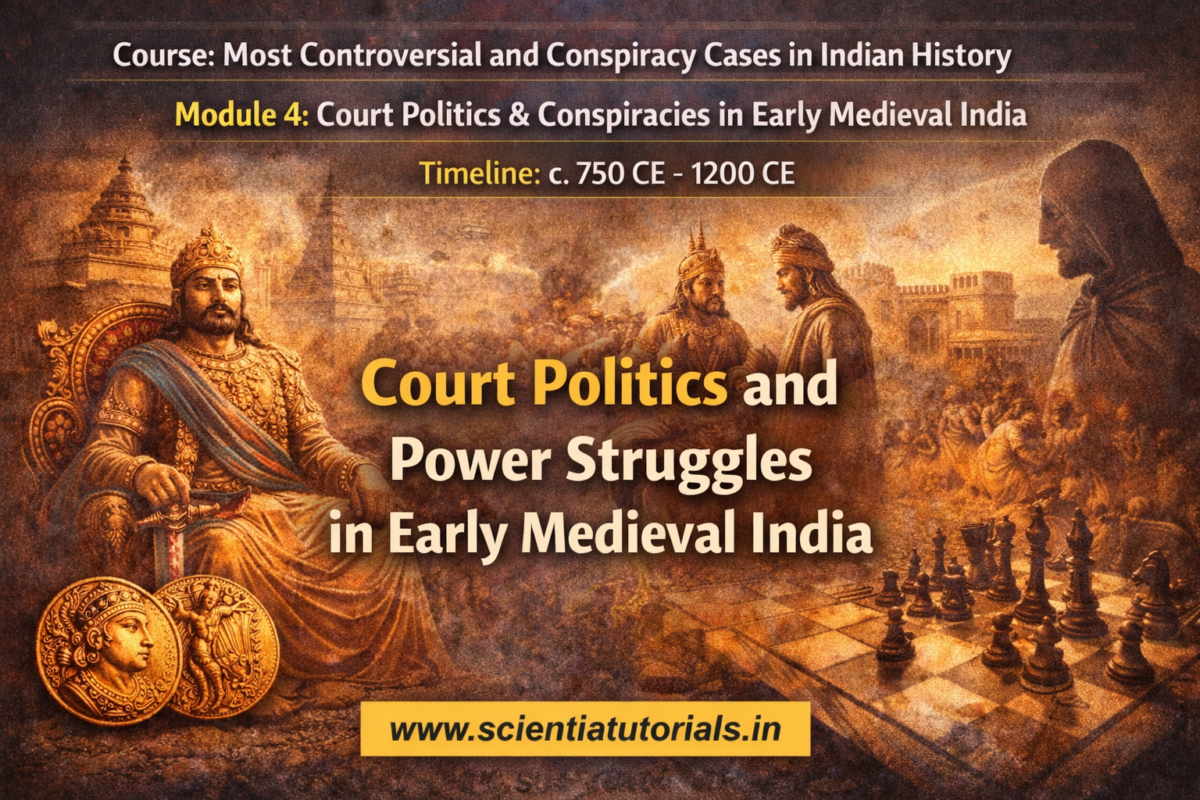

Court Politics and Power Struggles in Early Medieval India
Most Controversial and Conspiracy Cases in Indian History – Chronological, Evidence-Based Analysis
Module 4: Court Politics & Conspiracies in Early Medieval India
Timeline: c. 750 CE – 1200 CE
Lesson: Court Politics and Power Struggles in Early Medieval India – Study Module with Revision Notes
1. Introduction: Nature of Early Medieval Political Culture
The period between the eighth and twelfth centuries marks a decisive transition from the relatively centralized empires of earlier times to a fragmented, feudatory-dominated order. Political authority was exercised through royal courts that became arenas of negotiation, intrigue, and often conspiracy. Power struggles were shaped by:
- Frequent wars among the Rashtrakutas, Palas, Gurjara-Pratiharas, and later the Cholas, Chahamanas, Paramaras, and Chaulukyas
- Expansion of the samanta/feudatory system
- Ideological legitimization through religion, genealogy, and land grants
- Uncertain rules of succession
Unlike the Mauryan or Gupta age, early medieval kingship relied heavily on personal loyalty networks. The court therefore mattered more than abstract institutions.
Revision Note Box
- Key terms: samanta, mandaleshvara, brahmadeya, devadana, parivarajaka, sandhivigrahika
- Sources: copper plates, prashastis, temple inscriptions, Arab-Persian chronicles, literary works such as Rajatarangini
2. Sources for Studying Court Intrigue
2.1 Epigraphic Evidence
Thousands of inscriptions record grants and titles. Though they appear routine, they reveal the transfer of fiscal and judicial rights to courtiers and religious establishments, indicating how authority was shared. Witness lists in plates show the inner circle of power—queens, princes, ministers, and generals.
2.2 Literary Narratives
- Kalhana’s Rajatarangini (12th c.) gives vivid accounts of Kashmir’s assassinations and coups
- Sandhyakar Nandi’s Ramacharita reflects Pala succession tension
- Jain prabandhas describe Chaulukya and Paramara courts
- Tamil works like Periyapuranam and Chola records illuminate factional politics in the south
2.3 Foreign Accounts
Arab geographers—Sulaiman, Al-Masudi, Alberuni—noticed the instability of Indian dynastic succession, often attributing it to court rivalries.
Exam Tip
For answers, always write: “Inscriptions are normative; literature is narrative; both must be cross-verified with archaeology.”
3. Structure of the Royal Court
3.1 Principal Actors
- King (Maharajadhiraja/Parakesari etc.)
- Chief Queen – controlled access to the monarch
- Crown Prince (Yuvaraja)
- Ministers – especially the sandhivigrahika (war & peace)
- Senapati and feudatory chiefs
- Brahmana and monastic elites
3.2 Court Ritual and Access
The court followed elaborate etiquette—darbar, gift exchange, festivals, temple patronage. Control of access became the first instrument of conspiracy. Those who could present petitions or restrict others effectively ruled.
Revision Points
- Courts were residential as well as ceremonial spaces
- Land grants created semi-autonomous zones that courtiers managed
- The idea of divine ancestry (Solar/Lunar lines) was a political weapon
4. Succession Politics: The Core of Power Struggle
4.1 Absence of Primogeniture
Most dynasties did not strictly follow eldest-son rule. Multiple princes born of different queens led to fratricidal conflicts.
- Rashtrakuta history records contests among sons of Dhruva and Govinda III
- Pala throne after Devapala saw disputes culminating in weak rulers
- In Kashmir, queens engineered murders to enthrone favored sons
4.2 Role of Queens and Princes
Queens often formed blocs with ministers. The upbringing of a prince within the palace determined his faction. Marriage alliances with regional houses further complicated matters.
UPSC Mains Writing Tip (5 Marks)
Use frame:
“Genealogy → court faction → military backing → religious legitimation → outcome.”
5. The Samanta System and Decentralization
5.1 Rise of Feudatories
Originally defeated chiefs, samantas evolved into hereditary power holders. They attended court, supplied troops, but gradually acted independently. Courts became markets where they bargained for titles and territories.
5.2 Controversy over “Indian Feudalism”
Historians debate whether this order was feudal like Europe. Yet there is consensus that it produced:
- Weak royal treasuries
- Strong local magnates
- Increased court dependence on personal oaths
Revision Note
- The court was not above samantas; it was inter-dependent with them.
6. Major Regional Examples of Court Politics
6.1 Rashtrakuta Court (Deccan)
- Govinda III (793–814) maintained a powerful darbar with governors
- Later rulers faced ministerial dominance
- Grants to Jain monasteries show religious groups entering politics
6.2 Pala Court (Bengal-Bihar)
- Buddhist identity initially strong
- After Devapala, courts saw competition between Brahmana revivalists and Buddhist monks
- Ramacharita hints at how legitimacy was rewritten
6.3 Gurjara-Pratihara Court (Kanauj)
- Mihira Bhoja (836–885) created a prestigious centre
- The court attracted Rajput houses
- After his death, feudatories weakened Kanauj, making it vulnerable to external raids
6.4 Kashmir: The Classic Theatre of Conspiracy
- Queens like Didda (10th c.) allegedly ordered murders of grandsons
- Kalhana narrates poisonings, palace guards deciding fate
- Illustrates the extreme case where the court replaced the state
6.5 Chola Court (Tamil Country)
- Though more institutional, Cholas too had yuvaraja rebellions
- Kulottunga I emerged through a complex alliance involving eastern Chalukya relatives
- Temple endowments acted as stabilizers but also empowered priests
NCERT/CBSE Focus
Students should remember maps of: Kanauj, Manyakheta, Pataliputra, Thanjavur, Kashmir as political hubs.
7. Instruments of Intrigue
- Land Grants – creating loyal dependents
- Titles & Honors – buying allegiance
- Marriage Alliances
- Control of Treasury
- Use of Religion and Prashasti
Prashastis selectively praised one prince while ignoring others—an ideological form of conspiracy.
Exam Tip
Write: “Conspiracy was textual as well as physical.”
8. Assassinations and Coups
8.1 Patterns
- Use of palace guards
- Poisons
- Exile of rivals
- Blinding or monastic confinement
8.2 Case Study Method
Kalhana’s accounts from Kashmir should be compared with Bengal plates where succession is silent. The contrast shows regional diversity.
9. Religion and Legitimacy in the Court
- Grants of brahmadeya brought Brahmanas as political allies
- Devadana linked temples with court economy
- Buddhist viharas earlier enjoyed favor; later contraction altered court balance
Courts used sectarian affiliation—Shaiva vs Vaishnava vs Buddhist—to mobilize factions.
NET/CUET Concept Tip
Questions often ask the difference between brahmadeya and devadana—always connect them to court politics.
10. Administrative Offices and Power
Offices became hereditary, enabling ministers to act as kingmakers. The sandhivigrahika could declare war, thus determining which prince gained prestige.
11. External Raids and Court Weakness
Instability at Kanauj and in the Deccan partly explains the success of Arab and Turkic incursions. Courts busy with internal rivalry failed to build united defence.
UPSC Prelims Tip
Link: Pratihara decline → Kanauj politics → Ghaznavid opportunities.
12. Social Composition of Courtiers
- Kayasthas rising as scribal elite
- Jain merchants financing courts
- Brahmana priests advising on rituals
- Military clans of Rajputs
This mixed composition produced competing interests.
13. Ideology of Kingship
Kings projected themselves as universal rulers, yet real authority was negotiated daily in the palace. The contradiction between ideology and reality is the root of many “golden age” controversies.
14. Gender and Power
Queens, princesses, and royal mothers were not passive. Kalhana and Jain texts credit them with decisive though sometimes ruthless roles.
Mains Tip
Use phrase: “Palace feminism of power.”
15. Economy of the Court
Gift culture, temple festivals, and land revenue shaped intrigue. When treasury declined, ministers gained leverage.
16. South vs North Contrast
- Southern courts (Chola) more stable
- Northern courts (Kanauj, Kashmir) highly volatile
Exams reward such comparative paragraphs.
17. Role of Genealogies
Solar (Suryavansha) and Lunar (Chandravansha) claims were crafted in courts to defeat rivals without battle.
18. Education & Culture at Court
Patronage of poets, acharyas, and architects created prestige. Yet these groups also acted as factions influencing succession.
19. Causes Behind Repeated Power Struggles
- Multiple claimants
- feudatory autonomy
- economic decentralization
- ideological competition
- personal access politics
20. Conclusion: Understanding Conspiracy Historically
Early medieval conspiracy should be seen not as sensational episodes alone but as outcomes of a structural court-centred polity. Evidence suggests that the court was the real state.
Final Consolidated Revision Notes (Exam Crux)
- Timeframe 750–1200 CE = fragmentation and samanta dominance
- Courts were arenas of access control
- Succession lacked primogeniture
- Religion used as factional tool
- Kashmir shows narrative evidence of murders; Bengal shows epigraphic silence
- Kanauj politics explains vulnerability to Ghazni and Ghur
10 Master Revision Keywords
Darbar access, queen factions, yuvaraja rivalry, samanta bargains, brahmadeya allies, devadana economy, hereditary offices, prashasti ideology, regional hubs, defence failure.
Important for CBSE (NCERT Based)
- Identify capitals and dynasties on map
- Understand difference of land grants
- Remember that temples and monasteries both appear in witness lists as court actors
- Use Kalhana as story source but not as sole fact