
Political Assassinations in Early Indian Kingdoms
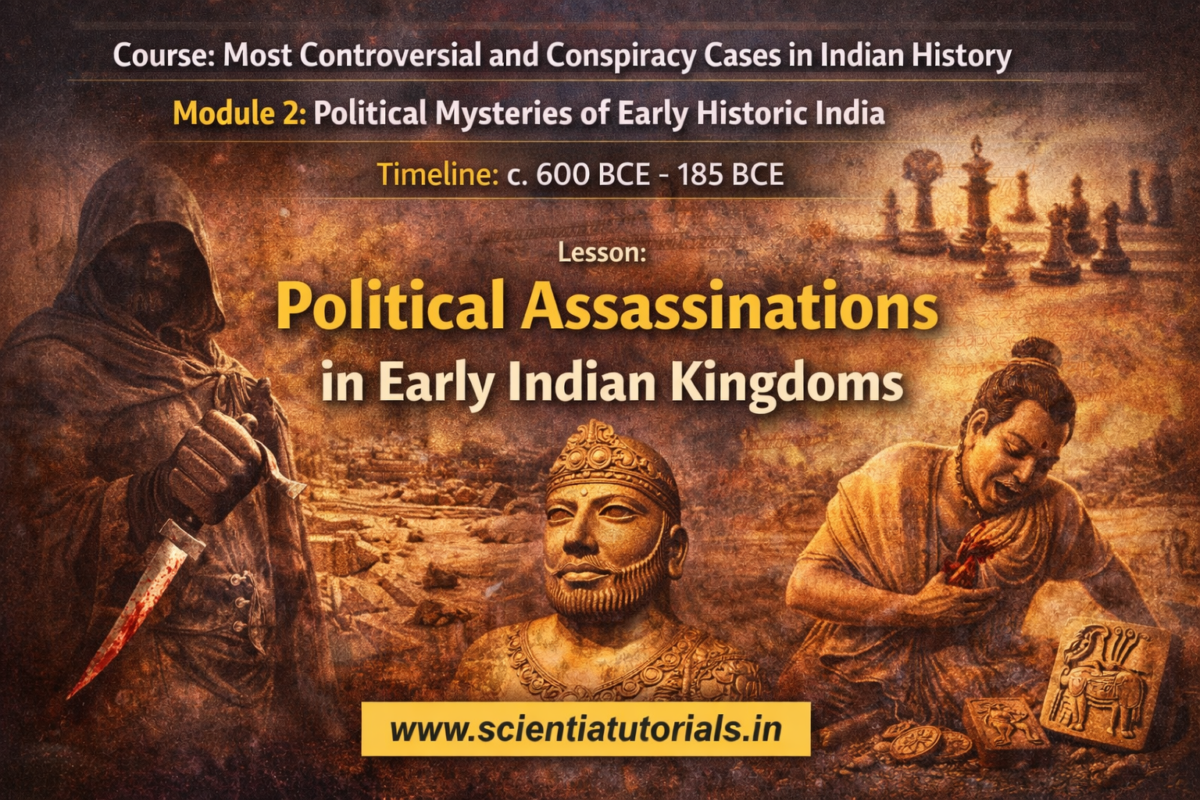

Political Assassinations in Early Indian Kingdoms
📘 Course: Most Controversial and Conspiracy Cases in Indian History
Module 2: Political Mysteries of Early Historic India
Timeline: c. 600 BCE – 185 BCE
Lesson: Political Assassinations in Early Indian Kingdoms
Based on the Lesson followed by the above Module and Course, we have created study materials aligned to the needs of UPSC, State PSC, UGC-NET, CUET, CBSE, and all school, college, and university examinations in India:
- Study Module with Revision Notes,
- Questions with Answers,
- MCQs with Answers and detailed explanations.
Study Module with Revision Notes
🔷 Lesson Introduction
The period between c. 600 BCE and 185 BCE marks the emergence of early historic Indian states, characterized by urbanisation, monetisation, standing armies, and centralised monarchies. Alongside these developments, political violence—especially assassinations—became a recurrent feature of statecraft.
Unlike later medieval conspiracies documented in detail, early Indian political assassinations must be reconstructed from Buddhist texts, Jain traditions, Brahmanical literature, inscriptions, and archaeological correlations. This lesson critically examines political assassinations as instruments of power, succession, and state formation rather than as isolated criminal acts.
🔷 Learning Objectives
By the end of this lesson, students should be able to:
- Understand the political context of assassinations in early Indian kingdoms
- Identify major assassination cases and disputed deaths
- Analyse sources and historiographical debates
- Distinguish between textual narrative, political motive, and historical probability
- Write balanced, exam-ready answers on political violence in early India
🔶 I. Conceptual Framework: Assassination in Early Indian Politics
1️⃣ Meaning of Political Assassination
A political assassination refers to the deliberate killing of a ruler, heir, or key political actor with the intention of:
- Securing succession
- Eliminating rivals
- Changing dynastic power
In early India, assassination was often legitimised retrospectively through religious or moral justifications.
2️⃣ Why Early Indian Kingdoms Were Prone to Assassinations
Key structural reasons include:
- Absence of codified succession laws
- Frequent patricide and fratricide
- Expansionist politics requiring decisive leadership
- Court factionalism and ministerial intrigue
- Ethical ambiguity in Dharmashastra traditions regarding power
🔶 II. Sources for Studying Political Assassinations
🔹 1. Buddhist Sources
- Anguttara Nikaya, Mahavamsa
- Emphasis on moral decline and karmic retribution
🔹 2. Jain Texts
- Parishishtaparvan
- Focus on ethical consequences of violence
🔹 3. Brahmanical & Puranic Traditions
- Genealogical legitimacy often overrides violence
🔹 4. Archaeology & Numismatics
- Corroborates regime change, not motive
⚠️ Historiographical Challenge:
Most sources are normative or sectarian, requiring careful cross-verification.
🔶 III. Major Political Assassination Cases (Chronological)
🔸 Case 1: Bimbisara and Ajatashatru (Magadha)
Key Figures:
- Bimbisara
- Ajatashatru
Narrative:
Buddhist texts state that Ajatashatru imprisoned and caused the death of his father Bimbisara to ascend the throne.
Political Motive:
- Fear of succession delay
- Pressure from court factions
- Expansionist ambitions (e.g., war against Vrijji confederacy)
Historical Assessment:
- Widely accepted as political patricide
- Illustrates early realpolitik over filial dharma
🔸 Case 2: Shishunaga Dynasty Transition
Issue:
- Ambiguous transition marked by violent regime change
Interpretation:
- Indicates elite overthrow, possibly involving assassination
- Lack of detailed narrative highlights source limitations
🔸 Case 3: Assassination of the Last Nanda Ruler
Context:
- Rise of the Mauryas
- Popular resentment against Nanda taxation
Sources:
- Greek accounts (Curtius, Diodorus)
- Indian literary traditions
Debate:
- Whether the Nanda king was assassinated or overthrown militarily
- Demonstrates intersection of rebellion and assassination
🔸 Case 4: The Fall of the Mauryas – Brihadratha
Key Figures:
- Brihadratha
- Pushyamitra Shunga
Event:
Pushyamitra allegedly assassinated Brihadratha during a military parade.
Political Significance:
- End of Mauryan dynasty (c. 185 BCE)
- Shift from Buddhist patronage to Brahmanical revival
Historiographical Debate:
- Buddhist sources portray Pushyamitra negatively
- Brahmanical texts legitimise dynastic change
🔶 IV. Assassination as Statecraft, Not Anomaly
Political assassinations in early India should be seen as:
- Instruments of dynastic transition
- Outcomes of institutional weakness
- Means of restoring perceived dharma or political order
They were often:
- Public acts, not secret plots
- Followed by ritual legitimacy (coronations, yajnas)
🔶 V. Historiographical Perspectives
🔹 Traditional View
- Moral decline narrative
- Kings punished by karma
🔹 Marxist Interpretation
- Class conflict and state consolidation
🔹 Political-Institutional View
- Weak succession mechanisms → violence
⚠️ Modern historians avoid sensationalism, focusing instead on structural causes.
🔶 VI. Methodology for Answer Writing (Exams)
How to Approach Questions on Assassinations:
- Establish political context
- Identify source type
- Distinguish narrative from probability
- Conclude with balanced judgement
🔷 VII. Revision Notes (Quick Recall)
- Timeline: 600 BCE–185 BCE
- Common pattern: Father–son or ruler–general conflict
- Sources are sectarian and retrospective
- Assassinations often public and legitimised
- Key examples: Bimbisara, Nandas, Mauryas
- Exam focus: analysis, not sensational detail
🔷 VIII. Model Conclusion (Exam-Ready)
Political assassinations in early Indian kingdoms were not aberrations but integral to state formation and dynastic politics. Their study reveals the pragmatic foundations of early Indian monarchy, where power often superseded moral idealism.
Questions with Answers
1. What is meant by political assassination in early Indian context?
It refers to the deliberate killing of a king, prince, or influential political figure to capture power or change state policy, usually organized by rivals within the court or military.
2. Which literary sources mention assassinations of Mahajanapada rulers?
Buddhist texts like Mahavamsa, Jain works such as Parishishtaparvan, Greek writings of Curtius and Diodorus, and later Sanskrit plays like Vishakhadatta’s Mudrarakshasa.
3. Who was Bimbisara?
The powerful ruler of Magadha (Haryanka dynasty, 6th century BCE) credited with expansion of the kingdom and patronage of the Buddha.
4. How did Bimbisara die according to tradition?
Buddhist and Jain narratives state he was imprisoned and allowed to die—or directly killed—through conspiracy led by his son Ajatashatru encouraged by ministerial factions.
5. Who was Ajatashatru?
Son of Bimbisara and Magadhan ruler who continued imperial expansion and fought the Vrijji confederacy.
6. What controversy surrounds Ajatashatru’s accession?
He came to the throne after violent removal of his father, showing early evidence of patricide as a political strategy.
7. Who assassinated the Shishunaga successor Kalashoka?
Some Puranic-Jain traditions hint that Kalashoka was killed amid palace rivalry, paving way for the rise of the Nanda family.
8. Who was Mahapadma Nanda?
Founder of the Nanda dynasty (mid-4th century BCE) who ended earlier dynastic lines of Magadha.
9. What is known about the last Nanda ruler Dhana Nanda?
Greek accounts portray him as wealthy but unpopular; Indian traditions describe his overthrow through Chanakya-backed movement.
10. Who was Chanakya (Kautilya)?
Scholar-strategist associated with Arthashastra and organizer of the coalition that replaced the Nandas with Chandragupta Maurya.
11. Was the killing of Dhana Nanda an assassination?
Evidence suggests a politically engineered overthrow with armed action; later texts represent it as targeted elimination inspired by Chanakya’s conspiracy.
12. Who was Parvataka mentioned in chronicles?
A Himalayan king allied with Chanakya; Jain tradition says he later died by poisoning, possibly arranged to remove a competing partner.
13. Which Mauryan ruler faced assassination attempt by his own kin?
Bindusara’s later years were disturbed by succession rivalry between princes including Ashoka and Susima, with reports of killings during civil conflict.
14. How was Mauryan prince Susima eliminated?
Buddhist legends claim Ashoka’s supporters caused his death in struggle for the throne—an example of faction-led targeted killing.
15. Who murdered Mauryan emperor Brihadratha (185 BCE)?
His commander-in-chief Pushyamitra Shunga killed him during a military parade.
16. What sources record Brihadratha’s assassination?
Primarily Banabhatta’s later work Harshacharita and Puranic memory.
17. What dynasty emerged after this event?
The Shunga dynasty with Pushyamitra as founder.
18. Why is Pushyamitra’s act considered controversial?
It marked the end of the Maurya empire and is debated as either a coup to save the state or personal ambition.
19. Did Indo-Greek kingdoms record assassinations?
Yes, Greek histories note murders of several Bactrian-Indian rulers due to rivalry among generals and relatives.
20. What general lesson do historians draw?
Assassinations were not isolated crimes; they were symptoms of evolving monarchical states where loyalty institutions were weak.
Multiple Choice Questions (MCQs) with Answers & Explanations
MCQ 1. The conspiracy leading to Bimbisara’s death is mainly described in:
A) Rigveda
B) Mahavamsa
C) Ain-i-Akbari
D) Rajatarangini
Correct Answer: B – Explanation:
Mahavamsa, a Buddhist chronicle of Sri Lanka, preserves early traditions about Magadhan politics and states that Ajatashatru, influenced by Devadatta and court faction, imprisoned his father. This helps learners understand that reconstruction depends largely on Buddhist–Jain memories rather than Vedic texts.
MCQ 2. Ajatashatru committed patricide to become ruler of:
A) Kosala
B) Avanti
C) Magadha
D) Kamboja
Correct Answer: C – Explanation:
Both Buddhist and Jain accounts agree that the throne of Magadha passed to Ajatashatru after removal of Bimbisara. The option tests geographical awareness and shows how succession violence aided Magadhan imperialism.
MCQ 3. The killing of emperor Brihadratha occurred in:
A) c. 600 BCE
B) 321 BCE
C) 185 BCE
D) 78 CE
Correct Answer: C – Explanation:
The year 185 BCE marks the parade-ground murder by Pushyamitra Shunga. Remembering this date is crucial for competitive exams as it signals transition from Maurya to Shunga phase.
MCQ 4. Pushyamitra Shunga was the ______ of Brihadratha.
A) Religious teacher
B) Commander-in-chief
C) Treasury head
D) Governor of Taxila
Correct Answer: B – Explanation:
He was the army chief. The question clears the concept that assassination emerged from military coup, not foreign invasion, highlighting internal power dynamics.
MCQ 5. The strategist associated with overthrow of Nandas was:
A) Megasthenes
B) Chanakya
C) Patanjali
D) Charaka
Correct Answer: B – Explanation:
Chanakya organized opposition to Dhana Nanda and installed Chandragupta Maurya. This MCQ distinguishes between historian Megasthenes and political actor Chanakya.
MCQ 6. Jain tradition records the possible poisoning of:
A) Bimbisara
B) Parvataka
C) Ashoka
D) Kanishka
Correct Answer: B – Explanation:
The Parishishtaparvan narrates that Parvataka died after consuming poisoned food prepared by Chanakya to remove a powerful ally who could challenge Maurya authority. It teaches that alliances also produced targeted killings.
MCQ 7. Greek writers portrayed Dhana Nanda as:
A) Beloved saint
B) Extremely wealthy but hated
C) Tribal chief
D) Vedic rishi
Correct Answer: B – Explanation:
Diodorus and Curtius describe the last Nanda as possessor of vast treasure and large army yet facing public anger. The MCQ links Indian and Greek perspectives.
MCQ 8. The murder of Kalashoka facilitated rise of:
A) Shunga dynasty
B) Nanda dynasty
C) Gupta dynasty
D) Satavahana dynasty
Correct Answer: B – Explanation:
Though details are hazy, traditions agree that Nandas replaced earlier Shishunaga line after palace turmoil. The concept cleared is “dynastic replacement through court violence.”
MCQ 9. Which work is a dramatic representation of Chanakya’s conspiracies?
A) Mudrarakshasa
B) Meghaduta
C) Buddhacharita
D) Gathasaptashati
Correct Answer: A – Explanation:
Vishakhadatta’s play Mudrarakshasa artistically narrates how Chanakya used spies and stratagems; although not a direct contemporary record, it reflects remembered political culture.
MCQ 10. Ashoka’s accession involved conflict with prince:
A) Sudarshan
B) Susima
C) Skandagupta
D) Samudragupta
Correct Answer: B – Explanation:
Susima was elder claimant. Legends of his death demonstrate that assassination-like eliminations accompanied Mauryan succession.
MCQ 11. The Arthashastra views assassination as:
A) Strictly immoral
B) One of many kutayuddha strategies
C) Unknown practice
D) Buddhist innovation
Correct Answer: B – Explanation:
Kautilya accepts covert methods when state interest demanded. This clarifies ideological background of realpolitik.
MCQ 12. Patricide of Magadha shows weakness of:
A) Federal republics
B) Monarchical loyalty norms
C) Foreign trade
D) Caste system
Correct Answer: B – Explanation:
Early monarchies lacked fixed primogeniture rules; hence family members became conspirators.
MCQ 13. Pushyamitra killed Brihadratha during:
A) Battle with Greeks
B) Horse sacrifice
C) Military inspection parade
D) Tax collection
Correct Answer: C – Explanation:
The setting indicates a coup from trusted general, an important exam point.
MCQ 14. After assassination of Brihadratha, capital of power remained at:
A) Pataliputra
B) Ujjain
C) Pratishthana
D) Madurai
Correct Answer: A – Explanation:
Shungas continued from Pataliputra, teaching continuity despite violent break.
MCQ 15. Indo-Greek political murders were results of:
A) Mauryan spies only
B) Rivalry among generals
C) Gupta expansion
D) None
Correct Answer: B – Explanation:
Greek polities too faced internal coups; assassination was trans-cultural phenomenon.
MCQ 16. Buddhist legends accuse Devadatta for provoking:
A) Killing of Ashoka
B) Conspiracy against Bimbisara
C) Murder of Alexander
D) Avanti war
Correct Answer: B – Explanation:
It highlights role of religious-court faction interplay.
MCQ 17. The year 321 BCE is linked with:
A) Nanda overthrow
B) Brihadratha murder
C) Buddha’s birth
D) Gupta era
Correct Answer: A – Explanation:
Chanakya installed Chandragupta around this time; remembering chronology is tested.
MCQ 18. Which Mahajanapada suffered from repeated succession violence?
A) Magadha
B) Madra
C) Asmaka
D) Chola
Correct Answer: A – Explanation:
Magadha provides clearest examples—Bimbisara to Ajatashatru, later Mauryan conflicts.
MCQ 19. Assassinations contributed to:
A) Spread of republicanism
B) Centralisation of empires
C) End of Buddhism
D) Decline of trade
Correct Answer: B – Explanation:
Violent coups often brought stronger military families like Shungas who centralized rule.
MCQ 20. Historical study of assassination must rely on:
A) Astrology
B) Primary chronicles and archaeology
C) WhatsApp stories
D) Myth only
Correct Answer: B – Explanation:
The final MCQ reinforces methodological caution and academic attitude.
Notes for Learners & Exam Tips
- Key Terms: patricide, coup, palace faction, realpolitik, dynastic transition.
- Must Remember Dates: 321 BCE (Maurya rise), 185 BCE (Brihadratha murder).
- Compare Sources: Buddhist vs Jain vs Greek portrayals.
- Analytical Point: Internal assassinations were more decisive than foreign attacks in this era.
Political assassinations in early Indian kingdoms reveal the turbulent nature of state formation between 600–185 BCE. From the alleged patricide of Bimbisara by Ajatashatru to the parade-ground killing of Mauryan emperor Brihadratha by Pushyamitra Shunga, violent coups repeatedly altered dynastic lines. Historians reconstruct these episodes through Buddhist–Jain chronicles, Greek accounts, and later literature, emphasizing evidence and context rather than conspiracy sensationalism. Understanding these events helps explain why Magadha rose as an empire and how post-Mauryan powers emerged on military foundations. This lesson therefore links political ethics, institutions of loyalty, and the chronology of early historic India in an exam-oriented manner.
Disclaimer: This module is prepared solely for academic and examination purposes based on accepted historical sources and scholarly interpretations. The intent is to promote critical understanding of early Indian politics while avoiding unverified or sensational claims.