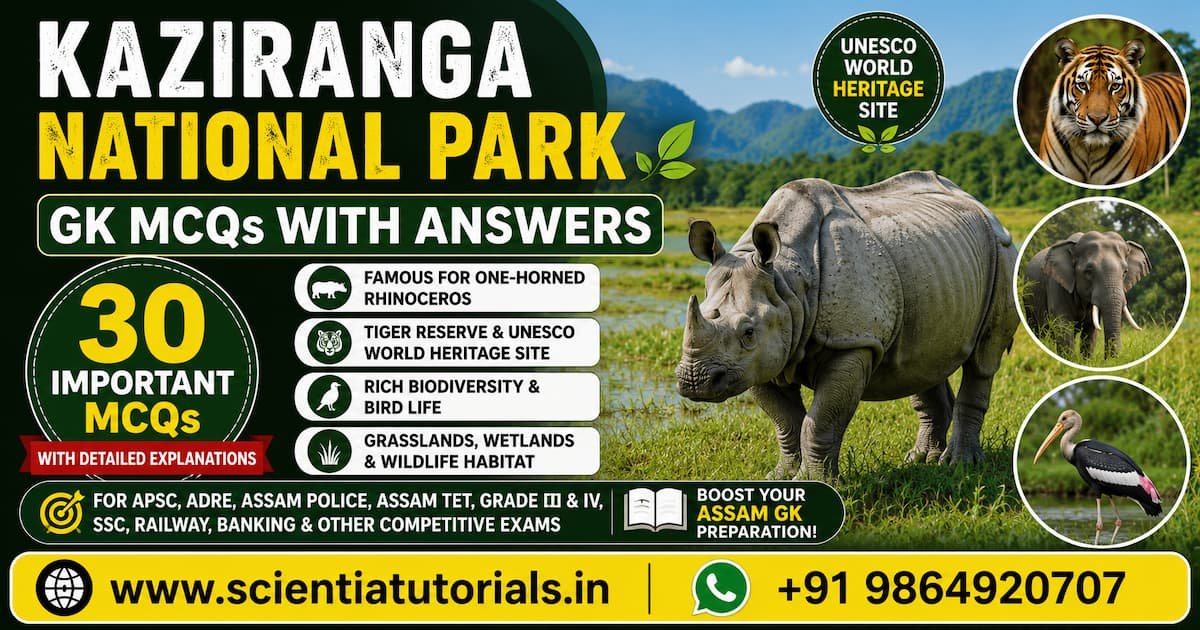
Kaziranga National Park GK MCQs with Answers | 30 Important Questions for APSC, ADRE & Assam Competitive Exams
Kaziranga National Park GK MCQs with Answers (1–30)
With Detailed Explanations
Exam-Oriented for: APSC, ADRE, Assam Police, Assam TET, Grade III & Grade IV, SSC, Railway, Banking, and Other Competitive Examinations
MCQ 1
1. Kaziranga National Park is located in which Indian state?
A. Arunachal Pradesh
B. Assam
C. Meghalaya
D. Nagaland
Answer: B. Assam
Explanation:
Kaziranga National Park is located in the state of Assam. It is one of India’s most celebrated protected areas and is globally renowned for conserving the Indian One-Horned Rhinoceros.
- Option A: Arunachal Pradesh has Namdapha National Park.
- Option C: Meghalaya is known for Balpakram and Nokrek National Parks.
- Option D: Nagaland does not contain Kaziranga.
MCQ 2
2. Kaziranga National Park is best known for conserving which animal?
A. Bengal Tiger
B. Asiatic Lion
C. One-Horned Rhinoceros
D. Red Panda
Answer: C. One-Horned Rhinoceros
Explanation:
Kaziranga is home to the largest population of the Indian One-Horned Rhinoceros (Rhinoceros unicornis) in the world and is the flagship species of the park.
MCQ 3
3. In which year was Kaziranga declared a National Park?
A. 1950
B. 1968
C. 1974
D. 1985
Answer: C. 1974
Explanation:
Kaziranga was officially declared a National Park in 1974 after earlier being protected as a reserve forest and wildlife sanctuary.
MCQ 4
4. Kaziranga National Park was declared a UNESCO World Heritage Site in:
A. 1974
B. 1980
C. 1985
D. 1992
Answer: C. 1985
Explanation:
UNESCO recognized Kaziranga National Park as a World Heritage Site in 1985 because of its exceptional biodiversity and successful wildlife conservation.
MCQ 5
5. Which river forms the northern boundary of Kaziranga National Park?
A. Barak River
B. Brahmaputra River
C. Kopili River
D. Sankosh River
Answer: B. Brahmaputra River
Explanation:
The mighty Brahmaputra River forms the northern boundary of Kaziranga and plays a vital role in maintaining its floodplain ecosystem.
MCQ 6
6. Kaziranga National Park spreads across which districts of Assam?
A. Kamrup and Nalbari
B. Golaghat, Nagaon, Sonitpur, and Biswanath
C. Dhubri and Goalpara
D. Dibrugarh and Tinsukia
Answer: B. Golaghat, Nagaon, Sonitpur, and Biswanath
Explanation:
Kaziranga extends across Golaghat, Nagaon, Sonitpur, and Biswanath districts of Assam.
MCQ 7
7. Which conservation project was launched primarily to protect the One-Horned Rhinoceros in Kaziranga?
A. Project Tiger
B. Project Rhino
C. Project Elephant
D. Project Snow Leopard
Answer: B. Project Rhino
Explanation:
Project Rhino was initiated to ensure the long-term conservation of the One-Horned Rhinoceros in Assam.
MCQ 8
8. Kaziranga National Park is also recognized as a:
A. Biosphere Reserve only
B. Tiger Reserve only
C. Important Bird Area and Tiger Reserve
D. Desert National Park
Answer: C. Important Bird Area and Tiger Reserve
Explanation:
Kaziranga is both a Tiger Reserve and an Important Bird Area (IBA) due to its rich biodiversity.
MCQ 9
9. Which species of deer is commonly found in Kaziranga?
A. Hangul
B. Swamp Deer (Barasingha)
C. Musk Deer
D. Blackbuck
Answer: B. Swamp Deer (Barasingha)
Explanation:
Kaziranga supports healthy populations of the Eastern Swamp Deer (Barasingha), an important grassland herbivore.
MCQ 10
10. Which large mammal is NOT naturally found in Kaziranga National Park?
A. Wild Water Buffalo
B. Asian Elephant
C. Asiatic Lion
D. Bengal Tiger
Answer: C. Asiatic Lion
Explanation:
The Asiatic Lion is found only in Gujarat’s Gir National Park, not in Kaziranga.
MCQ 11
11. Kaziranga National Park is famous for having one of the highest densities of which big cat?
A. Leopard
B. Snow Leopard
C. Bengal Tiger
D. Cheetah
Answer: C. Bengal Tiger
Explanation:
Kaziranga has one of the highest tiger densities among protected areas in the world.
MCQ 12
12. Which migratory and resident birds make Kaziranga an Important Bird Area?
A. More than 100 species only
B. More than 250 species
C. More than 500 species
D. Less than 50 species
Answer: B. More than 250 species
Explanation:
Kaziranga is home to over 250 species of birds, including many migratory waterfowl and endangered birds.
MCQ 13
13. Which of the following is an endangered bird found in Kaziranga?
A. Bengal Florican
B. Peacock
C. House Sparrow
D. Common Myna
Answer: A. Bengal Florican
Explanation:
The Bengal Florican is one of the world’s rarest bustards and inhabits the grasslands of Kaziranga.
MCQ 14
14. The grasslands of Kaziranga are mainly classified as:
A. Alpine Grasslands
B. Tropical Wet Alluvial Grasslands
C. Desert Grasslands
D. Temperate Grasslands
Answer: B. Tropical Wet Alluvial Grasslands
Explanation:
Kaziranga’s extensive tropical wet alluvial grasslands provide ideal habitat for rhinos, elephants, buffaloes, and deer.
MCQ 15
15. Which animal is the State Animal of Assam and also the flagship species of Kaziranga?
A. Asian Elephant
B. One-Horned Rhinoceros
C. Bengal Tiger
D. Golden Langur
Answer: B. One-Horned Rhinoceros
Explanation:
The One-Horned Rhinoceros is both the State Animal of Assam and the most iconic species of Kaziranga.
MCQ 16
16. Kaziranga is one of the most important habitats for which wild bovine?
A. Yak
B. Gaur
C. Wild Water Buffalo
D. Mithun
Answer: C. Wild Water Buffalo
Explanation:
Kaziranga supports one of the world’s largest populations of the endangered Wild Water Buffalo.
MCQ 17
17. Which reptile is commonly found in Kaziranga?
A. Gharial
B. King Cobra
C. Mugger Crocodile
D. Saltwater Crocodile
Answer: B. King Cobra
Explanation:
The King Cobra, the world’s longest venomous snake, inhabits the forests and wetlands of Kaziranga.
MCQ 18
18. Floods in Kaziranga are mainly caused by which river?
A. Ganga
B. Brahmaputra
C. Teesta
D. Yamuna
Answer: B. Brahmaputra
Explanation:
Annual flooding by the Brahmaputra River replenishes nutrients and maintains the park’s ecosystem, though severe floods also challenge wildlife.
MCQ 19
19. Which organization declared Kaziranga a World Heritage Site?
A. IUCN
B. UNESCO
C. WWF
D. UNEP
Answer: B. UNESCO
Explanation:
UNESCO designated Kaziranga as a World Heritage Site in 1985 due to its outstanding natural value.
MCQ 20
20. Which of the following is NOT a major attraction of Kaziranga?
A. Elephant Safari
B. Jeep Safari
C. Snow Leopard Trek
D. Bird Watching
Answer: C. Snow Leopard Trek
Explanation:
Snow Leopards do not occur in Assam. Kaziranga is famous for elephant safaris, jeep safaris, and birdwatching.
MCQ 21
21. Which international recognition has Kaziranga received for bird conservation?
A. Ramsar Site only
B. Important Bird Area (IBA)
C. Biosphere Reserve only
D. UNESCO Cultural Site
Answer: B. Important Bird Area (IBA)
Explanation:
Kaziranga has been recognized as an Important Bird Area (IBA) because of its rich avifaunal diversity.
MCQ 22
22. Which conservation category does Kaziranga belong to under Indian wildlife protection?
A. Reserved Forest only
B. National Park
C. Community Reserve
D. Conservation Reserve
Answer: B. National Park
Explanation:
Kaziranga is officially designated as a National Park, providing the highest level of legal protection under Indian law.
MCQ 23
23. Which season is generally considered the best time to visit Kaziranga National Park?
A. June–September
B. November–April
C. July–August
D. May–June
Answer: B. November–April
Explanation:
The park is generally open from November to April, when the weather is pleasant and wildlife sightings are more frequent.
MCQ 24
24. Which endangered primate can also be seen in parts of Kaziranga?
A. Golden Langur
B. Hoolock Gibbon
C. Slow Loris
D. Lion-tailed Macaque
Answer: C. Slow Loris
Explanation:
The Slow Loris, India’s only nocturnal primate, is found in the forests around Kaziranga.
MCQ 25
25. Kaziranga National Park is primarily famous for which type of ecosystem?
A. Desert Ecosystem
B. Floodplain Grassland Ecosystem
C. Alpine Ecosystem
D. Mangrove Ecosystem
Answer: B. Floodplain Grassland Ecosystem
Explanation:
Kaziranga is a classic example of a Brahmaputra floodplain ecosystem, consisting of grasslands, wetlands, and forests.
MCQ 26
26. Which of the following UNESCO World Heritage Sites is located in Assam?
A. Kaziranga National Park only
B. Manas National Park only
C. Both Kaziranga and Manas National Parks
D. Nameri National Park
Answer: C. Both Kaziranga and Manas National Parks
Explanation:
Assam has two UNESCO World Heritage Sites:
- Kaziranga National Park
- Manas National Park
MCQ 27
27. Which famous conservationist played an important role in the early protection of Kaziranga?
A. Salim Ali
B. Lady Mary Curzon
C. Jim Corbett
D. Kailash Sankhala
Answer: B. Lady Mary Curzon
Explanation:
Lady Mary Curzon’s concern about the declining rhino population helped initiate efforts that eventually led to the protection of Kaziranga.
MCQ 28
28. Which endangered bird is often associated with the grasslands of Kaziranga?
A. Bengal Florican
B. Indian Roller
C. Hoopoe
D. Indian Robin
Answer: A. Bengal Florican
Explanation:
The Bengal Florican thrives in tall grasslands and is one of the flagship bird species of Kaziranga.
MCQ 29
29. Kaziranga National Park is famous for conserving the ‘Big Five’ of Assam. Which of the following is NOT one of them?
A. One-Horned Rhinoceros
B. Asian Elephant
C. Wild Water Buffalo
D. Asiatic Lion
Answer: D. Asiatic Lion
Explanation:
Kaziranga’s “Big Five” generally include the One-Horned Rhinoceros, Bengal Tiger, Asian Elephant, Wild Water Buffalo, and Eastern Swamp Deer. The Asiatic Lion is not found in Kaziranga.
MCQ 30
30. Which statement about Kaziranga National Park is correct?
A. It is located in Gujarat.
B. It is famous for conserving the One-Horned Rhinoceros and is a UNESCO World Heritage Site.
C. It is India’s only desert national park.
D. It is located in Rajasthan.
Answer: B. It is famous for conserving the One-Horned Rhinoceros and is a UNESCO World Heritage Site.
Explanation:
Kaziranga National Park is located in Assam, is globally recognized for the Indian One-Horned Rhinoceros, and was declared a UNESCO World Heritage Site in 1985.
- Option A: Incorrect; Kaziranga is in Assam.
- Option C: Incorrect; Desert National Park is in Rajasthan.
- Option D: Incorrect; Kaziranga is not in Rajasthan.
Quick Revision: Kaziranga National Park
| Topic | Key Fact |
|---|---|
| Location | Assam |
| Declared National Park | 1974 |
| UNESCO World Heritage Site | 1985 |
| Famous For | One-Horned Rhinoceros |
| State Animal of Assam | One-Horned Rhinoceros |
| Northern Boundary | Brahmaputra River |
| Major Ecosystem | Tropical Wet Alluvial Grasslands |
| Tiger Reserve | Yes |
| Important Bird Area (IBA) | Yes |
| Best Visiting Season | November–April |
| Flagship Species | One-Horned Rhinoceros |
| Other Major Fauna | Bengal Tiger, Asian Elephant, Wild Water Buffalo, Eastern Swamp Deer |
Exam Tips
- Remember 1974 (National Park) and 1985 (UNESCO World Heritage Site).
- Kaziranga is famous for the largest population of the Indian One-Horned Rhinoceros.
- The Brahmaputra River shapes the park’s floodplain ecosystem.
- Lady Mary Curzon played a significant role in initiating efforts for Kaziranga’s protection.
- Questions on Kaziranga frequently appear in APSC, ADRE, Assam Police, Assam TET, Grade III & Grade IV, SSC, Railway, Banking, and other Assam competitive examinations.